US proposes 15% tariff on Taiwan as Samsung, SK hynix license Chinese technology
Zero One Investment Research Daily Intelligence Brief, November 26, 2026
US proposes 15% tariff on Taiwan as Samsung, SK hynix license Chinese technology
Top Market Signals
US proposes 15% on Taiwan, more on China
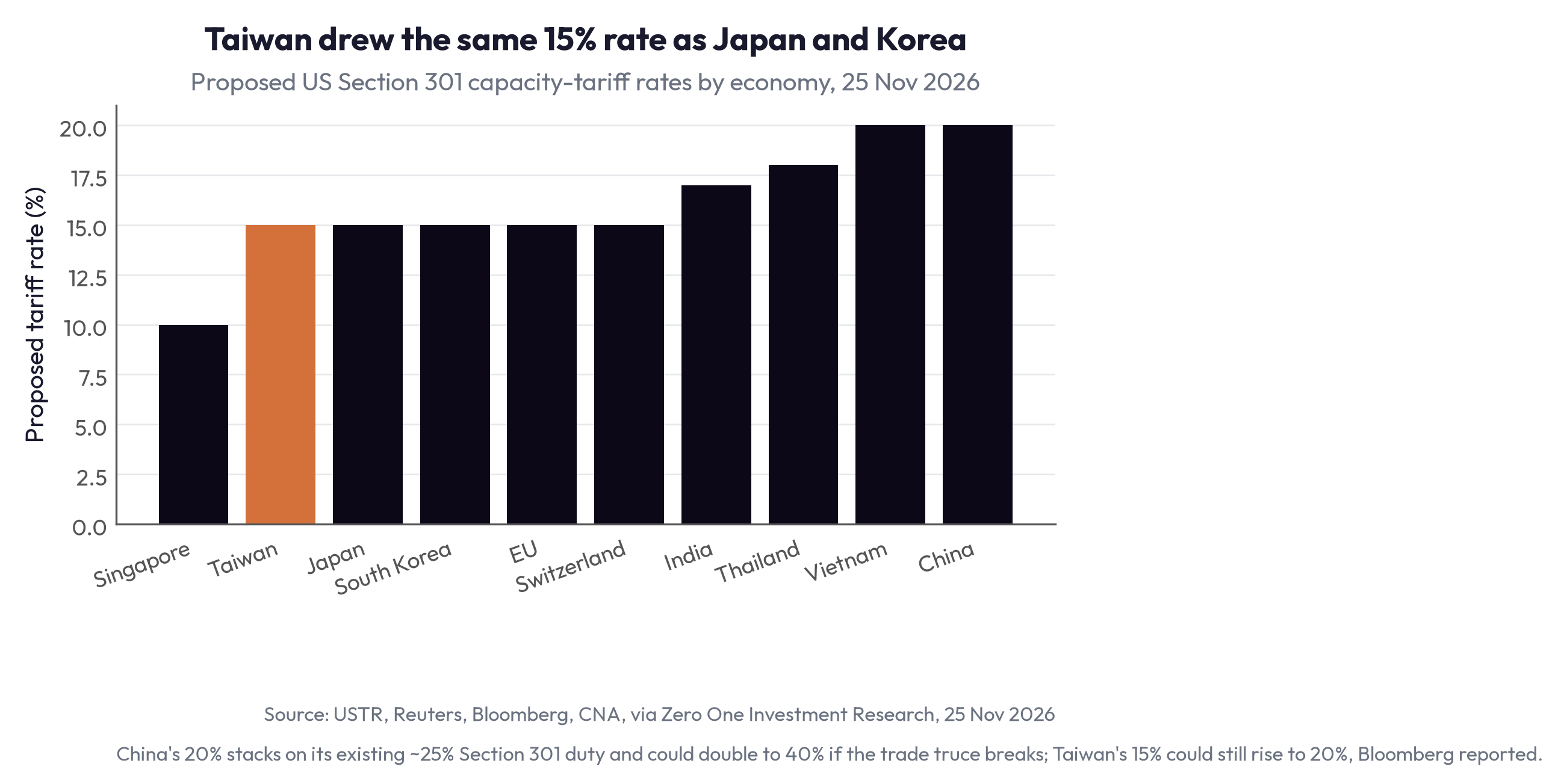
The US Trade Representative proposed new tariffs on 14 trading partners on 25 Nov, ending an eight-month Section 301 investigation into what it calls structural excess capacity. Taiwan's proposed rate is 15%, the same as Japan, South Korea, the European Union and Switzerland, Reuters reported.
China is the only one of the 14 whose new tariff would be added to existing Section 301 duties. The proposed 20% sits on top of the roughly 25% imposed in 2018, and a US official said it could double to 40% if China breaks the trade truce agreed last year. Thailand, Malaysia, Indonesia, Cambodia and Bangladesh face 18% and Singapore 10%, while Vietnam would face 20% and India 17% if they reach trade deals with the US. Mexico and Norway were investigated, but no rates for them were published.
For Taiwan, the US named a list of practices: repeated industrial plans to support manufacturing, especially high-tech manufacturing, and laws that give incentives to build industry ecosystems. It said the harm to US producers was most evident in electronics, semiconductors and telecoms. Taiwan's Executive Yuan said the rate is not stacked and sits in the lowest tier, Economic Daily News reported.
The 15% may not be final. Bloomberg reported the rates for the European Union, Japan, Taiwan and South Korea could rise to 20%, and trade representative Jamieson Greer told CNBC some rates may be raised by a few percentage points. The reports do not say whether chips or servers are carved out, which matters most for Taiwan's exports.
Linked stocks: 2330 TT, 2317 TT, 2382 TT
Samsung and SK hynix license YMTC's chip stacking
Samsung Electronics (005930 KS) and SK hynix (000660 KS) have each signed cross-licensing agreements to use parts of Yangtze Memory Technologies' (YMTC) Xtacking technology in their 3D NAND flash, Nikkei Asia reported on 25 Nov, citing three people briefed on the matter. Fees and terms were not disclosed.
Xtacking builds the memory cells and the control logic on separate wafers and then bonds the two together. YMTC unveiled it in 2018 and has used it in volume production since 2019. Samsung told Nikkei that bonding reduces the structural limits that arise as layers are stacked, allowing higher density. SK hynix declined to comment.
The two largest NAND makers are licensing from a Chinese company founded 10 years ago, which has filed more than 12,000 patents. Xtacking does not need the latest EUV lithography tools, so YMTC could develop it under US export controls. Its NAND market share rose to 14% in 2Q26 from 11% a year earlier, level with Kioxia and behind Samsung at 28%, SK hynix at 19% and Micron at 15%, Counterpoint data shows.
Analysts at Omdia said cross-licensing helps avoid costly litigation. YMTC has sued Micron (MU US) in several countries since 2023 and won a German injunction that Micron is appealing. Micron plans its own wafer bonding for its G11 NAND in late 2027, and Kioxia (285A JT) and SanDisk have used their own method since 2023.
Linked stocks: 005930 KS, 000660 KS, MU US, 285A JT
Shenzhen sellers ask five times US price for NVIDIA servers
Stalls in Shenzhen's Huaqiangbei electronics market are offering servers with eight of NVIDIA's (NVDA US) Blackwell B300 chips for RMB20m, about US$2.8m, the Washington Post reported. That is up from US$2m two months ago and more than five times the US retail price of US$500,000 to US$600,000. The Post could not verify that the chips in Shenzhen and Hong Kong warehouses were genuine.
Sellers said prices jumped after the US tightened export controls following the scandal around Jensen Huang. Restricted RTX 5090 and RTX PRO 6000 cards are also on open display after coming in through Hong Kong. Congressional documents show the Commerce Department approved sales of nearly 580,000 restricted NVIDIA chips to Chinese companies earlier this year, including two linked to the People's Liberation Army.
Tighter rules have cut the supply reaching these sellers. On 23 Nov the US blacklisted seven companies tied to Megaspeed in Singapore, Malaysia and Thailand, four days after requiring licenses for AI chip buyers in five countries. Singapore and Malaysia are now moving to show Washington they will not be routes to China, DigiTimes reported.
The Post linked the leaks partly to a split inside the administration. Treasury Secretary Scott Bessent accused Commerce Secretary Howard Lutnick this month of ignoring chip diversion. Huang meets three House committees on 1 Dec and testifies to the Senate Banking Committee on 3 Dec, the committee that oversees export controls.
Linked stocks: NVDA US, 2317 TT, 2382 TT
Texas recommends a US$354m tax break for TSMC
The Texas Comptroller has recommended a property tax break worth about US$354m for TSMC's (2330 TT) proposed US$22.6bn chip campus in Brazos County, DigiTimes reported on 25 Nov. TSMC's US unit had told the state two days earlier that the tax relief would decide whether it commits to the project.
The filing describes one or more fabs on about 3,232 acres, for chips made at 2nm or more advanced nodes. Commercial Times reported construction would start in 2027 and commercial operation in 2031. The relief is a 10-year limit on school district property tax for 2032 to 2041. It still needs the governor and the local school board, and TSMC names Arizona as a competing site with operating and cost advantages.
TSMC also confirmed its Arizona expansion ceremony for 4 Dec, with President Trump expected to attend alongside chairman C.C. Wei, DigiTimes reported. TSMC's US commitment stands at US$265bn, and its second Arizona fab is due to start 3nm volume production in 3Q27.
Taiwanese plant contractors stand to bid on the work wherever TSMC builds. Commercial Times, citing analysts, named United Integrated Services (2404 TT) and Marketech (6196 TT) among those likely to bid on cleanroom and plant engineering in the first phase.
Linked stocks: 2330 TT, 2404 TT, 6196 TT
Dell's AI server orders run 2.7 times shipments
Dell (DELL US) booked US$60.2bn of new AI server orders in its fiscal third quarter, ended 30 Oct, against US$22.0bn of AI server revenue. Its backlog of unshipped AI servers rose to a record US$132.3bn, about six quarters of shipments at the current pace.
Total revenue doubled to US$54.94bn from US$27.0bn a year earlier, TechNews reported, citing CNBC. Dell raised its full-year revenue forecast for the third time, to US$202bn from US$192bn, and its AI server revenue forecast to US$78bn from US$74bn. Chief operating officer Jeffrey Clarke said demand is well ahead of supply and that the shortfall will be wider in 2027 than this year.
Demand is also spreading beyond the largest cloud companies. Dell counts more than 7,500 customers for its AI server systems, 4,500 of them added in the past three quarters. Its PC unit grew only 3%, to US$12.89bn, because higher memory costs pushed up PC prices.
The shares still fell about 6% before the US open on 25 Nov; the reports give no margin figures, so the drop cannot be traced to the print. Hon Hai (2317 TT), Quanta (2382 TT) and Inventec (2356 TT) are among the Taiwanese contract manufacturers that build AI servers, and how fast Dell's backlog turns into their revenue depends on parts supply.
Linked stocks: DELL US, 2317 TT, 2382 TT, 2356 TT
Chinese cloud buyers cut their 2027 memory orders
Some Chinese cloud service providers have cut their 2027 orders for memory, TrendForce said on 25 Nov, and it now expects NAND flash prices to fall next year as supply keeps growing. It cut its 2027 NAND market forecast to US$419.3bn, growth of 29%.
The cuts land differently in the two memory types. In NAND, Chinese buyers reduced enterprise solid-state drive purchases by more than North American cloud orders grew, and PC and other device brands are cutting storage capacity to control costs, so contract prices turn down. In DRAM, the server memory Chinese buyers released outside long-term agreements was taken up at once by North American cloud companies, so supply stays short, but price increases narrow each quarter and may go flat in 2H27.
Our 21 Nov Blade reported WPG Holdings' (3702 TT) view that memory market growth would slow to about 40% in 2027 with NAND moving into oversupply. TrendForce now names the buyers behind the NAND reversal. Phison (8299 TT), Macronix (2337 TT) and other NAND names carry the most direct exposure, while DRAM makers such as Nanya Technology (2408 TT) still face a short market next year.
Linked stocks: 8299 TT, 2408 TT, 2344 TT, MU US
FCC clears SpaceX for a million AI satellites
The US Federal Communications Commission has authorized SpaceX to deploy up to 1 million satellites carrying AI chips under its Starmind project, the first approval the agency has granted for a full constellation of AI satellites, The Verge reported. The authorization runs to a 1 million satellite milestone in 2040.
SpaceX says Starmind will use solar power in space to run AI computing and send data to Earth by laser through Starlink. The FCC deferred SpaceX's request to dispose of satellites above 600km without burning them up in the atmosphere, saying it had not given enough information. Google and Jeff Bezos's Blue Origin are pursuing the same idea, and Google launched its first Project Suncatcher AI server satellite last month.
On the ground, SpaceX already rents computing to Anthropic for about US$3.1bn a month and to Google (GOOGL US) for about US$800m a month, the New York Times reported, and either side can end those contracts on 90 days' notice. Elon Musk told staff in August the company was failing to compete in AI and should sell computing instead.
Our 20 Nov Blade reported that SpaceX sold US$25bn of bonds secured by five years of its own NVIDIA (NVDA US) chip lease payments. The FCC approval gives it a second place to put computing, with the full constellation due by 2040, while the income from the chips it has already financed comes from tenants who can leave in three months.
Linked stocks: GOOGL US, NVDA US, TSLA US
先聲 First Word: Exclusives from Chinese-Language Sources
Enlitech spends NT$1bn on a silicon photonics test plant
Enlitech (7728 TT), which makes optical inspection equipment, broke ground on a NT$1bn plant in Kaohsiung's Luzhu park to expand its wafer-level test tools for silicon photonics, the chips that carry data center traffic as light. Semiconductor work rose to almost half of its revenue this year from about 10% last year, a sign that optical chip makers are moving from development lines to volume production. (25 Nov 2026) Source: 光焱砸10億元擴產 半導體業務占比逼近五成
SDI sees AI parts revenue more than doubling
SDI (2351 TT), which makes lead frames for power chips, expects revenue tied to AI to more than double next year on orders from chipmaker customers, after 3Q26 revenue rose 58.2% YoY to a record NT$4.03bn. Its heat spreaders, which already ship to Cisco and Amkor, add a second AI product, backed by about NT$1.7bn of planned 2027 capital spending. (25 Nov 2026) Source: 順德法說會/明年營運拚雙位數增長 AI 動能強、散熱新事業持續推進
Chien Tong's AI server copper revenue rose 4.4 times
Chien Tong (2460 TT) said 3Q26 revenue from its specialty copper products, used in AI server cooling plates and busbars, rose more than 4.4 times YoY to NT$361m, and it is developing copper microchannel parts for liquid cooling. The business turned the company back to a pretax profit this year, a small supplier pulled into the AI cooling chain. (25 Nov 2026) Source: 建通特殊銅材業務放量 搶攻AI液冷散熱商機

© 2026 Zero One Investment Research Pte Ltd. For informational purposes only. Not investment advice.