Server makers reprice signed contracts up to 45% as Samsung books memory through 2029
Zero One Investment Research Daily Intelligence Brief, November 23, 2026
Server makers reprice signed contracts up to 45% as Samsung books memory through 2029
Top Market Signals
Server makers reprice signed AI contracts up to 45%
Dell (DELL US), HPE (HPE US), Lenovo (992 HK) and Supermicro (SMCI US) have asked customers to pay more for servers months after the contracts were signed, by up to 45% in some cases, the Financial Times reported on 22 Nov. Some suppliers named the new price only when the equipment was ready to ship.
The cause is memory. JPMorgan research cited in the report puts memory costs up more than 400% since early 2024, and server makers are passing that on. One source said GPU server prices have risen at least 20% to 30%, while servers built around CPUs now cost more than three times the original price, because memory makes up a large share of their cost. The increases do not apply to every order.
Buyers named include the trading firms Jane Street, Optiver and Hudson River Trading, and most accepted the new prices because the computing is worth more to them than the extra cost. Whether a supplier may reprice after signing is contested: XTX sued Dell in an Irish court in June, saying it had agreed a US$550m price and paid a further US$5m to secure price certainty.
For Taiwan, Commercial Times notes that Dell's main contract manufacturer is Wistron (3231 TT), while HPE and Supermicro build mostly in-house, and that the increases pass through component costs without changing gross margin. Assemblers book more revenue per server at the same margin percentage. That holds only while buyers keep paying, and the XTX case will test whether they have to.
Linked stocks: DELL US, SMCI US, HPE US, 3231 TT
Samsung books memory capacity through 2029 with price floors
Most of Samsung Electronics' (005930 KS) memory capacity for 2027 to 2029 is already reserved under customer contracts, and some customers want their long-term agreements (LTAs) extended to 2031, TechNews reported on 23 Nov, citing Korea's Economy Tribune.
On its 29 Oct 3Q call, Samsung said it had signed LTAs with 10 major customers and was negotiating with 10 more, and aims to lock about 60% to 70% of its total memory capacity under LTAs by 2030. Every LTA signed so far carries a price floor, so contract revenue is protected if market prices fall. Industry sources say the major memory makers are meeting only about 60% to 70% of demand, and that DRAM bit supply can grow at most 20% to 25% a year.
Spot and contract prices are now moving in opposite directions. DIGITIMES reported on 23 Nov that memory spot prices fell as much as 20% in a month, while contract prices that Samsung and SK hynix (000660 KS) charge their main customers rose, with 2027 DRAM average prices expected to climb as much as 40%. Our 20 Nov Blade reported Phison saying some spot prices had loosened. Today's data confines that softness to the spot market, where trading is thin, while contract demand and contract prices rise. Memory equities, though, have sold off hard: Micron fell 23.6% and SanDisk 28.4% last week as memory stocks led the AI selloff, pricing the spot weakness rather than the protected contract book.
Storage is tighter still. Enterprise SSD supply covers only slightly more than half of demand, against about 70% for consumer NAND flash. The floors are tested if spot prices keep falling into the 2027 contract talks.
Linked stocks: 005930 KS, 000660 KS, MU US, 2408 TT
Google moves TPU orders from Broadcom to MediaTek
Google has cut its 2027 orders for Broadcom's (AVGO US) TPU 8i series by about 1m chips, roughly 20% of the year's expected volume, and is buying more TPUs from MediaTek (2454 TT), analyst Ming-Chi Kuo said, cnYES reported on 23 Nov. TPUs are the AI chips Google designs for its own data centers.
Kuo said the 8i Max version is hit hardest, and that Google changed its purchasing because both power and chip production capacity are limited. Yahoo Finance and Simply Wall St also reported the cut. The shift would hold down Broadcom's custom chip revenue and raise MediaTek's share of Google's AI chip supply.
It extends a pattern from our 19 Nov Blade, which reported Google looking to buy HBM (high-bandwidth memory) directly for the AI chips it develops with MediaTek. Google is moving more of the TPU program onto the MediaTek route. The figures come from one analyst's supply-chain checks, and Broadcom has not confirmed them.
Linked stocks: AVGO US, 2454 TT, GOOGL US
Datasection's 89% forecast cut reaches Taiwan's server makers
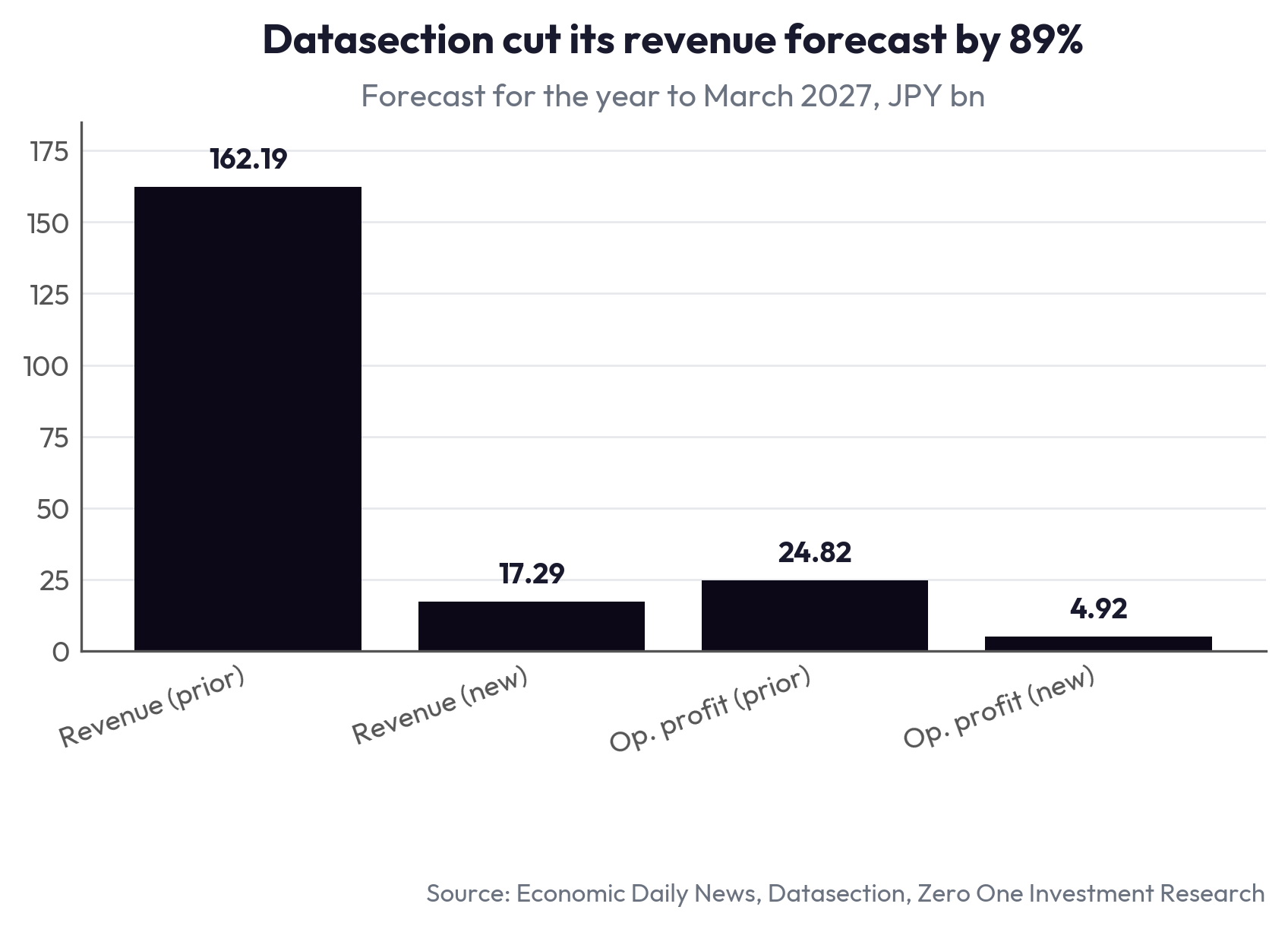
Datasection, a Japanese neocloud (a company that buys GPUs and rents out the computing), cut its revenue forecast for the year to March 2027 to JPY17.29bn from JPY162.19bn, down 89.3%, Economic Daily News reported on 23 Nov. Compal (2324 TT), Gigabyte (2376 TT), Inventec (2356 TT) and ASRock Rack (7711 TT) hold its orders and could face delayed or cancelled shipments.
Datasection blamed delays at one Japanese and two overseas AI data centers and slower large projects, which also triggered penalty fees. Its operating profit forecast fell to JPY4.92bn from JPY24.82bn, and a JPY8.70bn net profit forecast became a JPY1.48bn loss. The paper reports a large Chinese customer cut its orders. Barron's has named Tencent (700 HK) as a customer of its data centers, which the Financial Times said hold about 15,000 NVIDIA Blackwell processors near Osaka; the chief executive would neither confirm nor deny it.
The new US rule makes recovery harder. It bars data centers from renting advanced chip computing to Chinese companies and requires licenses for chip exports to Indonesia, Malaysia, Singapore, Thailand and Brazil. Gigabyte, through its unit Giga Computing, had planned a SuperCluster with Datasection in Osaka, and Compal and ASRock Rack signed contracts with it.
The lenders are exposed too. Asia Pacific data center operators raised US$49bn of loans over the past three years, Commercial Times reported citing Bloomberg, and the Institute for Progress estimated about 75% of China's overseas AI computing would sit in Southeast Asia by year end; some banks have pulled out of or paused deals. Our 21 Nov Blade covered the chipmaking side of the rule, TSMC pausing advanced Chinese orders; the rental side now reaches the server makers. Their November sales will show whether Datasection's orders were deferred or cancelled.
Linked stocks: 2376 TT, 2324 TT, 2356 TT, NVDA US
ASE and SPIL seen passing Amkor in 2027
ASE Technology (3711 TT) and its unit SPIL will have more CoWoS-like packaging capacity than Amkor (AMKR US) in 2027 for the first time, a DIGITIMES analyst estimates. CoWoS (chip-on-wafer-on-substrate) is TSMC's method of packaging an AI chip side by side with its memory.
TSMC's (2330 TT) own CoWoS lines remain fully booked and go first to AI accelerator customers, DIGITIMES reported on 23 Nov. That pushes server CPU makers to the outsourced packaging firms, ASE, SPIL and Amkor, and lifts demand for CoWoS-like capacity outside TSMC.
ASE's spending already points this way. Our 19 Nov Blade reported a NT$248.9bn ASE testing plant breaking ground in Kaohsiung, and NVIDIA is paying SPIL to expand capacity for its chips. Server CPUs add a second group of customers to the same capacity.
Linked stocks: 3711 TT, AMKR US, 2330 TT
US approved 26% of China AI chip requests
The US government approved exports of about 879,000 AI chips from NVIDIA (NVDA US) and AMD (AMD US) to Chinese companies between December 2025 and May 2026, 26% of the 3.4m requested, according to House Foreign Affairs Committee data reported by DIGITIMES on 23 Nov. The main buyers were Tencent, Alibaba (9988 HK), Baidu and BYD, and more than 30% went to companies with military links.
The data lands as Washington looks for who was accountable for NVIDIA's China sales. Treasury Secretary Scott Bessent said on 22 Nov the US must "see where the buck stops" on those sales, Nikkei Asia reported, and Reuters reported the US is seeking answers. NVIDIA's 4Q guide, covered in our 21 Nov Blade, already assumes no data center revenue from China.
The approvals show licensed volume running at about a quarter of what Chinese buyers asked for. Former chief executive Jensen Huang and the Commerce Secretary are due before Congress, and Huang's hearing on 1 Dec will show whether the licensed sales themselves come under question.
Linked stocks: NVDA US, AMD US, 700 HK, 9988 HK
先聲 First Word: Exclusives from Chinese-Language Sources
Winbond expects its car memory revenue to double in 2027
Winbond Electronics (2344 TT) expects automotive revenue to double in 2027 from more than NT$20bn in 2026, with European, Japanese and US orders secured under long-term agreements, DIGITIMES reported. Large memory makers are leaving car and industrial chips, and a Taiwanese maker is taking the customers they leave behind. (23 Nov 2026) Source: 車用、工控記憶體重新洗牌! 華邦電2027年歐、日、美系大單在握
Innolux hires TSMC's former packaging chief as adviser
Innolux (3481 TT) has reportedly hired TSMC's former vice president of advanced packaging technology and services, who ran InFO and CoWoS manufacturing before retiring in 2022, as an adviser. A display maker converting panel lines into AI chip packaging, with a 620x670mm panel platform aimed at mass production in 2H27, is buying TSMC's production experience. (23 Nov 2026) Source: 補戰力 群創延攬前台積大將
Taipower plans NT$109.6bn of grid for TSMC's Tainan parks
Taipower plans NT$109.6bn of transmission and substation investment for the Greater Tainan science parks, where power demand is estimated at 8,000MW, more than six large gas-fired units can supply, Economic Daily News reported. The parks host TSMC's (2330 TT) planned 1nm fabs, and power is the input Taiwan's chipmakers have most often asked the government to secure. (23 Nov 2026) Source: 台電將砸千億投資輸變電計畫 台積電1奈米用電穩了

© 2026 Zero One Investment Research Pte Ltd. For informational purposes only. Not investment advice.