Taiwan books a record US$123.8bn of orders; SpaceX pays 8.3% for NVIDIA chips
Zero One Investment Research Daily Intelligence Brief, November 20, 2026
Taiwan books a record US$123.8bn of orders; SpaceX pays 8.3% for NVIDIA chips
Top Market Signals
Taiwan's export orders set a monthly record
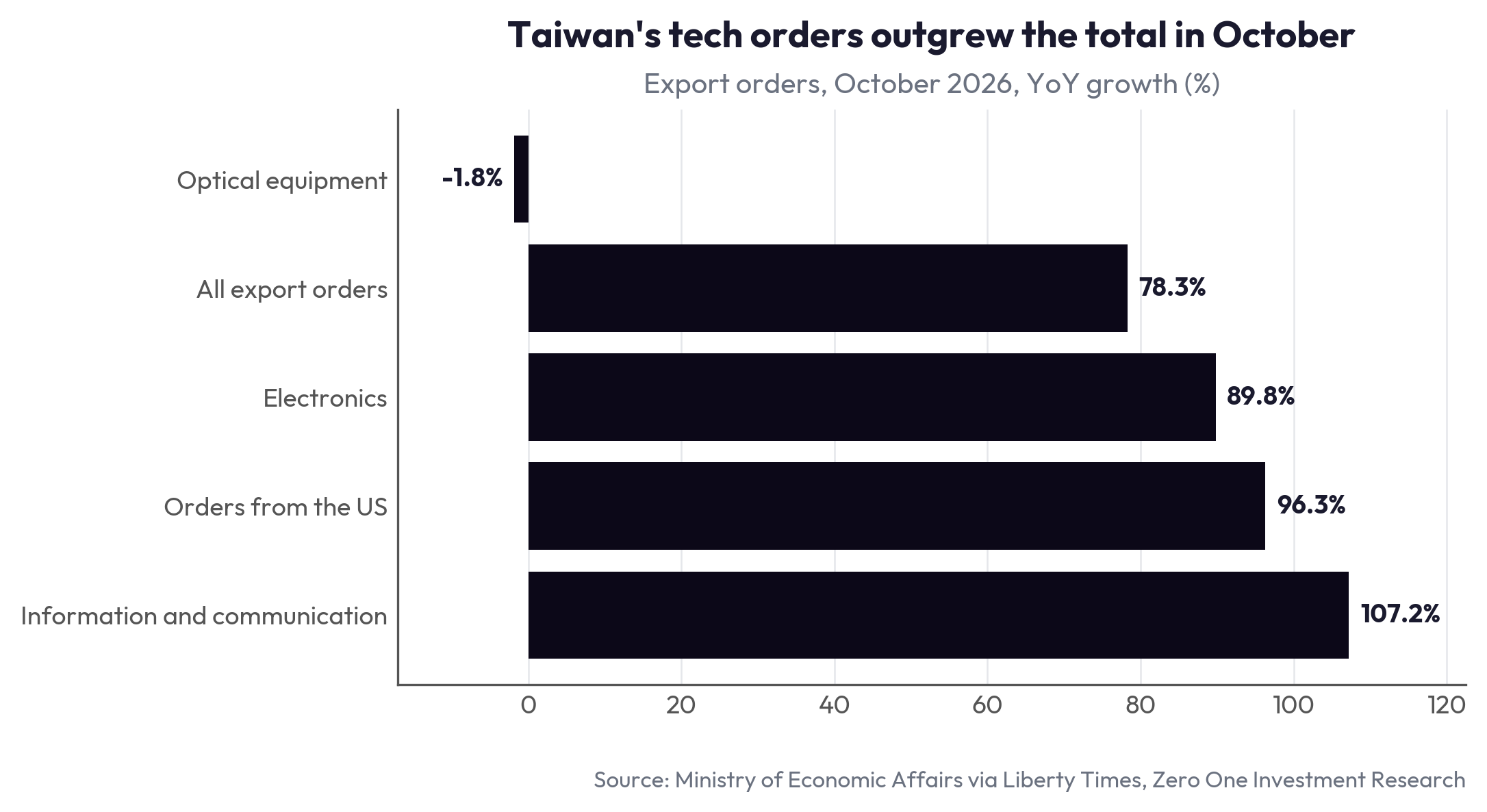
Taiwan's export orders reached US$123.82bn in October, the highest month on record and up 78.3% YoY, the Ministry of Economic Affairs said on 20 Nov. It was the 21st straight month of YoY growth. Orders from the US rose 96.3% to US$49.64bn, the largest increase on record and the main driver of the jump, the ministry said.
The growth came from the products that feed AI data centers. Information and communication orders, which cover servers, phones, networking gear and industrial PCs, rose 107.2% to US$46.77bn. Electronics orders, which cover chip manufacturing, chip distribution, chip design and memory, rose 89.8% to US$53.91bn. Both were monthly records. Optical equipment, tied to the weak display panel market, fell 1.8%.
The ministry's statistics chief, Huang Wei-jie, said Jensen Huang's exit from NVIDIA (NVDA US) cannot be put into its forecasting model, and that full-year orders can reach US$1.1tn but US$1.2tn would be difficult. January to October orders were US$943.02bn, up 58.6%.
The release fits what Taiwan's server makers said last week. Our 14 Nov Blade reported that Quanta's (2382 TT) five largest cloud customers had reserved its capacity 12 to 24 months ahead. October's order book shows that demand still arriving, on the same day the TAIEX fell 6.23%. November orders, due in December, will show whether orders from the US keep growing near this pace.
Linked stocks: 2382 TT, 2317 TT, 2330 TT, NVDA US
SpaceX borrows against its NVIDIA chip leases
SpaceX sold more than US$30bn of bonds on 19 Nov through a financing called Project Saturn, TechNews reported, citing the Financial Times. The largest piece, US$25bn of investment-grade bonds, is secured by SpaceX's next five years of lease payments for NVIDIA (NVDA US) chips and yields about 8.3%, 3.45 percentage points above US Treasuries.
Lenders got the protection a lease contract gives them. A "hell-or-high-water" clause bars SpaceX from walking away from the lease, and Moody's rated the bonds A3, one notch above SpaceX's own credit rating. The deal drew more than US$19bn of commitments before its formal sale. Lenders also tried to bar SpaceX from sending the pledged chips into orbit, where they could not be seized and sold, though SpaceX says the chips are for data centers on the ground.
The financing NVIDIA promised has not moved yet. Six firms, Apollo, Blackstone, BlackRock, Brookfield, Goldman Sachs and KKR, agreed this summer to help raise US$500bn so NVIDIA's customers could buy its chips, but not a dollar has been deployed, Commercial Times reported, citing the Wall Street Journal. The first NVIDIA chip-backed deal under it is unlikely before next year. Apollo chief executive Marc Rowan warned that many smaller cloud providers would lose access to capital if NVIDIA withdrew the guarantees banks rely on.
Our 16 Nov Blade reported that interim chief executive Colette Kress had paused parts of NVIDIA's credit program and sent new commitments to board review. SpaceX shows lenders will fund chips at about 8.3% when a five-year lease sits behind them. Buyers without that contract still depend on whether NVIDIA keeps its guarantees.
Linked stocks: NVDA US, APO US, KKR US, BX US
Phison sees memory spot prices start to slip
Phison (8299 TT), a maker of flash memory controllers and storage, said on 19 Nov that some memory spot prices have loosened and some customers are adjusting orders, Economic Daily News reported. Chief executive Pua Khein-Seng said AI demand has not changed, supply will stay tight in 2H27, and it is too early to say prices will turn down. He added that some memory products now carry gross margins of 80% to 90%.
The weakness reported so far is in Chinese storage orders. TrendForce, a research firm, said Chinese cloud providers are cutting 2027 orders for enterprise solid-state drives, citing GPU shortages and high inventory, by more than US cloud providers are adding, and expects the NAND flash market to move into oversupply in 2027. Pua said some Chinese buyers paused storage purchases because they could not get DRAM to finish servers, and large GPU deposits crowded out other parts.
DRAM still looks tight in smaller niches. Etron (5351 TT), a specialty memory designer, expects supply to stay short through 2H27 because the big memory makers are not adding capacity in its products, cnYES reported. Networking and communications rose to 35% of Etron's DRAM revenue in the first nine months of 2026, from 30% in 2025 and 24% in 2024.
Pua also said Phison has dropped a plan for an R&D site in Taoyuan, citing outside parties' involvement in Micron's (MU US) labor dispute there. Whether DRAM contract prices hold while NAND orders from Chinese cloud providers fall will show if the slip stays in storage.
Linked stocks: 8299 TT, 5351 TT, 2408 TT, MU US
SK hynix takes the top seat at Kioxia
SK hynix (000660 KS) will convert the convertible bonds it holds in a special-purpose company that owns Kioxia (285A JT) shares into common stock, Yonhap and Maeil Business reported on 20 Nov. The conversion makes SK hynix the largest shareholder of Japan's biggest NAND flash maker, with an indirect stake of 14.1%, Koreabizwire reported.
The step completes an investment SK hynix made eight years ago, when it joined the group that bought Toshiba's memory business, and gives it full ownership of the vehicle that holds Kioxia's largest stake, Moomoo reported. Korea's largest maker of HBM (high-bandwidth memory, the stacked memory packaged with AI chips) now holds the top shareholding in a company that sells mainly NAND, the storage memory used in solid-state drives.
The timing puts SK hynix deeper into NAND just as forecasts for that market turn. TrendForce expects NAND to move into oversupply in 2027 as Chinese cloud providers cut enterprise drive orders, as covered in the Phison signal above. What SK hynix does with its position at Kioxia's next shareholder meeting will show whether it plans to use the stake to coordinate supply or holds it as a financial investment.
Linked stocks: 000660 KS, 285A JT, 005930 KS, MU US
OpenAI's models redesigned part of AMD's GPU
OpenAI said its AI models improved the circuit design of AMD's (AMD US) upcoming flagship GPU by up to 14% in PPA (power, performance and area, the three measures chip designers trade against each other), Tom's Hardware reported. The models also delivered single-digit PPA gains on an AMD processor, and some of the changes have already been sent to manufacturing, Wccftech reported.
The models worked directly in SystemVerilog RTL, the code that describes a chip's circuits, and OpenAI said they reasoned at the level of an expert microarchitect. OpenAI says the work compressed about a year of conventional design effort into under five months, and it expects further gains from the improved baseline.
A design cycle that short changes how fast a chip designer can respond to a rival's product. OpenAI already designs its own inference chip, Jalapeño, with Broadcom (AVGO US), with small deployments expected around late 2026 and a broader rollout in 2027. Whether AMD ships the improved GPU on its planned schedule will show if model-driven design moves products to market faster or only improves them.
Linked stocks: AMD US, AVGO US, 2330 TT
NVIDIA bets on faster text-generation models
NVIDIA (NVDA US) is in advanced talks to buy Inception, a two-year-old startup, for at least US$500m plus performance payments, The Information reported, as carried by TechNews. Inception builds diffusion language models, which draft a rough answer and refine all of it in parallel, instead of writing one word at a time like the models behind ChatGPT and Claude. It says its Mercury models run up to ten times faster at a tenth of the cost.
The price is more than ten times the US$50m seed round Inception raised in November 2025, which Menlo Ventures led with NVIDIA's NVentures and Microsoft's (MSFT US) M12 taking part. Chief executive Stefano Ermon, a Stanford professor and a co-inventor of diffusion models, and co-founders Aditya Grover of UCLA and Volodymyr Kuleshov of Cornell would all join NVIDIA. Microsoft had also shown interest, but NVIDIA moved faster.
NVIDIA plans to use the technology in its Nemotron open-weight models and its robotics AI systems. The talks began before Jensen Huang resigned on 12 Nov, so whether the deal closes will show if interim chief executive Colette Kress keeps the acquisition plans she inherited.
Linked stocks: NVDA US, MSFT US
先聲 First Word: Exclusives from Chinese-Language Sources
Nan Ya PCB's October profit rose 389%
Nan Ya PCB (8046 TT), a maker of ABF substrates (the base boards that AI chips are mounted on), reported October net profit of NT$1.47bn, up 388.53% YoY, on revenue of NT$6.29bn, up 69.67%, at the regulator's request. October alone earned 45% of its 3Q profit, while its shares fell 35.28% this week on fears that NVIDIA would cut or downgrade substrate orders after Huang's exit. (20 Nov 2026) Source: 南電:10月獲利年增388.53% 本週股價暴跌35.2%
Largan spends NT$500m to build co-packaged optics parts
Largan Precision (3008 TT), a smartphone camera lens maker, committed more than NT$500m to plant works and equipment, and aims to have a fiber array and fiber array unit line ready by the end of 2Q27, with mass production in 2H27. These parts connect optical fibers to chips in co-packaged optics, so a phone lens maker is automating a step that rivals still largely assemble by hand. (19 Nov 2026) Source: 大立光布局 CPO 趕進度 斥資 5 億元擴產
MA-tek sees no slowdown in US cloud chip design work
MA-tek (3587 TT), which tests and analyzes chips during development, said customers including Tesla, Google, Cisco and Amazon are still pushing next-generation AI chip programs, with no sign of slowing after NVIDIA's leadership change. Because it works at the research stage, it sees customers' forward chip programs, and it plans a fourth Japan lab in 1Q27 and is evaluating its first US lab. (20 Nov 2026) Source: 輝達換帥衝擊AI產業?閎康董座:美CSP大廠研發需求未見減速

© 2026 Zero One Investment Research Pte Ltd. For informational purposes only. Not investment advice.