NVIDIA pays Kinsus and SPIL to at least triple capacity for its chips
Zero One Investment Research Weekly Intelligence Brief, Week ending November 21, 2026
Top Market Signals
NVIDIA pays over US$1bn to expand its Kinsus substrate capacity 3.5 times
NVIDIA (NVDA US) is putting more than US$1bn of cash into Kinsus (3189 TT), a Taiwanese maker of IC substrates, to equip Kinsus's Youshi plant in Taoyuan, Kinsus said on 18 Nov. The product is ABF substrate, the multi-layer board an AI chip package sits on. The capacity Kinsus dedicates to NVIDIA rises to more than 3.5 times today's level, with the full addition in place by 3Q28.
The same day SPIL, the packaging arm of ASE Technology (3711 TT), signed a multiyear deal under which NVIDIA provides several billion US dollars to triple SPIL's advanced packaging capacity in Taiwan by mid-2029. NVIDIA also plans to double its chip test capacity next year, Commercial Times reported, and ASE broke ground on a NT$248.9bn testing plant in Kaohsiung on 19 Nov.
The deals reached the suppliers seen as most at risk from Huang's exit. On 16 Nov chip executives told Commercial Times that second- and third-tier substrate and optics suppliers were the most exposed to his exit, because their expansion had been agreed directly between senior executives. Elon Musk wrote that many of Huang's deals were done on a handshake. Kinsus and SPIL now hold NVIDIA's cash, which clears that risk at least in the near term, and Kinsus said NVIDIA wants its substrate supply secured at least through 2030.
Linked stocks: 3189 TT, 3711 TT, 009150 KS, NVDA US
NVIDIA guides 4Q revenue 12% higher with China data center sales at zero
NVIDIA guided 4Q FY27 revenue to US$130bn, plus or minus 3%, on 17 Nov, in its first results under interim chief executive Colette Kress. The midpoint is about 12% above 3Q revenue of US$115.8bn. The guide assumes no data center compute revenue from China, after US$2.4bn of Hopper sales there in 3Q, and 4Q carries an extra week. Kress raised her growth estimate for the year to January 2028 from 70% to 75%.
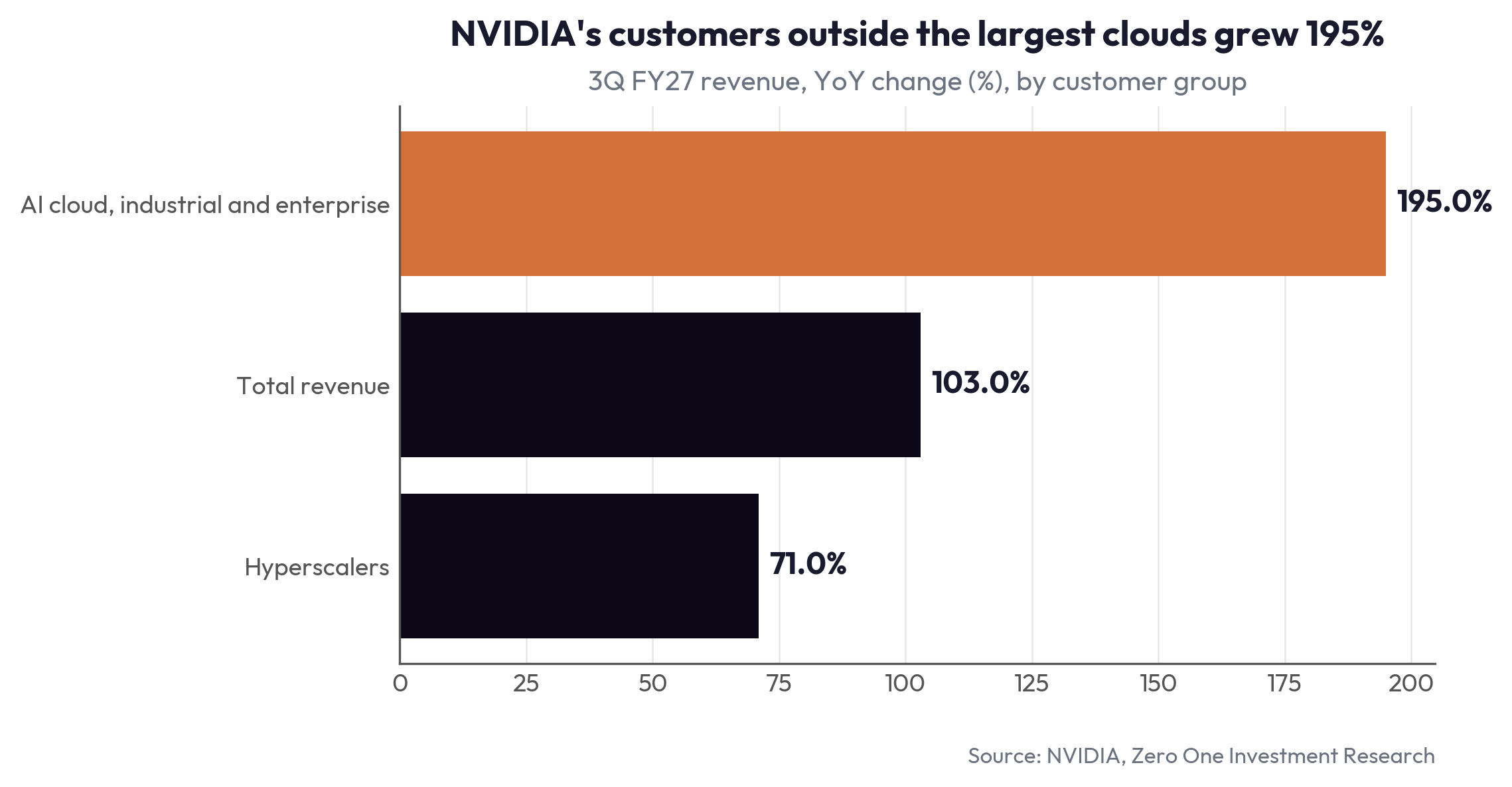
The fastest growth came from outside the largest cloud companies. Hyperscaler revenue rose 71% YoY to US$60.1bn, while AI cloud, industrial and enterprise customers rose 195% to US$47.5bn. That second group includes the neoclouds, smaller AI cloud firms whose projects depend most on outside financing, and on 16 Nov NVIDIA told customers that new credit commitments now need board review.
Kress said NVIDIA ships first to customers with land, power, a building shell and funding in place. Non-GAAP gross margin is guided to 71-72% in 4Q, from 74.9% in 3Q, as NVIDIA absorbs higher supply costs on orders it had already taken. SemiAnalysis, a semiconductor research firm, cut its 2027 AI chip spending forecast 19% in the same week, mostly on lower chip prices.
Linked stocks: NVDA US, CRWV US, NBIS US
Taiwan's October export orders rose 78.3% to a record US$123.8bn
Taiwan's export orders rose 78.3% YoY to US$123.82bn in October, the highest month on record, the Ministry of Economic Affairs said on 20 Nov. Orders from the US rose 96.3%, the largest increase on record. Information and communication orders, which include servers, rose 107.2%, and electronics orders, covering chips and memory, rose 89.8%.
Export orders are bookings, so they run ahead of the monthly revenue filings. The server makers said the same at their investor conferences. Pegatron (4938 TT) expects its server business to grow severalfold again in 2027 and sees demand for some products into 2028. Taiwan's assemblers said volume for NVIDIA's Vera Rubin platform in 1Q27 was always the plan, so the reported delay is the original schedule.
Further up the chain, Nan Ya PCB (8046 TT), an ABF substrate maker, reported October net profit up 388.53% YoY. MA-tek (3587 TT), which tests chips during development, said Tesla, Google, Cisco and Amazon are still pushing next-generation AI chip programs.
Linked stocks: 4938 TT, 2382 TT, 8046 TT, 3587 TT
Anthropic lists with US$900.9bn of compute commitments, US$161.2bn with Broadcom
Anthropic listed on Nasdaq on 19 Nov after pricing its IPO at US$83 a share, above its range, raising US$81.31bn. Its filing lists US$900.9bn of compute contract commitments running to 2045, about US$452bn of it due by the end of 2030.
Broadcom (AVGO US) is the largest counterparty, at US$161.2bn. Its contract is a five-year lease of about 3.5GW of racks built on Google's TPU, its in-house AI chip, installed in Anthropic's own data centers. Alphabet, SpaceX, AWS and Microsoft follow, and NVIDIA GPUs reach Anthropic through SpaceX and the cloud providers.
For Taiwan the load falls on packaging more than on wafers. A Taiwanese research firm cited by TechNews puts Anthropic's chip demand at 400,000-700,000 wafers, mostly in 2026-2028. At peak that is about 10-20% of TSMC's (2330 TT) annual CoWoS (advanced packaging) output, but only 3-6% of its front-end wafer capacity. Inventec (2356 TT), Quanta (2382 TT) and Foxconn (2317 TT), which build TPU boards and racks, are seen as candidates for the rack orders.
The Information's Martin Peers expects Anthropic's free cash flow, US$5.6bn in the first nine months, to shrink sharply as it moves to leasing chips for its own data centers.
Linked stocks: AVGO US, 2330 TT, 2356 TT, 2382 TT
SpaceX borrows US$25bn at 8.3% against five years of NVIDIA chip leases
SpaceX sold more than US$30bn of bonds on 19 Nov, TechNews reported, citing the Financial Times. The largest piece, US$25bn of investment-grade bonds, is secured by its next five years of lease payments for NVIDIA chips and yields about 8.3%, 3.45 percentage points above US Treasuries.
The lease is what earned the investment-grade rating. A "hell-or-high-water" clause bars SpaceX from walking away from the lease, and Moody's rated the bonds A3, one notch above SpaceX's own rating.
The financing arranged for NVIDIA's customers has not moved. Six firms, including Apollo, Blackstone and KKR, agreed this summer to help raise US$500bn so NVIDIA's customers could buy its chips, but not a dollar has been deployed, the Wall Street Journal reported.
Buyers without a long lease depend on NVIDIA's own credit. Its guarantees, up to US$118bn at the end of 3Q, take effect only once a partner's financing, site and power are ready. TSMC (2330 TT) sets a credit limit for each customer from its balance sheet, and orders above it are paid in cash.
Linked stocks: NVDA US, APO US, KKR US, BX US
TSMC pauses Chinese orders at 16nm and below as US license rule takes effect
TSMC (2330 TT) has paused some orders from Chinese chip designers on 16nm and more advanced processes until those customers obtain US export licenses, Reuters reported. The chipmaking requirements in the rule the US Commerce Department issued on 16 Nov took effect on 19 Nov. Samsung Electronics (005930 KS) told Chinese customers it is pausing some processor shipments as well, the Financial Times reported.
The rule takes the shipping decision away from the foundry. TSMC used to check a chip's specifications and ship it if it fell outside the controls. Advanced chips that meet set criteria are now presumed controlled. Chinese customers can still use 28nm and 40nm, but only for chips with no HBM (high-bandwidth memory) and no advanced packaging, which for an AI accelerator means a redesign.
Phone chips are caught too, because the rule drops the exemption for non-AI designs. TSMC makes phone chips for Xiaomi, Oppo and Vivo, and an industry source told the FT that licenses will likely be granted, but slowly. The rule's limits on remote access to advanced chips, and its license requirement for Indonesia, Malaysia, Singapore, Thailand and Brazil, take effect in 90 days.
Linked stocks: 2330 TT, 005930 KS, 2454 TT, QCOM US
Memory growth forecast to slow to 40% in 2027, with NAND seen moving into oversupply
WPG Holdings (3702 TT), a large Taiwanese component distributor, said on 17 Nov that memory market growth should slow to about 40% in 2027, from 323.8% in 2026, citing an outside research firm. WPG still expects DRAM to stay short.
The first softness is in storage. Phison (8299 TT) said some memory spot prices have loosened, and TrendForce expects NAND flash, the memory in solid-state drives, to move into oversupply in 2027 as Chinese cloud providers cut enterprise drive orders.
Linked stocks: 3702 TT, 8299 TT, 2408 TT, MU US

© 2026 Zero One Investment Research Pte Ltd. For informational purposes only. Not investment advice.