NVIDIA takes Huang back under new export oversight; TSMC reports no order changes
Zero One Investment Research Daily Intelligence Brief, November 24, 2026
NVIDIA takes Huang back under new export oversight; TSMC reports no order changes
Top Market Signals
NVIDIA takes Huang back and hands export compliance to a new board committee
NVIDIA's (NVDA US) board voted unanimously on 23 Nov to restore Jensen Huang as president, chief executive and director, 11 days after he resigned on 12 Nov. The board said it consulted senior US government officials and concluded his return poses no national security risk. Chairman Harvey Jones had said on 17 Nov that the board did not intend to reinstate him.
The return comes with three new controls. 1) A special committee of independent directors keeps investigating reports that Huang was the target of a foreign intelligence operation, and Huang has committed to cooperate. 2) A new National Security and Export Control Committee, made up only of independent directors, will oversee trade compliance and national security risk, according to NVIDIA's filing with the SEC. 3) NVIDIA is recruiting for a new chief compliance officer post, reporting to the board's nominating and governance committee. Colette Kress, interim chief executive since 12 Nov, continues as chief financial officer.
Washington's case is still open. The Trump administration put Megaspeed International, the Singapore company at the center of the scandal, on a trade blacklist that bars it from buying advanced AI chips, Bloomberg reported, and Director of National Intelligence Jay Clayton said the US is investigating Megaspeed and the businesswoman linked to Huang who once worked there.
Huang appears before three House committees on 1 Dec and in a public Senate Banking Committee hearing on 3 Dec; that committee oversees export controls. Treasury Secretary Scott Bessent had asked the board to find an outside chief executive. The hearings will show whether Congress accepts an independent board committee in place of that.
Linked stocks: NVDA US, 2330 TT, 3189 TT
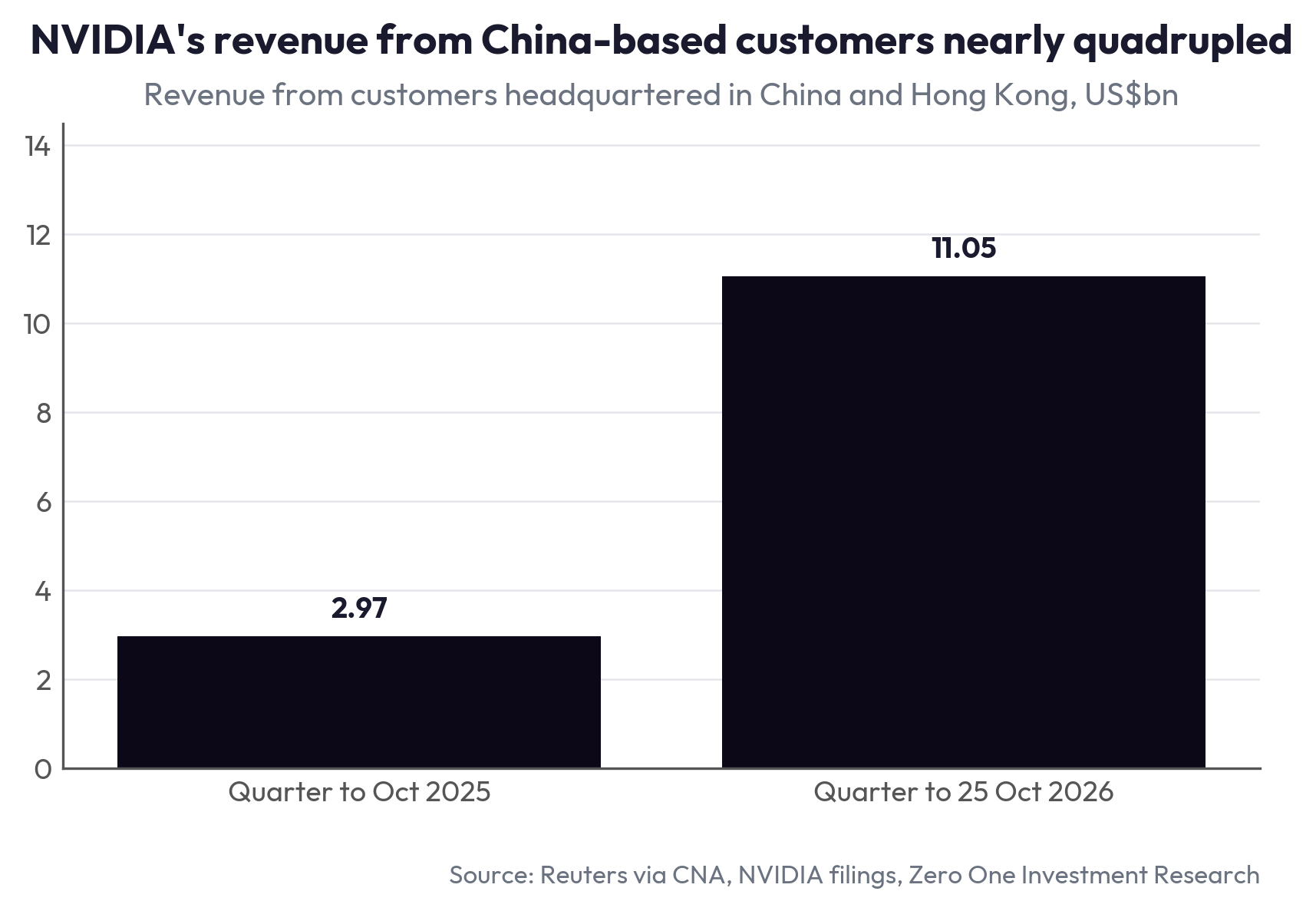
NVIDIA's revenue from China-headquartered customers nearly quadrupled
NVIDIA's (NVDA US) revenue from customers headquartered in China and Hong Kong rose to US$11.05bn in the quarter ended 25 Oct, from US$2.97bn a year earlier, Reuters reported on 23 Nov from NVIDIA's filings. Since Huang resigned, some Chinese customers have cancelled orders or held off, according to people familiar with the matter.
The growth came from lower-performance chips and software that NVIDIA sells within US export limits. Reuters reviewed more than 100 Chinese company announcements and procurement records showing rising use at universities, companies and research institutes, in applications from business software to humanoid robots. Two people said some buyers cancelled orders for the RTX PRO 5500, a professional workstation graphics card that can also run AI models, because they fear it will not be cleared for China. Reuters could not confirm the scale.
The figure counts where customers are headquartered, not where the chips are used, so it is not a direct measure of demand inside China. NVIDIA's 4Q guide, covered in our 21 Nov Blade, already assumes no data center compute revenue from China; the RTX PRO 5500 is a workstation product outside that line. Democrats take control of both houses of Congress in January, and Michael Kuiken, vice chair of the US-China Economic and Security Review Commission, said Congress will apply bipartisan oversight to chips and chipmaking. Huang's return does not settle those sales. NVIDIA's 4Q report will show how much of the US$11.05bn remains.
Linked stocks: NVDA US, AMD US, 2330 TT
TSMC says no customer has changed orders or shipments
TSMC (2330 TT) said on 23 Nov that demand for its advanced process technology remains strong and that capacity is still short of demand, a statement issued outside its quarterly earnings schedule. Hou Yung-ching, a TSMC senior vice president and chairman of the Taiwan Semiconductor Industry Association, said no customer had adjusted orders or shipments after recent events, speaking after a government meeting with industry and finance leaders.
The figures given at the meeting cover the whole industry. 1) Hou put Taiwan's semiconductor output at NT$6.5tn in 2025 and about NT$9.19tn in 2026, growth of more than 40%. 2) The science park association's vice chairman said companies have order visibility to 2028, and some are already discussing 2029. 3) SEMI Taiwan president Terry Tsao expects supply to stay short of demand in 2028 and 2029. TSMC also said demand is rising as AI use shifts from chatbots to AI assistants that carry out tasks.
TSMC added one caution: rising component prices and economic uncertainty are a challenge for consumer products and price-sensitive end markets. That is where memory costs are already cutting phone shipments (next signal). TSMC's November revenue, due by 10 Dec, is the first monthly check on whether orders held through the selloff.
Linked stocks: 2330 TT, 2454 TT, 3711 TT, 2449 TT
Smartphone shipments set to fall 25% in 4Q as memory costs rise
Global smartphone shipments fell 24.2% YoY to 230m units in 3Q26 and should fall about 25% YoY in 4Q, to roughly 250m, DIGITIMES Research analyst Lin Chun-chi said on 23 Nov. The fourth quarter is normally the industry's peak shipping season.
DIGITIMES gives three causes. 1) People are keeping their phones longer. 2) Memory and other component prices have risen. 3) Brands have cut the number of mid-range and low-end models and raised prices across their ranges. Contract price increases for phone memory slowed in 3Q, but production costs did not come down. Qualcomm's (QCOM US) handset business has been hurt by the DRAM shortage, DIGITIMES reported separately.
Memory makers are sending supply to AI customers first. Our 23 Nov Blade reported server makers repricing signed contracts by up to 45%, with memory costs up more than 400% since early 2024. Phone brands are passing costs on too, by raising prices and dropping cheaper models, and buyers are responding by buying fewer phones. TSMC flagged the same pressure on consumer markets on 23 Nov. MediaTek's (2454 TT) November revenue, due by 10 Dec, is the first company figure for the quarter.
Linked stocks: AAPL US, 005930 KS, QCOM US, 2454 TT
Samsung plans five times more advanced NAND capacity in Xi'an
Samsung Electronics (005930 KS) plans to raise monthly capacity for its 286-layer ninth-generation (V9) NAND flash at its second fab in Xi'an, China, to 50,000 to 60,000 wafers from about 10,000, with a target of November 2027, DIGITIMES reported on 23 Nov. It would add equipment and convert existing lines. NAND flash is the memory that stores data in phones and SSDs (solid-state drives).
The plan lands while memory buyers still cannot get enough supply. Our 23 Nov Blade reported enterprise SSD supply covering only slightly more than half of demand. Our 21 Nov Blade carried WPG Holdings' (3702 TT) expectation, citing an outside research firm, that NAND could move into oversupply in 2027 as memory market growth slows to about 40%.
The report comes from supply chain sources, and Samsung has not confirmed it. If SK hynix (000660 KS), Kioxia (285A JT) and Micron (MU US) add NAND capacity on a similar schedule, the 2027 oversupply WPG described would arrive sooner.
Linked stocks: 005930 KS, 000660 KS, MU US, 285A JT
先聲 First Word: Exclusives from Chinese-Language Sources
Jentech's AI chip lids move to a three-piece design from 2H27
Jentech Precision (3653 TT), which makes heat spreaders (the metal lids that draw heat off a chip package), stands to gain as a US AI chip leader's next-generation GPUs switch fully to a three-piece lid design from 2H27, with custom chips and cloud companies' own TPU chips following, Economic Daily News reported. Analysts expect advanced packaging to reach 80% to 90% of its sales in 2027. Its lids go to foundries and packaging houses before chips are packaged, so its shipments move ahead of server assembly. (24 Nov 2026) Source: 健策衝刺 AI 晶片散熱 三類客戶業務同步增長
Chunghwa Telecom keeps its data center build on schedule
Chunghwa Telecom (2412 TT) said customer demand for AI computing and data center capacity remains strong and its data center construction will not slow, Liberty Times reported. Projects in Taichung, Taipei, Taoyuan and southern Taiwan continue, single projects often cost several billion NT dollars, and spending next year is expected at a similar scale. Taiwan's largest telecom operator sees no pause in enterprise AI demand. (24 Nov 2026) Source: 中華電信:算力需求依舊強勁 未受影響
Macronix plans 3D NAND and 3D NOR samples around mid-2027
Macronix International (2337 TT) chairman Miin Wu said 3D NAND and 3D NOR flash will be the company's two engines of revenue and profit growth, with samples of both planned around mid-2027, DIGITIMES reported. The large memory makers are leaving low- and mid-capacity markets for AI, and Macronix is concentrating on specialty applications they leave behind. (23 Nov 2026) Source: 國際大廠退守中低容量市場 旺宏3D NAND、3D NOR並進

© 2026 Zero One Investment Research Pte Ltd. For informational purposes only. Not investment advice.