Anthropic lists with US$900bn of compute commitments as TSMC pauses advanced China orders
Zero One Investment Research Daily Intelligence Brief, November 19, 2026
Anthropic lists with US$900bn of compute commitments as TSMC pauses advanced China orders
Top Market Signals
TSMC pauses advanced orders from Chinese designers
TSMC (2330 TT) has paused some orders from Chinese chip designers on 16nm and more advanced processes until those customers obtain US export licenses, Reuters reported. The chipmaking requirements in the export rules the US Commerce Department announced on 16 Nov took effect on 19 Nov, while the remote-access limits in the same package start later. Samsung Electronics (005930 KS) has also told Chinese customers it is pausing some processor shipments while licenses are applied for, the Financial Times reported.
The rules take the decision away from the foundry. Until now TSMC could check a chip's computing power and other specifications and ship it if it fell outside the controls. Advanced chips that meet set criteria are now presumed to be controlled unless a US-approved exception applies. Chinese buyers had also ordered through independent packaging and test companies that certified a design was outside the controls, and that route is now closed.
Affected Chinese customers can still use 28nm and 40nm processes, but only for chips that use no HBM (high-bandwidth memory) and no advanced packaging, according to TSMC's order guidance as reported by Uanalyze. Leading AI accelerators are built on 7nm or better with HBM and advanced packaging, so a move to 28nm means redesigning the chip. TSMC will also check where a designer actually operates, its parent, its major shareholders and its packaging house, so orders placed through overseas affiliates can still be caught.
The rules reach beyond AI chips. They drop the exemption for chips designed for non-AI uses such as smartphones, so TSMC and Samsung now need licenses for advanced consumer chips, and both have told consumer electronics customers that shipments are paused. TSMC makes phone chips for Xiaomi, Oppo and Vivo. An industry source told the FT that licenses for phone chips will likely be granted, but approval delays will cause significant production delays. DigiTimes expects the rules to favor Qualcomm (QCOM US) and MediaTek (2454 TT), and MSI estimates the worst-case impact on its Southeast Asia shipments at about one month.
Linked stocks: 2330 TT, 005930 KS, 2454 TT, QCOM US
Anthropic's compute bill runs to 2045
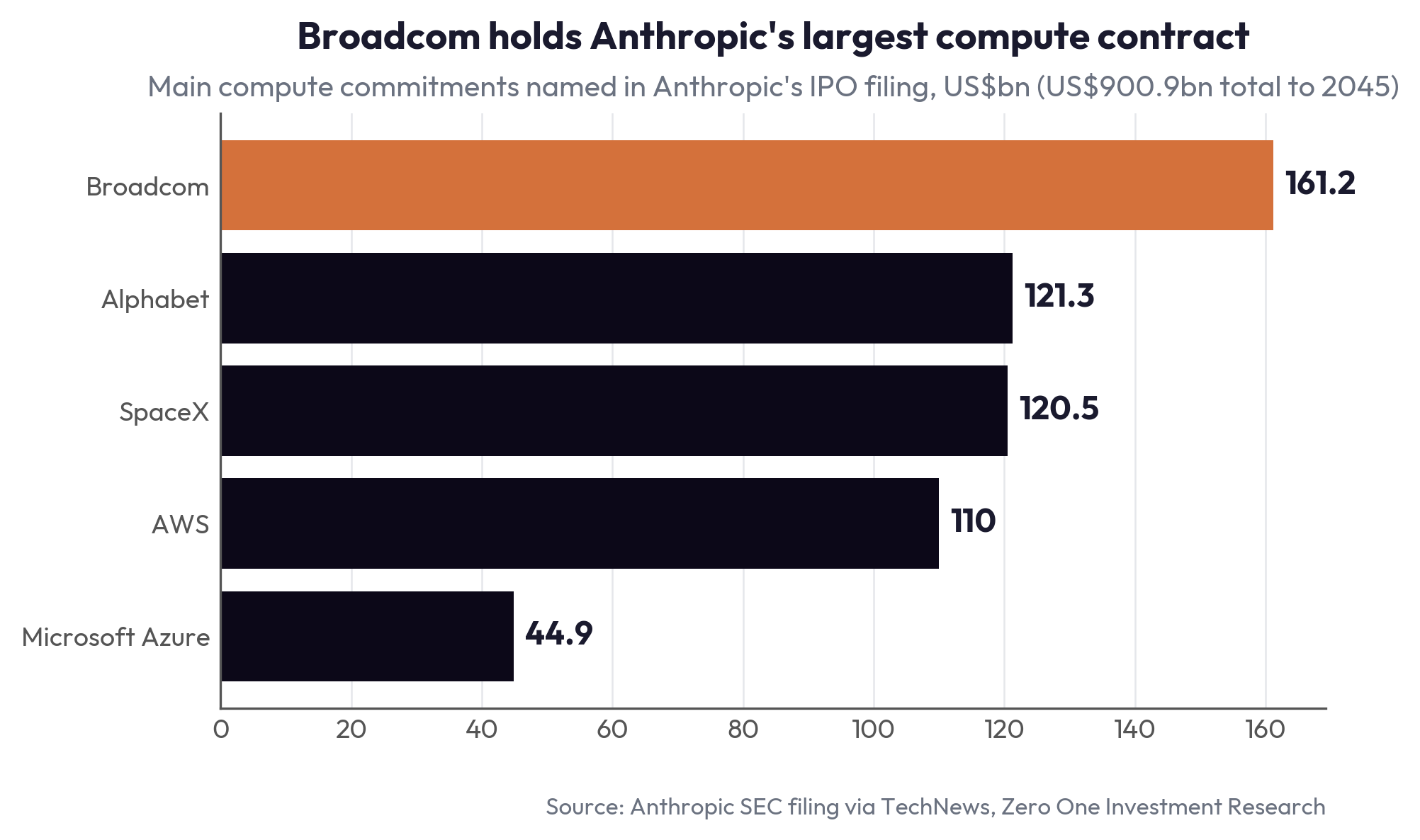
Anthropic listed on Nasdaq under the ticker ANT on 19 Nov after pricing its IPO at US$83 a share, above its US$70-78 range, raising US$81.31bn at a fully diluted valuation of about US$1.5tn. Its SEC filing lists US$900.9bn of compute contract commitments running to 2045, of which about US$452bn falls due by the end of 2030, TechNews reported.
Broadcom (AVGO US) is the largest counterparty at US$161.2bn, followed by Alphabet at US$121.3bn, SpaceX at US$120.5bn, AWS at US$110bn and Microsoft Azure at US$44.9bn. The Broadcom contract is a five-year equipment lease for about 3.5GW of Google TPU racks, including CPUs and HBM, installed in Anthropic's own data centers. Anthropic has also contracted more than 1m of AWS's Trainium2 chips, and uses NVIDIA GPUs through SpaceX and cloud providers as well as AMD GPUs.
Our 16 Nov Blade cited Ming-Chi Kuo's estimate that Anthropic will take about 14m Broadcom-designed TPUs in 2028-2029. The filing now puts a dollar figure on that pipeline, and Broadcom is the single largest commitment in it.
For Taiwan, a Taiwanese industry research firm cited by TechNews estimates Anthropic's chip demand at 400,000-700,000 wafers, concentrated in 2026-2028. At peak that is roughly 10-20% of TSMC's (2330 TT) annual CoWoS (chip-on-wafer-on-substrate, its advanced packaging line) output but only 3-6% of its front-end wafer capacity. Analysts see Inventec (2356 TT), Quanta (2382 TT) and Foxconn (2317 TT), which build Google TPU boards and racks, as candidates for the rack orders. TSMC bought 6,024,096 shares at the IPO price for US$500m, a 0.03% stake.
Anthropic booked about US$33bn of revenue and US$5.6bn of free cash flow in the first nine months of 2026, and its annualized run-rate revenue (ARR) reached US$81bn by the end of October. The Information's Martin Peers expects free cash flow to shrink sharply or reach zero as Anthropic shifts to leasing chips for its own data centers, and notes those fixed costs leave it unable to absorb any slowdown in growth. For Broadcom and the Taiwanese rack builders, the test is whether Anthropic's revenue keeps pace with the US$452bn that falls due by the end of 2030.
Linked stocks: AVGO US, 2330 TT, 2356 TT, 2382 TT
Google moves to buy AI memory directly
Google is looking to buy HBM (high-bandwidth memory, the stacked memory packaged next to an AI chip) directly for the AI chips it develops with MediaTek (2454 TT), DigiTimes reported. The move could cut billions of dollars from Google's procurement costs and change how Samsung Electronics (005930 KS), SK hynix (000660 KS) and Micron (MU US) negotiate with their largest customers. MLQ.ai, citing industry reports, described it as bypassing Broadcom (AVGO US).
Buying direct would make Google, rather than its chip design partners, the party memory makers negotiate with. Our 17 Nov Blade reported Samsung developing custom HBM for Meta's (META US) in-house AI chips. Google's move, two days later, is a second case of a company that designs its own AI chips dealing with memory makers itself.
The volumes involved are large. Our 16 Nov Blade reported Kuo's forecast of 16-18m TPU shipments in 2029, about double 2027. Google has not confirmed the change.
Linked stocks: 2454 TT, 000660 KS, MU US, AVGO US
Intel's newest process lands an outside customer
Intel (INTC US) has signed its first external customer for 18A-P, a version of its 18A (1.8nm-class) manufacturing process, DigiTimes reported; the customer was not named. Chief executive Lip-Bu Tan also said this week that 18A yields have reached 70%, and Intel signed a multi-year supply and packaging agreement with Microsoft (MSFT US).
"When I took over [...] 18A yield was horrible; now we are at 70%," Tan said at the TomorrowX conference, Tom's Hardware reported. He did not say which yield measure he meant. 18A is already in volume production for the compute tiles of Intel's Core Ultra 300 (Panther Lake) PC processors and its Xeon 6+ (Clearwater Forest) server chips.
Under the Microsoft agreement, Microsoft secures multi-year supply of Intel Xeon server processors, including the next-generation Diamond Rapids, and will use Intel's EMIB packaging (a bridge that links several chiplets inside one package) for data center chips it designs in house. Microsoft is the first company to publicly commit to EMIB for its own silicon. The announcement named no products, volumes or schedule, and DigiTimes judged that the packaging deal gives Intel credibility more than revenue.
Our 14 Nov Blade reported that shortages of wafers, substrates and packaging capacity cost Alchip about US$100m of 3Q revenue, so a second packaging source outside TSMC (2330 TT) matters to custom-chip designers.
Linked stocks: INTC US, MSFT US, 2330 TT
ASE commits NT$249bn to AI chip testing
Taiwan Fore Electronics, a subsidiary of ASE Technology (3711 TT), broke ground on 19 Nov on a new plant on the J plot of Kaohsiung's Renwu industrial park, investing NT$248.9bn with phased completion in 2028 and 2029. It follows NT$117.45bn on the adjacent K plot, and once both are built the two plots are expected to generate about NT$117.3bn of combined annual revenue and 3,300 jobs.
ASE chief executive Tien Wu said Renwu will be ASE's largest testing park, with its highest automation and output per worker, focused on advanced testing of high-performance chips.
Our 13 Nov Blade reported ASE opening its NT$100bn Luzhu advanced packaging plant. With Renwu J, ASE has announced about NT$349bn of new Taiwan plant investment in six days. Demand for testing is rising at the same time: Commercial Times reported that NVIDIA (NVDA US) plans to double its overall chip test capacity next year as its Vera Rubin platform ramps, and has paid KYEC (2449 TT) a US$1.1bn capacity prepayment for a new US test facility due to start production in April 2027.
Linked stocks: 3711 TT, 2449 TT, NVDA US
先聲 First Word: Exclusives from Chinese-Language Sources
European carmakers chase 2027 memory supply in person
Senior executives at Europe's leading automotive companies are personally chasing memory capacity and signing additional long-term supply agreements for 2027, DigiTimes reported, as Samsung, Micron and SK hynix move capacity to high-margin AI products and exit older process generations. Taiwanese memory makers are targeting the automotive, industrial and networking customers left short. (19 Nov 2026) Source: 歐系客戶2027罕見搶簽記憶體產能LTA 台廠強攻車用、工控、網通三大應用
Delta and ROHM bring 800V data center power to Japan
Delta Electronics (2308 TT) signed a basic cooperation agreement with ROHM (6963 JT) to bring 800V direct-current power systems for AI data centers to Japan, pairing Delta's power conversion and distribution equipment with ROHM's silicon carbide and gallium nitride power chips. Delta says AI server racks already exceed 100kW, against about 10kW for a traditional rack, and are heading toward 1MW, which is why the industry is evaluating higher-voltage power distribution. (19 Nov 2026) Source: 台達電鎖定日本高壓直流市場 攜手羅姆半導體簽署協議
Genius Electronic Optical sets a 2027 ramp for 3M optical connectors
Genius Electronic Optical (3406 TT), an Apple camera lens supplier, expects the expanded-beam optical connectors it makes with 3M to ramp from 4Q26 to 1Q27, and is targeting 20% revenue growth in 2027. Genius plans to bring in a 3M subsidiary through a NT$4.81bn private placement, so a phone lens maker is being funded to make data center optical parts. (19 Nov 2026) Source: 玉晶光EBO產品明年發酵 正向看未來營運成長

© 2026 Zero One Investment Research Pte Ltd. For informational purposes only. Not investment advice.