NVIDIA pays for Kinsus and SPIL capacity as it guides higher without China
Zero One Investment Research Daily Intelligence Brief, November 18, 2026
NVIDIA pays for Kinsus and SPIL capacity as it guides higher without China
Top Market Signals
NVIDIA guides higher with China at zero
NVIDIA (NVDA US) guided 4Q FY27 revenue to US$130bn, plus or minus 3%, on 17 Nov and said the outlook assumes no data center compute revenue from China. 3Q revenue was US$115.8bn, up 103% YoY and 20% QoQ, and it included US$2.4bn of Hopper data center sales to China.
The guide midpoint is about 12% above 3Q, and 4Q includes an extra week, so part of the step-up is calendar. Interim chief executive Colette Kress said NVIDIA no longer sells H200 chips to China. She raised her estimate for revenue growth in the next fiscal year, which ends in January 2028, from 70% to 75%, and said it allows for data center readiness, end demand and customers' ability to raise funding.
Margin moves the other way. Non-GAAP gross margin was 74.9% in 3Q and is guided to 71-72% in 4Q. The 3Q dip from 2Q already reflected early Vera Rubin ramp costs, TechNews reported. For 4Q, Kress said NVIDIA absorbs a significant change in supply costs while it fills customer orders it had already taken, without breaking that change down, and said her margin outlook for the next fiscal year has not changed.
Vera Rubin, NVIDIA's new rack platform, added nearly US$20bn of revenue over 2Q in its first quarter of volume shipments. Hyperscaler revenue was US$60.1bn, up 71% YoY, and revenue from AI cloud, industrial and enterprise customers was US$47.5bn, up 195%. 4Q will test two things separately: whether revenue reaches US$130bn with China at zero, and whether gross margin holds inside 71-72%.
Linked stocks: NVDA US, 2330 TT, 2317 TT
Kinsus and SPIL expand capacity with NVIDIA's cash
NVIDIA (NVDA US) is putting more than US$1bn of cash into Kinsus (3189 TT), a Taiwanese maker of IC substrates, to buy equipment for Kinsus's Youshi plant in Taoyuan, Kinsus said on 18 Nov. ABF substrate, the multi-layer board an AI chip package sits on, is the product. Kinsus will expand the ABF capacity it dedicates to NVIDIA to more than 3.5 times today's level, with production starting in 2H27 and the full addition in place by 3Q28.
The same day, SPIL, the packaging arm of ASE Technology (3711 TT), signed a multiyear deal under which NVIDIA provides several billion US dollars to triple SPIL's advanced packaging capacity in Taiwan by mid-2029, dedicated to NVIDIA. The new lines cover bumping, interposer wafers, assembly and test as one service. NVIDIA also amended its substrate agreement with Samsung Electro-Mechanics (009150 KS) and pointed to nearly US$3bn of earlier agreements, including prepayments, that fund Amkor's (AMKR US) expansion in Arizona and Korea.
The spending shows in NVIDIA's own accounts. Supply purchase commitments rose to US$390bn at the end of 3Q from US$279bn a quarter earlier, mainly for multi-year memory supply, TechNews reported. Kress named prepayments to key suppliers as a main use of cash, alongside returning capital to shareholders.
Our 16 Nov Blade reported chip executives saw the risk from Huang's exit concentrated in second- and third-tier substrate and optics suppliers, and were watching whether those suppliers would give AMD and custom chip customers more priority. The Kinsus deal ties new substrate capacity to NVIDIA directly: Kinsus said NVIDIA aims to secure its substrate supply at least through 2030 and is negotiating investments at more Kinsus sites.
Linked stocks: 3189 TT, 3711 TT, NVDA US, 009150 KS
NVIDIA rations supply by customer readiness and factory yield
NVIDIA (NVDA US) charges every customer the same list price and decides who gets chips first by whether they can put them to use, interim CEO Colette Kress said on the 3Q call, TechNews reported. The tests are land, power and building shell in place, plus secured funding and purchase volumes, and NVIDIA speeds up deliveries only to customers that pass all of them.
Its credit guarantees, up to US$118bn at the end of 3Q, follow the same rule: one takes effect only after the partner completes its financing and the site and power are ready, and it ends if the project is delayed.
The same test runs down the supply chain. NVIDIA operations head Debora Shoquist said NVIDIA reviews partner factories every week and adds no supply that week to a plant whose yield is low or whose chips sit too long, Commercial Times reported. Tracking each chip from its TSMC (2330 TT) die ID to the customer invoice lets NVIDIA cut the time from TSMC shipment to finished systems leaving Foxconn (2317 TT) or Wistron (3231 TT) from five weeks to two when needed.
For Taiwan's assemblers, a plant's share of NVIDIA volume moves with its own weekly yield and turnaround numbers.
Linked stocks: NVDA US, 2317 TT, 3231 TT, 2330 TT
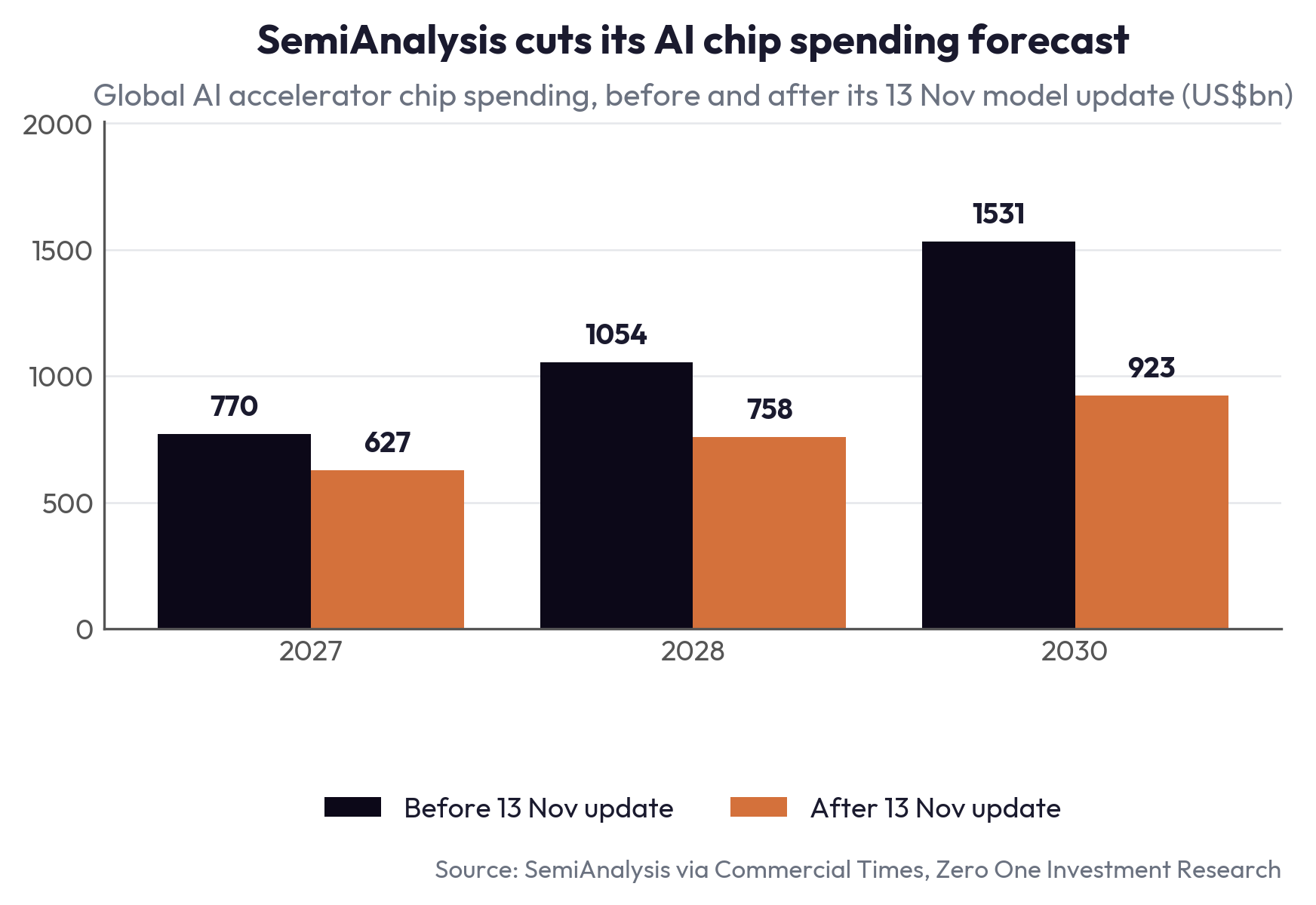
SemiAnalysis cuts 2028 AI chip spending 28%
SemiAnalysis, a semiconductor research firm, cut its forecast for 2028 global spending on AI accelerator chips to US$758bn from US$1,054bn, down 28%, in a model update on 13 Nov, Commercial Times reported. It cut 2027 by 19%, to US$627bn from US$770bn, and 2030 by 40%, to US$923bn from US$1,531bn.
Most of the cut comes from lower prices. SemiAnalysis expects better HBM (high-bandwidth memory) supply to lower chip costs and competition to shrink NVIDIA's (NVDA US) price premium, and it still has 2028 spending rising about 21% YoY. It also cited slower growth in new annualized revenue at AI model companies in 3Q, tighter capital markets, and data centers without hyperscaler purchase commitments finding it harder to raise money.
The cuts reach named Taiwan projects. Lifetime shipments of MediaTek's (2454 TT) TPU v9i project were cut 42%, and 2027 Vera Rubin rack orders for Microsoft by 200 racks. NVIDIA's 2028 compute revenue forecast fell 39% and Broadcom's (AVGO US) cumulative 2026-2030 custom chip revenue fell 11%, while Amazon's Trainium shipments for 2027 and 2028 were left unchanged.
The two views point in opposite directions. NVIDIA raised its growth estimate for the year to January 2028 to 75% this week, while SemiAnalysis cut 2027 by 19% and later years by more. Those later years are when the new Kinsus and SPIL capacity that NVIDIA is paying for comes on line.
Linked stocks: 2454 TT, NVDA US, AVGO US
Samsung's investment this year already tops 2025
Samsung Electronics (005930 KS) spent about KRW56.94tn on facilities and KRW41.8tn on R&D in the first nine months of 2026, each already above its full-year 2025 total, DigiTimes reported from Samsung's latest business report. The combined KRW98.74tn is 9.15% more than Samsung spent on both in all of 2025.
Memory profit pays for it. Samsung's nine-month revenue passed KRW500tn and operating profit rose 980.3% YoY. Samsung and SK hynix (000660 KS) held about KRW329tn (US$245.5bn) of cash and short-term financial assets at the end of 3Q, about KRW296tn net of borrowings, DigiTimes reported. The two drove 83% of the gain in nine-month operating profit at KOSPI companies, which reached KRW638tn, Chosunbiz reported.
Buyers are locking in supply at the same time, with most of NVIDIA's purchase commitments tied to multi-year memory supply. On the other side, SemiAnalysis now sees 2028 HBM demand 30% lower than its earlier forecast, Economic Daily News reported. Samsung is spending above its 2025 level while SemiAnalysis cuts 2028 HBM demand, so Samsung's 2027 investment plan will show whether memory makers slow their build to match.
Linked stocks: 005930 KS, 000660 KS, 2408 TT, MU US
Notebook slump expected to last into mid-2027
Notebook PC shipments should stay weak through 2Q27, after a 3Q peak season that disappointed and a further fall in 4Q, DigiTimes reported from supply chain sources. 4Q shipments are expected to drop by a single-digit to double-digit percentage. The most pessimistic sources see 2H26 consumer notebook shipments down 70% from 1H and commercial models down 40%.
Component prices are the cause the sources name. A 2H27 recovery depends on key component prices stabilizing, they said. Economic Daily News, reporting NVIDIA's (NVDA US) 3Q results, noted that higher memory and system prices still weigh on consumer PC demand. Phones show the same squeeze: brands raised retail prices to pass on memory costs, and full-year smartphone shipments are expected to fall about 17%.
Our 14 Nov Blade showed the split at Quanta (2382 TT): October revenue up 104% YoY while its notebook shipments fell 35.7% from September. Servers carry the assemblers through a notebook downturn that now runs at least two more quarters.
Linked stocks: 2357 TT, 2353 TT, 2382 TT, 2324 TT
先聲 First Word: Exclusives from Chinese-Language Sources
TSMC pays the top wind price for Hai Long 2A
TSMC (2330 TT) is reportedly the buyer behind the corporate power purchase agreement for the Hai Long 2A offshore wind farm, paying at least its selection-round price of NT$5.516 per kWh, against about NT$2.54 under its earlier Ørsted contracts, Liberty Times reported. Its nearly 2GW of contracted offshore wind would supply about 7.3bn kWh a year, close to 30% of the 25.8bn kWh its Taiwan sites used in 2025. (18 Nov 2026) Source: 獨家》台積電一年狂掃逾70億度離岸風電 地板價5.5元也買進
Nanya and Macronix pair their memory for carmakers
Nanya Technology (2408 TT) will bundle its low-power DRAM with Macronix's (2337 TT) SLC NAND flash in combined packages for car communication systems, after Macronix chairman Miin Wu agreed in person to supply, DigiTimes reported. With memory short, the two Taiwanese makers are using one joint product to win automotive supplier slots. (18 Nov 2026) Source: 南亞科與旺宏互補搶車聯網商機 吳敏求親自點頭同意給貨
Unimicron reshapes its loss-making flex board unit
Unimicron (3037 TT) said its Kunshan flexible circuit board subsidiary, loss-making for years, is changing its production rather than closing, after the unit forced a roughly RMB295m impairment at the parent in 2Q26, Economic Daily News reported. The group is concentrating on high-end products, and NVIDIA named Unimicron among the substrate makers expanding capacity for its platforms. (17 Nov 2026) Source: 欣興集團策略聚焦高階 旗下軟板廠欣興同泰轉型調整生產

© 2026 Zero One Investment Research Pte Ltd. For informational purposes only. Not investment advice.