
Anthropic signs US$11.6bn of Akamai compute as ASML sells nothing in Europe
Zero One Investment Research Daily Intelligence Brief, September 25, 2026
Anthropic signs US$11.6bn of Akamai compute as ASML sells nothing in Europe
Top Market Signals
Anthropic signs seven-year compute deal with Akamai
Anthropic has signed an US$11.6bn, seven-year contract with Akamai Technologies (AKAM US) for computing power, Bloomberg reported, adding to the AI developer's growing list of data center deals.
The size of these contracts shows up in a filing from NScale, a UK AI cloud provider that has applied for a US listing. Its S-1 shows contracts with Anthropic worth up to about US$44.6bn and with Microsoft (MSFT US) up to about US$43.8bn, running as late as 2033, according to TechNews reporting on the filing. Active and signed take-or-pay contracts, where the customer pays whether or not it uses the capacity, totaled about US$51.3bn at the end of July and cover about 289,000 GPUs. NScale's revenue was US$33m in all of 2025 and US$140.6m in 1H26.
The same filing shows where NScale started. Spring, a Singapore subsidiary of ByteDance, supplied about 73% of 2025 revenue by renting 2,304 NVIDIA (NVDA US) B200 GPUs at a former crypto mining site in Glomfjord, Norway, according to reports on the filing. NScale expects that customer to fall below 20% of revenue in 2026 as the US contracts ramp, and NVIDIA has committed more than US$2bn to the company plus an US$860m guarantee on a Texas data center lease. That makes NVIDIA at once the GPU supplier, a more than US$2bn investor and the guarantor of an US$860m lease behind a provider that booked US$140.6m of first-half revenue against a take-or-pay backlog of AI-lab compute, so the same NVIDIA capital is helping finance the demand its chips are sold into.
Our 22 September edition carried Korean reporting that Anthropic and OpenAI are expected to buy memory directly from 2027. The same developer is now also signing multi-year compute contracts with Akamai and NScale. NScale itself warns that its revenue depends on a few customers, and a cut in spending by any one of them would hit the business hard.
Linked stocks: AKAM US, NVDA US, MSFT US
ASML sold no chip tools in Europe this year
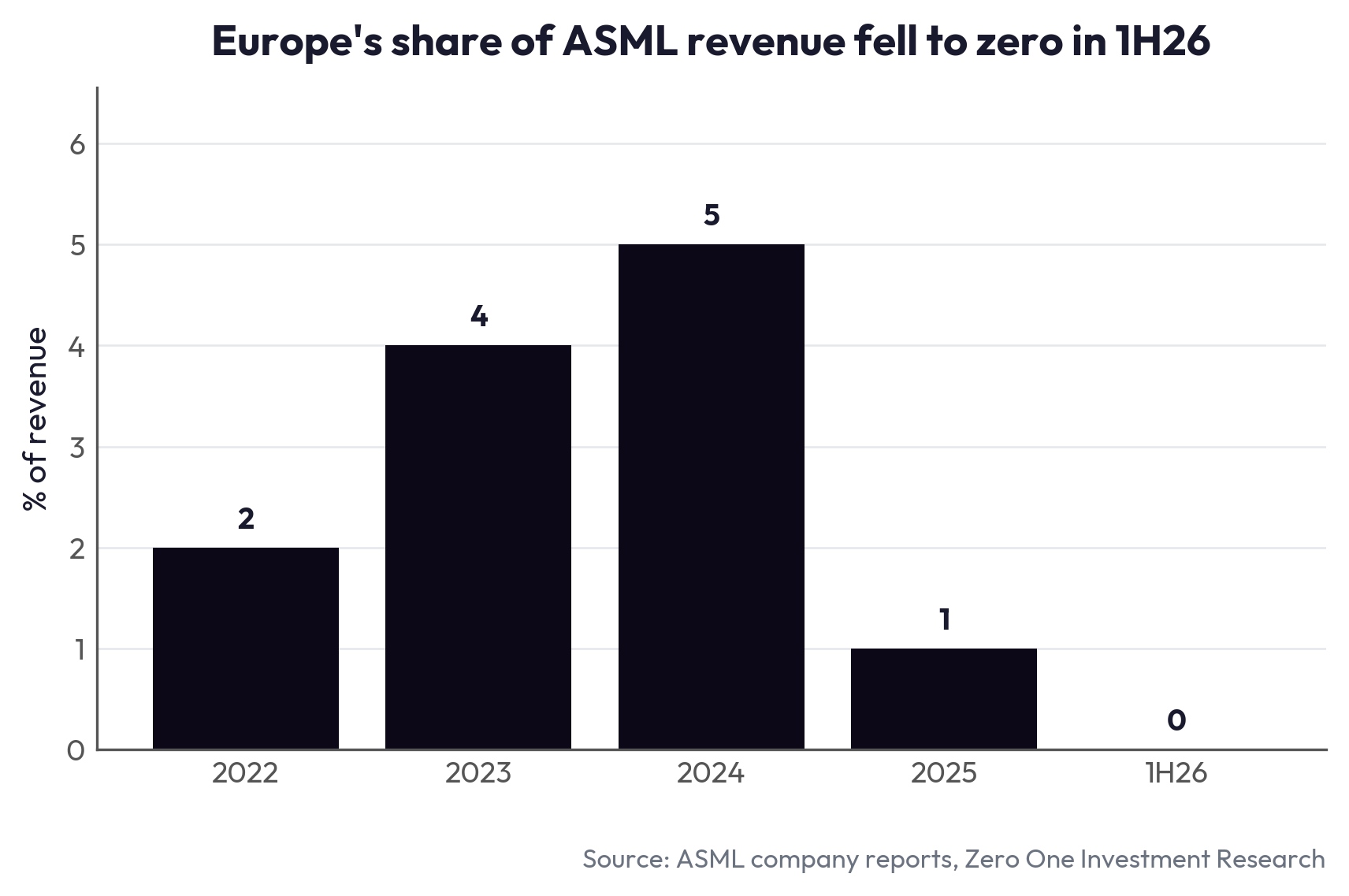
ASML (ASML NA) recorded none of its 1H26 revenue in Europe, down from 1% in 2025 and 5% in 2024, based on its earnings reports. "We are selling absolutely nothing in Europe," Frank Heemskerk, ASML's executive vice president of public affairs, said at a panel at De Balie in the Netherlands, because no chip factories are being built there.
ASML is Europe's most valuable company, at about US$660bn, and the only supplier of the extreme ultraviolet (EUV) machines that print the smallest chip features. Europe's share of its revenue was 2% in 2022, 4% in 2023 and 5% in 2024 before falling to 1% and then zero. Every system it sold in the first half went to customers outside its home region.
Heemskerk asked EU leaders to help create demand, by getting large European chip buyers to source from European fabs, instead of relying on subsidies for new plants. EU industry ministers were due to debate the proposed Chips Act 2.0 in Brussels on 24 September. Separately, Dutch prime minister Rob Jetten has discussed with President Trump the MATCH Act, US legislation that would further restrict ASML's sales in China.
ASML reports 3Q26 results on 14 October. A European fab project placing tool orders would be the first sign that Europe's share is coming back.
Linked stocks: ASML NA, 2330 TT, INTC US
Qualcomm keeps both 2nm flagships at TSMC
Qualcomm (QCOM US) launched two flagship phone processors, the Snapdragon 8 Elite Gen 6 and 8 Elite Extreme Gen 6, both built on TSMC's (2330 TT) 2nm process, with a phone CPU running above 5GHz for the first time. DigiTimes reports Qualcomm kept both chips at TSMC even as Samsung Electronics (005930 KS) ramps its second generation 2nm process and pushes to win advanced-node customers.
With Apple's A20 Pro and MediaTek's (2454 TT) Dimensity 9600 Pro already on the node, TSMC's 2nm now carries flagship chips from all three main phone chip suppliers, Commercial Times reported. TSMC started volume production on 2nm in 4Q25. In Kaohsiung, Fab 22 phase one is producing, phase two is planned to start in 4Q26 and phase three targets 1Q27. Xiaomi is first to ship phones on both new Qualcomm chips, with the Xiaomi 18 Pro starting at RMB5,999.
Qualcomm stayed after TSMC was reported, in our 24 September edition, to be raising 2027 wafer prices by 3% to 6%, with the largest increases on 2nm and 3nm. Samsung's most recent 2nm win in these pages was Tesla's AI5 chip, which began trial production in Texas (22 September).
Linked stocks: 2330 TT, QCOM US, 2454 TT, 005930 KS
NVIDIA gives substrate makers two years for glass
NVIDIA (NVDA US) has asked substrate makers in Korea, Japan and Taiwan to finish developing glass substrates within two years, possibly before 2028, according to Korean outlet kipost as relayed by MoneyDJ. A substrate is the board a chip package sits on, and today's high-end version is built from ABF, a resin film. German equipment maker SCHMID says it is developing glass core substrate tools with major suppliers in the Intel (INTC US), NVIDIA and AMD supply chains.
SCHMID chief strategy officer Roland Rettenmeier said metallizing the through-glass vias, the vertical wiring holes in the glass, still faces technical obstacles, and final customer qualification is not done. Glass is flatter and stiffer than resin and barely expands with heat, so it warps less as packages grow. That would let one package hold more chips and more HBM (high bandwidth memory), and could reduce or replace the silicon interposer that connects GPUs to HBM today.
The deadline lands on a resin substrate market that is already short. Kinsus Interconnect (3189 TT) reported August net profit of NT$817m, up 353.89% YoY, on ABF price increases, and has added about NT$19.6bn of capital spending this year in two rounds for AI chip customers. Goldman Sachs put the high-end ABF supply shortfall at 51% by 2028 (our 19 September edition), and Intel was reported in talks on packaging using AUO's (2409 TT) glass lines (21 September).
Linked stocks: NVDA US, 3189 TT, 4062 JT, 2330 TT
Micron exits a gaming memory chip for AI parts
Micron (MU US) has ended production of its 2GB (16Gb) GDDR7 graphics memory chips in both 28 Gbps and 32 Gbps versions, with the parts marked end of life on its website, Tom's Hardware reported. It is moving to 3GB (24Gb) GDDR7 chips, which carry higher margins and go into NVIDIA's (NVDA US) RTX PRO Blackwell professional GPUs for AI work.
Micron only began supplying 2GB GDDR7 to NVIDIA this year, and Samsung Electronics (005930 KS) and SK Hynix (000660 KS) supply most of the chips on RTX 50 gaming cards, so no immediate shortage is expected. The exit follows Micron's earlier withdrawal from its Crucial consumer memory and SSD business to prioritize data center customers.
The Korean makers are moving the same way. Samsung and SK Hynix are putting more capacity into HBM under long-term supply agreements with large technology customers, DigiTimes reports, which tightens supply of conventional DRAM. That leaves room for ChangXin Memory Technologies (CXMT), China's largest DRAM maker, to fill the gap; CXMT put its G5 platform into mass production on 20 September (our 21 September edition).
Micron reports fiscal 4Q26 results on 30 September. Any comment on how much capacity it is moving from consumer to data center products is the next data point.
Linked stocks: MU US, 005930 KS, 000660 KS, NVDA US
Taiwan PCB makers raise 2026 output forecast 7.9%
The Taiwan Printed Circuit Association (TPCA) raised its 2026 forecast for the total output of Taiwan's printed circuit board makers, at home and abroad, to NT$1.1365tn, up 24.2% YoY and 7.9% above the NT$1.0532tn it forecast in June, Economic Daily News reported. It expects 2H26 output of NT$611.8bn, up 24.5% YoY.
TPCA said demand from AI servers, high-speed networking and memory is driving growth in chip substrates, high layer count boards (HLC) and high density interconnect boards (HDI). Zhen Ding Technology (4958 TT) chairman Shen Ching-fang pointed to optical modules, silicon photonics and humanoid robots as further uses.
The upgrade follows company data already carried here. Tripod Technology (3044 TT) reported its first month of revenue above NT$10bn (23 September), and laminate maker ITEQ (6213 TT) earned 72% of its 2Q26 profit in August alone (24 September). Taiwan's listed companies report September revenue by 10 October, the first check on the second-half figure.
Linked stocks: 4958 TT, 3037 TT, 3044 TT, 2368 TT
Meta raises glasses prices on inflation and shortages
Meta Platforms (META US) priced its third-generation Ray-Ban Meta glasses from US$449, up from US$379 for the current second generation, and said the increase comes mainly from inflation and component shortages, with tight memory supply a smaller factor, Economic Daily News reported. It also launched Ray-Ban Meta Audio, a camera-free model from US$349, and US$1,299 VR glasses weighing about 100 grams, with the processor and battery moved to an external pack.
Through its partnership with EssilorLuxottica (EL FP), Meta will offer more than 100 frame choices across Ray-Ban, Oakley and Meta Glasses by year end, CNA reported. Global AI glasses shipments rose 263% YoY in 1H26, according to Counterpoint Research. Meta also showed Muse Charm, a handheld with a 2-inch touchscreen and 5G for its Muse AI agent, due in December.
Genius Electronic Optical (3406 TT) is the main lens supplier for Meta's glasses and expects its AI glasses business to grow this year. A price increase on a device Meta is pushing to a mass market shows inflation and component shortages reaching consumer prices beyond PCs and phones.
Linked stocks: META US, 3406 TT, EL FP, 2382 TT
先聲 First Word: Exclusives from Chinese-Language Sources
Yankey Engineering wins a Micron Tainan job worth over NT$20bn
Yankey Engineering (6691 TT), a cleanroom and plant systems contractor, has won a Micron project in Tainan worth more than NT$20bn, close to its entire revenue last year, lifting its order backlog to a record of over NT$55.3bn. A single Micron Taiwan order now matches a year of revenue for a local fab contractor, and Yankey is also in talks for Micron's Hiroshima fab in Japan. (24 Sep 2026) Source: 洋基工程:搶下美光台南工程 在手訂單逾553億元
ChipMOS lifts capex to over 25% of revenue for two years
ChipMOS Technologies (8150 TT) has raised this year's capital spending from under 20% of revenue to over 25%, and plans to keep it above 25% next year, as DDR4 demand stays strong and DDR5 volumes ramp. The money goes to memory plus new phone, ASIC, optical and silicon photonics products, and ChipMOS expects memory to perform better than its display driver business in 3Q26. (24 Sep 2026) Source: 南茂強攻記憶體封測
eMemory's royalties pass licensing fees for the first time
eMemory Technology (3529 TT), which licenses memory and security circuit designs to chipmakers, took 60.8% of 2Q26 revenue from royalties, overtaking upfront license fees (39.2%) for the first time. Royalties are paid per wafer and rise with the node, from about NT$100 at 7nm to NT$300 at 3nm, so revenue now tracks customers' production volumes. (24 Sep 2026) Source: 力旺(3529)權利金占比破六成!3奈米拉高IP身價,帳上卻藏著一個煞車

© 2026 Zero One Investment Research Pte Ltd. For informational purposes only. Not investment advice.