
Price increases spread from foundry wafers to power chips and Azure renewals
Zero One Investment Research Weekly Intelligence Brief, Week ending September 26, 2026
Top Market Signals
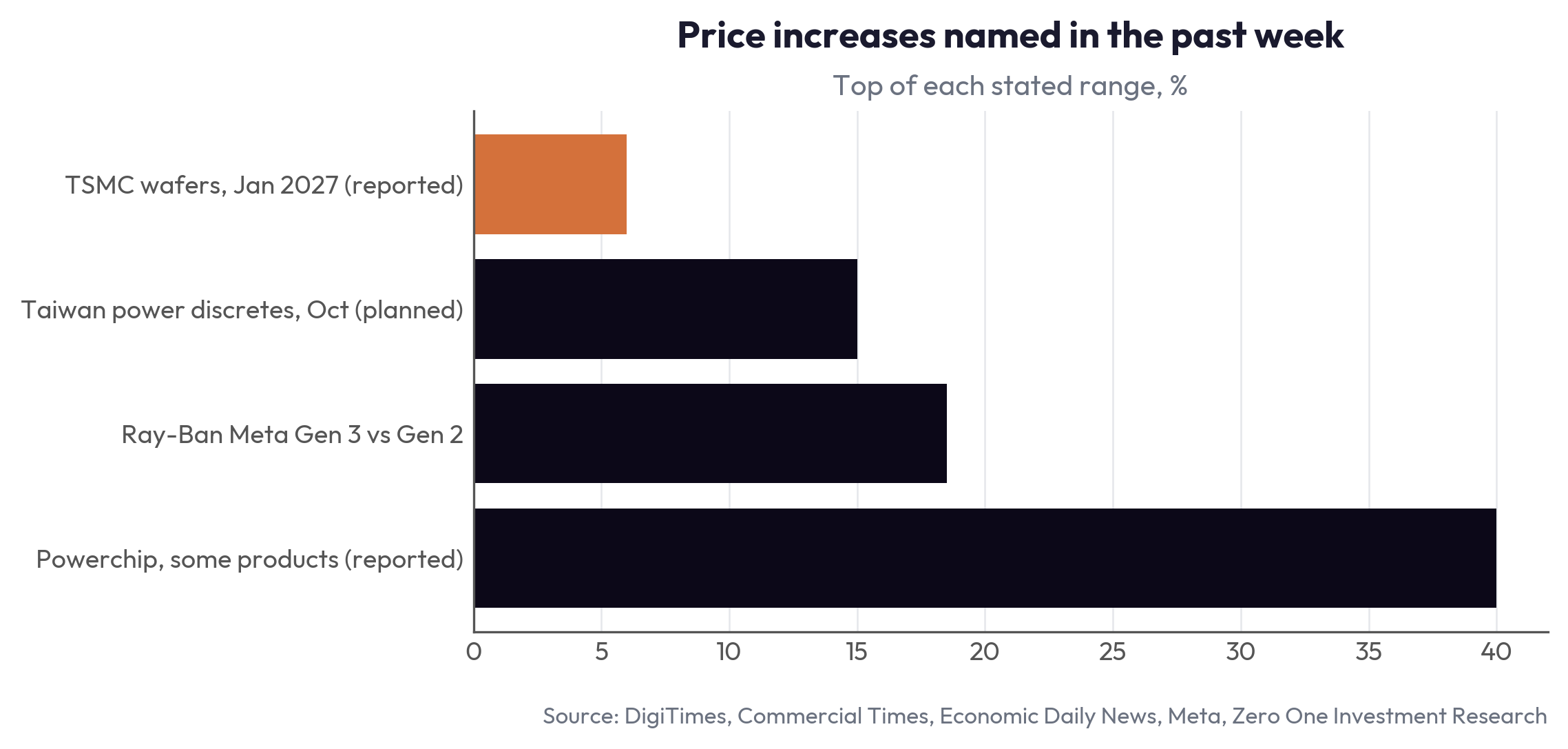
Foundry prices rise for 2027, with TSMC reported at 3% to 6%
TSMC (2330 TT) plans to raise wafer prices by about 3% to 6% from January 2027, according to supply chain sources cited by DigiTimes, with the largest increases on 2nm and 3nm. TSMC does not comment on market rumors. Days earlier, United Microelectronics (2303 TT) told the market that next year's price adjustments would be larger and broader than those in 2H26 if supply and demand hold.
The two ends of the node range are rising for different reasons. At the leading edge the driver is cost: TSMC has said the early 2nm ramp dilutes gross margin by about 3 to 4 percentage points, and the supply chain estimates a US fab costs four to five times as much to build as one in Taiwan. At mature nodes the driver is demand. Every AI server carries a large count of power management, control and power devices, and Economic Daily News reports 8 inch and 12 inch mature capacity has moved from oversupply to tight.
TSMC stepping back from parts of its mature business adds to that. The displaced orders are landing at UMC, Powerchip (6770 TT) and Vanguard International (5347 TT), whose 8 inch lines DigiTimes puts above 90% utilization. Powerchip is reported to be preparing increases of up to 40% on some products, which it declined to comment on.
Who pays is already sorting itself out. Chip designers told DigiTimes that high-end GPU and custom accelerator products can pass the increase on, while microcontrollers, power management chips and consumer parts face more competition and may absorb part of it. UMC guides utilization above 90% this quarter and says it will hold price discipline rather than chase share; a slide in that utilization back below 90% would be the first sign the mature node tightness is easing.
Linked stocks: 2330 TT, 2303 TT, 6770 TT, 5347 TT
Taiwan power chip makers plan 10% to 15% increases as onsemi follows
onsemi (ON US) has told customers it will raise prices on some products from 10 October, after earlier increases at Texas Instruments (TXN US) and Renesas (6723 JT), according to Commercial Times. Taiwan's PANJIT (2481 TT) and Taiwan Semiconductor (5425 TT) are reported to be planning increases of about 10% to 15% on some non-contract products from October.
The cause sits in the AI rack. As rack power climbs from around 100 kilowatts toward several hundred and power delivery moves from 48V to 800V direct current, each rack needs more power management chips, MOSFETs (the transistors that switch power on a board) and protection parts. Those come off 8 inch capacity that is being reallocated at the same time. PANJIT put AI at about 11% of its 1H26 revenue and rising.
The inputs behind these parts are short too. Episil-Precision (3016 TT), a Taiwan epitaxial wafer maker, says its 6 inch gallium nitride capacity is fully loaded after four straight quarters of growth. Its germanium-on-silicon epitaxy, used in the photodiodes that receive light in optical links, will meet less than half of customer demand next year even after capacity rises 3.5 to 4 times.
The companies say actual increases vary by product, customer and contract, so the October lists are a ceiling rather than a settled price.
Linked stocks: ON US, 2481 TT, 5425 TT, 3016 TT
Azure lifts prices at renewal as Anthropic books US$11.6bn more compute
Microsoft (MSFT US) told BNP Paribas that Azure prices are rising, applied when customers renew rather than by reopening existing contracts, according to a note carried by MoneyDJ. The size was not disclosed. Microsoft said Azure's recent strength did not come from pricing and that it is still catching up with demand, a point its Taiwan general manager made in Taipei last week, putting compute short of demand for two to three years with electricity and floor space as limits alongside chips.
A cloud provider charging more while it is still short of capacity is the shortage reaching the end customer. Because the increase applies only at renewal, it reaches Azure revenue as contracts roll over, across several quarters rather than in one.
The largest buyers are signing for years. Anthropic signed a seven-year, US$11.6bn compute contract with Akamai Technologies (AKAM US), Bloomberg reported. The US listing filing of NScale, a UK AI cloud provider, shows contracts with Anthropic worth up to about US$44.6bn and with Microsoft up to about US$43.8bn, running as late as 2033, against first-half 2026 revenue of US$140.6m.
The same filing shows how the build is financed. NVIDIA (NVDA US) has committed more than US$2bn to NScale plus an US$860m guarantee on a Texas data center lease, so NVIDIA capital is helping fund demand for its own chips. NScale warns that its revenue depends on a few customers.
Linked stocks: MSFT US, AKAM US, NVDA US
Acer puts the memory price reversal in 2H27 on cheaper Chinese supply
Acer (2353 TT) chief executive Jason Chen said the major memory makers are keeping the shortage message alive to protect their margins, and that only high-end parts such as LPDDR5X-9600 and a few processors are genuinely short. He expects PC prices to rise another 5% to 20% into year end, flatten through 1H27 and then fall. That puts a large buyer on record against SK Hynix's view that pricing does not normalize until 2030.
His mechanism is Chinese memory, and ChangXin Memory Technologies (CXMT), China's largest DRAM maker, supplied the evidence the same weekend. It put its G5 platform into mass production on 20 September, claiming an 11.95nm process reached by exposing each wafer four times on older lithography tools instead of once on the extreme ultraviolet machines it cannot buy. Acer, HP and ASUS already use CXMT parts in some products.
The other side answered within days. Phison (8299 TT) chief executive Pan Chien-cheng said DRAM is the biggest obstacle to putting AI into devices, that buyers cannot always get it even with money, and that from media reports only Acer seems to be spared. The large makers are also still moving capacity away from ordinary parts: Micron (MU US) ended its 2GB GDDR7 gaming chips for higher-margin 3GB parts used in AI workstation GPUs, while Samsung and SK Hynix tie more output to high bandwidth memory contracts. DigiTimes reports that shift is the room CXMT is filling, which is Chen's mechanism, arriving at the pace CXMT can add capacity.
Micron reports fiscal 4Q26 on 30 September, a week after its Taoyuan union moved to a strike vote and a Munich court granted YMTC injunctions that could restrict Micron's German sales.
Linked stocks: 2353 TT, 8299 TT, MU US, 000660 KS
Taiwan's circuit board industry raises its 2026 output forecast 7.9%
The Taiwan Printed Circuit Association raised its 2026 forecast for the total output of Taiwan's circuit board makers, at home and abroad, to NT$1.1365tn, up 24.2% YoY and 7.9% above its June forecast. It named AI servers, high-speed networking and memory as the demand behind chip substrates, high layer count boards and high density interconnect boards.
The company numbers point the same way, and most of the gain is landing on materials. ITEQ (6213 TT), which makes copper clad laminate, the base material of a circuit board, earned 72% of its entire 2Q26 profit in August alone on rising laminate prices and a richer mix. Kinsus Interconnect (3189 TT) reported August net profit up 354% YoY on price increases for ABF substrate, the resin-film board a large processor is mounted on.
The next material is already on a deadline. NVIDIA (NVDA US) has asked substrate makers in Korea, Japan and Taiwan to finish developing glass substrates within two years, Korean outlet kipost reported. Glass warps less than resin as packages grow, so one package can hold more chips and more high bandwidth memory. German tool maker SCHMID says metallizing the wiring holes through the glass still faces technical obstacles.
Capacity is being built for both. Intel (INTC US) is reported to be in talks with AUO (2409 TT), whose board has approved NT$8.64bn of spending that includes glass core substrate pilot lines, and Zhen Ding Technology's (4958 TT) substrate unit broke ground on a four-plant, RMB12bn project in Shenzhen.
Linked stocks: 6213 TT, 3189 TT, 4958 TT, 2409 TT
TSMC schedules A14 trial output for 1Q27 as Qualcomm stays on 2nm
TSMC (2330 TT) will begin trial production of its A14 process at the Baoshan Fab20 site in Hsinchu in 1Q27, with chip designers telling Commercial Times that development is running ahead of the original internal plan. TSMC told its July earnings call that A14 test chips were showing SRAM yield near 90%. Tool and materials purchasing for a node starts well before trial production, so a 1Q27 date pulls those orders into the coming two quarters.
The current node kept its customers through the price news. Qualcomm (QCOM US) launched two flagship phone processors, both on TSMC's 2nm, so N2 now carries flagships from Apple, MediaTek (2454 TT) and Qualcomm. DigiTimes reports Qualcomm stayed even as Samsung Electronics (005930 KS) ramps its second generation 2nm and pushes for advanced-node customers.
Samsung's gain came from a different kind of customer. It began trial production of Tesla's AI5 chip at its Taylor, Texas fab ahead of its November target, because its Korean 2nm to 4nm lines are full. That work sits under a US$16.5bn supply contract signed in 2025, while the phone flagship volume stays at TSMC.
Linked stocks: 2330 TT, QCOM US, 005930 KS, 2454 TT
China's audit finds Broadcom switches in up to 90% of state enterprises
China's state asset regulator has been counting Broadcom (AVGO US) switches in state-owned data centers and put its preliminary penetration figure as high as 90%, the Financial Times reported, which could lead to informal guidance to cut it; private sites and installed equipment are not covered. The replacement is constrained at home, since Huawei says its Ascend output cannot yet meet China's own demand.
Linked stocks: AVGO US, NVDA US, 981 HK

© 2026 Zero One Investment Research Pte Ltd. For informational purposes only. Not investment advice.