
Aspeed locks two years of ASE capacity as NOR flash prices double again
Zero One Investment Research Daily Intelligence Brief, September 15, 2026
Aspeed locks two years of ASE capacity as NOR flash prices double again
Top Market Signals
Aspeed books two years of ASE capacity
Aspeed Technology (5274 TT), which supplies the remote server management chips that sit on server motherboards, has signed a two year capacity purchase contract with ASE Technology (3711 TT). The board approved it on 14 September and the contract runs from 1 January 2027 to 31 December 2028.
The last time Taiwanese chip designers locked long term capacity at a packaging and test house was the pandemic shortage, when fabless companies pre-booked wafer and back end capacity to hold their place in line. Industry commentary read Aspeed's move as a marker for the sector rather than one company's decision, on the view that semiconductor capacity stays tight for the next two years.
Aspeed's own numbers show where the pressure sits. Substrate and other supply chain tightness capped its first half growth, and then July and August revenue each set records, with August at NT$1.626bn. Management expects 3Q26 and 4Q26 to grow sequentially and plans a double digit percentage price increase in 4Q26 to pass through supplier increases.
ASE has said it built 15 plants in a single year and still could not meet customer orders. As cloud providers move their own accelerator designs into volume production from next year, and as AI chips grow larger and package structures more complex, the same unit volume ties up more equipment and more process time at the back end.
Linked stocks: 5274 TT, 3711 TT, 2330 TT
CoWoS upside moves from wafers to content
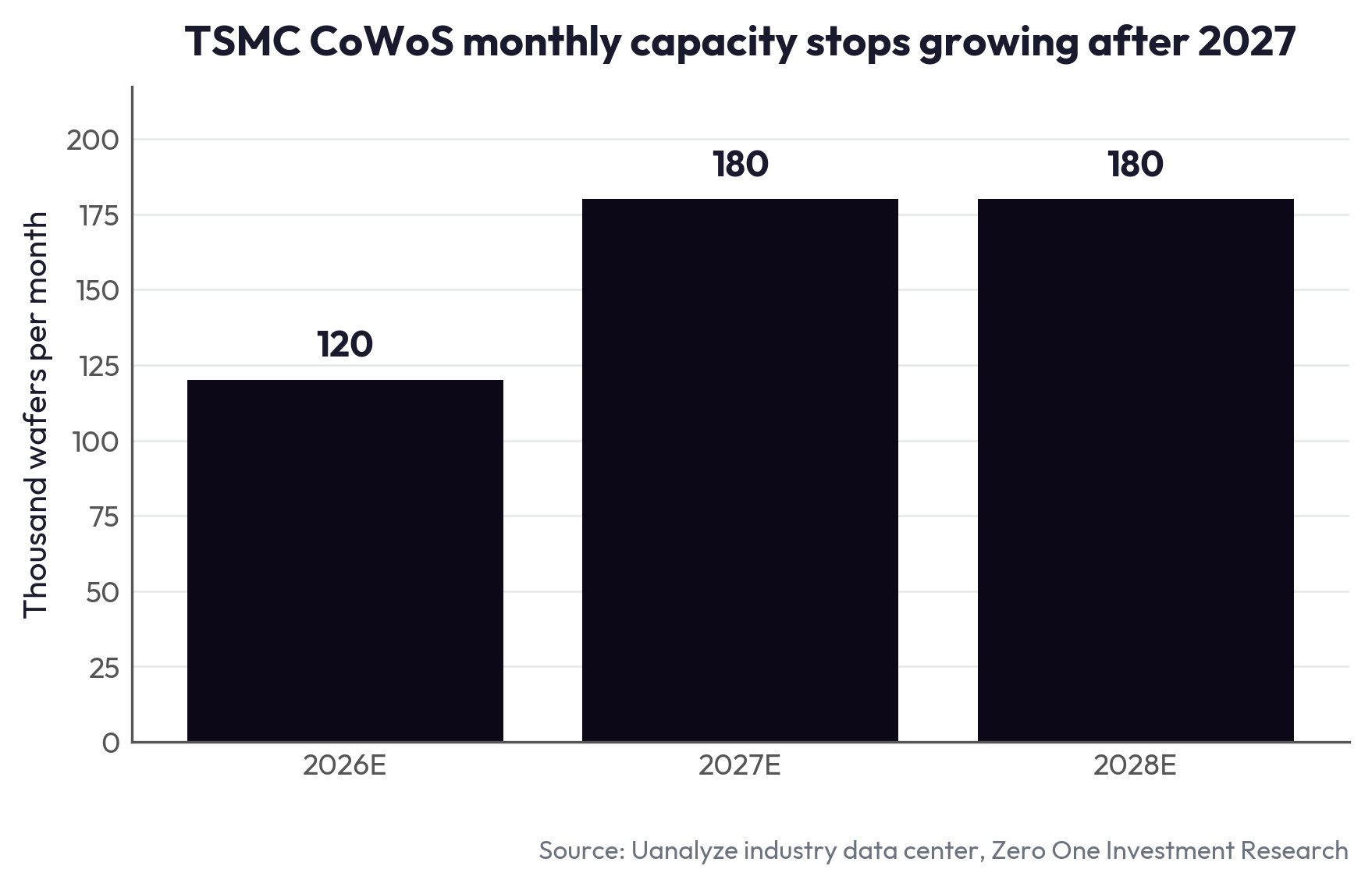
The argument about TSMC (2330 TT) advanced packaging has been about how many CoWoS wafers it can add. Institutional estimates compiled by Uanalyze now put end 2027 monthly capacity at about 180,000 wafers, raised from about 160,000, with 2028 held at the same 180,000. On those numbers the wafer count stops carrying growth after next year.
What keeps rising is what each wafer consumes. Large CoWoS-L packages are heading toward roughly 5.5 times reticle size, so a wafer supports fewer finished units even when chip demand grows as expected. Bigger packages also raise warpage, void, thermal and power integrity difficulty, which lengthens equipment handling time and lifts material use per package.
The same Uanalyze estimates run through to the equipment suppliers. TSMC CoWoS annual capacity is modeled to grow about 89% in 2026, and All Ring Tech (6187 TT), which holds close to 100% equipment share in CoWoS underfill dispensing and thermal interface material attach, is modeled to grow its CoWoS related revenue about 86% over the same period. A degassing equipment supplier with roughly 80% share (7734 TT) now has order visibility running into 2027, and its 2026 revenue growth estimate was raised to about 64% from above 40%.
Capacity is also spreading past TSMC. ASE advanced packaging capacity is estimated at about 30,000 wafers per month in 2026 and Amkor (AMKR US) at about 19,000, against TSMC's roughly 120,000. ASE 2026 equipment capital spending is estimated to rise about 44%, with FOCoS (fan-out chip-on-substrate) capacity up more than 300%. Suppliers that sell into both TSMC and the assembly and test houses collect from two capital spending cycles rather than one. SoIC runs the other way, with estimates for end 2027 and end 2028 cut to about 32,000 and 60,000 wafers per month from about 40,000 and 80,000, while CoPoS (chip-on-panel-on-substrate) is still in pilot and more likely to reach volume in 2029 to 2030.
Linked stocks: 2330 TT, 3711 TT, 6187 TT, AMKR US
NOR flash prices can double again
TrendForce says the NOR flash market is going through its most important supply and demand change in nearly a decade, and that contract prices for 256Mb and larger parts carry another 90% to 110% of increase in 2H26. Prices across the category already rose 100% to 120% cumulatively over the first half.
Demand is arriving from applications NOR flash did not serve at volume before. An AI server uses three to five times the NOR flash of a conventional server, because each retimer chip on the board needs its own NOR device to load microcode. Edge AI hardware, AI PCs and robots carry model firmware several times larger than before, pushing the same way toward high density and Octal SPI parts.
Supply cannot answer quickly. TrendForce notes that Taiwanese and Chinese suppliers are both expanding, but new capacity has to clear process shrink, yield ramp, product validation and customer design in before it counts as usable supply. Winbond (2344 TT) holds the largest share of the market and is set to add the most bit output of any major supplier this year, on a full ramp at 45nm and a migration toward 25nm and 20nm that lifts capacity per wafer without much additional wafer input.
The split within the category decides who collects. Low and mid density NOR is consolidating at a high level with fourth quarter increases of 10% to 20%, well short of the high density move, so the gains concentrate in suppliers weighted toward the parts AI servers and automotive systems actually buy.
Linked stocks: 2344 TT
Enterprises restrict frontier models over data retention
NVIDIA (NVDA US), Palantir (PLTR US) and Booz Allen Hamilton (BAH US) have each narrowed how Anthropic and OpenAI models may be used inside their businesses, according to reporting by The Information. The trigger was a June change to Anthropic's policy for its Fable model that allows the company to retain customer usage data for 30 days.
Anthropic says the retention exists to catch sophisticated and novel misuse. Several enterprise customers read the same clause as exposure of proprietary material. Palantir has asked for an irrevocable zero data retention guarantee before it will serve Anthropic models to its own customers. NVIDIA restricts Anthropic models to lower sensitivity work and relies on its internal Nemotron models for the rest. Booz Allen has barred staff from using Anthropic's commercial models on proprietary cybersecurity work.
Both vendors say they do not train on enterprise customer data by default, and that the usage metadata they collect is aggregated and anonymized. The dispute is over what that metadata covers. C Spire, a telecom operator whose contracts block training on its data, says those same contracts still permit collection of technical usage data, including which applications the models connect to. Northrop Grumman has gone further and runs open source models on its own air gapped servers.
Microsoft (MSFT US) is selling into the gap, pitching isolated cloud environments and its own models to customers that want tighter data control. For the chip and server chain, this means enterprise adoption of frontier models is being paced by contract language rather than by model capability or compute supply. What would settle it is a zero retention commitment written into the standard enterprise agreement instead of negotiated one customer at a time.
Linked stocks: NVDA US, PLTR US, MSFT US
Power chip price increases spread wider
Renesas Electronics (6723 JT) has told customers of another price increase, effective 1 January 2027, citing higher raw material, energy, advanced packaging, manufacturing capacity and global logistics costs. It lands as the latest step in a widening run of price increases across the sector.
Infineon (IFX GR) has raised prices twice this year. Texas Instruments (TXN US) began its fourth round since 2025 in July. China Resources Microelectronics, Silan and Hongwei have followed. Taiwanese suppliers including Panjit (2481 TT) and Deway (3675 TT) are reported to be weighing spot increases of roughly 10% to 15% from October, though neither has confirmed the range or which products it would cover.
Revenue is turning alongside the pricing. Deway posted August revenue above NT$300m for the first time, up 31.51% YoY and a monthly record, with the first eight months at NT$2.076bn and up 20.67%. Panjit reported August revenue of NT$1.376bn, up 29.81% YoY, with the first eight months at NT$10.201bn and up 18.1%.
What the increases are made of is the open question. Much of this round still passes through input costs rather than reflecting a broad recovery in end demand. Confirmation that power discretes have turned would be shipments, prices and gross margin rising together, with automotive, industrial and AI power demand continuing to recover, rather than price moving on its own.
Linked stocks: 2481 TT, 3675 TT, 6723 JT, IFX GR
Murata moves power under the chip
Murata Manufacturing (6981 JT) plans to begin volume production next year of an integrated package solution it calls iPaS, which builds capacitor and inductor functions into a multilayer power substrate instead of mounting those parts on the surface beside the chip. Murata is targeting annual revenue of ¥50bn within 18 months of the production start.
The engineering problem is current. As AI accelerator performance rises, chip power draw and supply current rise with it while core operating voltage stays low, so the final stretch of the power path carries steadily more current. Sitting the power module beside the accelerator and routing through the printed circuit board and package substrate costs resistance and voltage drop across that distance.
iPaS shortens the path by moving the power module directly beneath the chip, with vias carrying power vertically through the substrate. Murata showed samples in 2023 and a module built on iPaS at the 2024 Electronic Components and Technology Conference, where testing held voltage ripple close to a conventional design while cutting surface mounted capacitor count by more than 60%. The surface area that frees up can go to HBM (high-bandwidth memory) and other components.
Two things have to move with it. Thermal management gets harder once the power module sits under a high current device, and multilayer substrate materials, reliability and the routing of power against signal lines in a confined package all have to be solved before vertical power delivery goes wide. The demand behind the effort shows in the order book, with Murata capacitor orders up 85.5% YoY to ¥415.5bn in the April to June quarter, and the company now weighing a larger expansion on top of the ¥80bn of MLCC (multilayer ceramic capacitor) equipment spending already committed through the fiscal year ending March 2028.
Linked stocks: 6981 JT, 2327 TT, NVDA US
Toshiba sells down as Kioxia eyes New York
Kioxia (285A JT) is considering a US listing through American depositary receipts that would raise at least US$10bn, according to Bloomberg, with Bank of America, Goldman Sachs and JPMorgan in discussion and a possible timetable of next year. Reuters said it could not independently verify the report.
The listing would do two things beyond raising cash. It would add US market liquidity for a company whose tradable float has been thin since its December 2024 initial public offering, and an ADR line could make Kioxia eligible for semiconductor sector indices, which brings buying that a Tokyo only listing does not reach.
Its largest shareholder is moving the other way. Toshiba (6502 JT) filed with the Kanto Local Finance Bureau on 14 September that its Kioxia holding had fallen to 12.84% as of 7 September from 14.06% on 3 August, sold across seven market transactions between 4 August and 7 September. Toshiba held more than 30% at the time of the IPO and has been selling steadily since 2025.
Both moves point at the same thing, which is that Kioxia's shareholder register is being rebuilt while NAND pricing is strong. Whether the ADR plan survives a turn in NAND pricing is the part still open, and the report describes the plan as preliminary, with the size of the sale and the bank list both subject to change.
Linked stocks: 285A JT, 6502 JT, MU US
先聲 First Word: Exclusives from Chinese-Language Sources
Hanmi Test Systems draws NT$865.6bn in subscriptions
Hanmi Test Systems, an emerging board listed wafer test supplier, drew 384,717 public subscription entries against 1,048 lots on offer, an allocation rate of 0.27%, freezing about NT$865.6bn at the NT$2,250 subscription price. Its August revenue reached NT$503m, up 114.78% YoY, on high end probe cards for AI chips, CoWoS equipment and silicon photonics test. (15 Sep 2026) Source: 漢測公開申購凍資8,656億 申購38.4萬筆中籤率0.27%
SPIL nears a decision on an Arizona plant
SPIL, the packaging and test unit of ASE Technology, is reported to be finalizing plans for a plant in Arizona that would offer back end test services, and ASE declined to comment on the report. ASE raised 2026 capital spending by US$2bn to US$10.5bn, and SPIL broke ground in mid August on a Douliu plant planned for CoWoS. (15 Sep 2026) Source: 矽品傳亞利桑那州布局將定案,台廠在美先進封測受矚
Episil lifts 8 inch epitaxy share to 70%
Episil Technologies (3016 TT) raised the 8 inch share of its epitaxy mix to 70% from 55% and posted August revenue up 57.79% YoY, as NVIDIA's 800V high voltage direct current rack architecture pulls in silicon carbide devices rated for higher voltage. It shows how quickly the data center power change is reaching Taiwan's compound semiconductor suppliers. (14 Sep 2026) Source: 受惠漲價、8吋磊晶需求強勁 嘉晶逆勢上揚日K連3紅

© 2026 Zero One Investment Research Pte Ltd. For informational purposes only. Not investment advice.