
Micron's customers post US$32bn of commitments as phone makers cut memory demand
Zero One Investment Research Daily Intelligence Brief, October 1, 2026
Micron's customers post US$32bn of commitments as phone makers cut memory demand
Top Market Signals
Micron's customers post US$32bn to secure supply
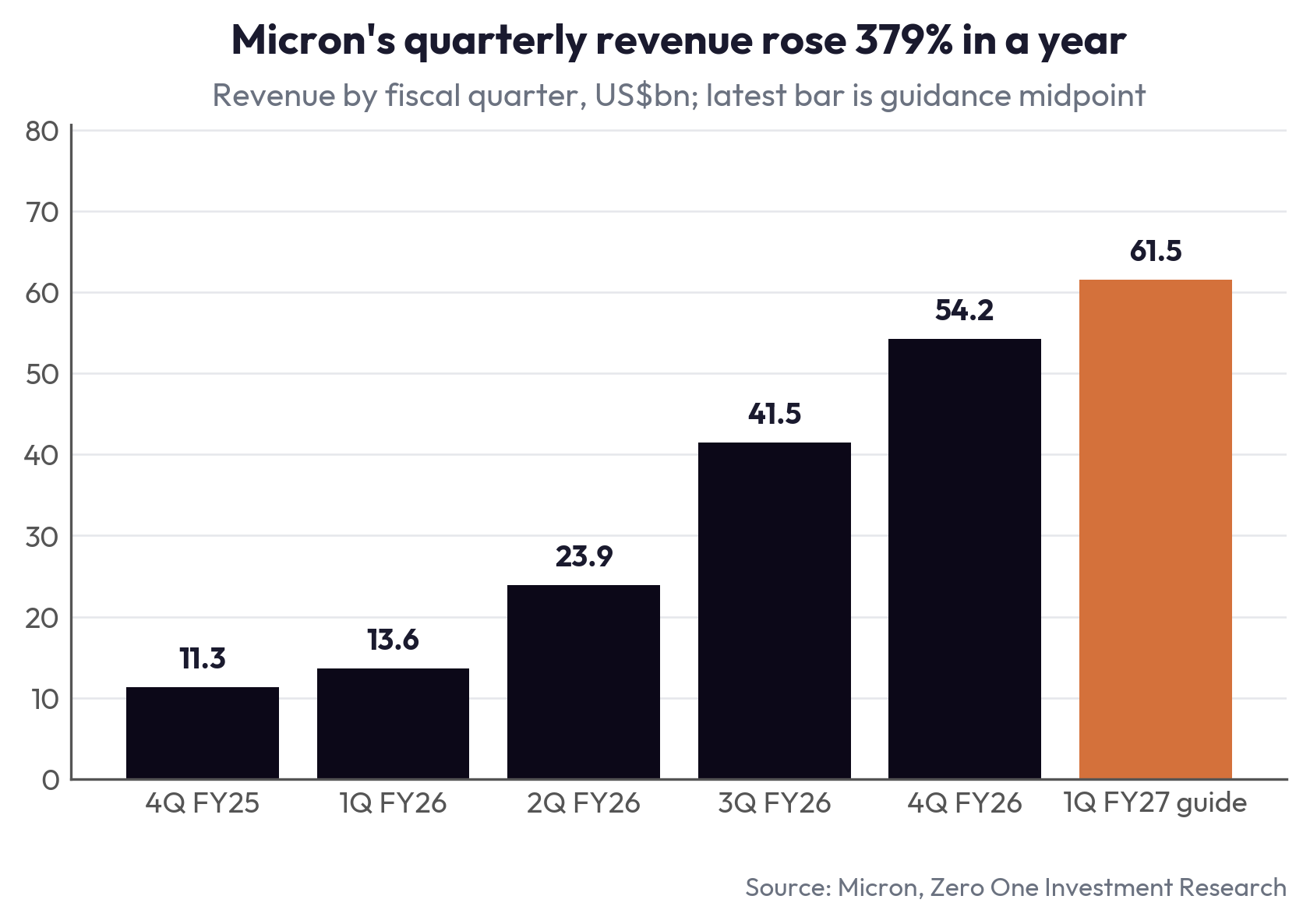
Micron (MU US) said customers have made US$32bn of financial commitments to secure memory supply, the vast majority of it cash deposits, alongside fiscal 4Q26 revenue of US$54.2bn, up 379% YoY and 31% QoQ. It has signed 26 long-term supply agreements that it estimates cover more than 35% of revenue through 2030.
More than 75% of fiscal 2027 output is already committed, and Micron has agreed the vast majority of its calendar 2027 HBM (high-bandwidth memory, the stacked DRAM placed beside AI processors) bit supply at significantly higher prices than this year. Management said supply and demand will be much tighter in fiscal 2027 and 2028 than in 2026, and that it has no line of sight to when they return to balance. One risk sits over that HBM lock: Netlist filed a US International Trade Commission complaint alleging Micron's HBM infringes two of its patents, the case in today's Top Movers.
It guided fiscal 1Q27 revenue to US$61.5bn, plus or minus US$1.5bn, and GAAP gross margin to about 86%, just below the 86.8% it reported. The dip comes from roughly US$1bn of higher costs, including incentive pay absorbed into inventory, and management guided the quarter as the low point for gross margin in fiscal 2027. Bloomberg's coverage led with the narrower margin rather than the forecast, and the shares slipped 0.78% after hours.
Capex is rising with the commitments. Micron expects about US$25bn in 1H FY27, close to the US$27.4bn it spent in all of fiscal 2026, with more in the second half. Our 30 Sep 2026 Blade covered Samsung Electro-Mechanics funding a substrate expansion partly with reported NVIDIA advance payments; Micron's deposits show the same customer financing at memory scale.
Linked stocks: MU US, 000660 KS, 005930 KS, 2408 TT
Phone makers cut memory demand 30% to 40%
Phison (8299 TT) chief executive Pua Khein-Seng said on 30 Sep that smartphone customers have already cut their memory demand by 30% to 40% and may cut 2027 further, while some PC makers expect 2027 demand and shipments to fall 25%, Commercial Times reported.
Pua said new DRAM and NAND capacity still cannot keep up with AI demand and the imbalance could last years, even if the market expects some relief in 2028. New fabs need land, power, water, tools and process technology before they add output, and he said memory makers' gross margins above 80% give them a strong incentive to build. The shortage also reaches wafers, substrates, packaging and capacitors.
On 26 Sep 2026 our Blade reported Acer's chief executive saying only high-end parts were short and that PC prices would fall after 1H27. Pua addressed that debate directly, saying the whole industry is affected by tight DRAM supply. The two readings would converge if device makers' cuts free enough memory for AI buyers; a further round of phone cuts in 2027 would show they have not.
Linked stocks: 8299 TT, 2353 TT, 2408 TT, MU US
HBM orders cut Samsung's foundry loss by 41%
Samsung Electronics' (005930 KS) non-memory businesses, its foundry and System LSI chip design units, are expected to lose KRW3.92tn in 2026, down about 41% from KRW6.74tn in 2025, according to Kiwoom Securities and Digital Daily estimates carried by TechNews. HBM, more than 2nm orders, is the main reason.
Each HBM stack sits on a base die, a logic chip that must be made on a logic process, and Samsung makes its own on its 4nm line. As HBM shipments rise, memory sales turn into foundry revenue and lift utilization of Samsung's 8nm and more advanced lines. The estimates have the quarterly loss narrowing to KRW777bn in 3Q26, from more than KRW2tn at its worst.
Our 30 Sep 2026 Blade carried Samsung's forecast that HBM will take nearly 30% of DRAM wafer capacity in 2027, up from about 20%. That shift also sends more base-die wafers to its foundry. Whether the foundry reaches profit depends on outside customers and advanced-node orders, which the estimates do not yet show turning it around.
Linked stocks: 005930 KS, 000660 KS, 2330 TT
Unimicron buys a tire plant for substrates
Unimicron (3037 TT), a Taiwan maker of IC substrates and circuit boards, paid NT$10.09bn at auction on 30 Sep for Bridgestone Taiwan's Hukou site in Hsinchu, about 19,100 ping of land and 17,600 ping of buildings (one ping is 3.3 square meters). Unimicron said the site serves its medium to long term plans and high-end substrate capacity expansion.
The deal pushed Taiwan's 3Q26 commercial property transactions past NT$100bn, a record for a single quarter, Economic Daily News reported. JLL's Taiwan managing director said technology suppliers are buying finished factories they can refit and run quickly, because sites with the right power, zoning and clean soil are scarce.
Substrates are the boards that high-end chip packages sit on, and makers in Taiwan and Korea are adding capacity. Our 30 Sep 2026 Blade covered Samsung Electro-Mechanics investing KRW6.78tn in ABF substrate capacity. Buying a standing plant lets Unimicron skip land acquisition; how quickly it installs substrate lines there will set when the capacity counts.
Linked stocks: 3037 TT, 8046 TT, 3189 TT, 009150 KS
AMD's Helios rack wins its first HPE order
Hewlett Packard Enterprise (HPE US) has taken a US$1.2bn order from Vultr, a cloud computing provider, for AMD's (AMD US) Helios AI rack, its first order for the system. The racks go into Vultr's US data centers.
Each Helios rack carries 72 AMD Instinct MI455X GPUs, AMD EPYC Venice CPUs and Pensando Vulcano network cards, linked by six HPE Juniper switch trays over standard Ethernet with support for UALink, an open alternative to NVIDIA's NVLink connection between GPUs. HPE did not disclose the rack count or delivery schedule, so the order cannot yet be converted into a number of GPUs.
An order placed through HPE gives AMD an established server vendor to sell Helios to cloud providers. The next test is whether larger cloud providers place Helios orders of their own.
Linked stocks: AMD US, HPE US, NVDA US
DeepSeek open-sources coding tools for Huawei chips
DeepSeek has released free, open-source software it built with Huawei to program Huawei's Ascend AI accelerators, including TileLang, a programming language tuned for the Ascend 950, according to Bloomberg reporting carried by The Star. TileLang is positioned as China's alternative to CUDA, the NVIDIA (NVDA US) software platform most AI developers write for.
DeepSeek plans to deploy at least 160,000 Huawei accelerators in a data center in Inner Mongolia. It is valued at close to RMB500bn (US$74bn) and is preparing a public listing.
Our 26 Sep 2026 Blade noted that Huawei's Ascend output cannot yet meet China's own demand. Software has been the other barrier, since models written for CUDA must be rewritten to run well on other chips. Tools from a leading Chinese model developer lower that barrier; Huawei's chip supply still sets how fast Chinese buyers can move off NVIDIA.
Linked stocks: NVDA US, 981 HK, 688256 CH
先聲 First Word: Exclusives from Chinese-Language Sources
Powerchip in talks to license imec silicon photonics
Powerchip Semiconductor Manufacturing (6770 TT) is negotiating an optical communications technology license from imec, the Belgian chip research institute, supply chain sources told Economic Daily News; Powerchip declined to comment. A license would give the foundry a proven 12-inch silicon photonics platform for AI data center links instead of developing one alone. (30 Sep 2026) Source: 力積電強攻矽光子
ASE buys a Lumileds plant in Singapore
ASE Technology (3711 TT) will pay about US$68.44m (NT$2.15bn) through its Singapore subsidiary for a factory in Yishun industrial park from Lumileds, the Dutch LED maker, to expand capacity. It follows ASE's NT$5.67bn purchase of a plant in Chungli, Taiwan announced on 30 Jul, as the packager buys ready-built sites for AI packaging and test. (30 Sep 2026) Source: 日月光斥資21.52億元購新加坡廠房 擴大星馬AI先進封測
Four glass makers settle on one substrate size
Corning, AGC, Nippon Electric Glass and Schott have all chosen 510mm by 515mm for their glass core substrates, DigiTimes reported. A shared panel size lets packaging lines and equipment be built once for all four suppliers, and DigiTimes asks whether it points to the specification of TSMC's next-generation glass substrate. (30 Sep 2026) Source: 四大玻璃廠齊攻同一尺寸 台積電下一代玻璃基板規格呼之欲出?

© 2026 Zero One Investment Research Pte Ltd. For informational purposes only. Not investment advice.