
Amazon buys into its Taiwan board maker as Anthropic lists US$518bn of compute obligations
Zero One Investment Research Daily Intelligence Brief, September 30, 2026
Amazon buys into its Taiwan board maker as Anthropic lists US$518bn of compute obligations
Top Market Signals
Amazon buys a stake in Gold Circuit
Amazon (AMZN US) will buy 1,856,308 new shares of Gold Circuit Electronics (2368 TT), a Taiwan maker of circuit boards for AI servers and network switches, in a NT$1.59bn private placement at NT$856 a share, Gold Circuit disclosed on 29 September. The shares cannot be freely sold for three years.
Gold Circuit already supplies boards for Amazon Web Services' Trainium AI servers, and Trainium 3 is due in mass production in 3Q26, cnYES reported. It is rare for a large cloud provider to invest directly in a Taiwan board maker, DigiTimes said. The price is 80% of the NT$1,070 reference price and 23.6% below Gold Circuit's 29 September close of NT$1,120.
On the same day Gold Circuit's board approved NT$7.9bn for a new plant, NT$3.8bn for land and NT$4.1bn for buildings and equipment, to be spent from 4Q26 and funded with unsecured convertible bonds. The placement money goes to working capital.
Our 24 September edition reported that Gold Circuit had won a large cloud provider's AI chip main board project, with boards of more than 30 layers shipping from 4Q26. Gold Circuit did not name that customer, and it has not said whether Amazon's stake comes with capacity commitments at the new plant.
Linked stocks: 2368 TT, AMZN US, 8046 TT
Anthropic's filing lists US$518bn of compute obligations
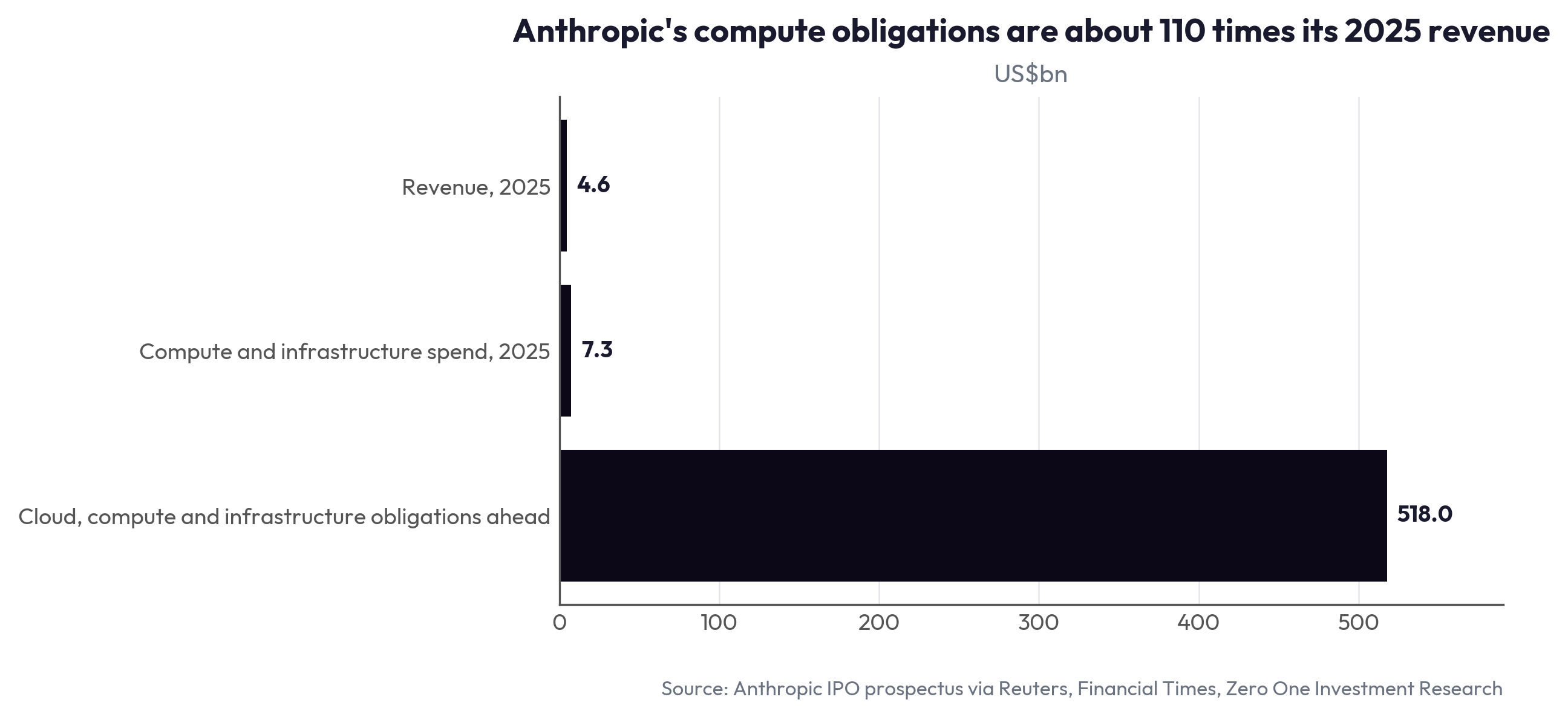
Anthropic plans to take on US$518bn of cloud, computing and infrastructure obligations over the next several years, according to its IPO prospectus as reported by Reuters and the Financial Times. Its 2025 revenue was about US$4.6bn, up about 12 times, and it spent US$7.33bn on computing and infrastructure that year.
That compute spending tripled from 2024 and made up more than half of 2025 operating expenses of US$12.65bn, leaving an operating loss of more than US$8bn. Amazon (AMZN US) and Google (GOOGL US), its two earliest strategic partners, have invested billions in Anthropic and provide the cloud infrastructure to train and run its Claude models.
The obligations run for years; much of the revenue does not. Nearly a quarter of 2025 revenue came from two customers, and many of its largest customers have no long-term contracts and could cut or stop spending, the prospectus says. OpenAI carries the same gap: its chief financial officer, Sarah Friar, warned colleagues that slower revenue growth could strain its future compute contracts, Commercial Times reported, as OpenAI seeks at least US$30bn at a pre-money valuation of about US$1.4tn.
Our 29 September edition carried NVIDIA's figure of more than US$180bn of Anthropic cloud contracts through 2028; the prospectus total is almost three times that. Reuters has reported the listing could come after the US midterm elections in November, which would be the first time public market investors fund these commitments directly.
Linked stocks: AMZN US, GOOGL US, NVDA US
Samsung Electro-Mechanics expands substrates, reportedly on NVIDIA prepayments
Samsung Electro-Mechanics (009150 KS) will invest KRW6.78tn (about US$5bn) in South Korea and Vietnam to expand ABF substrates, the resin-film boards that high-end chip packages sit on, for AI servers and high-performance computing, DigiTimes reported. Part of the money reportedly comes from advance payments by NVIDIA (NVDA US) and other technology companies.
Samsung Electro-Mechanics already supplies substrates for NVIDIA's NVSwitch chips and for Groq 3, DigiTimes said, and Korean outlet KED called it the company's largest substrate investment. The added capacity competes with Taiwan's ABF makers Unimicron (3037 TT), Nan Ya PCB (8046 TT) and Kinsus (3189 TT).
Our 25 September edition reported NVIDIA asking substrate makers in Korea, Japan and Taiwan to finish developing glass substrates within two years. The prepayments go into ABF, the material in use today. Taiwan panel makers AUO and Innolux are working on glass substrate processing, Commercial Times reported, but companies in the field say manufacturing yield and customer qualification still stand between them and volume production.
Linked stocks: 009150 KS, NVDA US, 3037 TT, 8046 TT
HBM nears 30% of DRAM capacity in 2027
Samsung Electronics (005930 KS) expects HBM (high-bandwidth memory, the stacked DRAM placed beside AI processors) to take nearly 30% of the memory industry's DRAM wafer capacity in 2027, up from about 20% now, Reuters and DigiTimes reported on 29 September.
A 10-point shift of wafer capacity toward HBM comes out of the conventional DRAM used in servers, PCs and phones unless new fabs arrive first. DigiTimes tied the forecast to Samsung speeding up new capacity as supply of both HBM and conventional DRAM tightens. Our 29 September edition reported Samsung moving tool installation at its P5 fab, mainly for DRAM and HBM, two months earlier to May 2027.
Buyers of conventional memory are feeling it through price. Qualcomm's (QCOM US) head of computing and gaming, Kedar Kondap, said at Snapdragon Summit that component shortages for PCs are manageable and the bigger problem is how sharply prices are swinging, DigiTimes reported. Micron's (MU US) fiscal 4Q26 results on 30 September are the next disclosure on conventional DRAM pricing.
Linked stocks: 005930 KS, 000660 KS, MU US, 2408 TT
NVIDIA wants insurers to cover loans backed by GPUs
NVIDIA (NVDA US) is in talks with insurers to take on part of the risk in loans secured by its AI chips, the Financial Times reported, as carried by TechNews. The aim is to help neoclouds (smaller companies that rent out GPU capacity), whose balance sheets are weaker than the large technology companies', buy more NVIDIA chips. The talks are early and may not produce a deal.
One idea is insurance on neocloud loans: if a borrower defaults and the pledged chips resell for less than the loan, the insurer covers part of the loss. NVIDIA has given at least one insurer data on chip depreciation and future computing prices, and is studying passing some risk on to hedge funds.
The resale value of a used GPU is what the insurers would be pricing. Barkr AI, a valuation firm, estimates that an eight-GPU H100 system NVIDIA launched in 2022 is worth about US$320,000 today, roughly its original value. If computing supply catches up with demand, it estimates a system keeps about two thirds of its value after a year of use and falls to about US$30,000 after six years.
Our 29 September edition reported that the two largest named Anthropic cloud contracts sit with neoclouds, US$45bn with Nscale and US$35bn with Lambda, the kind of provider this insurance is meant to support.
Linked stocks: NVDA US, CRWV US, HUT US
Samsung's 2nm yield nears 60%
Samsung Electronics' (005930 KS) 2nm (SF2) yield has reportedly risen to near 60%, from the mid-50s the market had estimated, Economic Daily News reported. Samsung said on 29 September that its foundry customer count could reach four times its 2017 level by 2029; 2017 is when the foundry became a separate division.
With yield steadier, Samsung is moving engineering resources to proving power and performance with prospective customers, DigiTimes reported, and aims to lift AI and high-performance computing toward 66% of foundry revenue as its Taylor, Texas fab ramps. Samsung and its affiliates also committed US$1bn to Helix, an AI infrastructure company backed by NVIDIA and KKR.
Our 25 September edition reported Qualcomm (QCOM US) kept both of its new 2nm flagship phone chips at TSMC (2330 TT) even as Samsung ramped its second-generation 2nm process. A named large customer order would show whether a yield near 60% is enough to win one.
Linked stocks: 005930 KS, 2330 TT, QCOM US
先聲 First Word: Exclusives from Chinese-Language Sources
TSMC hands a fifth of one packaging step to Xintec
Xintec (3374 TT), a TSMC affiliate, will take orders equal to about 20% of TSMC's capacity for the on-substrate step of its advanced packaging, and its related capacity is set to rise 2.5 times next year, Economic Daily News reported, citing supply chain sources. TSMC used to send Xintec work only when its own lines were full; the outsourcing now grows with packaging demand. (30 Sep 2026) Source: 精材營運大進補
Topoint plans to double drill bit output by 2028
Topoint Technology (8021 TT), which makes the drill bits that cut holes in circuit boards, plans capacity of 45m bits a month by end-2026, 70m by end-2027 and 90m in 2028, and priced share and convertible bond issues worth over NT$2.1bn on 29 September, cnYES reported. August revenue rose 97.75% YoY to a record NT$771m on AI server demand. (29 Sep 2026) Source: 尖點擴產急發行CB及現增案籌資案今完成訂價估將籌資逾21億元
Holy Stone's August profit rises 285% on AI server capacitors
Holy Stone Enterprise (3026 TT), a Taiwan capacitor maker, reported August net profit up 285% YoY on revenue up 33.2%, as AI server power supplies need larger high-voltage MLCCs (multilayer ceramic capacitors), Economic Daily News reported. AI products were 25% to 30% of its passive component sales in 1H26, it targets 40% by year end, and it is adding capacity in Taiwan and Japan. (29 Sep 2026) Source: 禾伸堂8月每股純益1.33元 喊擴產

© 2026 Zero One Investment Research Pte Ltd. For informational purposes only. Not investment advice.