
Broadcom follows NVIDIA by lending Anthropic up to US$42bn for its chips
Zero One Investment Research Daily Intelligence Brief, October 2, 2026
Broadcom follows NVIDIA by lending Anthropic up to US$42bn for its chips
Top Market Signals
Broadcom will lend Anthropic up to US$42bn
Broadcom (AVGO US) has agreed to provide Anthropic with up to US$42bn of financing for AI infrastructure, according to Anthropic's IPO filing as reported by Reuters and carried by Central News Agency. The filing says Anthropic is on track to become the largest customer of Broadcom's core chip design business next year.
Broadcom now supplies Anthropic's compute, leases it equipment and lends it money. That is a different role from Amazon (AMZN US), which mainly provides Anthropic with cloud infrastructure and distribution. Anthropic itself disclosed that Broadcom's position as both hardware supplier and lender creates a potential conflict of interest that could limit how it sources compute.
The size of the facility makes sense against Broadcom's own forecasts. Broadcom expects AI semiconductor revenue of about US$115bn in fiscal 2027 and US$230bn in fiscal 2028, and the filing expects Anthropic to be its largest compute customer in 2027. Up to US$42bn of lending is equal to roughly a third of that fiscal 2027 revenue figure.
Our 30 Sep 2026 Blade reported NVIDIA (NVDA US) in early talks with insurers to take on part of the risk in loans secured by its AI chips, so that neoclouds (smaller companies that rent out GPU capacity) can buy more of them. Reuters noted that Broadcom's facility follows the approach NVIDIA has taken in recent years, using its financial strength to drive chip sales, here for a single customer. Robert Leitao, a managing partner at Rothschild & Co, described the situation as a concentrated bet that the two companies can generate enough revenue to support the whole financing structure. That depends on Anthropic's revenue, about US$4.6bn in 2025, growing into the US$518bn of compute obligations its filing lists.
Linked stocks: AVGO US, NVDA US, AMZN US
Micron's 2027 HBM is mostly sold, at higher prices
Micron (MU US) has signed long-term agreements covering most of its 2027 HBM (high-bandwidth memory, the stacked DRAM that sits beside AI processors) capacity, at contract prices above 2026's, Micron Taiwan chairman Lu Donghui said on 1 Oct. Some customers have signed three to five year contracts, a few running to 2030 or 2031.
Taiwan carries most of the new HBM work. Micron's second advanced packaging fab in Taichung, converted from an existing building because the first ran out of space, opens in mid-October to support HBM expansion. Powerchip (6770 TT) will take on HBM back-end wafer processing for Micron at its Hsinchu site, with trial runs in 4Q26 and volume production in 4Q27 at about 20,000 wafers a month. Powerchip says about 70% of the equipment overlaps with its existing wafer-stacking line, so it does not have to build the line from scratch.
Micron's cumulative investment in Taiwan passed NT$1.6tn (about US$52bn) by June, about half of it in the last four years. At Tongluo, the fab it bought from Powerchip in February, more than 100 tools have moved in and production is targeted for 1Q28. In Taoyuan, Fab 11E is being built for EUV (extreme ultraviolet lithography) tools and is due online around end 2027 to early 2028.
Our 1 Oct 2026 Blade reported US$32bn of customer commitments to secure Micron supply. The new information is price: 2027 HBM is contracted above this year's level. Micron has also guided gross margin down slightly to 86.25% this quarter on higher pay and incentive costs, and says this quarter will be the low point for the fiscal year.
Linked stocks: MU US, 6770 TT, 000660 KS
Nanya builds a stacking plant for custom DRAM
Nanya Technology (2408 TT) won approval on 1 Oct from the Science Park Review Committee of Taiwan's National Science and Technology Council to build a 3D wafer packaging and test plant in the Pingtung area of the Southern Taiwan Science Park. The plant will use through-silicon vias (vertical wiring through the chip) and wafer stacking to make high-capacity, high-bandwidth, low-power memory, the council said.
DigiTimes reported that Nanya decided to add the plant because some customers of its custom DRAM have moved designs into pilot production and its existing packaging and test lines are full. Nanya did not disclose the investment amount.
DigiTimes frames the plant as Nanya's move into HBM-like products, since stacked custom DRAM uses the same kind of 3D processing as HBM. It lands alongside Micron's HBM packaging expansion in Taichung and Winbond's (2344 TT) expansion in Kaohsiung. Economic Daily News cited industry estimates that further investment in Taiwan by the three memory makers could approach NT$200bn.
Linked stocks: 2408 TT, 2344 TT, MU US
Samsung lifts Galaxy S26 prices up to 13%
Samsung Electronics (005930 KS) raised Taiwan prices across its Galaxy S26 range and several Galaxy A models on 1 Oct because of rising memory costs, TechNews reported. The top Galaxy S26 Ultra (16GB memory, 1TB storage) went from NT$59,900 to NT$67,900, up 13%, the first range-wide S26 price change since launch.
The mid-range is moving faster. The Galaxy A57 5G with 12GB and 512GB rose to NT$26,990 in October after rising to NT$23,990 in September, up 20% in two months from NT$22,490. The entry Galaxy A17 5G rose NT$1,000 to NT$11,490.
Our 1 Oct 2026 Blade reported Phison (8299 TT) saying smartphone customers have cut memory demand by 30% to 40%. Samsung's price list is the other response to the same cost: charging more for the memory that stays in the phone. DigiTimes reported that Samsung's mobile unit is expected to post another operating loss in 3Q26, of more than KRW1tn, as memory costs rise. Samsung Taiwan describes the local phone market as falling volume with rising prices, so the test is whether unit sales hold through the fourth-quarter selling season.
Linked stocks: 005930 KS, 8299 TT, 000660 KS
Tencent rents 100,000 AI chips through Oracle
Oracle (ORCL US) has signed a five-year overseas AI compute rental agreement with Tencent (700 HK) worth up to US$7bn, the Financial Times reported, as carried by Economic Daily News. Tencent will use the compute of 100,000 AI chips in Oracle data centers in Southeast Asia, and has paid about 30% upfront as a deposit.
US rules restrict Chinese companies from buying advanced AI chips, so renting from overseas cloud providers is the fastest way for Chinese cloud companies to add compute beyond their own in-house chips. Tencent's 2Q26 capex rose 176% YoY to about US$7.9bn, mainly for AI infrastructure and prepaid compute.
For Oracle, the deposit arrives while its free cash flow was negative US$5.4bn last quarter, after it signed a five-year compute contract with OpenAI worth US$300bn. The Taiwan server assemblers building for Oracle include Foxconn (2317 TT), MiTAC (3706 TT), Quanta (2382 TT) and Wiwynn. Quanta has been producing Vera Rubin servers since the second half and expects the current quarter to be its peak of the year.
Linked stocks: ORCL US, 700 HK, 2382 TT, 2317 TT
Chips are now half of Korea's exports
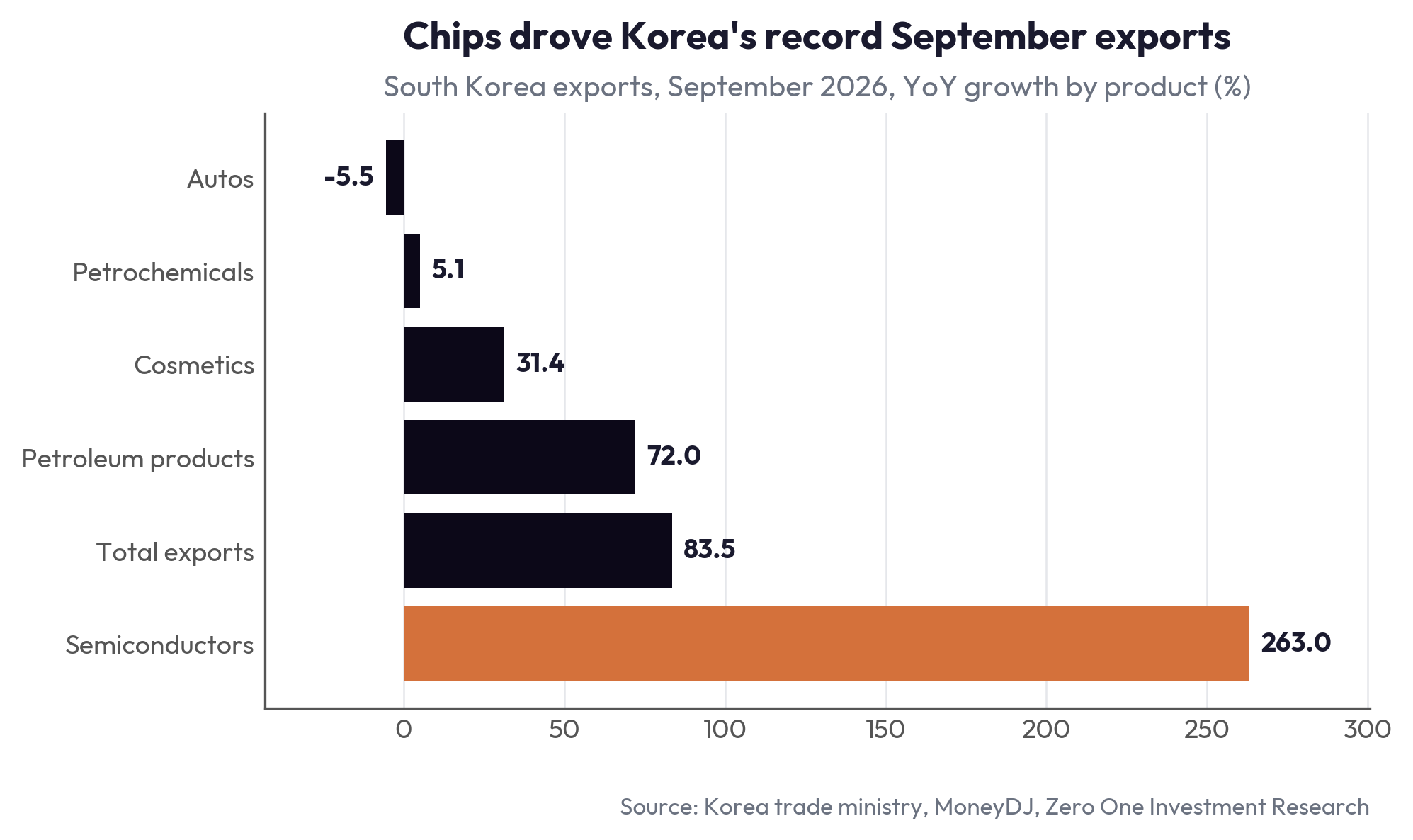
South Korea's semiconductor exports rose 263% YoY to US$60.3bn in September, the first month above US$60bn, the trade ministry said on 1 Oct, as carried by TechNews from MoneyDJ. Total exports rose 83.5% to a record US$120.9bn, so chips made up half of the total.
The ministry attributed the chip growth to rising memory demand, higher prices and higher shipments, without splitting price from volume. No other product line came close: petroleum products rose 72% to US$7.22bn, cosmetics 31.4%, petrochemicals 5.1%, while autos fell 5.5% to US$6.05bn on fewer working days over the Chuseok holiday.
Exports to China rose 123% to US$26.0bn, led by chips and wireless equipment, and exports to the US rose 137% to US$24.33bn. January to September exports passed US$800bn, already above Korea's previous full-year record of US$709.3bn. The chip total is a value figure; Samsung's and SK Hynix's 3Q26 results will show how much of the 263% came from price.
Linked stocks: 005930 KS, 000660 KS, MU US
先聲 First Word: Exclusives from Chinese-Language Sources
Kinsus raises its capex budget for the second time this year
Kinsus Interconnect (3189 TT) has added project capex twice this year to expand high-end ABF substrate capacity, and its August net profit rose 354% YoY to NT$817m. Kinsus became the third Taiwan substrate maker trading above NT$1,000 a share as ABF prices keep rising and its lines run full. (02 Oct 2026) Source: 熱門股》獲利噴發 景碩首登千金股
Pegatron starts shipping AI racks to a US customer
Pegatron (4938 TT) said new full-rack AI server orders from a US customer have started shipping and will show up in September revenue, and AI servers could reach 10% of revenue this year. Its co-chief executive also said Taiwan's own capital is no longer enough and the company needs to borrow overseas. (02 Oct 2026) Source: 和碩攻AI伺服器 報捷
Chenming begins shipping racks for NVIDIA's VR200
Chenming Electronic Tech (3013 TT) has started shipping racks and chassis for NVIDIA's VR200 servers with at least a quarter of order visibility, and full-system assembly made up 18% of revenue in the first eight months. It plans to grow that higher-margin assembly work next year as its Thailand plant adds capacity. (02 Oct 2026) Source: 晟銘電接單旺 營運衝

© 2026 Zero One Investment Research Pte Ltd. For informational purposes only. Not investment advice.