
Memory customers are now negotiating supply contracts for 2029 and 2030
Zero One Investment Research Daily Intelligence Brief, September 16, 2026
Memory customers are now negotiating supply contracts for 2029 and 2030
Top Market Signals
Memory buyers are negotiating into 2030
Winbond Electronics (2344 TT) president Chen Pei-ming said customers have begun negotiating long-term supply running out to 2029 and 2030, a booking horizon that commodity memory buyers have not reached for in recent cycles. He also said he expects 2027 memory supply and demand to be tighter than 2026.
A Bloomberg Intelligence analysis published this week puts the same view in supply terms. As long as the large cloud operators keep adding AI infrastructure, DRAM supply and demand stays tight at least through 2027 and possibly out to 2029 or 2030.
The mechanism is displacement rather than demand alone. Samsung, SK Hynix and Micron are steering resources toward high-bandwidth memory (HBM, the stacked DRAM used beside AI accelerators), and HBM needs roughly three to four times the silicon wafers to deliver the same memory capacity as conventional DRAM. Every increment of HBM output therefore removes more standard DRAM supply than it adds.
On current expansion plans Bloomberg estimates supply catches up with demand in 2028 at the earliest, and later if new fabs run behind schedule. Industry figures cited in the report expect Google, Amazon, Microsoft, Meta, SpaceX and Oracle to keep raising capital spending into 2027, which lifts server DDR5 and high-capacity DRAM alongside HBM.
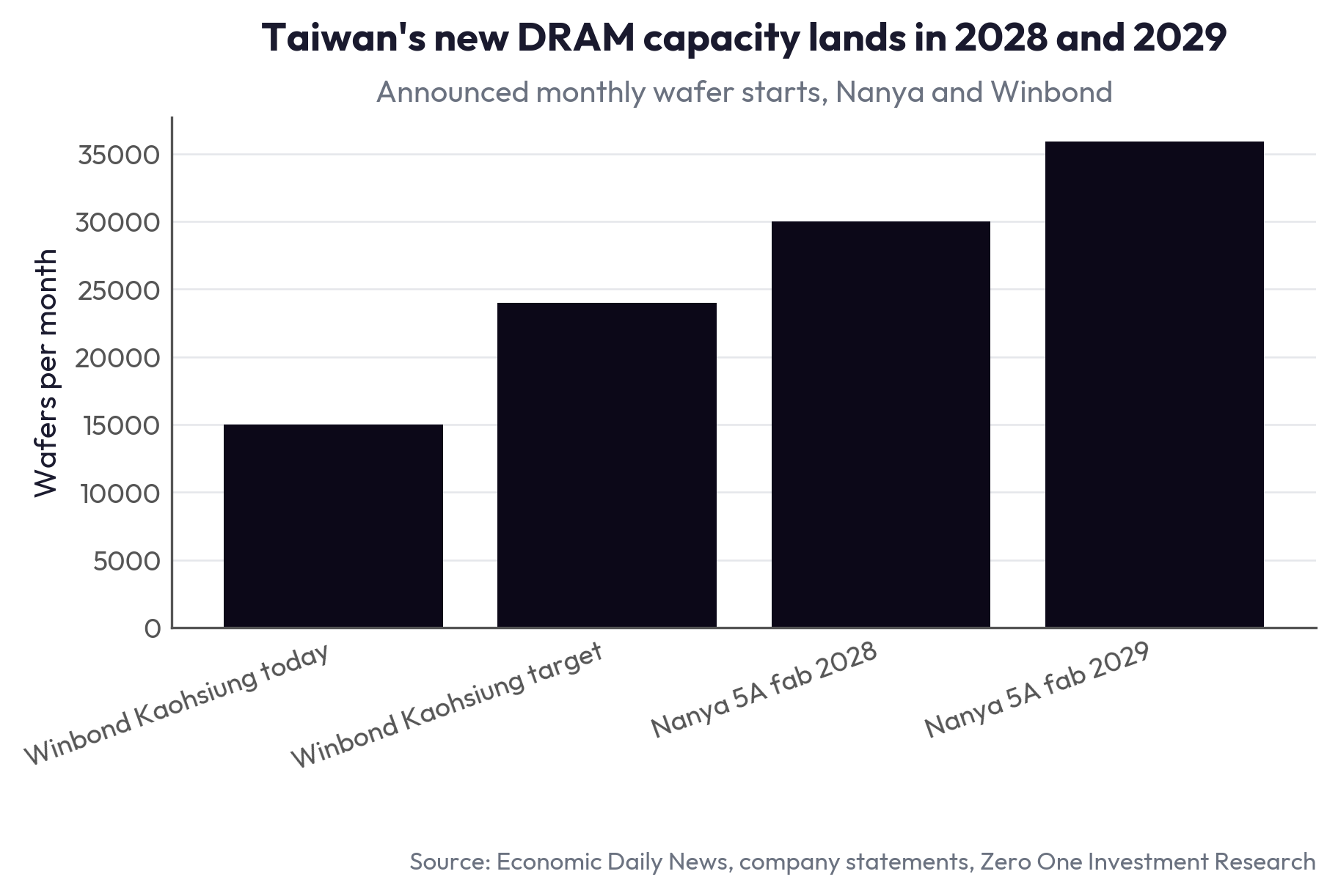
Taiwan's two DRAM makers are building into that gap. Nanya Technology (2408 TT) said DDR5, LPDDR5, DDR4, LPDDR4 and DDR3 are all in short supply, and that DRAM average selling prices rose more than 70% QoQ in 1Q26. Nanya has raised the capital spending ceiling on its expanded 5A fab to NT$346.6bn across 2026 to 2029, with wafer starts from 2H27, monthly capacity of 30,000 wafers in 2028 and 35,900 wafers in 2029, running 1B, 1C, 1D and 1E class nodes with EUV.
Winbond runs about 15,000 wafers a month in Kaohsiung today against a 24,000 target, and starts building its Module B extension in early 2027 for volume output at the end of 2029 on 16nm, 14nm and later 12nm.
The two schedules explain the contract horizon. New Taiwanese supply arrives in 2028 and 2029, so a buyer who needs certainty before then is negotiating 2030.
Linked stocks: 2408 TT, 2344 TT, MU US
MediaTek's first 2nm chip skips the new packaging
MediaTek (2454 TT) launched the Dimensity 9600 Pro on 15 September, its first phone processor built on TSMC's (2330 TT) 2nm process, and paired it with the Dimensity 9600M on TSMC 3nm. Running two nodes in one flagship generation lets MediaTek hold a premium tier and a volume tier without waiting for 2nm capacity to broaden.
The more revealing decision is in the package. Asked before the launch why the 9600 Pro does not use WMCM, the newer wafer-level multi-chip package its competitor has adopted, MediaTek said it stayed with the existing HBPoP (high-bandwidth package-on-package) arrangement because controlling cost is still the first consideration for its customers. That is a supplier choosing the cheaper known process at the moment it moves to the most expensive node available.
Inside the chip the changes are larger. The CPU moves to a 2+3+3 all-large-core layout, the cache architecture is upgraded, and the NPU doubles to a dual-NPU design, which is where the reported 51% AI performance gain comes from. TrendForce reports the part at a record US$220, closing the gap with Qualcomm at the top of the Android range. Handsets are expected as early as October.
Taiwanese back-end suppliers pick up the work. Analysts quoted by Economic Daily News expect ASE Technology (3711 TT), King Yuan Electronics and Sigurd to take assembly and test orders on both parts. MediaTek's president and chief operating officer separately said the token economy keeps widening on three supports: more varied connection entry points, hybrid computing that adds AI factory capacity, and a broadening user base.
Linked stocks: 2454 TT, 2330 TT, 3711 TT
Intel's 18A yield is reported near 80%
Intel (INTC US) is running its 18A process at about 80% yield on Panther Lake, according to a GF Securities analyst cited by Wccftech and picked up in Taiwan on 15 September. The same analyst put 14A capacity at roughly 6,000 wafers a month by the end of 2027 and raised the possibility of an AI CPU jointly developed by Intel and NVIDIA.
This is an analyst estimate rather than a company disclosure, and Intel has not confirmed either figure. It matters because 18A is the node the foundry case rests on, and because a yield in that range would be the first external number suggesting the process is manufacturable at volume rather than merely demonstrable. The 14A figure cuts the other way: 6,000 wafers a month at the end of 2027 is pilot-scale volume, well below competitive external-foundry throughput.
Linked stocks: INTC US, 2330 TT, NVDA US
BizLink names its fourth quarter variables
BizLink Holding (3665 TT) chairman Liang Hua-che said on 15 September that the company's US$850m cash purchase of Interplex Datacom's information and communications business, plus up to US$50m of contingent consideration, should close in 2H26. It is the largest acquisition BizLink has made.
Liang said the deal fills the Power half of BizLink's two core businesses, Data and Power, and that Interplex capacity in China, Vietnam, Thailand and Malaysia is usable immediately, which is faster than BizLink expanding on its own. As AI rack power moves to higher wattage and higher voltage, he expects the combination to widen the company's technical lead in power delivery.
He was unusually direct about what could go wrong. Asked whether 4Q26 keeps growing, Liang said he has not seen signs of a slowdown yet but that the quarter carries many variables. The first is component supply. The second is funding: AI customers are raising very large amounts of capital at the same time, which is tightening money, and whether they all raise what they need is itself a variable.
He added that AI customers are placing long orders because materials are scarce and costs are rising, but that the same customers can ask the supply chain to pause at any time, and BizLink has planned for that.
On co-packaged optics (CPO, where the optical engine sits in the same package as the switch chip), Liang said the constraint beyond capacity is reliability. Waste heat combined with the stress created during assembly makes CPO too expensive today. He expects the upstream semiconductor work to move faster than the assembly and fiber array unit steps, which is where he thinks the difficulty sits.
Linked stocks: 3665 TT, 2308 TT, 2317 TT
Micron's record bonus did not settle Taiwan
Micron's (MU US) Taiwan union turned down the company's largest ever employee award on 15 September and asked instead for a permanent profit-sharing formula set at 15% of operating profit.
Micron announced the award on 11 September. It covers NT$1m in thank-you cash for every Taiwan employee who joined before 29 August 2025, an annual performance bonus of up to 500% of base target, and additional stock. Micron said Taiwan production staff would receive total compensation equivalent to 35 to 68 months of salary, that more than 60,000 employees worldwide would receive the special award, and that the overall scale was a company record.
Union chairman Lin Che-jui said Micron announced the bonus while labor dispute mediation was still under way, which he argued was an attempt to shape opinion. The union does not want a one-time payment, he said, but an open, transparent and verifiable profit-sharing system, benchmarked at 15% of operating profit. Micron responded that it will keep listening to team members and take part in mediation in good faith, and that the award reflects contributions from its teams worldwide.
Lin set out the escalation path clearly. Whether this reaches a strike depends on the negotiating sessions on 18 and 21 September and whether the company brings a more definite proposal. If the union concludes Micron is playing for time, it will declare talks broken and move toward a strike vote. The request would convert a discretionary cyclical bonus into a recurring cost indexed to profits that are currently rising quickly.
Linked stocks: MU US, 000660 KS, 005930 KS
Samsung Electro-Mechanics develops an organic answer to EMIB
Samsung Electro-Mechanics (009150 KS) is developing an organic bridge for AI chip packaging together with Qualcomm (QCOM US) and several other customers, according to Korean industry reporting carried by DigiTimes. The technology does the same job as the silicon bridge inside Intel's (INTC US) EMIB, which links two chips inside one package at high density without a full interposer underneath.
Samsung Electro-Mechanics is a substrate maker rather than a foundry, so building the bridge from organic substrate material rather than silicon would run it on substrate lines instead of the advanced packaging capacity that currently limits AI accelerator output. The reporting does not give a qualification timetable, does not put a cost figure on the approach, and no customer has confirmed a production commitment.
Linked stocks: 009150 KS, QCOM US, INTC US
先聲 First Word: Exclusives from Chinese-Language Sources
Greatek lifts flip chip capacity by 29% into AI orders
Greatek Electronics reported 1H26 revenue of NT$10.006bn, up 21.8% YoY, with gross margin recovering to about 24%, up 2.7 percentage points, as AI-related revenue grew about 180% and industrial control grew about 50%. Flip chip monthly capacity moves from 170m units at the end of 1Q26 to 200m in 2Q26 and 220m by late 3Q26, while international customers have gone from about 10% of revenue to 60% to 70% across more than 300 accounts. (15 Sep 2026) Source: cnYES 鉅亨網
Ennoconn's physical AI line earns double the group margin
Ennoconn reported 2Q26 revenue of NT$48.379bn, up 39.45% YoY and a record, with its order book rising from NT$215bn in May to NT$255bn in August. First-half revenue from what the company calls physical AI passed NT$10bn at a gross margin above 42%, against a group gross margin of 19.32% in 2Q26 that fell short of the 22.5% analysts had expected. (15 Sep 2026) Source: cnYES 鉅亨網
Kinpo puts a quantum control system into verification
Kinpo Electronics said its first-generation single-unit qubit control system is complete and enters hardware and software verification at the end of October, with samples scaling to dozens of units in early 2027. Kinpo is building the room-temperature control layer with US partner SEEQC while ITRI and National Taiwan University handle cryogenic CMOS, and management named IBM and Google as potential customers. The company also restarted its paused low-earth-orbit satellite project. (15 Sep 2026) Source: 〈金寶法說〉金寶新產品多點開花 量子電腦Q4進行驗證同步重啟低軌衛星業務

© 2026 Zero One Investment Research Pte Ltd. For informational purposes only. Not investment advice.