
Nanya's margin passes 85% as Broadcom says the memory shortage may ease within a year
Zero One Investment Research Daily Intelligence Brief, October 13, 2026
Nanya's margin passes 85% as Broadcom says the memory shortage may ease within a year
Top Market Signals
Nanya's DRAM prices jump 60% as shipments fall
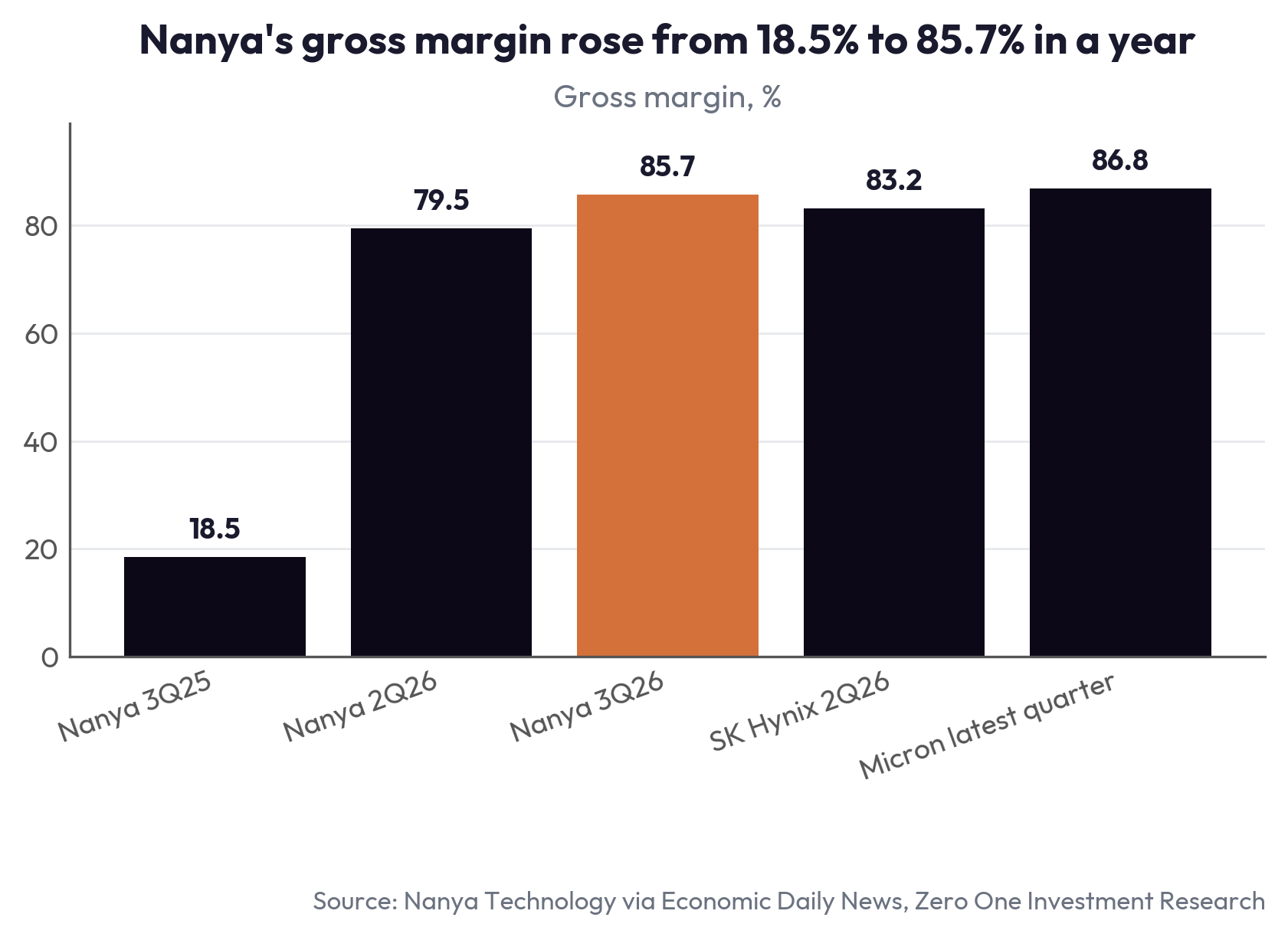
Nanya Technology (2408 TT) reported 3Q26 revenue of NT$133.65bn, up 61.9% QoQ, as its average DRAM selling price rose more than 60% QoQ while shipments fell by a mid-single-digit percentage, about 4% to 6%. Gross margin reached a record 85.7%, up 6.2 points QoQ and 67.2 points YoY, and operating margin reached 80%.
Net profit rose 74.6% QoQ to NT$87.63bn, close to 1.8 times Nanya's combined profit of about NT$49bn for 2019 to 2025, Economic Daily News calculated. President Lee Pei-ing said older long-term supply agreements, mostly negotiated in mid and late 2025 when prices were lower, ran off and new contract prices applied in the quarter. He expects selling prices to keep rising in 4Q26 and sees room for gross margin to go higher.
Customers now want longer commitments. Long-term agreements cover about 50% to 70% of Nanya's capacity, some customers want terms of three years or more, and some strategic partners have proposed taking equity stakes to secure supply, though nothing is agreed, Lee said. Samsung Electronics (005930 KS) has reportedly contracted close to 80% of its 2027 memory output, including HBM (high-bandwidth memory), through long-term agreements, DigiTimes reported.
Nanya is spending the cash on capacity. Equipment move-in at its new Linkou 5A fab starts in 1Q27, with total investment of close to NT$480bn funded from its own cash and a target of 30,000 wafers a month by end-2028 and 50,000 by end-2030. A new Pingtung plant will stack and bond memory wafers, with equipment from 2H28. Whether customers turn their requests into three-year contracts at current prices would help set how high Nanya's margin stays when prices next fall.
Linked stocks: 2408 TT, 005930 KS, MU US
Microsoft shifts AI inference to its own chip
Microsoft (MSFT US) said it will scale its Azure Maia chips to multi-gigawatt deployments from 2027 and make them the primary inference system (the computing that runs trained AI models for users) for its own products and services. The compute chiplets of the new Maia 300 use TSMC's (2330 TT) N2P 2nm-class process, and Reuters reported Microsoft could deploy more than 1m of the chips next year.
Microsoft says Maia 300 delivers 40% more tokens (the units of text an AI model produces) per megawatt than leading GPU systems. A Maia 300 rack holds 96 chips and draws about 167kW, against 72 GPUs and about 142kW in NVIDIA's (NVDA US) GB300 rack, CNA reported. Each chip carries eight HBM4 stacks, giving a full rack 27.6TB of HBM.
The suppliers differ from an NVIDIA rack. TSMC makes both the 2nm compute chiplets and the lower-cost 3nm chiplets that move data in and out, and the memory makers supply the HBM4. The racks will be assembled by Lenovo (992 HK) rather than a Taiwan server maker, supply chain sources told DigiTimes. Microsoft already runs the prior Maia 200 in the US, Europe and Australia and expects capex of more than US$175bn this year.
Linked stocks: MSFT US, 2330 TT, NVDA US, 992 HK
ASE's packaging sales beat its own guidance
ASE Technology (3711 TT) reported 3Q26 revenue of NT$244.16bn, up 27.8% QoQ and 44.8% YoY, against its July guidance of 21% to 22% QoQ growth. Its packaging, testing and materials business grew 20.1% QoQ to NT$151.49bn, against guidance of 11% to 13%. September revenue of NT$88.13bn was a third straight monthly record.
ASE has said its advanced packaging and test business (LEAP) will beat the US$3.5bn it originally expected this year and double in 2027. It recently added US$1bn each of plant and equipment capex, and the market now puts its 2026 capex at about US$10.5bn, Economic Daily News reported. Volume production of co-packaged optics (optical connections built into the chip package) is scheduled for the end of this year.
Our 12 Oct Blade reported Taiwan packaging and test companies raising prices by 10% to 30%, with ASE named among the beneficiaries. ASE's monthly release does not split revenue into volume and price, so its 3Q26 results briefing is where the share of the beat that came from pricing should show.
Linked stocks: 3711 TT, 2330 TT, NVDA US
Broadcom's CEO says the memory shortage may ease within a year
Broadcom (AVGO US) CEO Hock Tan said on 12 Oct that today's memory shortage may no longer be a problem a year from now, and that the wafer shortage could ease in 2028 or 2029, speaking at a DBS conference in Singapore, CNA reported citing CNBC. He named capital as the likely biggest limit on AI growth, ahead of chips, memory or power.
Tan still sees demand for computing infrastructure above what Broadcom can supply, with the imbalance possibly lasting to 2029 or 2030. Intel (INTC US) CEO Lip-Bu Tan, on the same panel, said computing could stay short until 2029, and pointed to the cost of capital and whether AI spenders earn a return as the open questions.
The memory comment runs against what the memory makers said the same day: Nanya expects prices to keep rising in 4Q26 and has customers asking for contracts of three years or more. Hock Tan's own company is arranging more than US$50bn of financing for OpenAI's custom chips, one of the deals in the more than US$150bn of AI chip financings our 10 Oct Blade counted.
Linked stocks: AVGO US, INTC US, 2408 TT, MU US
NVIDIA opens its rack design to more suppliers
NVIDIA (NVDA US) said at the OCP Global Summit on 12 Oct that it will publish its Vera Rubin rack and compute tray designs as part of the open MGX 1.2 specification, and that its Vera CPU racks for AI inference have started shipping. Partners showing MGX hardware at the summit rose to nearly 100 from 40 last year, Commercial Times reported.
Twelve Taiwan makers are on the Vera CPU rack partner list, including Foxconn (2317 TT), Quanta's QCT, Wistron, Wiwynn, Inventec, Pegatron, ASUS and Gigabyte. The new compute trays drop internal cables, hoses and fans for modular liquid cooling, which NVIDIA says cuts assembly and repair from hours to minutes, and the liquid-cooled power bars carry up to 5,000 amps.
NVIDIA and Cisco (CSCO US) also introduced USFP, a pluggable optical module standard with 400 gigabits per second per lane and up to 32 lanes, or 6.4 terabits per second per module, four times the bandwidth density of current 1.6 terabit modules. Because the standard goes into the open OCP program, cloud companies can order from any supplier that builds to it. Taiwan's LuxNet (4979 TT) is developing 1.6 terabit modules for mass production in 2H27, Economic Daily News reported.
Linked stocks: NVDA US, CSCO US, 2317 TT, 4979 TT
Memory now up to 40% of phone parts costs
Memory now makes up 30% to 40% of the parts cost of a mainstream 8GB/256GB smartphone, up from about 10% to 15%, and LPDDR5X phone memory prices rose 78% to 83% QoQ in 2Q26, Commercial Times reported citing research firms. Data centers are taking more of the memory makers' output, leaving less for phones.
Phone makers are cutting specifications to hold their price points. Qualcomm (QCOM US) says manufacturers are reworking memory and storage configurations, and some are switching from OLED to LCD screens. Chip costs are rising too: Qualcomm's two new flagship platforms and MediaTek's (2454 TT) Dimensity 9600 Pro move to TSMC's 2nm, and Qualcomm raised prices on its Snapdragon X and X2 Elite PC platforms by about 10% from 1 Oct.
The higher prices are now showing up in volumes. US video game hardware unit sales fell 15% YoY in August to 559,000, the lowest August in 13 years, Circana data show, after Microsoft, Sony and Nintendo raised prices; the Xbox Series X digital edition now sells for US$749.99, against US$449.99 at launch. Our 9 Oct Blade reported Samsung's phone division asking suppliers to cut deliveries by 20% to 30% as memory costs rose. Console assemblers include Foxconn (2317 TT) and Pegatron (4938 TT).
Linked stocks: QCOM US, 2454 TT, 2317 TT, 4938 TT
先聲 First Word: Exclusives from Chinese-Language Sources
Compal joins NVIDIA's Vera CPU rack partners
Compal Electronics (2324 TT), which was not among the contract makers invited to NVIDIA CEO Jensen Huang's first supplier dinner in Taiwan, is on NVIDIA's partner list for Vera CPU racks, and analysts expect it to begin volume production of Vera Rubin AI servers in 1Q27. Compal has said servers could reach 30% to 40% of its revenue in 2027, with its Texas plant key to moving into full rack assembly. (13 Oct 2026) Source: 仁寶出頭天 躋身輝達鏈
Wistron adds NT$7.1bn of capex and buys a Tainan plant
Wistron (3231 TT) approved NT$6.5bn and NT$591.6m of capex for buildings and equipment in Kaohsiung and Hsinchu, and up to NT$1bn to buy a Tainan plant from Coretronic, citing strong AI server demand. Its new Kaohsiung plant starts production in 1Q27, and Wistron expects 2027 capex to rise again. (12 Oct 2026) Source: 緯創持續擴大生產規模 高雄、新竹廠產能擴充 購置台南新廠
WPG passes NT$200bn in a month on pre-holiday orders
Chip distributor WPG Holdings (3702 TT) reported September revenue of NT$219.59bn, up 146.5% YoY and 54.4% MoM, as customers ordered ahead of China's Golden Week holiday and some product prices rose. Its 3Q26 revenue of NT$507.93bn beat the top of its NT$460bn to NT$500bn guidance. WPG said orders for power management, server and networking components remain strong. (12 Oct 2026) Source: 大聯大9月營收攻頂飛越2,000億 大漲54% 單季站上5,079億

© 2026 Zero One Investment Research Pte Ltd. For informational purposes only. Not investment advice.