
US patent probe could bar Foxconn and Delta AI servers as chip prices climb
Zero One Investment Research Daily Intelligence Brief, October 12, 2026
US patent probe could bar Foxconn and Delta AI servers as chip prices climb
Top Market Signals
US patent probe could bar Foxconn and Quanta servers
The US International Trade Commission (USITC) voted on 9 Oct to open a patent investigation into vertical power delivery (VPD) systems used to power AI servers, naming Foxconn (2317 TT), Quanta (2382 TT) and Delta Electronics (2308 TT) among 20 companies. Vicor (VICR US), the US power module maker that filed the complaint, is asking for a limited exclusion order and a cease-and-desist order, which would keep infringing products, and the computing systems that carry them, out of the US.
Vicor has won before, and Delta is the most exposed of the named Taiwan companies: in February 2025 the USITC ruled in a separate case that Delta and Cyntec power modules infringed a Vicor patent and barred the unlicensed modules, and computing systems carrying them, from entering the US. In September Vicor licensed its VPD technology to an unnamed AI system maker and said unlicensed system makers and cloud companies may need a license, DigiTimes reported.
This is Vicor's second complaint of this kind this year. Its February case named companies including Delta, Quanta, Wistron and Wiwynn; the new case, 337-TA-1526, drops Wistron and Wiwynn and adds Foxconn and its server unit Ingrasys. Infineon (IFX GR), Luxshare, Monolithic Power Systems, Flex and Celestica are also named. Foxconn said the case concerns US patent 10,903,734, and Luxshare said its products involved are still in customer qualification, not volume production.
Foxconn, Quanta and Delta all said production and shipments are unaffected. The USITC sets a target completion date within 45 days, and Taiwan's trade agency says these cases usually take 12 to 16 months; the last Vicor case took about 18 months to a final ruling. Named companies can respond by designing around the patent, taking a license or settling, and a final order limited to specific modules would hit server and power suppliers unevenly, cnYES reported.
Linked stocks: 2317 TT, 2382 TT, 2308 TT, VICR US
Intel's biggest price rise hits its TSMC-tile parts
Intel (INTC US) has raised PC processor prices since 1 Sep, with the largest increases, 15% to 20%, on high-end Panther Lake parts whose graphics tile TSMC (2330 TT) makes on its 3nm N3E process, supply chain sources told Commercial Times. Meteor Lake and Arrow Lake prices rose about 5% to 10%. It is Intel's third round of increases since late last year.
Intel makes the Panther Lake compute tile on its own 18A process, so the steepest increases fall on the parts that carry TSMC's leading-edge cost. Qualcomm (QCOM US) raised prices on its Snapdragon X and X2 Elite PC platforms by about 10% from 1 Oct, and AMD (AMD US) is reportedly preparing CPU increases, with size and timing not yet confirmed.
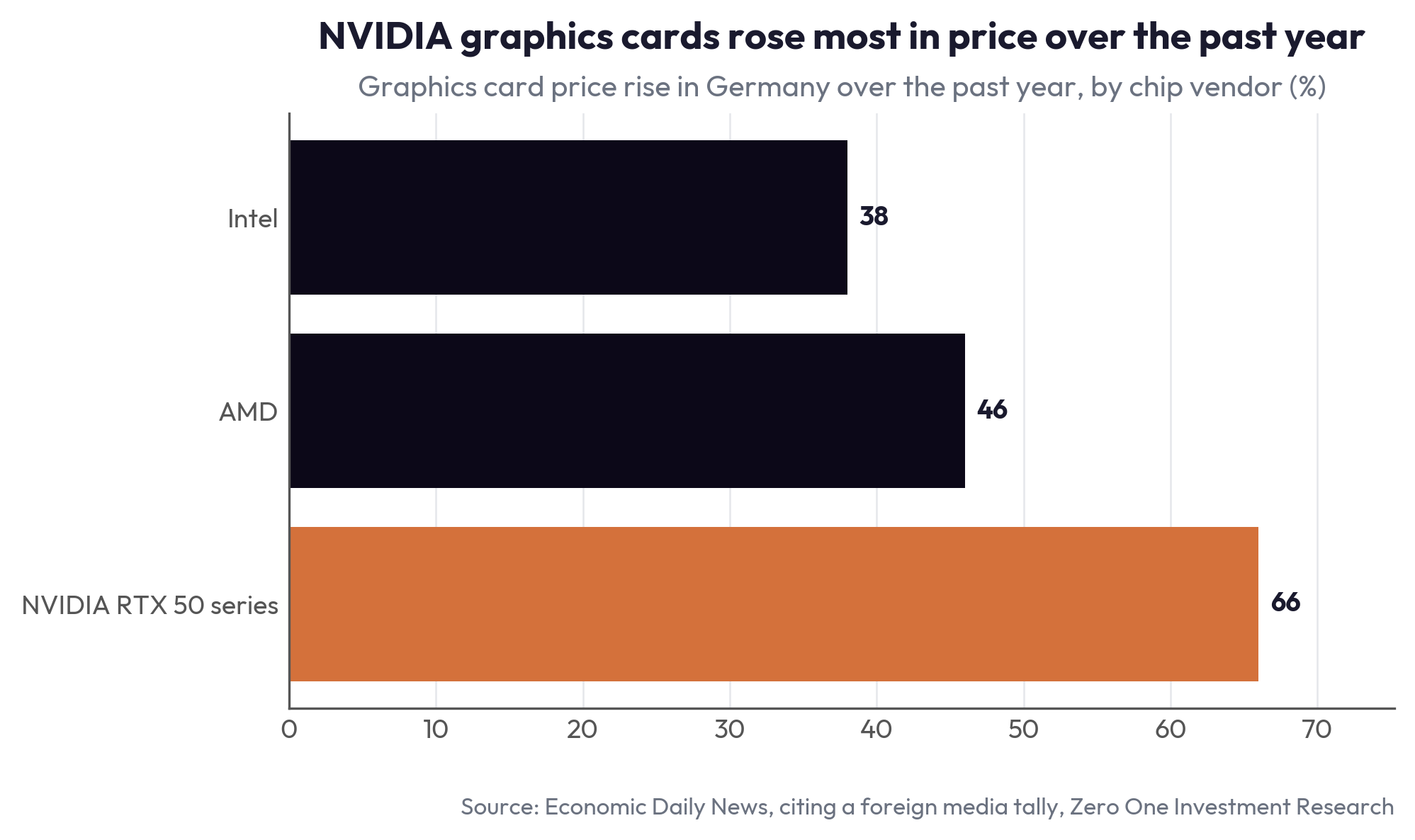
Graphics chips are rising too. AMD told its graphics card partners of an average increase of about 10% from 1 Oct, its third this year, citing graphics memory and foundry costs, Economic Daily News reported, and ASUS (2357 TT), MSI and Gigabyte are expected to follow. NVIDIA (NVDA US) is reportedly ending the RTX 5090 so that its GB202 chip goes only to RTX Pro professional cards.
Our 7 Oct Blade reported supply chain sources saying TSMC will adjust wafer prices by process node from January 2027, so chip designers' costs have a further step ahead. Demand is the limit: analysts told Economic Daily News that this year's PC and graphics card increases are already making consumers hold back.
Linked stocks: INTC US, QCOM US, AMD US, 2330 TT
Chip packaging and test prices rise up to 30%
Taiwan's chip packaging and test companies are raising prices by 10% to 30%, and small customers with rush orders are paying as much as double, industry sources told Economic Daily News, which called it the strongest round of increases the industry has seen. Longer test times for AI chips, and the in-house chips cloud companies are launching, have left capacity short. ASE Technology (3711 TT), King Yuan Electronics (2449 TT), Powertech (6239 TT) and Ardentec were named as beneficiaries.
Smaller firms are filling the gap as the large ones move capacity to high-end AI products. Orient Semiconductor (2329 TT), Greatek (2441 TT) and the Sigurd (6257 TT) group are taking orders for enterprise SSDs, optical communications and custom chips (ASICs). Orient Semiconductor, mainly a NAND flash packager, began seeing the benefit of its own price increases in 3Q26.
Our 6 Oct Blade reported that Lisa Su's Taiwan trip aimed to secure capacity from packaging, test and substrate suppliers that were short of capacity and raising prices; today's report puts a size on those increases. The figures come from industry sources, so the companies' 3Q26 results and 4Q26 guidance are the first chance to confirm them.
Linked stocks: 3711 TT, 2449 TT, 6239 TT, 2329 TT
Samsung wants AI memory to win AMD foundry orders
Samsung Electronics (005930 KS) is the main supplier of HBM4 (high-bandwidth memory, stacked beside AI processors) for AMD's (AMD US) Instinct MI400 series, and wants to use that position to win AMD's advanced logic chips for its foundry, Korean outlet The Elec reported, as carried by TechNews. AMD's annual report warns that moving products to a new foundry risks delays, lower yields or weaker performance.
The two signed a three-year, non-binding memorandum in March 2026 covering HBM4 and DDR5 supply, joint memory work for AI systems, an evaluation of making future AMD platforms at Samsung's foundry, and advanced packaging. Visiting Korea on 7 Oct, Lisa Su called Samsung and SK Hynix (000660 KS) both key partners and said AI demand requires supply planning three to five years out. AMD has started delivering MI455 chips with 432GB of HBM4 each, along with its Helios rack systems.
Samsung's bargaining power rests on memory pricing. Samsung is negotiating 2027 HBM supply terms with major customers and seeking a large price increase as HBM4 becomes its main shipment product, DigiTimes reported, with its headline putting the price at up to US$5 per gigabit. A Korean analyst expects Samsung to pass SK Hynix in HBM shipments and revenue from 2027.
AMD already uses Samsung's foundry and UMC (2303 TT) for some programmable logic chips. An advanced AMD processor moving from TSMC (2330 TT) to Samsung would be the first evidence that memory supply can buy foundry share; AMD has made no such commitment.
Linked stocks: 005930 KS, AMD US, 000660 KS, 2330 TT
CXMT aims to beat Samsung to denser DRAM
CXMT, a leading Chinese DRAM maker, plans to launch a DDR5 RDIMM server memory module built on a 4F² memory cell before the end of 2026, TechNews reported, about two years ahead of Samsung Electronics (005930 KS), which is expected to adopt the design in 2028. The module moves CXMT into server memory, beyond the low-end consumer products it has sold so far.
A 4F² cell stands the transistor and capacitor up vertically instead of laying them side by side, which raises the number of memory cells per chip area by 30% to 50%. Today's 6F² design is becoming hard to shrink below 10nm. Industry sources expect CXMT to use 4F² first on its 15nm G5 process, and yield, cost and reliability at volume are unproven.
CXMT's three 300mm DRAM fabs are expected to reach about 350,000 wafers a month by year end. A server module that passes customer qualification would be the first proof that CXMT can compete on technology as well as volume.
Linked stocks: 005930 KS, 000660 KS, MU US, 2408 TT
NVIDIA discusses a talent deal for Reflection AI
NVIDIA (NVDA US) is in talks to increase its investment in, or acquire, open-model developer Reflection AI, likely structured like its Groq deal: hiring the top staff and licensing the technology without buying the whole company, the Financial Times reported. A deal could come within weeks, though talks could still fail.
NVIDIA already owns US$800m of Reflection, valued at US$25bn in a March funding round, and Reflection released its first open-weight model, Beam, last week. The structure lets NVIDIA hire staff and license technology without the long regulatory review of a full acquisition; it used the same approach for its US$20bn Groq deal last December. NVIDIA has its Nemotron open models but no frontier-scale model of its own.
NVIDIA is also reportedly planning to invest another US$1bn in humanoid robot maker Figure, valued at about US$38bn, where it is already a major shareholder. Solomon (2359 TT) and Delta Electronics (2308 TT) build robots and automation systems on NVIDIA's robotics platforms. Both deals put NVIDIA's cash into the models and robots that run on its chips.
Linked stocks: NVDA US, 2359 TT, 2308 TT
先聲 First Word: Exclusives from Chinese-Language Sources
VSMC trims its Singapore fab plan to make silicon interposers
VSMC, the Singapore 12 inch venture of Vanguard International (5347 TT) and NXP (NXPI US), cut its planned capacity to about 44,000 wafers a month from 55,000 to make room for silicon interposers and other higher-value products, Commercial Times reported; customers have already booked first-phase capacity. Interposers, the silicon base under an AI chip and its memory, are bringing older-process foundries into AI packaging work. (12 Oct 2026) Source: 聯電、世界 三策略拚高值化
Apple's COO tours Foxconn's iPhone Duo line before launch
Apple (AAPL US) chief operating officer Sabih Khan toured the iPhone Duo line at Foxconn's (2317 TT) Zhengzhou plant amid market talk of yield problems, Economic Daily News reported. Foxconn is the sole assembler of Apple's first foldable phone, which opens for pre-order on 16 Oct; Chinese media reported Apple raised Duo orders 30%, to a total still below 10m units. (12 Oct 2026) Source: 蘋果折疊機良率沒卡關 COO親赴鴻海鄭州廠視察 證明上市無虞
Walsin Lihwa's memory stake could lift 3Q profit to a record
Walsin Lihwa (1605 TT), a cable and stainless steel group, could earn close to NT$10bn in 3Q26, a quarterly record, analysts told Economic Daily News, mainly from its roughly 21% stake in memory maker Winbond (2344 TT), whose 3Q26 net profit they put at about NT$42.3bn. Walsin Lihwa's shares closed at NT$39.1 on 8 Oct, below its book value of NT$46.12 per share. (12 Oct 2026) Source: 華新Q3獲利挑戰百億

© 2026 Zero One Investment Research Pte Ltd. For informational purposes only. Not investment advice.