
TSMC pulls 2027 2nm capacity into 2026; Samsung's DRAM margin seen above 80%
Zero One Investment Research Daily Intelligence Brief, September 28, 2026
TSMC pulls 2027 2nm capacity into 2026; Samsung's DRAM margin seen above 80%
Top Market Signals
Customers book up to 20% more TSMC 2nm
Apple (AAPL US), NVIDIA (NVDA US), AMD (AMD US), Qualcomm (QCOM US) and MediaTek (2454 TT) have added 10% to 20% to their bookings of TSMC's (2330 TT) 2nm family capacity, Economic Daily News reported, citing industry sources. TSMC does not comment on customers or market reports.
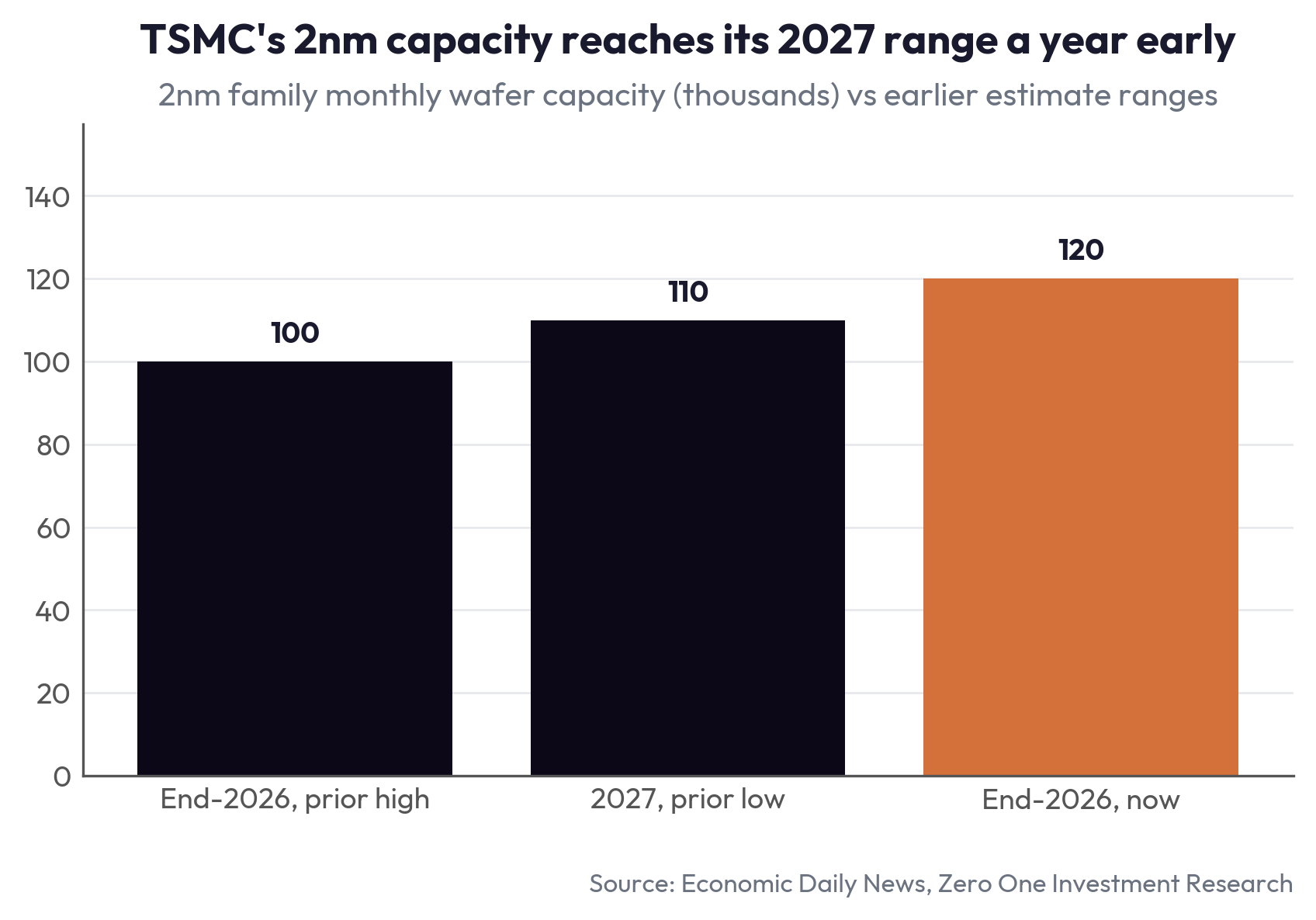
The market had expected 2nm family capacity of about 90,000 to 100,000 wafers a month by the end of this year, rising to 110,000 to 140,000 in 2027. Industry sources now put the year-end figure at 120,000 wafers a month, which is inside the range expected for 2027, a year early.
TSMC set out the pace at its North American Technology Symposium this year. Five 2nm fabs, two in Hsinchu and three in Kaohsiung, ramp at the same time; first-year 2nm wafer output is 45% above 3nm's first year in 2023; and 2nm capacity grows at a 70% compound annual rate from 2026 to 2028.
Our 14 September edition reported that TSMC's first look at next year's expansion put the larger addition at 3nm. That comparison still holds: 3nm capacity in Tainan alone approaches 180,000 wafers a month in 4Q26, about 1.5 times the new 2nm year-end figure, and could reach 200,000 to 210,000 in 2027. A higher capital spending plan at TSMC's 3Q26 results would confirm the faster 2nm build.
Linked stocks: 2330 TT, AAPL US, NVDA US, 2454 TT
Samsung's DRAM margin seen above 80%
Samsung Electronics (005930 KS) is expected to report more than KRW100tn of operating profit in a quarter for the first time, the Korea Herald reported. DB Securities, Mirae Asset Securities and BNK Securities put 3Q26 operating profit at KRW107.7tn on average, up 20.3% from KRW89.4tn in 2Q26, with a DRAM operating margin above 80% across HBM and conventional parts and 72% to 75% for the whole chip division.
TrendForce put 3Q26 DRAM contract prices up 13% to 18% QoQ, after a rise of about 60% in 2Q26. Samsung is also moving advanced DRAM lines to HBM (high-bandwidth memory, stacked chips that sit beside AI processors) and high-capacity server memory: HBM is projected at 40% of its DRAM capacity in 2027, and conventional DRAM falls to 59% from 65% this year. Lead times for high-capacity server DDR5 run up to 52 weeks, against about 6 weeks in a normal market.
New supply is mostly more than a year away, Commercial Times reported. Micron (MU US) expects first DRAM wafers from its new Boise fab in mid-2027. Nanya Technology (2408 TT) starts wafer input at Fab 5A in 2H27, reaching 30,000 wafers a month in 2028. SK Hynix (000660 KS) restarts expansion of its Dalian NAND fab, with tools arriving as early as November and mass production targeted for 1H27, and industry executives say most supply from large new fabs arrives from 2028.
Our 14 September edition reported that CXMT, China's largest DRAM maker, reached an operating margin of about 82% in 2Q26. The brokers' estimates put Samsung, the largest DRAM maker, above 80% one quarter later. Micron's fiscal 4Q26 results on 30 September will show whether its DRAM margin moved the same way.
Linked stocks: 005930 KS, 000660 KS, MU US, 2408 TT
Samsung Electro-Mechanics nears KRW4tn of AI capacitor contracts
Samsung Electro-Mechanics (009150 KS) is in final talks on a supply contract worth about KRW700bn for AI server MLCCs (multilayer ceramic capacitors, the small parts that steady the power feeding each chip) with a global power and electronic components company, Chosun Ilbo reported, as carried by Commercial Times. Since May it has signed KRW3.32tn of long-term contracts for silicon capacitors and AI server MLCCs with more than 10 global companies, so the new deal would take the total above KRW4tn.
Earlier this month it signed a KRW1.1tn AI server MLCC contract covering January to December 2027, its largest ever. Demand now comes from custom accelerators as well as NVIDIA GPUs: Google's TPU v8, Amazon's Trainium 4 and Meta's MTIA 400 and 450. Samsung Electro-Mechanics has expanded high-capacity MLCC output since March and plans about KRW15tn of investment in Busan through 2040.
Taiwan's makers report the same pull. AI-related business is about 16% of Yageo's (2327 TT) group revenue, and Holy Stone (3026 TT) says lead times on high-end AI MLCCs have stretched past 20 weeks. Upstream, Bloomberg reported that Sakai Chemical Industry (4078 JT), which makes the ultra-fine powders used inside capacitors, is quickly filling its production capacity.
Our 12 September edition reported that Murata (6981 JT) had stopped taking new orders for its general purpose capacitors to keep AI customers supplied. Samsung Electro-Mechanics is now writing that kind of capacity into year-long AI server contracts. Contracts running beyond 2027 would show buyers committing further ahead.
Linked stocks: 009150 KS, 2327 TT, 6981 JT
Vera Rubin racks sell for over 50% more
Supermicro (SMCI US) has delivered its first NVIDIA Vera Rubin NVL72 rack system, to SpaceX AI for its Grok models, and Dell (DELL US) delivered its first to CoreWeave (CRWV US) in early June, Commercial Times reported. Wistron (3231 TT), the main supplier to both, is set for rising AI server shipments each quarter through 2H26.
Analysts cited by Commercial Times put the platform's unit price more than 50% above the previous generation. They expect AI GPU rack shipments of 75,000 in 2026 and 110,000 in 2027, with Vera Rubin starting in small volume in 4Q26. One Supermicro liquid-cooled rack holds 72 Rubin GPUs, 36 Vera CPUs and 20.7TB of HBM4, and SpaceX AI plans more than 2GW of Grok computing power by the end of this year and up to 10GW by the end of 2027.
Taiwan's assemblers are already growing fast on the current platform. Quanta (2382 TT) reported revenue for the first eight months of NT$2.64tn, up 102.6% YoY, and raised this year's capital spending to NT$40bn from NT$30bn. Foxconn (2317 TT) reported NT$6.51tn, up 39.73%, and expects its AI rack shipments to more than double this year. Custom chips add volume on top: analysts expect more than 100,000 Google TPU racks in 2027, and AWS Trainium shipments of 2.3m chips in 2026 and 3m in 2027.
The higher rack price reaches Taiwan's assemblers as volume builds through 2027. Wistron's monthly revenue from October onward will show when Vera Rubin shipments start to count.
Linked stocks: 3231 TT, SMCI US, NVDA US, 2382 TT
TSMC plans five more packaging fabs in Chiayi
TSMC (2330 TT) plans five more advanced packaging fabs in a third phase of the Chiayi Science Park, which would bring its packaging plants there to ten, Liberty Times reported, citing supply chain sources. Taiwan's National Science and Technology Council has opened public comment on the expansion, about 198.65 hectares of land mostly leased from Taiwan Sugar.
In the first phase, TSMC's P1 plant is in production and P2 is installing tools. The second phase holds P3, P4 and P5, with P3 under construction and the whole phase due by 2031, according to the Southern Taiwan Science Park Bureau. Industry sources said current expansion still cannot fully meet demand for CoWoS (chip on wafer on substrate, the packaging that joins AI processors to their memory) from NVIDIA (NVDA US), AMD (AMD US) and Apple (AAPL US).
The land is at the start of approval. One month of public comment comes first, then a feasibility study, Executive Yuan approval, urban planning and an environmental impact assessment. Local officials expect at least 3,000 staff per plant once running.
Linked stocks: 2330 TT, NVDA US, AMD US
Beijing signals approval for NVIDIA's new workstation chip
China's Ministry of Industry and Information Technology asked companies including ByteDance and Alibaba (BABA US) to report their plans to buy NVIDIA's (NVDA US) RTX PRO 5500, and told some Chinese companies the government intends to approve the purchases, The Information reported. Reuters could not immediately verify the report.
The RTX PRO 5500 is a workstation card built on NVIDIA's Blackwell design with 84GB of memory, unveiled this month, and some industry executives expect it to fall outside US export restrictions. NVIDIA said the situation reflects outdated US export controls and China's own limits on US imports. A formal approval, and the volumes the companies report to the ministry, would show how much Chinese AI demand the card can serve.
Linked stocks: NVDA US, BABA US
先聲 First Word: Exclusives from Chinese-Language Sources
Intel works with AUO on Micro LED optical links
Intel (INTC US) is working with AUO (2409 TT) on co-packaged optics that embed Micro LED light sources in the glass substrate of a chip package, drawing on AUO's experience with through-glass vias and wiring, cnYES reported, citing market sources. Micro LED links use about a fifth of the power per channel of silicon photonics and could cut a 1.6Tbps optical module from 30W to about 1.6W, for the short links inside a data center rack. (27 Sep 2026) Source: 英特爾跨入Micro LED CPO 台LED廠迎AI矽光子商機
TSMC plans carbon storage under the sea off Mailiao
TSMC (2330 TT), Formosa Petrochemical (6505 TT) and ExxonMobil (XOM US) are working on capturing carbon from new gas units at Formosa's Mailiao power plant and storing it under the seabed, so TSMC could buy that plant's output as low-carbon power, Wealth Magazine reported. Green power was about 11% of TSMC's Taiwan electricity use in 2025, and Formosa Petrochemical plans to file for exploration by year end. (27 Sep 2026) Source: 台積電麥寮外海祕密計畫獨家曝光,全新台灣能源之路隱然成形
Foxconn's Beijing robot venture starts operating
Foxconn (2317 TT) and Chinese automotive engineering firm IAT Automobile Technology have started operating Beijing Futekang, a joint venture that takes embodied AI robots from lab prototype to volume production, and signed partner deals with robot makers including Songyan Power. IAT brings 20 years of vehicle development across 500 models, and the venture targets robot projects that stall at the sample stage on supply chain, validation and manufacturing cost. (27 Sep 2026) Source: 鴻海搶具身智慧量產商機 打造機器人一站式平台

© 2026 Zero One Investment Research Pte Ltd. For informational purposes only. Not investment advice.