
Apple accepts memory prices up to 40% higher as Winbond buys Infineon's flash business
Zero One Investment Research Daily Intelligence Brief, September 17, 2026
Apple accepts memory prices up to 40% higher as Winbond buys Infineon's flash business
Top Market Signals
Winbond buys Infineon's NOR flash business
Winbond Electronics (2344 TT) will pay US$1.12bn in cash for 100% of Infineon Technologies' NOR Flash and F-RAM business, the largest cross-border acquisition in the history of Taiwan's memory industry. The board approved the share purchase agreement on 16 September and the deal is expected to close in 2H27.
The acquired business will be renamed Spansion, headquartered in the US and run independently under its existing operating model. Spansion began as a joint venture between AMD and Fujitsu, agreed to merge with Cypress Semiconductor in 2014, completed that merger in 2015, and disappeared as a brand when Infineon bought Cypress in 2019. Winbond said the transaction brings in specialists from more than ten countries along with global research resources and customer-service reach.
TrendForce expects contract prices for NOR Flash of 256Mb and above to rise another 90% to 110% in 2H26, on top of a cumulative 100% to 120% increase in 1H26, because an AI server uses three to five times as much NOR Flash as a conventional one and every retimer needs its own device to load microcode. Infineon is selling into that.
Winbond already holds the largest share of the NOR market, so the deal adds share rather than fabs. Institutional forecasts cited in the reporting see little growth in its wafer starts this year, with the volume gain instead coming from a full ramp of 45nm NOR and a shrink toward 25nm and 20nm that lifts bits per wafer. Buying share is the faster route while new capacity still has to clear process shrink, yield ramp, qualification and customer design-in before it becomes supply.
Linked stocks: 2344 TT, IFX GR, 2408 TT
Apple accepts memory prices up to 40% higher
Apple has accepted Samsung Electronics' (005930 KS) memory price increase for 1Q27, with DRAM and NAND Flash set to rise 30% to 40% from 3Q26 levels, according to Chinese outlet Jiemian News and Korean outlet Asia Daily. A buyer agreeing a quarter ahead to that size of increase is conceding that the scarce thing is capacity rather than product.
Customers are also paying earlier. Samsung's advance receipts reached KRW3.29tn, about US$2.23bn, in 1H26, up 70.4% from the end of 2025, as it used prepayments to harden its multi-year supply agreements.
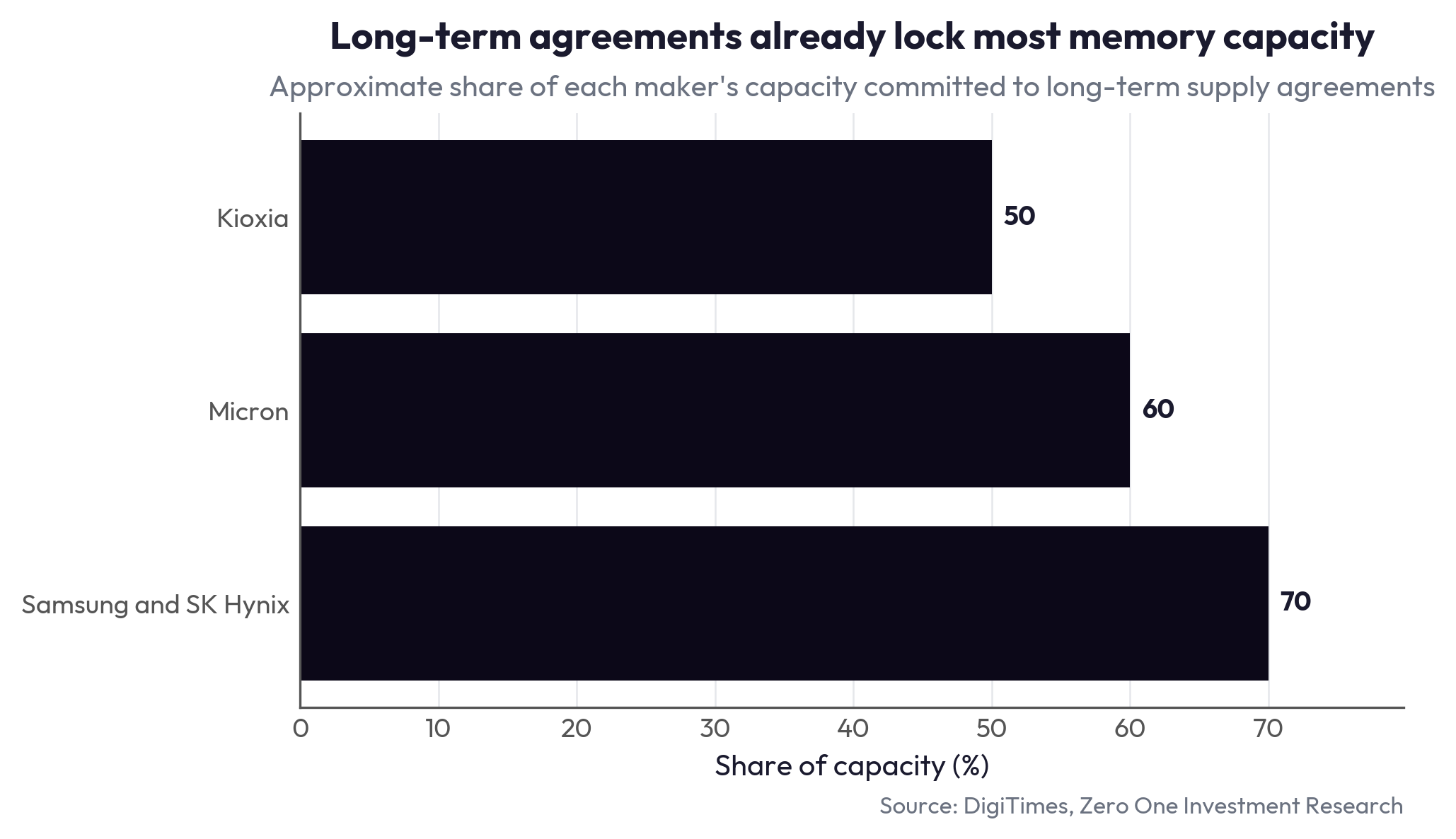
Those agreements now cover most of what the industry can make. Long-term agreements account for roughly 50% of Kioxia's capacity, about 60% of Micron's (MU US) and about 70% at the two Korean makers, and the supply chain expects 2027 to be the tightest year of the shortage.
Our 16 September Blade reported memory buyers negotiating supply contracts into 2029 and 2030. Today puts prices and cash against those contracts: the length was the first half of the story, the 30% to 40% step and the prepayment are the second.
Linked stocks: 005930 KS, MU US, AAPL US
SK Hynix weighs memory production at Intel's Ohio site
SK Hynix is in talks with Intel (INTC US) about making memory chips in the US for the first time, Reuters reported, with one option being to lease part of Intel's Ohio site. SK Hynix has never manufactured memory in the US.
The company said in a statement that nothing has been decided about working with any company or about producing memory chips in the US, and that it is exploring options to strengthen its global competitiveness without having settled on a specific plan or arrangement. A second option under discussion is a joint venture between SK Hynix, Intel and cloud providers. Reuters said it is not clear which product SK Hynix would make there; its range covers DRAM, NAND Flash and HBM.
Bloomberg reported that Korean authorities have confirmed the postponement of a briefing to the National Assembly, originally scheduled for 17 September, on the first project under the country's US investment plan.
For Intel the appeal is a tenant for a plant it has already delayed, which would take weight off the balance sheet carrying it. Intel rose 4.03% to US$101.05 on the report and SK Hynix's ADR opened at least 3% higher in New York.
Linked stocks: INTC US, 000660 KS, MU US
Intel can supply only half its CPU demand
Intel chief executive Lip-Bu Tan said the company can meet only about 50% of customer CPU demand, and that he apologizes to customer chief executives every day. Demand is rising as AI applications move from training into large-scale inference and agent workloads, and Tan said the shortage may persist.
Tan also warned that the memory shortage in 2027 could be more severe than in 2026, with cost pressure reaching smartphones and notebooks. The reporting framed the near-term consequence for PC brands such as ASUS (2357 TT) and Acer (2353 TT) as a question of how well they can allocate scarce supply rather than how much they can sell.
In the same interview Tan named advanced packaging a priority for the next five years, and said he is concerned that packaging substrate material comes from very few suppliers, two in Japan and two in Taiwan, and that large prepayments are needed to secure capacity from them.
On process, Tan said 14A will enter trial production in 1Q27, earlier than the 2H27 risk production Intel gave on its earnings call, with volume production still set for 2H28. Intel 18A-P, the first performance-enhanced member of the 18A family, is in risk production and delivers up to 9% more performance at the same power as 18A.
Linked stocks: INTC US, 2357 TT, 2353 TT
Samsung offers HBM base die choice, outsources modules
Samsung Electronics plans to offer customers a choice of base die for custom HBM, either from its own foundry or from TSMC (2330 TT), dropping its practice of supplying the whole stack from inside the group. Some customers have already taken the combination of a TSMC base die with Samsung DRAM.
The base die sits beneath the DRAM stack and handles the interface to the processor. Samsung's memory business designs it, so routing the wafer to TSMC changes who manufactures the logic layer of Samsung's own product while leaving the design in-house.
At the other end of the line, Korean media report Samsung plans to outsource conventional memory module and SSD production so it can concentrate its own capacity on HBM. Taiwanese module makers are the candidates. Transcend (2451 TT) has been a Samsung direct account for more than a decade, has taken module contract work from Samsung before, and runs a Taipei plant with surface-mount lines covering development, module manufacturing and test. Apacer (8271 TT) names Samsung as a main DRAM and Flash supplier in its annual report and builds both modules and SSDs.
Both moves run in the same direction. Samsung is giving up integration on the work that is ordinary and keeping its own capacity for the product that is short.
Linked stocks: 005930 KS, 2330 TT, 2451 TT
Meta commits a gigawatt to its own chips
Meta (META US) will start deploying its third-generation MTIA 450 chip, code-named Arke, in its data centers in 1H27, and has committed to installing more than 1GW of self-designed compute within twelve months. Broadcom (AVGO US) co-designs the chip and TSMC manufactures it.
TSMC delivered twelve of the new chips to Meta on 1 September, and measured performance came within 2% to 3% of Meta's own simulations. The team ran Meta's models on them the first day, along with DeepSeek and Alibaba models, and found no obvious design problem, though months of testing and tuning remain as output rises. A fourth generation, MTIA 500 code-named Astrid, enters data centers gradually from the end of 2027 at larger scale.
Meta executives said the chips run the company's own models more efficiently than anything NVIDIA currently ships, a claim scoped to Meta's own workloads rather than to the merchant market. All four MTIA generations use HBM and target general-purpose inference rather than the low-latency inference market.
The Taiwan read-through runs through Andes Technology (6533 TT), whose processor IP sits in several MTIA generations and whose largest customer is Meta. Andes declined to comment on customer orders.
Linked stocks: META US, 2330 TT, AVGO US, 6533 TT
Foxconn has optical capacity waiting on materials
FIT Hon Teng chairman Lu Sung-ching said the biggest limit on optical communications today is material supply, naming fiber, lasers, chips, CW lasers and wafers as all short. Material availability, he said, is now what sets the pace at which the optical industry can grow.
Lu added that the technology path is not settled, so final material demand depends on which architecture cloud providers choose. Linear pluggable optics, near-package optics, co-packaged optics and ultra-high-density pluggable optics are all in contention, and FIT participates in each while following the pace of the lead supplier in every architecture.
Capacity is not the problem. Lu said FIT already carries optical product volume and spare capacity, runs three plants in Vietnam with a large fourth under construction at Nghe An that should cover three to five years of demand, and has no further Southeast Asia plans for now. If gaps open upstream, the group would consider securing supply by purchase or investment, in some cases jointly with Foxconn (2317 TT) and Foxconn Industrial Internet (601138 CH).
FII chairman Cheng Hung-meng said the two units are moving from a supplier relationship into joint development on 800G, 1.6T and later opto-electronic integration, and that silicon photonics co-packaged optics components and other interconnect options arrive between 4Q26 and 1Q27.
Linked stocks: 2317 TT, 6088 HK, 601138 CH
先聲 First Word: Exclusives from Chinese-Language Sources
TSMC's equipment donation to Taiwan's state labs is in doubt
ITRI has broken ground on an advanced semiconductor pilot production lab, due for completion at the end of 2027, to house three sets of 12-inch equipment donated by TSMC, but the separate National Science and Technology Council co-creation base has been revised, TSMC's 2024 commitment may be cancelled or cut back, and no 2027 construction budget has been allocated. Taiwan's plan to give university researchers hands-on 12-inch process experience rests on equipment only TSMC can supply. (17 Sep 2026) Source: 台積電12吋設備捐贈計畫生變? 吳誠文:合作有新定義
Sinbon raises its semiconductor equipment revenue target
Sinbon Electronics (3023 TT) lifted 2026 semiconductor equipment revenue guidance to NT$3.0bn to NT$3.5bn from NT$2.5bn to NT$2.8bn, after an industrial segment that grew 40% YoY in 2Q26 became its largest business at 38% of revenue, and it has bought two plants to take the follow-on orders with visibility it puts at 2028. A cable supplier moving up into rack assembly and system integration shows how far AI capital spending has pushed into the Taiwan supply chain. (16 Sep 2026) Source: cnYES 鉅亨網
Samsung Display commits KRW300bn to 12-inch OLED on silicon
Samsung Display will invest KRW300bn, about US$203m, in a mass production line for 12-inch RGB OLED on silicon, with roughly KRW150bn of deposition equipment supplied by Sunic System. OLED on silicon is the display layer for headsets and smart glasses, and choosing a 12-inch line rather than a smaller pilot format signals Samsung is planning for volume. (17 Sep 2026) Source: SDC砸3000億韓元 押注12吋RGB OLEDoS量產

© 2026 Zero One Investment Research Pte Ltd. For informational purposes only. Not investment advice.