
Murata stopped taking general purpose capacitor orders to keep AI customers supplied
Zero One Investment Research Weekly Intelligence Brief, Week ending September 12, 2026
Top Market Signals
Murata exits general purpose capacitors as Yageo runs above 90% utilization
Murata Manufacturing (6981 JT), the largest maker of the ceramic capacitors that sit inside almost every electronic product, told customers in early September that it will accept no new orders for its general purpose parts, and issued end of life notices on its oldest part numbers, including some in its automotive grade series.
The decision is arithmetic inside its own factories. Lead times on Murata's high value parts have stretched from 8 to 10 weeks to more than 20 to 26 weeks, and deliveries on orders already booked have been pushed to January. The company is sending its limited output to AI server and high end automotive parts, where the margin is better, and leaving the cheap end.
Taiwan collects the transferred orders, and its two largest passive makers were already running tight. Local coverage names Yageo (2327 TT), Walsin Technology (2492 TT) and Holy Stone Enterprise (3026 TT). Yageo's president said in late July that book to bill, orders received against orders shipped, had reached 2.2, with utilization heading above 90% in the third quarter. Walsin Technology's own book to bill moved from 1.4 to 1.8 over the same period.
What last week changed is which layer of the bill of materials the AI build is taking from. A general purpose capacitor sells for a fraction of a cent and nobody models it, but no device ships without one, and the industry's largest supplier would rather not make it. Murata's lead times are the series that would say the squeeze is easing: a move back inside 20 weeks would be the first sign, and the September letters point the other way.
Linked stocks: 2327 TT, 2492 TT, 3026 TT, 6981 JT
Korean memory inventories fell below 10 days as HBM4 takes DRAM wafers
Samsung Electronics (005930 KS) and SK Hynix (000660 KS) were carrying less than 10 days of memory inventory as of the third quarter, according to KB Securities, whose research head framed the level as an outright shortfall of supply, not a demand recovery.
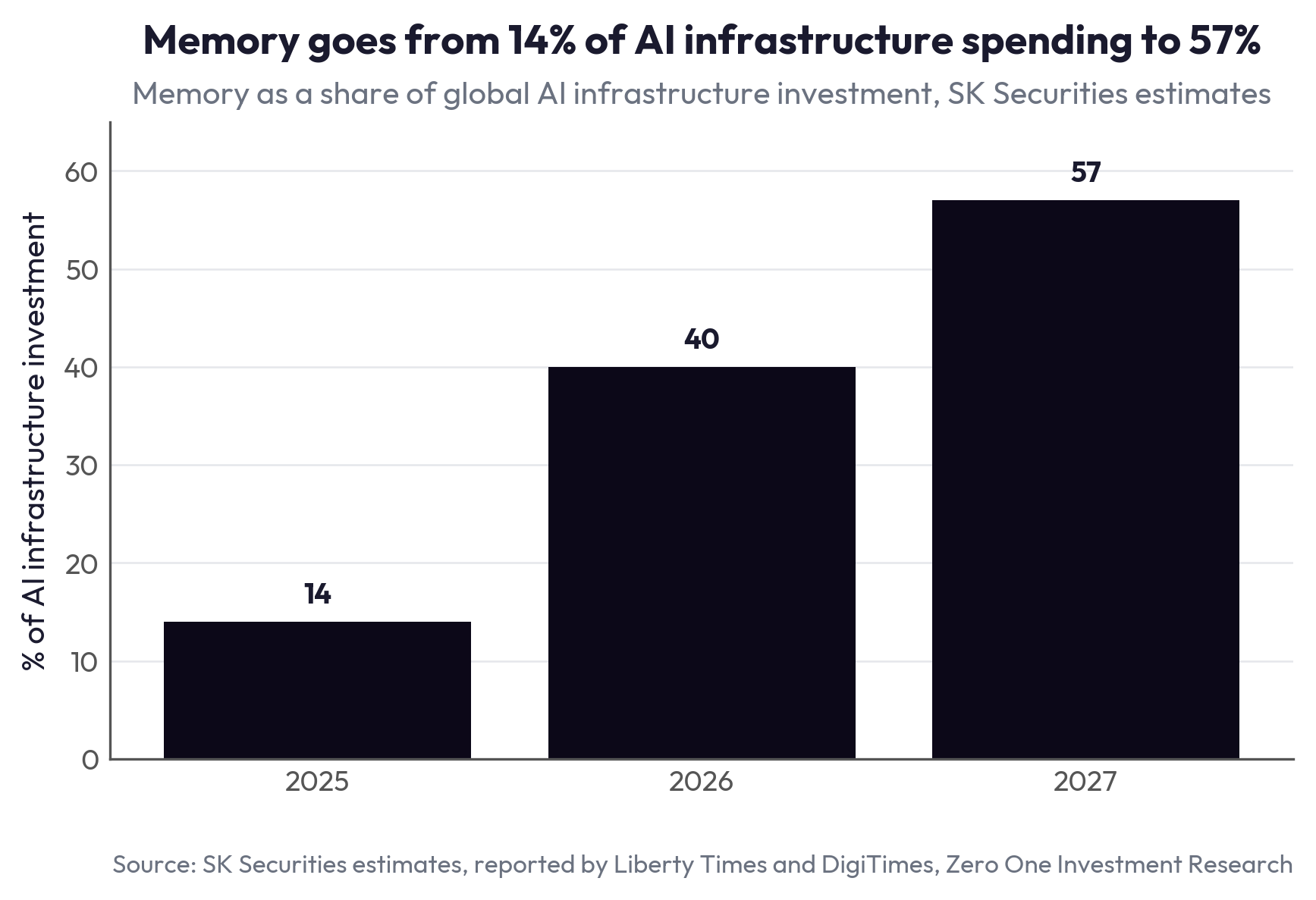
Memory's claim on the AI budget has moved furthest. SK Securities' estimates, in the chart below, take memory from 14% of AI infrastructure investment in 2025 to 57% in 2027, and TrendForce puts that figure higher still at 68%. Both sit against a base that is itself growing, with KB Securities modeling US$1.3tn of cloud operator AI infrastructure spending in 2027.
Two mechanisms sit underneath. AI buildouts pull server DDR5 and enterprise solid state drives as well as high bandwidth memory, the stacked memory beside an accelerator, so standard DRAM and NAND tighten together. And HBM4, the next generation of that stacked memory, needs up to three times the wafer capacity of conventional DRAM for the same output, so each increment subtracts from the DRAM pool.
The squeeze now reaches leading edge logic as well. Korean outlet ZDNet Korea reported that Samsung has committed more than half its 4nm foundry capacity to base dies, the logic chips at the bottom of a memory stack. Samsung has not confirmed it. If it is accurate, the foundry business that spent years chasing external logic customers has handed its most advanced volume node to its own memory division.
Linked stocks: 005930 KS, 000660 KS, MU US, 2408 TT
Kioxia calls memory prices high enough after a 70% quarterly rise
Kioxia's chief executive told Bloomberg that memory prices have already risen enough, and said he has asked his sales team not to raise prices sharply on data center customers because it would damage their willingness to invest in AI. He is the first large memory maker in this upcycle to argue for a brake, and his stated reasoning is that even hyperscale buyers work to a budget.
He is arguing against his own pricing power. Kioxia's NAND flash average selling price rose about 70% quarter over quarter in the three months to June, after a rise of more than 100% in the quarter before. TrendForce puts the company fourth in NAND with roughly 13.6% share, and it supplies Apple (AAPL US) and NVIDIA (NVDA US).
The pass through he is worried about was visible in three separate places last week. Apple's iPhone 18 Pro and Pro Max start US$100 above the previous generation, which Economic Daily News reports alongside the component shortage. Huawei raised the quoted price of its Ascend 950DT accelerator by 20 to 50% in two months on gray market memory costs, per a Reuters report citing unnamed sources. And all seven Taiwan memory suppliers filing August revenue grew more than 177% year over year, led by Innodisk (5289 TT) at 576.3%, in businesses selling into personal computers and retail channels.
Taiwan has money riding on which way this goes. Phison (8299 TT), ADATA (3260 TT) and Macronix (2337 TT) have been earning gains on low cost inventory bought before the rise, and Economic Daily News notes those cool if pricing flattens. Phison's chief executive spent the same week buying more cheap NAND, which puts his balance sheet on the other side of Kioxia's argument.
Linked stocks: 8299 TT, 3260 TT, 2337 TT, 000660 KS
Qualcomm gives AWS a US$4bn stock warrant against US$60bn of chip orders
Qualcomm (QCOM US) agreed a multi generation collaboration with Amazon Web Services covering custom AI inference chips and optical interconnect, and disclosed the same day that it has issued AWS a warrant to buy Qualcomm stock at US$161.26 a share.
The warrant is worth about US$4bn if fully exercised. It vests in stages against binding purchase orders and actual purchases, sits against a chip purchase ceiling of US$60bn, and runs to September 2036. Marvell (MRVL US) agreed the same structure with Google earlier in 2026, at about US$12.2bn against a US$120bn ceiling. The customer commits no cash up front and converts the option only by buying.
Taiwan's custom chip designers cannot answer that in kind, for a reason that has nothing to do with engineering. IC design executives told DigiTimes that writing share vesting against a customer's purchase volumes into a legal document is difficult in Taiwan because company law provides no instrument for it. MediaTek (2454 TT) holds production orders for two generations of Google's tensor processing unit with a third in contention, but nothing committed past 2030. Amazon has twice subscribed for Alchip (3661 TT) equity without attaching any supply guarantee.
That leaves process, capacity and per generation execution as the levers Taiwanese vendors have, a looser hold than a decade long option priced off order flow. Qualcomm's finance chief said another hyperscale customer is in discussion.
Linked stocks: QCOM US, 2454 TT, 3661 TT, MRVL US
Alchip guides gross margin to 21% after starting the year near 50%
Alchip Technologies (3661 TT) reported August revenue of NT$8.78bn, up 273% year over year and a second consecutive monthly record. The ramp that produced the record is compressing the margin, and management has said how far.
Gross margin was around 50% in the first quarter and fell to the low 30s in the second. The company expects the low to mid 20s in both the third and fourth quarters, and 21 to 26% for the full year. The cause is mix rather than price. Its 3nm AI accelerator program for a North American cloud provider entered mass production recently, so production revenue, which carries the wafer cost, is displacing the design service work that carried the high margin.
This is the ordinary shape of a custom chip business as a program moves from tape out to volume, and it is the first clean look at the size of the effect. Chairman and chief executive Shen Xianglin said demand on the program is running better than expected and that the company may raise next year's estimates. Advanced driver assistance chips for a Chinese automaker are now its second largest revenue line, with orders secured for two further generations.
Global Unichip (3443 TT) is the name to watch for the same transition. Its next generation project for a large North American cloud operator is scheduled for production between the end of this year and early 2027, with TSMC (2330 TT) capacity already secured.
Linked stocks: 3661 TT, 3443 TT, 2330 TT, 2454 TT
Taiwan's listed companies cleared NT$6tn in a month as computers grew 90.6%
Taiwan's listed companies reported combined August revenue of NT$6.07tn, the first month above NT$6tn, and the growth ran widest outside the chip layer.
The three fastest growing sectors were computers and peripherals at 90.59% year over year, electronics distribution at 88.92% and general electronics at 65.71%. Semiconductors did not make that list. Three of the five largest companies by monthly revenue were server assemblers and a fourth was a distributor. Breadth improved with it: 162 companies set a record August, against 80 a year earlier. Note the scope: Taiwan's listed companies only, not a global aggregate.
TSMC's own month effectively settled its quarter before September started. Its NT$514.81bn was a first month above NT$500bn and a fourth consecutive record, and July and August together already cover more than 67% of its third quarter dollar revenue guidance. Even a tenth's decline from August in September would leave the quarter inside its guided range.
The split inside the assemblers is the part to carry forward. Wistron (3231 TT) passed Quanta (2382 TT) to become Taiwan's second largest contract manufacturer by revenue, at NT$460.07bn, while its August notebook shipments fell 36.4% year over year. Quanta guided its own notebook business to a double digit full year decline in the same week it set a record month. The consolidated line at both now moves almost entirely on AI servers.
Linked stocks: 2317 TT, 2330 TT, 3231 TT, 2382 TT
TSMC sets 2030 for High NA lithography while Intel passes one million wafers
TSMC (2330 TT) said it will put High NA extreme ultraviolet lithography, the newest machine ASML (ASML NA) builds at roughly US$380m to US$410m each, into advanced process volume production from 2030, and will work with ASML to replace the industry's 6 inch photomask with a 12 inch one. Intel (INTC US) and ASML have already run more than one million wafers through the tool, including production layers of Intel 18A, and Samsung Electronics (005930 KS) is targeting DRAM production in 2028. Three competitors coordinating on one mask standard is what gives the supplier base enough volume to invest behind it.
Linked stocks: 2330 TT, ASML NA, INTC US, 005930 KS

© 2026 Zero One Investment Research Pte Ltd. For informational purposes only. Not investment advice.