
SpaceX targets 20GW of AI compute as Unimicron warns of a 20% materials gap
Zero One Investment Research Daily Intelligence Brief, October 21, 2026
SpaceX targets 20GW of AI compute as Unimicron warns of a 20% materials gap
Top Market Signals
SpaceX targets 20GW of AI compute by end-2027
SpaceX plans to expand its data center capacity to as much as 20 gigawatts (GW) by the end of 2027, from 1.7GW at the end of 3Q26, Elon Musk said on the company's third-quarter call. That is nearly 12 times today's capacity in about five quarters, from a company that rents most of its compute to others.
The plan rests on the quarter just reported. SpaceX revenue rose 161% YoY to US$14.6bn, and its Super Intelligence unit, which sells AI computing capacity, grew nearly 830% and made up more than half of group revenue for the first time, Economic Daily News reported. Musk said every hyperscaler and dozens of smaller companies keep asking to rent more capacity. SpaceX said current compute pricing lets a deployment pay back within a year, and possibly within six months next year.
Spending is moving with it. SpaceX expects to invest US$35-40bn in physical infrastructure this quarter, against US$19.6bn of capex last quarter, and set a 1Q27 revenue target of US$33-37bn, well above the US$22bn FactSet consensus. It confirmed its target of US$100bn in annualized recurring revenue by December.
On the chip side, Musk said ASML (ASML NA) and other toolmakers are speeding up deliveries for Terafab, the chip plant SpaceX and Tesla (TSLA US) are building. SpaceX aims to make its first test chips in May or June 2027 and reach volume production as early as 3Q28. Separately, SpaceX and Tesla have formed board committees with independent directors to explore a merger; the committees have not agreed terms. The 4Q26 capex print will show whether spending is keeping pace with the 20GW target.
Linked stocks: NVDA US, ASML NA, TSLA US, AMAT US
Super Micro raises revenue guide 27% and margins
Super Micro Computer (SMCI US) now expects revenue of US$18.5-19.5bn for the quarter ended 30 September, up from its prior guide of US$14.5-15.5bn and above the US$15.23bn LSEG analyst estimate, and raised its gross margin guide to 12-12.5% from 10.4-10.8%. That is up 279% YoY, Economic Daily News reported.
The margin is the new part: Super Micro is guiding gross margin up by about 1.6 points at the midpoint at the same time as revenue jumps. The company attributed the improvement to strong AI supply chain demand and a better product mix. Evercore ISI's Amit Daryanani said the margin level should lift margins across the server industry, since Dell (DELL US) has historically priced AI servers at a premium to Super Micro.
Shares rose 16.35% after hours to US$37.78 on 20 Oct, and Dell and Hewlett Packard Enterprise also rallied. The numbers are preliminary; Super Micro reports the full quarter on 3 Nov, which will show how much of the margin gain came from mix and how much from pricing.
Linked stocks: SMCI US, DELL US, 2317 TT, 6669 TT
Chinese orders for an NVIDIA workstation chip double supply
ByteDance, Alibaba (9988 HK) and Tencent (700 HK) have ordered more than 3 million of NVIDIA's (NVDA US) RTX PRO 5500 chips, worth more than US$35bn at about US$11,400 each, Reuters reported. NVIDIA has told partners that 2027 global output of the chip is capped at 3 million units, while orders from Chinese customers already exceed 6 million.
The RTX PRO 5500 is a workstation chip built for professional computers, not one of NVIDIA's data center AI processors, but it is among the most capable NVIDIA chips Chinese buyers can still purchase. NVIDIA told customers it cannot guarantee their orders, and partners may receive only 5-10% of the quantities they requested, according to the people cited by Reuters.
Our 17 Oct 2026 Blade reported IDC data showing NVIDIA shipped 44% fewer AI accelerators to China's data centers in 1H26 while Huawei's shipments rose to 572,000. Today's orders show the demand for NVIDIA hardware did not go away when the data center chips were restricted; it moved to the best chip still allowed. How much of it NVIDIA captures now depends on how many units it allocates to China out of a fixed 3 million, and on whether US export rules reach this product line.
Linked stocks: NVDA US, 9988 HK, 700 HK
Unimicron sees a 20% shortfall in substrate materials
Unimicron (3037 TT) chairman S.C. Chien said some key IC substrate materials could be about 20% short of demand in 2027, at the TPCA Show in Taipei on 20 Oct. IC substrates are the boards that connect an AI chip to the rest of the server. Chien said the bottleneck has spread from individual plants to the whole supply chain: T-glass fiber cloth, copper clad laminate (CCL) and ABF (Ajinomoto Build-up Film) remain tight, and lead times on some equipment run to 30 months.
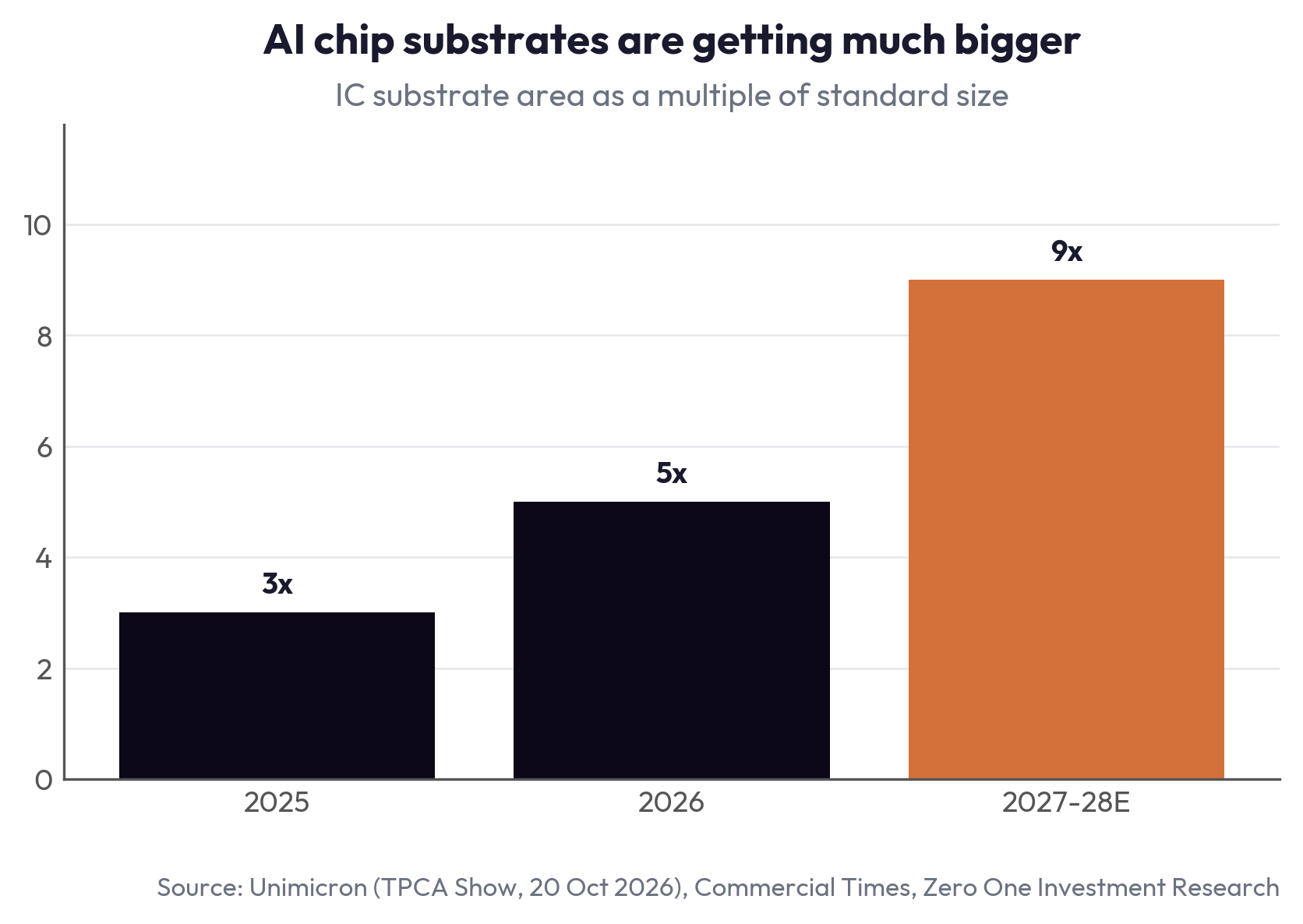
The size of each substrate explains why. Chien said an AI substrate was 3 times standard size in 2025 and 5 times in 2026, and should reach 9 times in 2027-28, possibly 12-14 times later, as chips move from a GPU with high-bandwidth memory (HBM) to cloud providers' own custom chips that combine more dies. A substrate three times larger uses roughly three times the material, so the same supply covers fewer chips even before unit demand grows.
The rest of the chain is reporting the same tightness. Zhen Ding (4958 TT) chairman Shen Ching-fang said upstream material shortages have not eased and the company has passed most costs on to customers. Nan Ya PCB (8046 TT) reported 3Q26 revenue of NT$16.38bn, up 49.3% YoY and a 15-quarter high. In Korea, Samsung Electro-Mechanics (009150 KS) signed a KRW360.5bn (US$271.8m) long-term contract to supply memory package substrates from 2027, taking its long-term orders signed over five months to KRW4.3tn across capacitors and substrates.
Our 17 Oct 2026 Blade reported Samsung had signed five-year contracts covering close to 80% of its expected 2027 memory output. The Samsung Electro-Mechanics deal shows customers now locking in the boards that memory sits on, not only the memory itself. Chien said the actual size of the 2027 gap depends on how demand develops.
Linked stocks: 3037 TT, 8046 TT, 4958 TT, 009150 KS
TSMC pauses steelwork at all new Taiwan sites
TSMC (2330 TT) has halted steel structure work at its Kaohsiung construction site and at all of its new fab sites across Taiwan, after four contractor workers died in an accident at the Kaohsiung F22 Phase 4 site on the evening of 20 Oct, Central News Agency reported. A bolt on a steel connection plate failed during crane lifting, and the workers fell from height.
The Southern Taiwan Science Park bureau has ordered work at the site stopped and said it will issue stop-work orders and fines under the Occupational Safety and Health Act. TSMC said the site was within its contractors' scope of work and its safety team is working with authorities on the investigation.
Kaohsiung and Hsinchu are TSMC's 2nm production bases, and TSMC expects its annual 2nm capacity to more than double in 2027. The pause covers steelwork for the new buildings that capacity depends on; how long it lasts, and whether the regulator's order extends beyond the F22 Phase 4 site, will determine whether any of the 2027 schedule moves.
Linked stocks: 2330 TT, TSM US, ASML NA
Samsung moves 4nm capacity to AI memory base chips
Samsung Electronics (005930 KS) will build its next external 5G modem, the M2800, on its 2nm process instead of 4nm, and is shifting a large share of its 4nm foundry capacity to HBM base dies, TheElec reported via TechNews. The base die is the logic chip with the control circuitry at the bottom of a high-bandwidth memory (HBM) stack.
The M2800 is due to finish development in 2027 and ship in the Galaxy S28 in 2028, paired with the Exynos 2800 processor; the M2700 for the 2027 Galaxy S27 stays on 4nm. Samsung's foundry business has yet to sign 2nm contracts with major global technology companies, while demand has pushed its 4nm lines close to full capacity, DigiTimes reported. Moving its own modem to 2nm puts in-house volume on a node still waiting for outside customers.
Our 19 Oct 2026 Blade reported that Samsung will use TSMC's (2330 TT) 3nm process for the base die of NVIDIA's next custom HBM, the first time it has worked with TSMC at the HBM manufacturing stage. Today's report shows the other half of the same demand: Samsung is also turning its fully loaded 4nm node over to base dies. The next check is whether an external customer signs for Samsung 2nm; without one, the modem is the node's main anchor.
Linked stocks: 005930 KS, 000660 KS, 2330 TT
先聲 First Word: Exclusives from Chinese-Language Sources
NVIDIA books Kinsus substrate capacity through 2030
Kinsus (3189 TT) won a large NVIDIA CPU substrate order this year, and NVIDIA has reserved its capacity through 2030, Liberty Times reported; a US brokerage estimates NVIDIA server CPU substrates at 15-20% of Kinsus revenue in 2027. A customer reserving substrate capacity four years ahead is the same behavior the memory makers' long-term contracts show. (21 Oct 2026) Source: 焦點股》景碩:輝達急訂未來3年產能 市場狂追
TSMC reported to shift a fifth of a packaging step to Xintec
TSMC is reported to be handing Xintec (3374 TT) orders equal to about 20% of the capacity of the on-substrate step of its CoWoS advanced packaging, with Xintec's related capacity set to grow 2.5 times next year, Liberty Times reported. TSMC's own packaging lines are full, so overflow work is going to Taiwan partners. (21 Oct 2026) Source: 焦點股》精材:感恩台積訂單外溢 早盤亮燈漲停
ITEQ plans 60% more laminate capacity by 2029
ITEQ (6213 TT) plans to raise monthly copper clad laminate capacity from 5.7 million sheets this year to 6.3 million, 8.25 million and 9.15 million by the end of 2029, and sees high-end orders visible beyond 2029, Economic Daily News reported. Its chairman said the biggest challenge is getting enough raw material, the same input shortage Unimicron flagged. (21 Oct 2026) Source: 聯茂旺到 2029年 看好高階 CCL 能見度

© 2026 Zero One Investment Research Pte Ltd. For informational purposes only. Not investment advice.