
NVIDIA asks SPIL for 15 times today's optical engine capacity; Amazon's racks wait for power
Zero One Investment Research Daily Intelligence Brief, October 22, 2026
NVIDIA asks SPIL for 15 times today's optical engine capacity; Amazon's racks wait for power
Top Market Signals
NVIDIA wants 15x optical engine capacity at SPIL
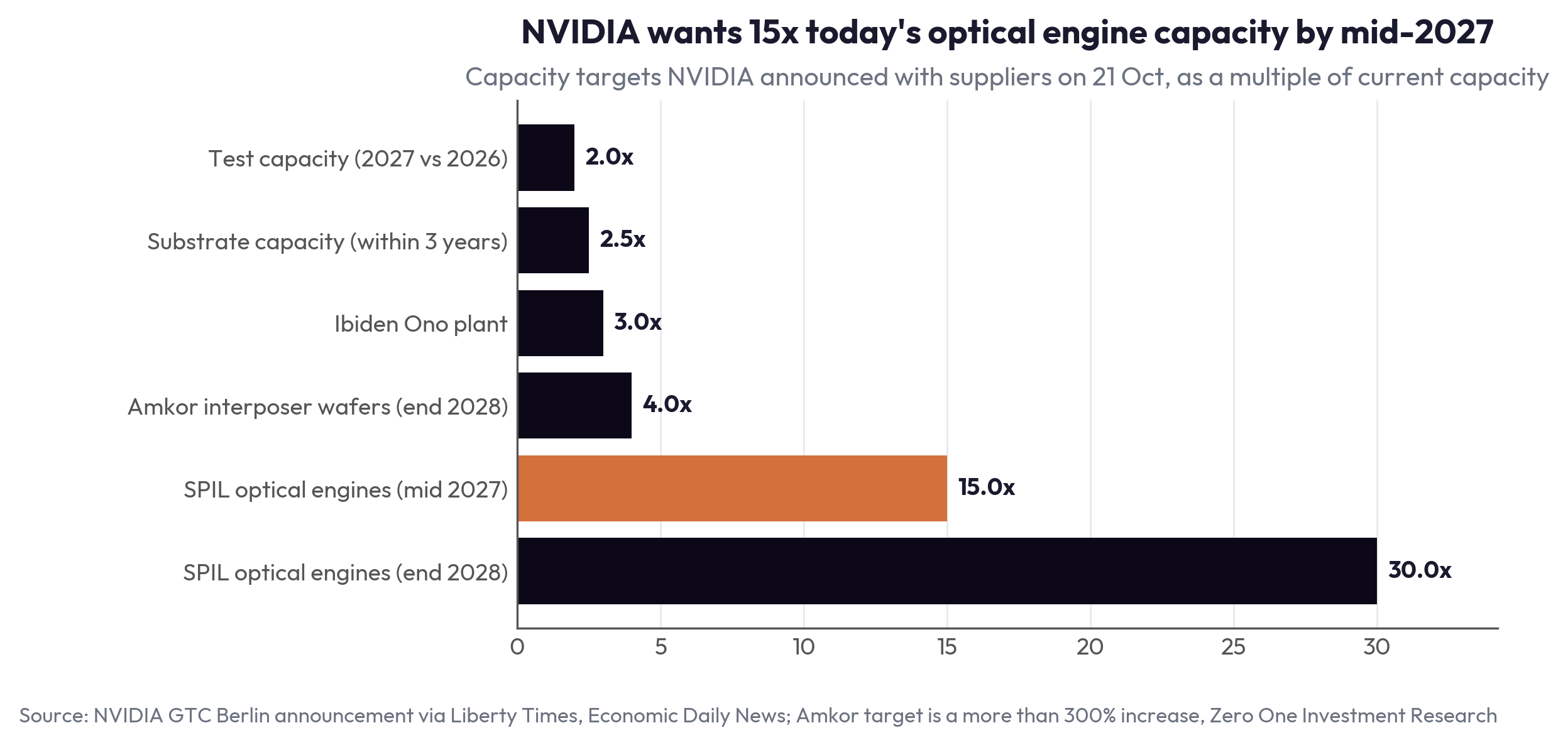
NVIDIA (NVDA US) and SPIL, the packaging unit of ASE Technology (3711 TT), plan to raise capacity for the optical engines used in co-packaged optics (CPO) to 15 times current levels by mid-2027, and to double it again by end-2028, NVIDIA announced at GTC Berlin on 21 Oct. CPO places the parts that convert electrical signals into light inside the switch package, next to the chip, instead of in pluggable modules at the front of the rack.
Jensen Huang said NVIDIA's Spectrum-X CPO Ethernet switch, built on the COUPE silicon photonics process NVIDIA developed with TSMC (2330 TT), is now in volume production, Commercial Times reported. The SPIL target is the largest multiple in a set of supplier deals announced the same day: substrates go to 2.5 times within three years and test capacity doubles from 2026 to 2027. NVIDIA gave no absolute current base for the optical engines, so the 15 times figure is a directional vendor target on an undisclosed starting volume, not a stated absolute capacity.
Economic Daily News reported that optical speeds per lane are moving from 100G to 200G and could reach 400G next year. It named two NVIDIA-certified Taiwan suppliers: Foci Fiber Optic Communications (3363 TT), which makes fiber array units for NVIDIA and is a TSMC COUPE partner, and Browave (3163 TT), which co-develops the fiber shuffle boxes and connectors around NVIDIA's CPO line, with volume shipments possible next year.
Our 20 Oct Blade covered Amtran's fiber shuffle boxes passing NVIDIA and US cloud certification. Browave is a second Taiwan supplier of the same part, now tied to a dated capacity target at the packaging stage.
Linked stocks: 3711 TT, NVDA US, 2330 TT, 3363 TT
NVIDIA puts US$1.1bn behind KYEC's US test plant
NVIDIA (NVDA US) will pay King Yuan Electronics (2449 TT), known as KYEC, a US$1.1bn capacity reservation prepayment to build test facilities and buy equipment in the US, targeting volume production in April 2027. NVIDIA expects its total chip test capacity to double between 2026 and 2027 across the US, Taiwan and Singapore, with the expanded Singapore operation in volume production from February 2027.
Our 17 Oct Blade reported the prepayment agreement KYEC signed on 13 Oct, when neither company disclosed the amount. KYEC's board had approved a US plant of up to US$1.4bn in July.
NVIDIA also plans to raise the substrate capacity available for its products to 2.5 times today within three years. Ibiden (4062 JT) received a prepayment of several billion US dollars earlier this year to triple its Ono plant in Japan, with new capacity from 1Q28. Samsung Electro-Mechanics (009150 KS) joins the supply chain with new plants in Sejong and Busan. Unimicron (3037 TT) signed a capacity reservation to add substrate capacity in Taiwan from 2Q27, reaching full capacity by mid-2028.
Amkor (AMKR US) will raise interposer wafer capacity in Korea by more than 300% by end-2028. The agreements pay for plant capacity. Unimicron's chairman said on 20 Oct, as covered in our 21 Oct Blade, that some key substrate materials could be about 20% short of demand in 2027, and the announcement does not address those materials.
Linked stocks: 2449 TT, 3037 TT, 4062 JT, AMKR US
NVIDIA targets 14-day AI factory setup once powered
NVIDIA (NVDA US) launched DSX POD, a reference design that builds a complete Vera Rubin AI factory inside modular containers, integrated and tested before it ships. NVIDIA says that cuts on-site deployment from six months to as little as 14 days once the site's power, cooling and network are ready, with global deliveries starting in early 2027.
Six Taiwan companies are on the partner list: Foxconn's (2317 TT) Ingrasys, Delta Electronics (2308 TT), Gigabyte (2376 TT), Pegatron (4938 TT), Quanta's (2382 TT) QCT and Wistron (3231 TT), alongside Dell, HPE, Lenovo, Eaton, Schneider Electric and Vertiv. Economic Daily News reported that Foxconn took part in the early design and manufacturing work.
The design moves compute, networking, cabling, rack power and liquid cooling installation from the customer's site to the partner's factory. For the server assemblers, that is more of the data center built and tested on their own production lines before delivery.
Linked stocks: 2317 TT, 2308 TT, 2382 TT, 3231 TT
Amazon stockpiles NVIDIA racks it cannot power
Amazon (AMZN US) is taking in billions of dollars of NVIDIA (NVDA US) GB300 rack systems a month, but many cannot be installed because AWS data centers are short of power, so they sit in intermediate warehouses, Business Insider reported citing internal documents and staff meeting recordings, as carried by TechNews. Under an Early Rack Receipt process started in August, Amazon took in about US$5bn of equipment that month and expects to buy about US$3bn of GB300 racks a month after that.
The process pays for equipment early in the supply chain instead of after installation, so cash goes out months before the racks earn anything. In a September meeting, AWS AI infrastructure head Prasad Kalyanaraman said the AI business faces large cash flow losses and expects them to stay negative for about two years. Amazon's trailing 12-month free cash flow was negative US$7.6bn as of 2Q26, with 2026 capex of US$220bn. Amazon said deploying equipment ahead of power is normal industry practice.
The bottleneck is power. Goldman Sachs data show the B200 on-demand rental price index at US$6.01 per GPU hour, up 40% from its January low of US$4.29 and close to the March record of US$6.11. Amazon had expected the shortage to ease in 2027 and now projects demand will still exceed deployed capacity that year.
NVIDIA's DSX POD 14-day figure, above, also starts only once a site's power is in place.
Linked stocks: AMZN US, NVDA US, VRT US
Powerchip targets 10-20% higher prices in 2027
Powerchip Semiconductor Manufacturing (6770 TT), or PSMC, plans to raise mature-node foundry prices by another 10-20% in 2027 after raising all of its 2026 prices, and will give capacity priority to customers on long-term agreements, management said on its 21 Oct call. 3Q26 gross margin rose 19.3 percentage points QoQ to 47.6%, on revenue of NT$21.34bn, up 23.4% QoQ and 80.3% YoY.
Price did the work. Utilization rose to 97% from 87%, but wafer shipments of about 416,000 fell about 1.4% QoQ as equipment moved out of the Tongluo fab, which PSMC hands to Micron (MU US) by 1Q27. PSMC raised 3Q26 wafer prices for customers without annual contracts by 10-15% on some orders, about 8-10% on average.
DRAM foundry work made up 55% of sales. PSMC said the large memory makers are moving capacity to high-bandwidth memory (HBM) and leaving niche DRAM, which keeps that foundry pricing high. It expects 4Q26 revenue to rise by double digits QoQ. Its cleanrooms are full, and it is studying new fabs in Taiwan, Singapore and Japan for its 3D AI foundry work, with strategic customers as possible co-investors.
Our 20 Oct Blade cited Sigmaintell's forecast that 8-inch and 12-inch mature-node prices rise 4-8% QoQ in 1Q27. PSMC's 2027 plan would make next year a second straight year of increases.
Linked stocks: 6770 TT, 2303 TT, 5347 TT, MU US
Samsung converts its China NAND fab to 286 layers
Samsung Electronics (005930 KS) is converting its Xi'an, China plant to make 286-layer V9 NAND flash, targeting 5,000 wafers a month in December and 40,000 a month by December 2027, Reuters reported as carried by Liberty Times. Samsung confirmed the upgrade is under way in close consultation with Washington, and said it is not adding capacity or building new facilities, in line with US export controls.
SK hynix (000660 KS) is considering moving its Dalian plant to NAND of 240 layers or more, and said it has installed equipment there while talking with the US government. Both companies need an annual US license to install US-made etch tools in their China plants, and the US Commerce Department said in 2025 it did not plan to grant licenses to upgrade or expand them. Both have lost share in China to YMTC, the Chinese NAND maker.
Our 16 Oct Blade reported SK hynix asking Washington to license more US tools for Dalian in return for building a US NAND fab through Solidigm. Samsung has now put wafer targets on its own Xi'an conversion.
Linked stocks: 005930 KS, 000660 KS, MU US
先聲 First Word: Exclusives from Chinese-Language Sources
All Ring's optical packaging tools now take up to eight months
All Ring Tech (6187 TT), a packaging equipment maker extending into fiber-to-chip alignment for co-packaged optics, has order visibility to 2Q27, and its tool lead times have stretched to 6-8 months from 3-6, Commercial Times reported. The equipment that aligns and bonds fiber to the chip is the next step that has to scale after NVIDIA's 15x optical engine target at SPIL. (22 Oct 2026) Source: 輝達衝刺CPO 台設備廠鍍金
Zhen Ding has 22 plants under construction and nine more planned
Zhen Ding Technology (4958 TT), the PCB and IC substrate maker, runs 28 plants in China, Thailand and Kaohsiung, with 22 more under construction and 9 in planning, its president said at the TPCA Show on 21 Oct. A company built on Apple's flexible boards is now adding plants for AI server boards, optical modules and substrates. (21 Oct 2026) Source: AI訂單接不完! 臻鼎:22棟新廠正在蓋 還有9棟規劃中
Nan Ya PCB's AI substrates pass half of revenue
AI substrates now make up more than half of Nan Ya PCB (8046 TT) revenue, substrates for 1.6T switches have shipped in volume since 3Q at more than twice the price of 800G parts, and new AMD server CPU substrate orders are in certification, cnYES reported. Its NT$46.8bn Chiayi plant adds capacity no earlier than 1H29, so 2027-28 growth depends on existing lines, through higher utilization and debottlenecking at its Kunshan plant. (21 Oct 2026) Source: cnYES 鉅亨網

© 2026 Zero One Investment Research Pte Ltd. For informational purposes only. Not investment advice.