
Korean memory inventories fall under 10 days as Samsung reassigns 4nm capacity
Zero One Investment Research Daily Intelligence Brief, September 8, 2026
Korean memory inventories fall under 10 days as Samsung reassigns 4nm capacity
Top Market Signals
Memory heads for 57% of AI infrastructure budgets
Samsung Electronics (005930 KS) and SK Hynix (000660 KS) are carrying less than 10 days of memory inventory, and Korean brokerage forecasts now describe 2027 as the tightest supply year on record.
According to Seoul Economic Daily reporting, KB Securities said on 7 September that inventory at the two makers had fallen below 10 days of supply as of 3Q26. Research head Kim Dong-won framed that as something other than a demand recovery, arguing the level points to an outright shortfall of supply, and raising the possibility that the two makers have nothing left to sell in 2027.
Memory's claim on AI budgets is rising faster than the inventory count suggests. SK Securities puts memory at 14% of AI infrastructure investment in 2025, 40% this year and 57% in 2027, and TrendForce puts the 2027 figure at 68%. KB Securities has raised its estimate of cloud operators' 2027 AI infrastructure spending to US$1.3tn, up 60% YoY, so memory's share is growing against a base that is itself growing.
Two mechanisms sit underneath that. The shortage is not confined to high bandwidth memory (HBM), because AI server buildouts also pull server DDR5 and enterprise solid-state drives, which tightens standard DRAM and NAND at the same time. And HBM4 competes for the same wafers as standard DRAM: Kim put HBM4's wafer requirement at up to three times conventional DRAM for the same output, so every increment of HBM4 production subtracts from the DRAM pool. KB Securities expects DRAM and NAND demand growth to run more than 10 percentage points ahead of supply growth next year.
Linked stocks: 005930 KS, 000660 KS, MU US, 2408 TT
Samsung books half its 4nm foundry for HBM4
Samsung has reportedly committed more than half of its 4nm foundry capacity to producing HBM4 base dies, the logic chip that sits at the bottom of a memory stack and handles input, output and control.
Korean outlet ZDNet Korea reported the allocation and it was picked up by DigiTimes and by TechPowerUp, which put the share at half; Wccftech reported the figure running as high as 60% of 4nm output. Samsung has not confirmed it. The stated purpose is to widen 2H26 supply of sixth-generation HBM4 to NVIDIA (NVDA US), Broadcom (AVGO US) and AMD (AMD US).
Samsung's foundry business has spent several years trying to win external logic customers away from TSMC, and by these accounts its most advanced volume node is now largely booked by Samsung's own memory division. That also explains part of the tightness in the signal above, because a base die is a logic product, so HBM4 growth consumes leading-edge foundry wafers as well as DRAM wafers.
Samsung's memory position is why the trade-off is worth making. The company holds roughly 39% of the global DRAM market on Korea Times reporting, and industry DRAM revenue rose close to 60% QoQ in 2Q26.
Linked stocks: 005930 KS, 000660 KS, NVDA US, AVGO US
Memory price rises reach Taiwan's module makers
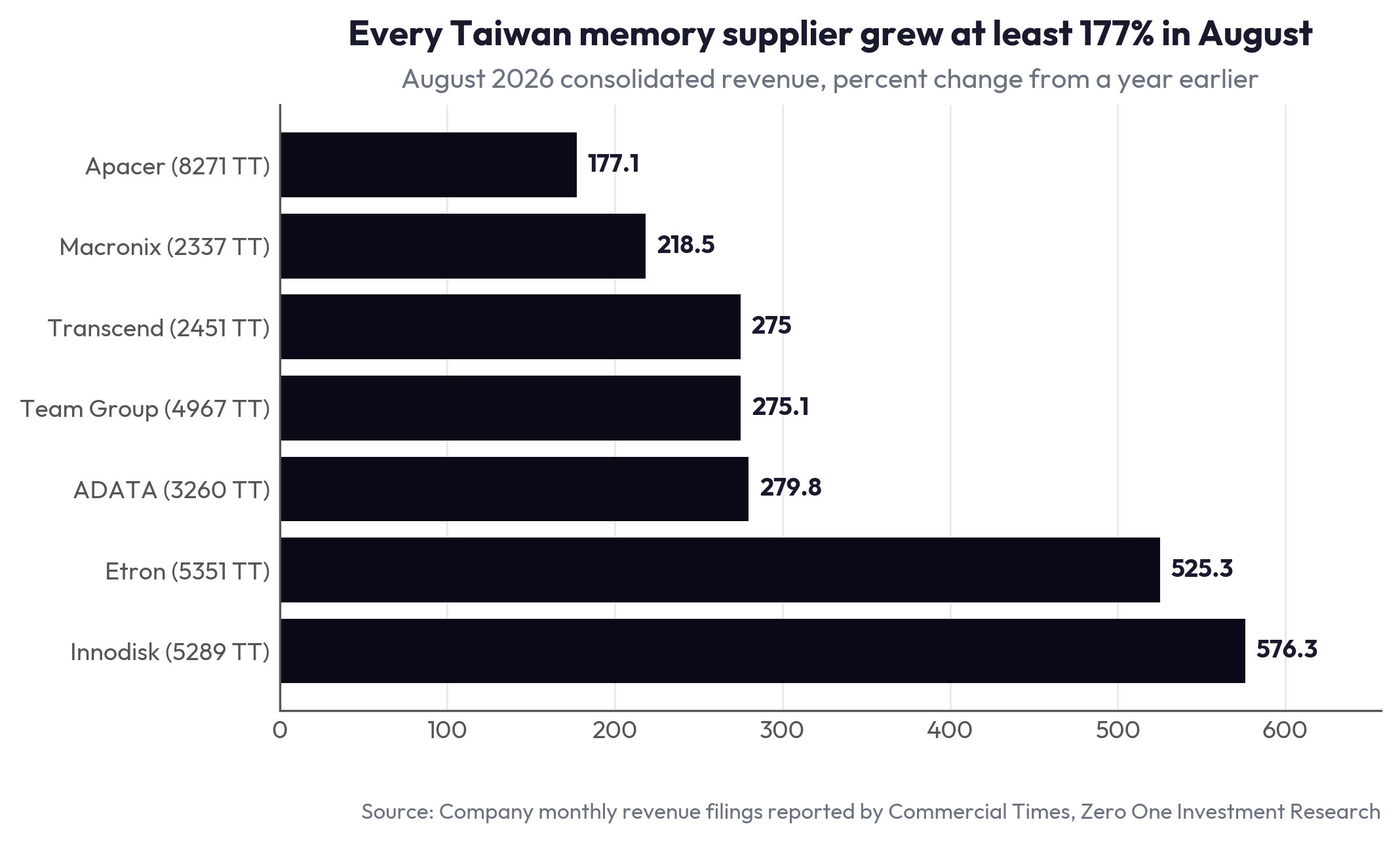
Seven Taiwan memory suppliers have now reported August revenue and every one of them grew more than 177% YoY, which puts the price cycle well past the three large DRAM makers and into the module and niche-memory layer.
Innodisk (5289 TT) led at 576.3% YoY, followed by Etron (5351 TT) at 525.3%, its fifth consecutive record month. ADATA (3260 TT) reported NT$18.93bn, up 279.8% YoY and a sixth straight record, taking its eight-month total past NT$100bn for the first time. Team Group (4967 TT) grew 275.1%, Transcend (2451 TT) about 275%, Macronix (2337 TT) 218.5% to a record NT$8.145bn, and Apacer (8271 TT) 177.1%.
The mix inside ADATA's month shows where the money is landing. DRAM was 69.3% of revenue and solid-state drives 26.6%, with SSD revenue at a record NT$5.03bn. Chairman Simon Chen said upstream supply of memory for non-AI applications remains tight, which is keeping prices on an upward path while personal computer, industrial control and channel demand rise at the same time.
These companies sell into personal computers, industrial equipment and retail channels rather than into AI servers. Their revenue therefore measures how far the AI-driven squeeze has now pushed into applications that have no AI content at all.
Linked stocks: 2337 TT, 3260 TT, 5289 TT, 2451 TT
AI chip sockets head toward 20,000 test pins
Winway Technology (6515 TT) put a number on how fast AI chips are outgrowing the equipment that tests them, and the progression explains why test interface pricing keeps rising.
Executive vice president Chen Shao-kun said a CPU package used to need roughly 5,000-6,000 pins in its test socket. AI chips now need 10,000-13,000, and the next generation may approach 20,000. Winway's HyperSocket platform handles up to 20,000 pins, which the company expects to cover mainstream high-end AI chips for about two more years, and average selling prices rise as pin counts do. Chen said the industry is limited by supply rather than demand, and that Winway will add roughly 50% more capacity between 2Q27 and 3Q27.
The revenue trail matches. Winway reported August revenue of NT$1.706bn, up 233.37% YoY and a third consecutive record. Powertech Technology (6239 TT) reported NT$8.557bn, up 24.46% YoY, and King Yuan Electronics (2449 TT) reported NT$4.08bn, up 31.58%, both second straight records. Powertech chief executive Hsieh Yung-ta pointed to rising average selling prices and higher utilization rather than volume alone.
Timing at one customer runs the other way. King Yuan had expected first silicon for NVIDIA's next-generation Rubin GPU to enter test late in 2Q26, but a thermal design change pushed volume testing to 4Q26. Analysts quoted by Liberty Times now expect the company's 3Q26 growth to land below the original plan and 4Q26 to rise about 20% QoQ.
Linked stocks: 6515 TT, 6239 TT, 2449 TT, NVDA US
AI switches and custom chips set Taiwan records
Accton Technology (2345 TT) passed NT$40bn of monthly revenue for the first time and Global Unichip (3443 TT) set a third consecutive record, with both companies pointing at named customer programs rather than general AI demand.
Accton reported August revenue of NT$40.872bn, up 59.42% YoY, taking its eight-month total to NT$246bn. July and August combined reached NT$80.342bn, which is 84% of the whole of 2Q26, and analysts cited by Liberty Times expect 3Q26 to clear NT$100bn for the first time, a rise of more than 20% QoQ. The drivers named are 800G switch shipments, 1.6T switches, optical circuit switches sold alongside full racks, and pull from the Trainium 3 program, Amazon's custom AI training chip.
Global Unichip reported NT$5.84bn, up 111% YoY, with eight-month revenue up 103.8%. The company guided 2H26 revenue momentum above 1H26 and expects cloud applications to hold near 80% of revenue, with an older cryptocurrency project shrinking and automotive work replacing it.
Global Unichip also said a next-generation AI project for a large North American cloud operator is scheduled for production between the end of this year and early 2027, and that it has already secured TSMC (2330 TT) capacity support for 2027. Foundry allocation is usually what decides whether a custom chip design ships on schedule, so the commitment carries more information than the monthly revenue does.
Linked stocks: 2345 TT, 3443 TT, 2330 TT, AMZN US
Samsung tests silicon photonics on TSMC certified probes
Samsung is validating its photonic integrated circuit wafers with the same two probe card suppliers TSMC certified for its own co-packaged optics platform, which routes a Korean entrant into silicon photonics through a Taiwanese and American toolchain.
Korean outlet TheElec reported that Samsung is using probe cards from FormFactor (FORM US) and MPI (6223 TT) to test photonic integrated circuit wafers. A probe card connects optical and electrical measurement equipment to the wafer to confirm that the optical components convert between electrical and light signals as designed. Industry sources told TheElec that Samsung aims to finish its own evaluation this year and to open a silicon photonics foundry service in 2027.
Qualification is what makes this narrow. TSMC used FormFactor and MPI probe cards to develop and validate COUPE, its co-packaged optics (CPO) silicon photonics platform, and those two remain the only suppliers to have cleared TSMC's co-packaged optics test qualification. A second large foundry entering silicon photonics therefore runs through the same short vendor list rather than widening it.
Test intensity is rising underneath this. A brokerage report cited by Economic Daily News notes that AI chip cycles are shortening while test time lengthens, that customers are adding more testers per project, and that probe card counts are moving from 30,000 toward at least 40,000, with the mix shifting to higher-margin microelectromechanical probes.
Linked stocks: 6223 TT, FORM US, 005930 KS, 2330 TT
先聲 First Word: Exclusives from Chinese-Language Sources
Realtek says it already has 3nm custom chip designs
Realtek (2379 TT) chairman Chiu Shun-chien said the company has custom networking chip designs at 3nm as well as 6nm, has Wi-Fi 8 in mass production with development moving to Wi-Fi 9, and is building optical communications intellectual property, with chip shipments reaching 2.5bn units this year. His caution matters for the rest of the Taiwan chain: he said the AI boom is pulling supply chain resources away from traditional consumer products. (08 Sep 2026) Source: 瑞昱:已布局3奈米ASIC
Nanya-backed memory startup lists on 16 September
PD Technology, 33.96% owned by Nanya Technology (2408 TT), lists on Taiwan's emerging stock board on 16 September at a reference price of NT$740, with 1H26 revenue of NT$1.088bn, up 248% YoY. It stacks DRAM vertically onto the processor using hybrid bonding, claiming 17 nanosecond latency and 144 GB/s per die. Chairman Ting Ta-kang notes compute has grown three times every two years for three decades while memory bandwidth grew 1.6 times, which is the gap the company is selling into. (07 Sep 2026) Source: TechNews
Samsung expands cheap phone output while rivals retreat
Samsung plans to expand production of mid-range and low-end smartphones, according to Korean outlet Maeil Business citing industry sources. Rivals are cutting output of low-priced handsets because rising memory prices have made them unprofitable, and Samsung's opposite move is described in the report as a play for share. It is a direct test of whether an integrated memory maker can absorb its own input costs where merchant buyers cannot. (08 Sep 2026) Source: 三星面對晶片通膨反其道而行 傳擴產平價A系列手機搶市佔

© 2026 Zero One Investment Research Pte Ltd. For informational purposes only. Not investment advice.