
TSMC commits to the US$400m chip tool it resisted as Intel pulls ahead
Zero One Investment Research Daily Intelligence Brief, September 9, 2026
TSMC commits to the US$400m chip tool it resisted as Intel pulls ahead
Top Market Signals
TSMC sets 2030 for the tool it resisted
TSMC (2330 TT) said it will put High NA EUV, the newest and most expensive lithography machine ASML (ASML NA) builds at roughly US$380m to US$410m each, into advanced-process volume production from 2030, and will work with ASML to replace the industry's 6 inch photomask with a 12 inch one. The photomask is the master pattern a scanner prints onto the wafer, and its size has not changed in decades.
The mask has to change because of the optics. High NA uses an anamorphic lens system to resolve finer circuit patterns, and the cost of that design is an exposure field roughly half the area of the previous generation. AI data center processors from NVIDIA (NVDA US) and Google already run to about 800 square millimeters, at the ceiling of a single print. On a 6 inch mask, a chip that size has to be built from two exposures joined by a seam, which costs wafer throughput and puts the defect risk exactly on the join. ASML chief technology officer Marco Pieters said industry-wide adoption of the 12 inch mask would raise High NA system productivity by up to 40%.
The schedule runs long. TSMC starts High NA volume production in 2030 on existing 6 inch masks, builds a 12 inch pilot line by 2031, and targets 12 inch High NA in advanced-process volume production in 2033. TSMC has not named the node. A14 is due in 2028, and A13 and A12 in 2029 on the current Low NA tools, which puts the first High NA critical layers on the generation after, reported as A10 or A11.
What is new is the commitment, not the technology. TSMC avoided public comment on High NA for years because its teams kept advancing the process without buying the tool, and chairman C.C. Wei's endorsement now signs Taiwan up to an infrastructure change rather than a purchase. Mask size touches design automation software, mask blanks, pellicles, writing and inspection and repair tools, and every handling system inside a fab, so the supply-chain read-through runs past the two chipmakers into that mask ecosystem, and the standard only moves if competitors coordinate on it. Intel and Samsung have joined the same 12 inch initiative, which is what gives the standard enough volume for suppliers to invest behind it.
Linked stocks: 2330 TT, ASML NA, INTC US, NVDA US
Intel's lithography lead now measures a million wafers
Intel (INTC US) Foundry said it and ASML have run more than one million wafers through High NA EUV, including production layers of Intel 18A and of Panther Lake, the Core Ultra Series 3 processor. Intel is the only chipmaker shipping products built with the tool.
Intel said overlay accuracy, throughput and tool availability have all met its expectations, and that 18A products using High NA on selected layers perform at or above the matching layers made on ASML's current 0.33 NA platform. That last claim is the one that matters. The case against buying early was that a halved exposure field and an unproven machine would cost more than the resolution was worth, and a million wafers of production data is the first evidence either way.
Samsung Electronics (005930 KS) is entering from the other end of the business. It said it will put High NA into DRAM volume production in 2028, before any logic use, and it has joined the 12 inch mask initiative. SK Hynix (000660 KS) is still evaluating, also targeting 2028. Memory is a different bet from TSMC's: DRAM's repeating cell patterns make the resolution gain easier to bank than the mixed critical layers of leading-edge logic, and it lets Samsung learn the tool on its own product before offering it to foundry customers.
Intel is solving the field-size problem in the meantime rather than waiting for the bigger mask. It offers customers reticle stitching plus process design kit support, so a chip can either be planned to fit inside one 6 inch mask or stitched across two, today. Intel said it has pushed the larger mask standard for more than three years, and that the current work is preparation for Intel 14A. Whether the lead converts into anything depends on 14A customer commitments, which is the next thing to look for.
Linked stocks: INTC US, ASML NA, 005930 KS, 000660 KS
Arm lines up 80 partners for robot chips
Arm (ARM US) expanded its Arm Total Design for Physical AI program to more than 80 companies, and put the compute market for physical AI at about US$25bn last year, rising above US$200bn a year by 2030. TSMC, Realtek (2379 TT), Artery Technology, AAEON, Everfocus, NEXCOM's NexCOBOT unit, Insyde Software and VicOne are all listed partners.
The Taiwanese entries are the part to watch. TSMC, Realtek and Artery sit in the silicon group, and Artery enters through microcontrollers. That placement is the point: a robot does not run on one high-performance AI processor. Motor control, joint actuation, sensor capture and real-time control each need their own controllers working together, and as a robot gains degrees of freedom the number and the performance requirement of those low-level chips rise with it. Taiwan's microcontroller makers have sold mostly into industrial and consumer equipment, and this moves them toward machine control.
Realtek's inclusion is about networking. Its business is Ethernet, Wi-Fi, Bluetooth, audio and connectivity silicon. A physical AI device needs central compute and also constant real-time links, and as robots move from standalone units to group operation with edge processing and cloud management, the connectivity content per unit goes up rather than down.
Arm named latency as the main thing separating physical AI from phone and cloud AI. The loop from a sensor reading to a decision that drives a motor, a brake or an arm has to close in a very short time, and drones and robots are weight and power sensitive, which makes performance per watt the competitive measure, ahead of raw throughput. Arm also said it is building a robot capability grading framework as a shared language for developers, chip firms and system makers. That is the part worth tracking, because whoever sets the grading standard shapes which suppliers get specified into a design.
Linked stocks: ARM US, 2379 TT, 2330 TT
Quanta sets a record and guides notebooks down
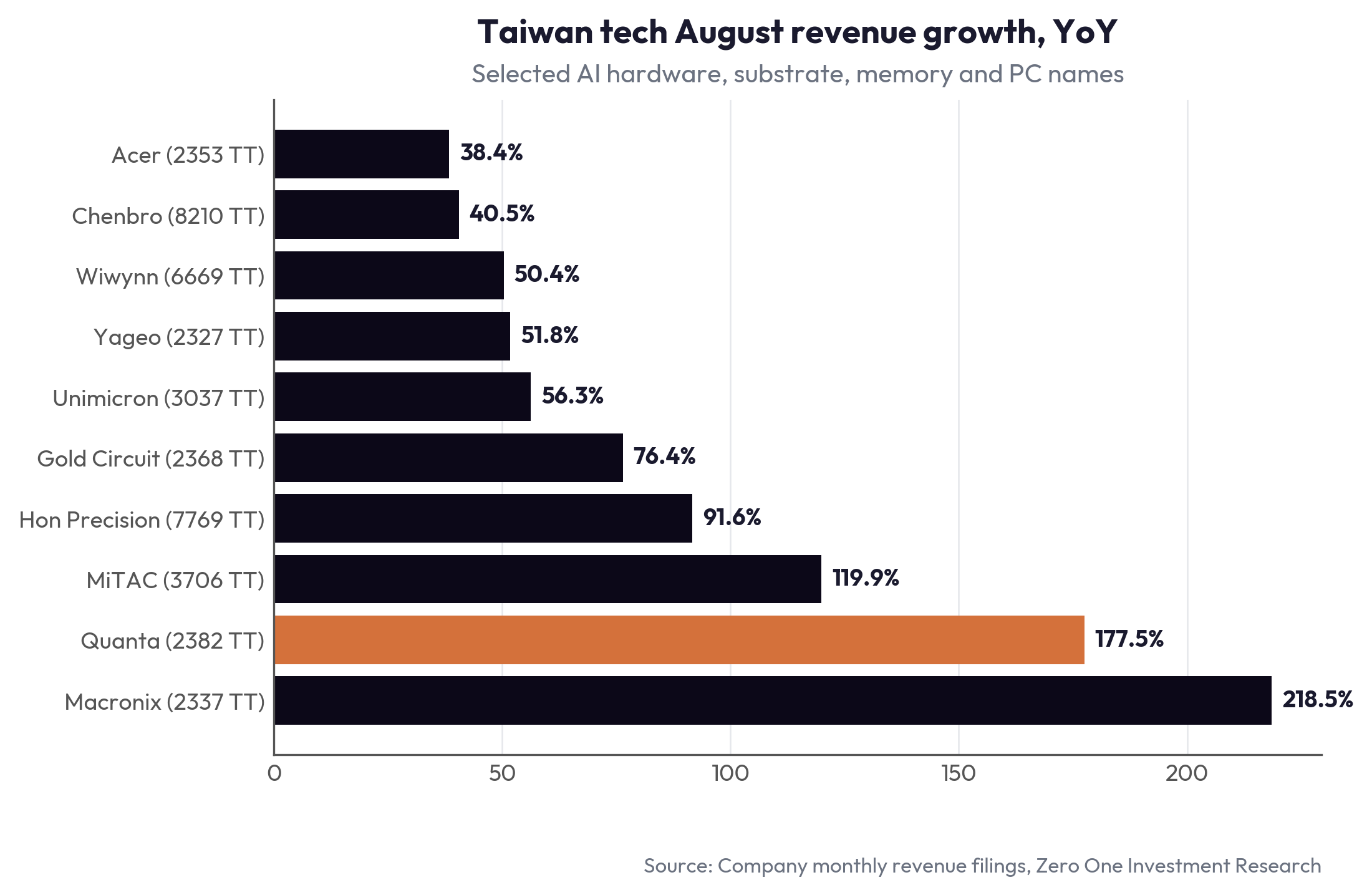
Quanta Computer (2382 TT) posted August consolidated revenue of NT$423.97bn, up 15.8% MoM and 177.5% YoY and its highest month on record, and guided its notebook business to a double-digit decline for the full year.
The AI server side carried it. Eight-month revenue reached NT$2,636.06bn, up 102.63% YoY, after passing NT$2tn in the first seven months alone. Management said AI server revenue will still grow QoQ in 3Q26 and kept its full-year targets of doubling AI server revenue and double-digit growth in general servers. Shipments are still mostly GPU platforms; small sample volumes of the next platform ship late in 3Q26, with the changeover landing in 4Q26.
The notebook side went the other way in the same month. Quanta shipped 2.6m notebooks in August, down 7% MoM, and said second-half pull-in demand had already been brought forward, leaving the traditional peak season under pressure. It expects 3Q26 shipments to fall more than 20% QoQ and the second half to come in below the first. A record month and a guided annual decline in the same release is worth separating, because the consolidated revenue line now moves almost entirely on AI servers.
The peers moved with it. Wiwynn (6669 TT) posted NT$144.31bn, up 22.62% MoM and 50.36% YoY, also a record, taking eight-month revenue to NT$816.66bn, up 42.8%. Wiwynn's AI server mix leans toward custom ASIC projects rather than GPU platforms, and it said cloud service provider customers have again raised both capex plans and their forecasts to it. MiTAC Holdings (3706 TT) reported NT$13.56bn, up 119.9% YoY.
Linked stocks: 2382 TT, 6669 TT, 3706 TT, NVDA US
Broadcom's substrate line reads as supply insurance
Unimicron (3037 TT) posted August revenue of NT$17.75bn, up 9.2% MoM and 56.3% YoY, its fifth consecutive record month, as Morgan Stanley told clients that Broadcom's (AVGO US) new Singapore substrate capacity buys in outside supply, with no move to make its own.
Broadcom said on a recent earnings call that it is building substrate capacity with a partner at its Singapore site, and Morgan Stanley said clients had asked whether Nan Ya PCB (8046 TT) would lose share as a result. Its checks point to AST, the joint venture Broadcom has run with Japan's Toppan since March 2024, and read the purpose as securing FC BGA (flip-chip ball-grid array, the substrate that carries a large processor die) supply, with no shift to in-house production. On that reading the supply positions of Unimicron and Nan Ya PCB are largely unchanged.
The demand data underneath is still tightening. Unimicron's ABF (Ajinomoto Build-up Film, the material used in high-end IC substrates) line grew fastest of its products in 2Q26, lifting ABF from 49% of revenue to 52%, with ABF revenue up 22% QoQ and 51% YoY. AI products were 40% of its substrate revenue in 2025 and it plans 60% this year, with the group AI share targeted above 60% and rising toward 70% in 2H26. Eight-month revenue reached NT$114.33bn, up 34.1%.
Where the two houses split is on price. Morgan Stanley attributes the increases since 2H25 to raw material costs, T-glass, gold and copper, and expects T-glass supply limits to peak this year and ease from 2027 as more suppliers qualify, which would flatten cost-driven rises. Daiwa takes the other side on BT substrates, arguing that as two major producers cut BT capacity, unit prices accelerate again. Gold Circuit Electronics (2368 TT), which makes the boards rather than the substrates, posted August revenue of NT$10.38bn, up 76.4% YoY and a record.
Linked stocks: 3037 TT, 8046 TT, AVGO US, 2368 TT
Huawei runs the program behind China's own scanners
Huawei is coordinating China's domestic deep ultraviolet lithography effort across the scanner, the lens and the light source, according to a Financial Times report carried by Taiwan's Economic Daily News. DUV is the older, cheaper generation of chip printing tool that sits below EUV, and it is the level China is trying to reach on its own.
The first advanced domestically built DUV scanner, co-developed by Yuliangsheng, has been tested on lines at SMIC (981 HK) and at Huawei itself, with the stated goal of producing advanced AI chips. Yuliangsheng was spun out of SiCarrier, a company closely tied to Huawei, and is developing several DUV prototypes with Shanghai Micro Electronics Equipment. SMIC has tested Yuliangsheng's 28nm tool and used multipatterning, printing several coarser layers on top of each other, to produce 7nm chips.
The investments reach into the two hardest components. Huawei's Hubble Investment and Huawei-backed Shenzhen Yuanzhi Xinghuo have both put money into Fujian Zhiqi Photonics, an ultra-precision optics firm under Fuji Crystal that is developing a scanner lens meant to replace Germany's Zeiss. Hubble has also invested in Beijing RSLaser, which is working with Shanghai Micro Electronics Equipment on a light source for a 28nm DUV scanner to replace products from Japan's Gigaphoton and ASML's own Cymer.
A Bernstein semiconductor analyst quoted in the report described Huawei's role as project management, and made the qualification that matters: a prototype is not the achievement, because thousands of suppliers and customers have to be integrated to improve the machine, and Huawei is becoming the body coordinating that. The report added that domestic tools may still need several years of validation and tuning to reach ASML-class production efficiency. Set against the same day's news, the distance is easy to read: TSMC, Intel and Samsung are coordinating a mask standard for 2033, while China's program is working to qualify a 28nm scanner.
Linked stocks: ASML NA, 981 HK, 2330 TT
Korea's chip build could need 20 reactors
South Korea's climate, energy and environment minister Kim Sung-hwan said AI-related demand alone will add 25GW to 30GW to national electricity demand in the coming years, driven by Samsung Electronics (005930 KS) and SK Hynix (000660 KS) capacity expansion and by new AI data centers.
If that increment were met entirely by nuclear, it would equal roughly 20 reactors at Korea's current design standard. Korea operates 26 reactors today, and nuclear supplies under a third of national electricity demand. On top of the AI load, Kim cited the shift from combustion engines to electric vehicles and from gas to electric heating as further sources of domestic demand growth.
The schedule is the new part. Samsung and SK Hynix have committed to new plants in southwestern Korea as part of a KRW800tn, about US$590bn, program announced this year. Kim said the plan was originally set for completion around 2045 and has been sharply accelerated, and is now due in the early 2030s. A build pulled forward by more than a decade puts the demand in place well before any newly approved reactor could be commissioned.
Korea publishes an updated long-term energy roadmap next month, extended by two years to 2040, and whether it commits to new reactors is the open question in it. Kim said the number is under expert review and declined to give one, while calling nuclear indispensable to the generation mix. The roadmap is where the power side of Korea's memory expansion either gets funded or does not.
Linked stocks: 005930 KS, 000660 KS
先聲 First Word: Exclusives from Chinese-Language Sources
Samsung's glass substrate slips on TSMC validation
Samsung Electro-Mechanics may delay mass production of glass substrates again and is considering slowing its investment, after the reliability evaluation of the through-glass-via module it submitted to TSMC ran behind schedule. Glass is the leading candidate to replace organic ABF substrates under very large AI packages, so a slip here leaves the incumbent substrate makers with a longer runway. (08 Sep 2026) Source: 三星電機玻璃基板量產恐再延 傳台積TGV驗證延遲、擬放緩投資
Hon Precision ships CPO test equipment from October
Hon Precision (7769 TT) expects to begin shipping co-packaged optics equipment in October, alongside continued back-end test demand from high-end AI GPUs and custom ASICs. CPO puts the optical engine next to the switch or accelerator chip, and the test tooling has to be qualified before any of it ships in volume. (09 Sep 2026) Source: 熱門股》鴻勁CPO設備 10月出貨
Yageo's August revenue sets a monthly record
Yageo (2327 TT) reported August revenue of NT$16.33bn, up 1.2% MoM and 51.8% YoY and a monthly record, with eight-month revenue of NT$115.09bn, up 34.9%. The company said AI applications and Asian demand held through the European and US holiday period, with both standard and specialty products growing. Yageo is Taiwan's largest passive component maker, so its monthly print reads across the hardware build rate. (09 Sep 2026) Source: 營收速報》AI需求強 國巨*8月營收創新高

© 2026 Zero One Investment Research Pte Ltd. For informational purposes only. Not investment advice.