
Memory makers sell 2027 early as phone shipments fall 20%
Zero One Investment Research Weekly Intelligence Brief, Week ending October 17, 2026
Top Market Signals
Samsung commits nearly 80% of 2027 memory on five-year contracts
Samsung Electronics (005930 KS) has signed five-year contracts covering close to 80% of its expected 2027 memory capacity, Korean media reported, with NVIDIA (NVDA US), Google and Microsoft among the main customers. Micron (MU US) opened its second advanced packaging and test plant in Taichung on 15 Oct and said the plant's 2027 capacity is already sold out.
Buyers are locking in supply at high prices. Nanya Technology (2408 TT) said its average DRAM selling price rose more than 60% QoQ in 3Q26 while shipments fell about 4% to 6%. Its gross margin reached a record 85.7%. Long-term agreements now cover 50% to 70% of Nanya's capacity, and some customers have asked for terms of three years or more.
Two arguments against the shortage came up last week. Broadcom (AVGO US) CEO Hock Tan said on 12 Oct that the memory shortage may no longer be a problem a year from now. CXMT, a leading Chinese DRAM maker, plans a server memory module on a denser 4F² cell, which fits 30% to 50% more memory cells in the same chip area, before the end of 2026. Phison (8299 TT) CEO K.S. Pua answered that verification, yield and volume ramp all take time, and that supply is severely short.
New supply may also arrive later. SK hynix (000660 KS) has pushed part of the HBM4 (high-bandwidth memory, stacked beside AI processors) back-end tool orders it planned for 2H26 into 2027, DigiTimes reported; SK hynix has not confirmed it. DigiTimes Asia tied it to rising conventional DRAM prices, which give SK hynix a competing use for its capital.
Linked stocks: 005930 KS, MU US, 2408 TT, 000660 KS
TSMC's 2nm share nearly triples to 8% of wafer revenue
TSMC (2330 TT) said 2nm chips made up 8% of wafer revenue in 3Q26, up from 3% in 2Q26, and the ramp cut gross margin 1.3 points QoQ to 66.4%. Revenue of US$46.72bn still beat the top of its own guidance. TSMC raised its full-year US dollar revenue growth forecast to about 44%, its third increase this year.
Server chips are joining phone chips on the new node. AMD's (AMD US) Venice server CPU is the first high-performance computing product in 2nm volume production. Microsoft (MSFT US) said its Maia 300 chip, with compute chiplets on TSMC's N2P process, will be the main system running AI models for its own services from 2027. TSMC plans 2027 2nm capacity at more than double 2026.
TSMC is also adding 3nm capacity it would normally skip. Chairman C.C. Wei said TSMC will build another 3nm fab in Tainan for volume production in 1H28, although it usually stops adding capacity once a node reaches its target. TSMC kept 2026 capex at US$60bn to US$64bn and said 2026 to 2028 capex will be significantly higher than in the prior three years.
Wei also said TSMC will plan 2027 cautiously, because rising component prices are weighing on consumer and price-sensitive markets. Its 4Q26 revenue guidance of US$52.3bn to US$54.3bn implies about 14% QoQ growth at the midpoint.
Linked stocks: 2330 TT, AMD US, MSFT US
ASML raises guidance a third time as customers ask for 2030 tools
ASML (ASML NA) reported record 3Q26 revenue of EUR11.66bn, up 55% YoY, and raised full-year guidance for the third time this year, to EUR44bn to EUR45bn. CEO Christophe Fouquet said the capacity ASML planned for 2027 and 2028 may not fully meet demand, and that some customers want to place orders for 2029 and even 2030.
ASML had planned to raise capacity for its standard EUV tools (extreme ultraviolet lithography, the machines that print the finest chip features) by 30% in 2027 and another 30% in 2028. Fouquet called that clearly not enough and said ASML is studying how to add more for 2028.
Applied Materials (AMAT US) said cleanroom space is what holds equipment sales back. Fabs cannot be built fast enough for the demand, and Applied tracks more than 100 fab projects worldwide when it forecasts. TSMC alone has nearly 20 fabs under way, 13 of them advanced fabs and packaging plants in Taiwan.
Taiwan suppliers work on both the tools and the buildings. Marketech (6196 TT) builds EUV subsystem modules for ASML and, with United Integrated Services (2404 TT), takes fab construction work for TSMC. Gudeng (3680 TT) makes the pods that carry and store EUV masks.
Linked stocks: ASML NA, AMAT US, 6196 TT, 3680 TT
NVIDIA prepays KYEC for US testing as packaging prices rise up to 30%
King Yuan Electronics (2449 TT), known as KYEC, signed an agreement on 13 Oct under which NVIDIA (NVDA US) pays in advance for test capacity that KYEC builds in the US and reserves for NVIDIA. The prepayment is repaid through future test fees, and neither company disclosed the amount. KYEC's board approved a US plant of up to US$1.4bn in July, with small-volume operation planned from 2028.
The structure moves the risk of the US build toward the customer. KYEC cancelled a US$300m guarantee line it no longer needs. NVIDIA reserved back-end capacity at Amkor (AMKR US) in July, and advance payments from NVIDIA and others are helping fund Samsung Electro-Mechanics' substrate expansion.
Back-end capacity is short enough to lift prices. Taiwan packaging and test companies are raising prices 10% to 30%, and small customers with rush orders pay up to double, industry sources told Economic Daily News. ASE Technology's (3711 TT) packaging, testing and materials revenue rose 20.1% QoQ in 3Q26, against its guidance of 11% to 13%. Analysts estimate NVIDIA's Rubin chips need more than 50% longer test time than Blackwell.
Sigurd (6257 TT) is buying a NT$2.19bn Hsinchu plant that adds 25% to group test capacity.
Linked stocks: 2449 TT, NVDA US, 3711 TT, 6257 TT
Global phone shipments fall 20% as memory reaches 40% of parts cost
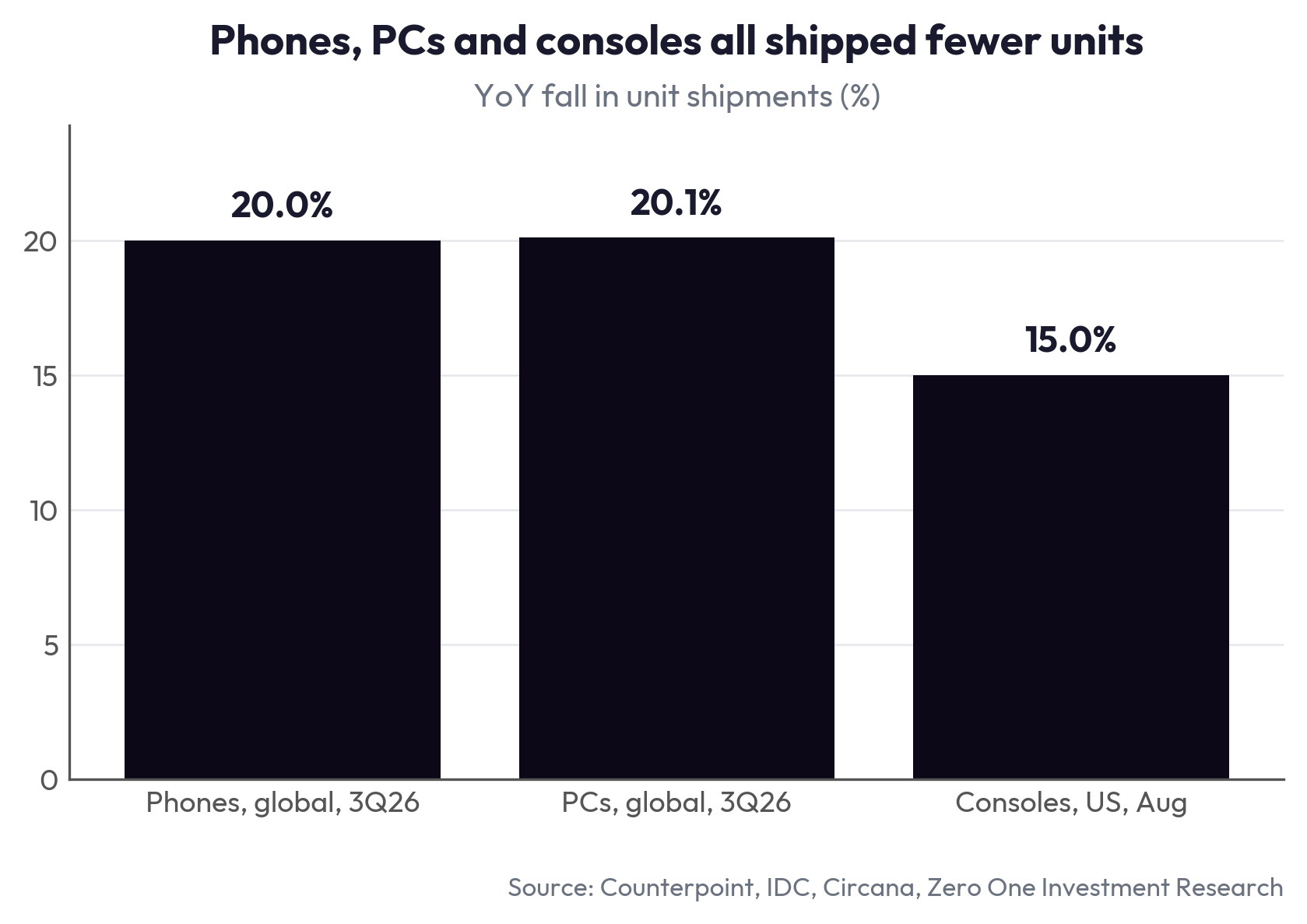
Global smartphone shipments fell 20% YoY in 3Q26 to the lowest third quarter since 2012, Counterpoint's preliminary data show. Counterpoint blamed higher memory costs, which pushed phone makers to raise prices and ship fewer units. Memory now makes up 30% to 40% of the parts cost of a mainstream 8GB/256GB phone, up from about 10% to 15%, research firms cited by Commercial Times estimate.
Cheaper phones fell hardest. Xiaomi (1810 HK) shipped more than 30% fewer phones, while Samsung Electronics (005930 KS), with steady parts supply for its mid-range models, fell only 3%. PCs moved the same way: IDC data show global PC shipments fell 20.1% YoY in 3Q26.
Chip prices are still rising into those devices. Intel (INTC US) has raised high-end Panther Lake PC processor prices by 15% to 20% since 1 Sep, its third round of increases. An explosion at Intel's Kiryat Gat plant in Israel on 14 Oct killed two workers. Intel has not said whether output is affected, and PC brands including Acer (2353 TT) and ASUS (2357 TT) are looking for other sources.
Linked stocks: 1810 HK, 005930 KS, INTC US, 2357 TT
Anthropic's quarter runs above OpenAI's pace as CoreWeave bond yields pass 15%
Anthropic told prospective investors its 3Q26 revenue reached US$16.8bn, Bloomberg reported on 14 Oct, or about US$67bn a year when multiplied by four. The Financial Times put OpenAI's annualized revenue at about US$50bn at the end of September. The measures differ: Anthropic's is a full quarter times four, OpenAI's a run-rate at one point in time. Anthropic is preparing an IPO at a valuation of about US$2tn, Bloomberg reported.
Credit cost more for two of the largest AI spenders. Yields on CoreWeave's (CRWV US) bonds rose above 15%, Bloomberg reported, and its five-year credit default swaps, a form of insurance against default, imply a more than 60% chance of default. NVIDIA CEO Jensen Huang said CoreWeave's funding costs are falling and NVIDIA does not need to back it. SoftBank (9984 JT), which has committed US$64.6bn to OpenAI, sold a 2034 bond last month at a 9.75% coupon, its highest ever.
Broadcom's Hock Tan named capital, ahead of chips, memory or power, as the likely biggest limit on AI growth.
Linked stocks: GOOGL US, AVGO US, CRWV US, 9984 JT
NVIDIA's China AI chip share falls to 34% as Huawei reaches 28%
NVIDIA (NVDA US) shipped 44% fewer AI accelerators to China's data centers in 1H26, IDC data reported by Reuters show, while Huawei's shipments rose to 572,000. ByteDance, which cannot buy NVIDIA's most advanced chips, is in final-stage talks to buy custom data center chips from MediaTek (2454 TT), Bloomberg reported, which would make it MediaTek's second major data center AI chip customer after Google.
Linked stocks: NVDA US, 2454 TT, 688256 CH

© 2026 Zero One Investment Research Pte Ltd. For informational purposes only. Not investment advice.