
Memory shortage moves Intel's lines to servers as Microsoft borrows US$25bn
Zero One Investment Research Daily Intelligence Brief, October 30, 2026
Memory shortage moves Intel's lines to servers as Microsoft borrows US$25bn
Top Market Signals
Memory shortage moves Intel's capacity to servers
Intel (INTC US) guided 4Q26 below expectations because soaring memory prices are cutting PC demand, and it will take capacity used for Panther Lake laptop chips offline to build more Granite Rapids data center CPUs, CFO David Zinsner said on the 29 Oct call. A fatal explosion at its Kiryat Gat fab in Israel adds a second hit.
The forward guide is what moved the shares down about 21% after a quarter in which revenue rose 21% to US$16.5bn and data center revenue grew about 78%. Zinsner said Intel is "not optimistic about next year in terms of memory" and does not expect supply to improve in 2027, The Verge reported. CEO Lip-Bu Tan said PC makers are "aggressively managing inventory to match softer sell-through," Tom's Hardware reported.
The fab blast is the smaller, shorter problem. Zinsner told Reuters Intel cut 4Q26 revenue guidance by about US$300m and gross margin by about 200 basis points because of it, and expects a similar revenue hit in 1Q27, Central News Agency reported. The plant makes data center chips on Intel's 10nm process and was restarting after a two-week stop.
Demand is moving to the cheapest chips. Intel's low-cost Wildcat Lake laptop chips are sold out, and products on its 18A process now make up a third of client CPU revenue, up from under 5% in 1Q26. The same squeeze is hitting phones: global smartphone shipments fell 20% in 3Q26, the lowest third quarter since 2013, research firm Omdia said. Zinsner left 2028 open as the first year memory supply could improve; until then, Intel is putting its scarce capacity behind servers.
Linked stocks: INTC US, AMD US, 4062 JT, 005930 KS
Microsoft borrows US$25bn while still generating cash
Microsoft (MSFT US) plans to raise about US$25bn in its first US investment-grade bond sale since 2017, in up to 10 tranches running from 2 to 40 years, Reuters reported, citing people familiar. Orders passed US$100bn, more than four times the size of the deal.
Microsoft is the one large cloud provider that still expects positive free cash flow for its fiscal year to June 2027, and it is borrowing anyway. CFO Amy Hood said on the 28 Oct call that Microsoft would seek other funding sources when terms were attractive, to keep cash flow and financial flexibility. Its peers are spending cash faster than they make it: Alphabet (GOOGL US) burned US$9.07bn in 3Q26, and Amazon's (AMZN US) free cash flow over the 12 months to September was negative US$42.4bn.
AI chip suppliers are also lending their balance sheets. NVIDIA (NVDA US) is in talks to provide credit guarantees for an Nscale data center facility planned for Anthropic, Bloomberg reported; The Information put the project at US$45bn. Our 27 Oct 2026 Blade flagged Broadcom arranging US$63bn of bank and Blackstone financing for the Broadcom chips Anthropic uses. Today's NVIDIA talks repeat that pattern, with the chip seller standing behind its customer's debt.
The test is whether bond buyers keep this demand as the cash burn spreads. Amazon CEO Andy Jassy said 2027 capex will rise significantly from 2026.
Linked stocks: MSFT US, GOOGL US, AMZN US, NVDA US
Amazon will sell Trainium chips outside AWS
Amazon (AMZN US) plans to make Trainium, its in-house AI chip, available outside Amazon Web Services (AWS) by the end of 2027, CEO Andy Jassy said on the 29 Oct call, because customers kept asking for it. Amazon would join Google (GOOGL US) in selling a cloud provider's own AI chip to outside buyers.
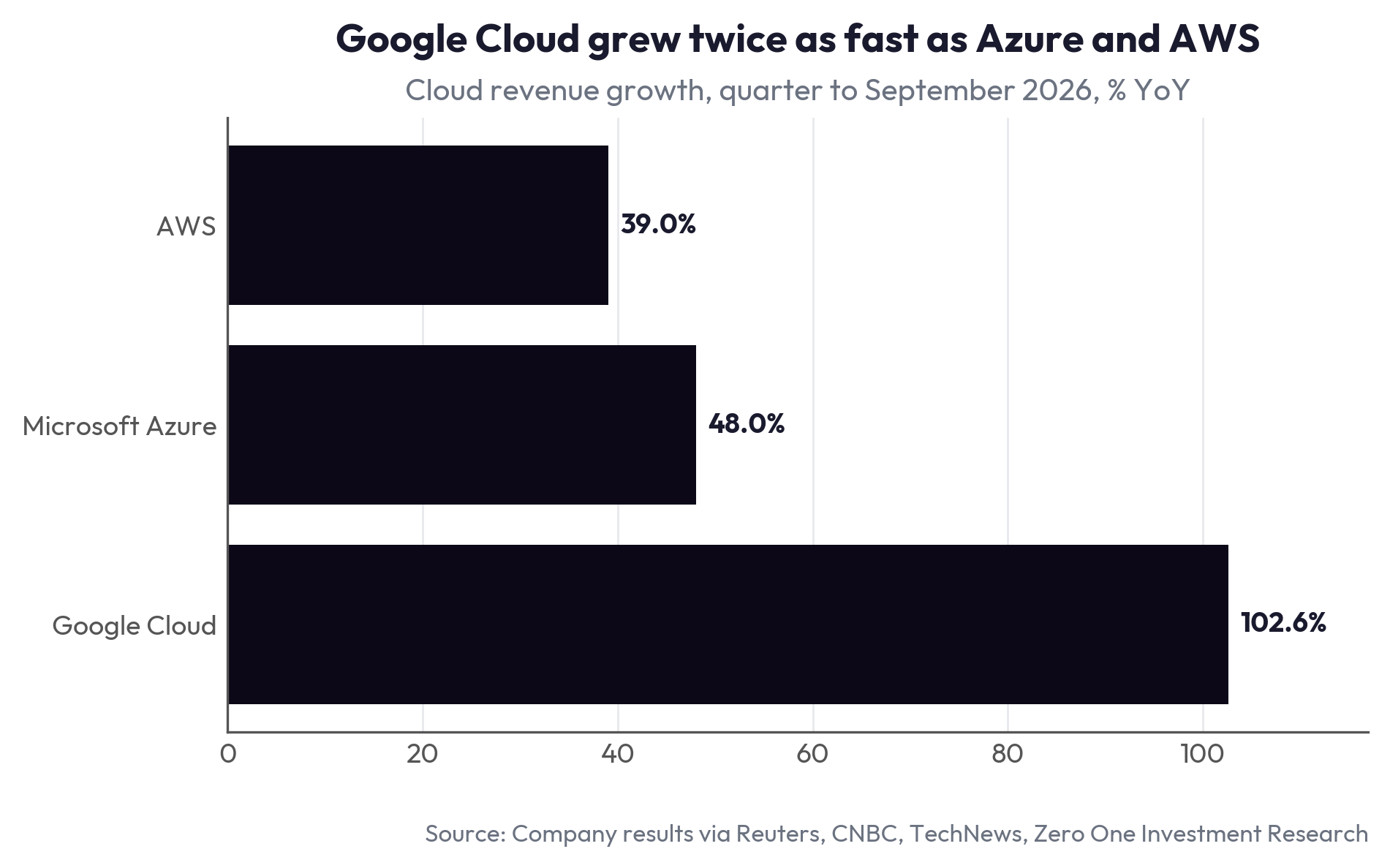
AWS revenue rose 39% YoY to US$45.98bn in 3Q26, its fastest growth since 2021 and up from 37% in 2Q26, and operating profit rose 55% to US$17.77bn. Jassy said he expects AWS to grow more than 40% in both 2027 and 2028.
The step follows Google's run of outside wins. Our 29 Oct 2026 Blade reported OpenAI plans to buy Google's TPUs, and on 28 Oct we reported about half of Anthropic's US$807bn compute commitment is tied to them. Trainium sold outside AWS gives NVIDIA (NVDA US) a second cloud provider competing for the same buyers. How fast it happens depends on chip supply, and Amazon gave a date but no volume.
Linked stocks: AMZN US, GOOGL US, NVDA US, 2330 TT
ASE expects full CoWoS sales to pass US$1bn
ASE Technology (3711 TT) expects revenue from full-process CoWoS, where it runs every step of the chip-on-wafer-on-substrate packaging used for AI chips, to rise from about US$300m in 2026 to more than US$1bn in 2027, it said on its 29 Oct call.
ASE raised its 2026 target for LEAP, its advanced packaging and test business, to more than US$4bn from US$3.7bn and expects it to double in 2027. Co-packaged optics (CPO), which puts the optical parts beside the switch chip, enters volume production in 4Q26 and should bring in more than US$500m in 2027. CFO Joseph Tung said capacity still cannot meet demand.
Floor space now limits the build. ASE lifted 2026 capex for the third time, to US$11.5bn from US$10.5bn, with half of the extra US$1bn going to buildings, and has 22 plant projects underway in Taiwan while it looks for existing buildings to buy. TSMC (2330 TT) is buying them too: AUO (2409 TT) confirmed on 29 Oct it will sell two Taichung panel fabs to TSMC for NT$38.8bn, after our 29 Oct 2026 Blade reported the deal near at more than NT$20bn.
Linked stocks: 3711 TT, 2330 TT, 2409 TT
Marvell nears a record deal for Lumentum
Marvell Technology (MRVL US) is in talks to buy Lumentum (LITE US), the maker of the lasers inside optical links for AI data centers, and a deal could be announced as soon as next week, Bloomberg reported, as carried by Economic Daily News. Lumentum is worth about US$83bn, so the deal would pass Microsoft's US$69bn purchase of Activision Blizzard as the largest technology acquisition.
The logic is one supplier for the whole optical link. Marvell sells the networking and signal-processing chips; Lumentum makes the EML and continuous-wave lasers and optical modules. Together they could offer complete co-packaged optics, the market where Broadcom (AVGO US) already sells a full set. NVIDIA invested US$2bn in Lumentum earlier this year.
Taiwan suppliers are already gaining from the reshuffle. As Lumentum and Japanese makers move capacity from light detectors to lasers, Taiwan's Ding Yuan (2426 TT) is taking their detector orders, and some detector prices have risen about fivefold. Shunsin (6451 TT), Foxconn's optical packaging unit, is producing 51.2T CPO in small volumes. No agreement has been signed, and terms could change.
Linked stocks: MRVL US, LITE US, AVGO US, 6451 TT
Samsung's 2nm foundry orders more than double
Samsung Electronics (005930 KS) expects 2nm foundry orders this year to more than double from last year after winning new projects from large cloud providers and AI chip customers in 2Q and 3Q, it said on its 29 Oct results call. It expects AI and high-performance computing to exceed 50% of foundry sales in 2027.
Samsung is locking these customers in with long-term agreements. Foundry results improved in 3Q26 on demand for HBM base dies, the logic chip at the bottom of each high-bandwidth memory stack, and it expects double-digit sales growth in 4Q26 as volumes of its second-generation 2nm mobile chips rise.
The group's operating profit rose 783% YoY to KRW107.44tn on revenue of KRW195.25tn, and Samsung said its 2027 HBM supply is sold out. Faraday Technology (3035 TT) is one of the new 2nm customers: our 29 Oct 2026 Blade reported its 2nm AI chip for a US cloud company will be made at Samsung's foundry. The shares still fell more than 4% because net profit missed estimates and the new shareholder return plan was pushed to end-January. The 2nm read firms up if those cloud projects reach volume in 2027.
Linked stocks: 005930 KS, 000660 KS, 2330 TT, 3035 TT
Capacitor makers move AI buyers to long contracts
Samsung Electro-Mechanics (009150 KS) is negotiating long-term supply contracts with 50 customers for multilayer ceramic capacitors (MLCC), the tiny parts that steady power on every circuit board, and expects AI server MLCC demand in 2027 to reach about eight times the 2026 level, DigiTimes reported. Its 3Q26 revenue and operating profit were the highest since it was founded.
Taiwan's Yageo (2327 TT) reported the same tightness on 29 Oct. Its 3Q26 net profit rose 88.5% YoY, AI now makes up nearly 20% of revenue, and utilization on both its standard and specialty lines will exceed 95% in 4Q26 with book-to-bill ratios above 2. Some customers bid against each other to switch supply.
Distributor stock is falling. Global distributor inventory dropped from about five months to four over the past three months, and Greater China has stayed below two months, Yageo said. Buyers signing multi-year contracts are planning for supply to stay short beyond 2027.
Linked stocks: 009150 KS, 2327 TT, 2492 TT
先聲 First Word: Exclusives from Chinese-Language Sources
I-Chiun is one of two NVIDIA chip lid suppliers
I-Chiun Precision (2486 TT), once the world's top maker of LED lead frames, is one of only two companies supplying NVIDIA with the metal heat spreader lids packaged onto its AI chips; the other is Jentech (3653 TT). I-Chiun passed NVIDIA qualification in 2024 after 15 years of moving its metal stamping skills into chip cooling, and its parts are also used on Google and Amazon in-house AI chips. (29 Oct 2026) Source: 從股價8元到打進輝達! 一詮靠15年黑手功夫 卡位AI散熱核心
Foxconn doubles AI rack output to 2,000 a week
Foxconn (2317 TT) can now build 2,000 AI server racks a week, double the 1,000 a year ago, chairman Young Liu said at its 30 Oct Tech Day. A cableless design developed with NVIDIA cuts assembly of a Vera Rubin compute tray from about two hours to 20 minutes, and Foxconn has built automated fiber alignment lines to take co-packaged optics into volume. (30 Oct 2026) Source: 鴻海董座劉揚偉:輝達 VR 平台高精密度的秘訣 AI 機櫃周產達2,000個
PSMC fills TSMC's packaging gaps with DRAM-made capacitors
Powerchip (6770 TT) is acting as a second source for a key customer while TSMC's interposer capacity stays short, its chairman said, using its DRAM heritage to make silicon capacitors far denser than a logic line can. These thin capacitors sit inside interposers or ABF substrates to steady power for AI chips, giving a mature-node foundry a role in advanced packaging. (30 Oct 2026) Source: 謝再居:成熟製程與 DRAM 核心技術跨界整合使力積電跟隨 AI 發展賺錢

© 2026 Zero One Investment Research Pte Ltd. For informational purposes only. Not investment advice.