
SK hynix sells out its memory through 2029 as UMC plans 10% price rises
Zero One Investment Research Daily Intelligence Brief, October 29, 2026
SK hynix sells out its memory through 2029 as UMC plans 10% price rises
Top Market Signals
SK hynix sells its memory out through 2029
SK hynix (000660 KS) said its DRAM and HBM (high-bandwidth memory, the stacked memory beside AI chips) capacity is effectively sold out through 2029, and customers are asking for more than twice what it can supply, Commercial Times reported after its 28 Oct results. The company expects the shortage to last into 2030.
The sell-out rests on long-term contracts. SK hynix has long-term supply agreements with 14 core customers, including the major cloud providers, usually running five years. Those agreements already cover more than half of its 2027 and 2028 capacity, and talks still under way fill the rest through 2029.
The 3Q26 print shows both price and volume at work. Revenue rose 327.9% YoY to KRW104.6tn and operating profit rose 632.1% to KRW83.3tn, an 80% operating margin. Average DRAM prices rose more than 25% QoQ on higher conventional DRAM prices and a larger share of HBM4, while server DDR5 shipments rose more than 40% QoQ.
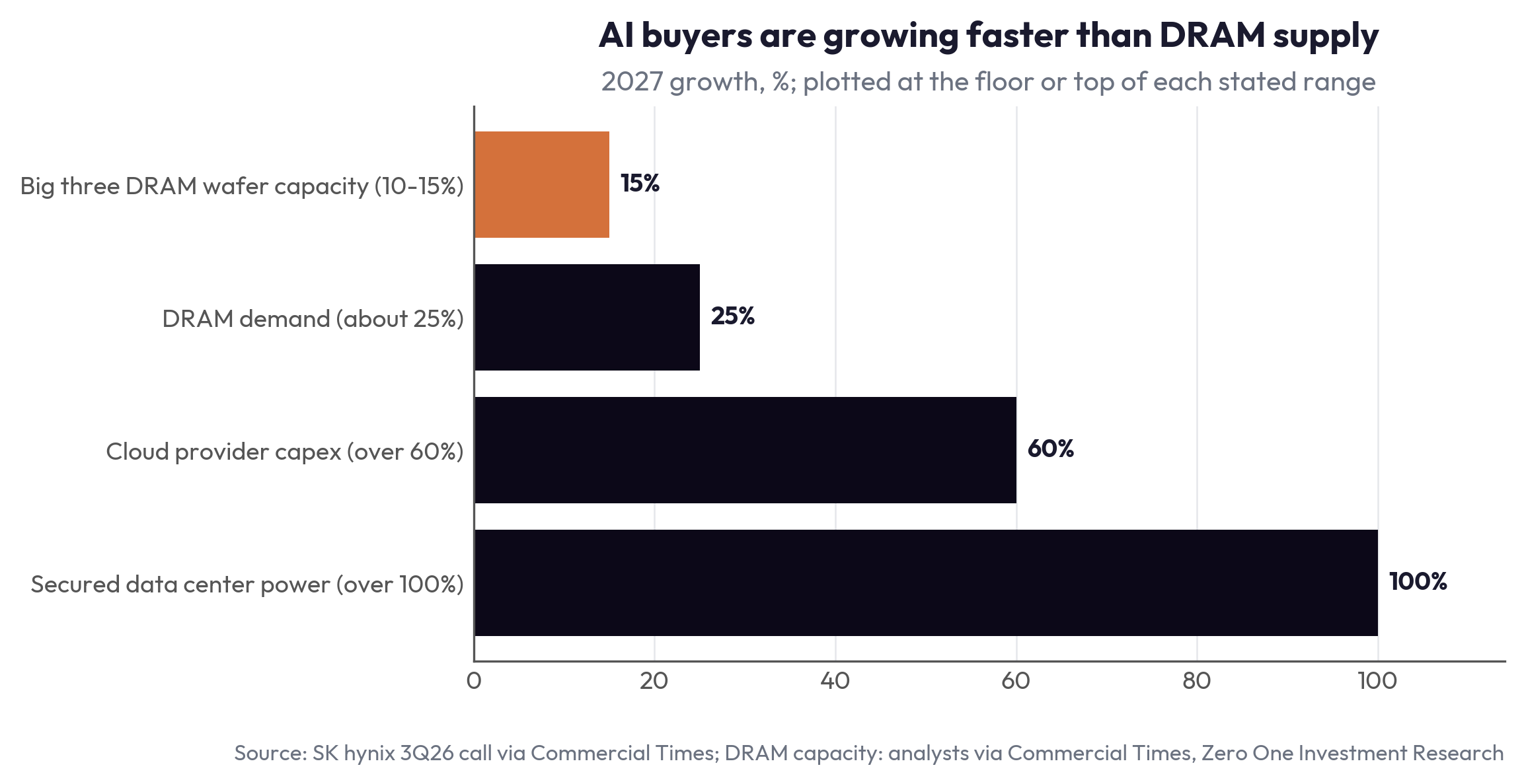
For 2027 the company expects DRAM demand to grow about 25%, cloud provider capex to rise more than 60% and the data center power those providers have secured to more than double. Analysts cited by Commercial Times expect the three largest DRAM makers to add only 10-15% to monthly wafer capacity by the end of 2027. SK hynix plans to return about KRW100tn to shareholders this year and to keep raising investment.
Our 28 Oct Blade reported Alibaba, Tencent and ByteDance asking Samsung and SK hynix for server memory contracts running to 2035. Today's disclosure shows how far that buying has already gone: the next three years of SK hynix output are spoken for. The view would change if customers began to push contract volumes out as Samsung and SK hynix capacity arrives in 2028.
Linked stocks: 000660 KS, 005930 KS, MU US, 2408 TT
UMC plans 10% higher prices for 2027
United Microelectronics (2303 TT), or UMC, expects its blended average selling price to rise about 10% in 2027, starting in 1Q27, CEO Jason Wang said on the 28 Oct call. He said growth is shifting from shipping more wafers to charging more per wafer.
The reason is that UMC cannot ship much more. Utilization reached 92% in 3Q26, several 12-inch fabs are full, and shipments hit a record of more than 1.2m 12-inch equivalent wafers. The board approved about US$3.2bn of extra capex for Singapore and Tainan on top of this year's US$2bn, but the main new capacity arrives from the end of 2028, so 2027 shipments stay capacity-limited. Wang said every expansion is backed by customer long-term contracts.
The 10% is a company-wide average that includes a richer product mix, so individual processes will rise by different amounts, Commercial Times reported. Gross margin rose to 34% in 3Q26 from 32.5% in 2Q26, and UMC guided 4Q26 shipments up 1-3% QoQ with gross margin around 34%. Management warned that depreciation from the new capex and rising material costs will weigh on margins.
Our 22 Oct Blade reported Powerchip Semiconductor Manufacturing (6770 TT) planning 10-20% higher mature-node prices in 2027 and giving capacity priority to long-term contract customers. UMC is now the second Taiwan mature-node foundry to price 2027 up on full fabs. UMC also expects AI-related revenue, about US$300m this year, to reach about 25% of sales by 2029, led by silicon photonics and advanced packaging.
Linked stocks: 2303 TT, 6770 TT, 5347 TT, GFS US
Late outside capacity held Microsoft's capex below plan
Microsoft (MSFT US) spent US$45.2bn on capex in the September quarter, up 30% YoY but below its own forecast of about US$50bn, because some third-party cloud computing capacity was delivered late, investor relations head Jonathan Neilson said, Economic Daily News reported. He said the overall spending plan had not changed.
Demand was not the issue. Azure revenue, disclosed in dollars for the first time, was US$33.2bn, up 48% YoY and above the 44-45% CFO Amy Hood had guided, TechCrunch reported. Azure is now about 36% of Microsoft's US$92.3bn quarterly revenue. Hood guided Azure growth of 49-50% this quarter, said demand still exceeds supply, and expects capex above US$50bn this quarter with further increases in the first half of next year.
OpenAI remains a large customer. Microsoft booked US$10bn of revenue from OpenAI arrangements in the quarter, nearly 11% of the total, against US$24.1bn for the whole of fiscal 2026. Free cash flow was US$18.6bn, down 27% YoY. Alphabet (GOOGL US), reporting the same evening, showed free cash flow of negative US$9.07bn as its capex jumped, even though its cloud revenue doubled.
The shortfall delays supplier revenue: Microsoft still has US$56.9bn of capex to spend in the last three months of 2026 to reach the US$175bn it guided in July. That holds if the delayed third-party capacity arrives this quarter.
Linked stocks: MSFT US, GOOGL US, NVDA US, 2382 TT
OpenAI plans to buy Google's AI chips
OpenAI plans to buy tensor processing units (TPUs), the custom AI chips of Google (GOOGL US), to add computing capacity, The Information reported, followed by Bloomberg and Economic Daily News. Final terms are not known, and both companies declined to comment.
Google now sells its chips to a direct rival in AI models. Our 23 Oct Blade reported Meta running TPUs in production, and our 28 Oct Blade reported Oracle offering TPUs in its cloud and Anthropic committing about half of its US$807bn compute plan to Google. OpenAI would join that list.
The server work goes to Taiwan. Foxconn (2317 TT) builds TPU compute trays and has moved into L10 and L11 shipments, meaning complete servers and full racks, which are in volume production, Economic Daily News reported. Inventec (2356 TT) has moved from L6 boards to L10 and L11 systems, which raises the value of each order.
OpenAI has said it will start using its own chips later this year. Its chip effort is led by Richard Ho, who worked on Google's TPU. The read for NVIDIA (NVDA US) depends on the order size, which neither company has disclosed.
Linked stocks: GOOGL US, 2317 TT, 2356 TT, NVDA US
CXMT samples low-yield AI memory to China chipmakers
ChangXin Memory Technologies (CXMT), the Chinese DRAM maker, plans to start producing HBM3E memory for AI chips even though its yield is only 20-30%, against about 70% at SK hynix (000660 KS), Reuters reported citing two people familiar, as carried by Liberty Times. CXMT has sent samples to Chinese AI chip designers and expects small-scale production within two months.
China's AI chipmakers are short of memory. The US has restricted exports of some advanced HBM to China since December 2024. Huawei, Cambricon, MetaX and Iluvatar CoreX raised prices on current and next-generation AI chips by 20-50% last month because memory is so costly, Reuters reported earlier.
At that yield, each good memory stack consumes far more wafers than at SK hynix, and CXMT is expected to price its HBM3E above foreign equivalents. In testing, its performance is closer to SK hynix's previous-generation HBM3. SK hynix held about 50% of HBM revenue in 2Q26, Samsung (005930 KS) 33% and Micron (MU US) 18%, per Counterpoint Research.
CXMT is also keeping its supply at home. It reportedly declined Apple's request for lower DRAM prices and Taiwan server makers' DDR5 inquiries, Commercial Times reported, so Chinese output is not easing the shortage outside China.
Linked stocks: 000660 KS, 005930 KS, MU US
Elite Material plans NT$98.6bn to add laminate capacity
Elite Material (2383 TT), the largest maker of copper-clad laminate (CCL, the base material circuit boards are built from), will spend NT$98.6bn on capex from 2027 to 2030 to add 9.4m sheets of capacity, Liberty Times reported. The plan takes group capacity to 15.25m sheets, which implies about 5.85m today, more than doubling it.
The company is expanding while it still sells everything it makes. It expects to keep running at full output and selling all of it for the next year, with new lines in Taoyuan, Kunshan, Zhongshan, Huangshi and Penang.
The 3Q26 numbers show pricing power. Gross margin rose to 37.7%, up 3.8 percentage points QoQ and 7.6 points YoY, and net profit rose 265.8% YoY to a record NT$14.5bn. Taiwan Union Technology (6274 TT), the second-largest laminate maker, also posted record profit, up 284.5% YoY, helped by a larger share of high-end products and laminate price increases.
Linked stocks: 2383 TT, 6274 TT, 2368 TT
先聲 First Word: Exclusives from Chinese-Language Sources
TSMC and Xintec near a deal for two AUO panel fabs
TSMC (2330 TT) and its affiliate Xintec (3374 TT) are reported to be close to buying AUO's L7A and L5C panel fabs in Taichung for more than NT$20bn, which would be the largest sale of an old panel fab in Taiwan. The fabs sit next to TSMC's Fab 15, and buying finished buildings shortens the time to add advanced packaging capacity while CoWoS stays short. AUO did not comment. (29 Oct 2026) Source: 友達中科廠出售案 可望拍板
Faraday wins its largest project, a 2nm AI chip for a US cloud company
Faraday Technology (3035 TT) has won a 2nm AI chip design project for a US cloud company worth tens of millions of US dollars, its largest ever, with revenue starting in 1H27. The chip will be made at Samsung's foundry with UMC as a partner, which puts a Taiwan design-service house on a leading-edge AI chip outside TSMC. (29 Oct 2026) Source: 熱門股》法說會報喜 智原跳空漲停
LandMark's customers now order six months ahead
LandMark Optoelectronics (3081 TT), which makes the laser wafers used in optical modules, said its main customers are placing orders six months or more ahead and that its capacity will rise sixfold within two years. 3Q26 gross margin reached 59%, up 15 points YoY, on rising silicon photonics shipments. (29 Oct 2026) Source: 台光電、台燿、聯亞報喜 Q3財報同創單季新高

© 2026 Zero One Investment Research Pte Ltd. For informational purposes only. Not investment advice.