
Anthropic commits half its US$807bn compute to Google; Alibaba seeks 10-year memory deals
Zero One Investment Research Daily Intelligence Brief, October 28, 2026
Anthropic commits half its US$807bn compute to Google; Alibaba seeks 10-year memory deals
Top Market Signals
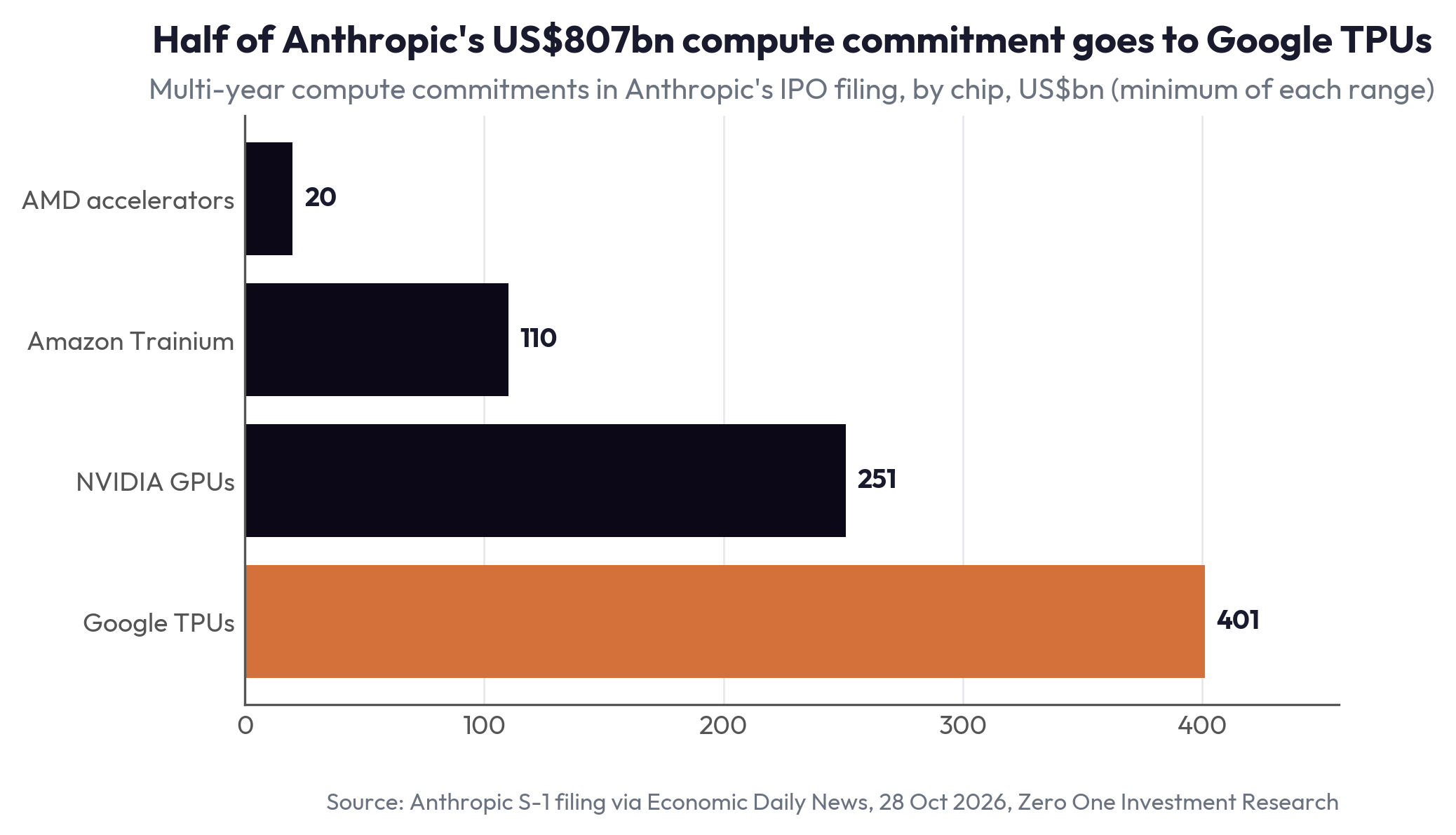
Half of Anthropic's US$807bn compute goes to Google
Anthropic's IPO filing commits about US$807bn to compute over the coming years, and about half of it, US$401-426bn, is tied to Google's tensor processing units (TPUs), Economic Daily News reported. NVIDIA (NVDA US) GPUs take about a third, up to US$251bn.
Amazon's (AMZN US) in-house Trainium chips take 14%, at least US$110bn, and AMD (AMD US) accelerators 2%, more than US$20bn. Most of the TPU commitment cannot be cancelled, and neither can at least US$110bn of the Amazon commitment, whose contracts run to 2036. A compute lease with SpaceX runs to 2029 but can be cancelled from 2027 on 90 days' notice.
Brokers cited by the paper say TSMC (2330 TT) makes the chips for all of these contracts. MediaTek (2454 TT) co-designs Google's TPUs, including the TPU 8i inference chip, and Foxconn (2317 TT), Quanta (2382 TT) and Inventec (2356 TT) build TPU servers. Bloomberg's analysis cited in the report said advanced-node capacity gains whichever accelerator wins share, adding pressure on TSMC, which kept its 2026 capex guide at US$60-64bn on 15 Oct.
Our 23 Oct Blade reported Meta running Google's AI chips in production; Anthropic's filing now puts the largest single compute commitment on the same chips. Non-cancellable contracts must be paid even if the compute goes unused, so if Anthropic's growth falls behind the commitments, the fixed bill stays.
Linked stocks: 2330 TT, 2454 TT, GOOGL US, NVDA US
Macronix stops adding NOR capacity, bets on NAND
Macronix (2337 TT) will add no more NOR flash capacity and will put all new capacity into eMMC and 3D NAND, chairman Miin Wu said on its 27 Oct call, after 3Q26 gross margin reached 70.5%. NOR flash stores the startup code inside devices; NAND stores data, and eMMC packages NAND with its controller as a single storage chip.
Revenue was NT$24.24bn, up 27% QoQ and nearly three times the NT$8.2bn of a year earlier, and net profit reached a record NT$10.95bn. Gross margin rose from 64.4% in 2Q26. NAND revenue grew 39% QoQ and 768% YoY, NOR 21% QoQ and 158% YoY.
Price did most of the work. Wu said capacity is limited, so near-term growth comes mainly from price increases; NOR shipments fell 12% QoQ because capacity moved to NAND, Wu said, rather than because demand slowed. Remaining NOR output will go to space communications, data center and medical customers.
New output arrives slowly. The first phase of tools entered the fab this year, with volume production in 2H27, and NT$15.8bn of further equipment arrives around end-2027, with production possibly in 2028. Wu said Macronix has never signed a long-term agreement, and that contract price increases are inevitable with the right customers. Until 2H27, Macronix's growth depends on price rather than volume.
Linked stocks: 2337 TT, 2344 TT, 2408 TT
Unimicron orders NT$50.9bn more long-lead tools
Unimicron (3037 TT) approved about NT$50.9bn of additional long-lead equipment orders on 27 Oct, to build new plants and upgrade its processes, Liberty Times reported. In July it had already raised its 2026 capex plan to NT$53.7bn from NT$34bn.
The orders came with record 3Q26 revenue of NT$52.65bn. Gross margin was 28.85%, up 4.05 percentage points QoQ and 15.47 points YoY, as demand for ABF (Ajinomoto Build-up Film) substrates, the boards that carry AI chips, outruns supply. Unimicron is expanding its Kuang Fu site in Taiwan with NVIDIA (NVDA US) for next-generation AI substrates, with production from 2Q27.
The board also approved a letter of intent to sell its entire stake in Unimicron Japan to Meiko Electronics (6787 JT), with terms still to be negotiated.
Our 21 Oct Blade quoted chairman S.C. Chien saying some substrate materials could be 20% short of demand in 2027 and that some equipment lead times run to 30 months. Ordering tools now is how Unimicron gets them in time. Unimicron said execution will flex with customer demand, so the pace of actual payments against these orders will show whether the build holds.
Linked stocks: 3037 TT, 3189 TT, 8046 TT, NVDA US
China's cloud giants seek 10-year Korean memory contracts
Alibaba (9988 HK), Tencent (700 HK) and ByteDance are asking Samsung Electronics (005930 KS) and SK hynix (000660 KS) for server memory supply agreements running to 2035, Maeil Business Newspaper reported via Liberty Times. Supply agreements usually run three to five years.
They want server DDR memory and LPDDR, the low-power memory first built for phones that AI servers now use to save power. China's own makers, CXMT and YMTC, are seen as behind on performance and volume in high-end server memory. Industry sources estimate 70-80% of Samsung's and SK hynix's planned memory capacity for 2027 is already covered by five-year agreements with global big tech. Samsung says it has signed its top five data center customers and is negotiating with five more.
CXMT itself is reportedly turning buyers away. It declined Apple's request for prices below Samsung, SK hynix and Micron, and declined DDR5 inquiries from a Taiwan server maker, Commercial Times reported citing Wccftech; industry analysts see CXMT putting domestic customers first. Brokers expect a DDR4 shortfall of more than 20% to last through 2027, while the three major makers' DRAM wafer capacity grows only 10-15% from end-2026 to end-2027.
With most of 2027 already committed, how much of this demand Samsung and SK hynix accept on 10-year terms decides how much spills to Taiwan's Nanya (2408 TT) and Winbond (2344 TT).
Linked stocks: 005930 KS, 000660 KS, 2408 TT, 2344 TT
Advanced packaging reaches 30% of Powertech's sales
Powertech Technology (6239 TT) said advanced packaging now makes up 30% of revenue, and its packaging and test lines are both running above 90% utilization, chairman D.K. Tsai said on 27 Oct, Economic Daily News reported. Most customers are accepting price increases.
3Q26 gross margin was 24%, up more than 2.2 percentage points both QoQ and YoY, and net profit hit a quarterly record, up 17.7% QoQ and 69.8% YoY. Logic chips were the largest product line at 43% of revenue, ahead of NAND at 28% and DRAM at 20%.
Powertech was built packaging standard DRAM and NAND. Tsai said its customer and development list now includes cloud service providers designing AI chips, top-tier chip designers and AI chipmakers. From 2027 he expects growth to come from fan-out panel-level packaging (FOPLP), which processes chips on large rectangular panels instead of round wafers, 2.5D and 3D stacking, co-packaged optics (CPO) and high-end flip-chip (FCBGA) packaging. Powertech is changing the ownership structure of its China legacy packaging plant to focus investment on Taiwan.
Tsai said utilization should keep rising this quarter with revenue. Orders from the cloud customers turning into panel-level volume in 2027 would confirm that its growth no longer tracks the memory cycle.
Linked stocks: 6239 TT, 3711 TT, 2449 TT
Oracle adds Google and Cerebras chips beside NVIDIA
Oracle (ORCL US) will offer Google's TPUs and Cerebras computers in its cloud while expanding its chip supply deal with NVIDIA (NVDA US), Reuters reported. Other reports add SambaNova chips to the lineup.
NVIDIA and Oracle also plan a multi-gigawatt expansion of NVIDIA's Vera Rubin systems on Oracle Cloud Infrastructure, HPCwire reported, and Vera Rubin GPUs and Vera CPUs are now generally available on Oracle, Data Center Dynamics reported. VentureBeat reported the two companies are pitching better utilization as enterprises report idle GPUs.
Offering Google's TPUs, Cerebras and SambaNova chips alongside an expanded NVIDIA deal turns Oracle into a multi-vendor AI cloud, and its pitch to enterprises is better utilization of GPUs they already run idle. Neither Oracle nor NVIDIA disclosed how much capacity each chip will get; that split is the number to watch.
Linked stocks: ORCL US, NVDA US, GOOGL US
先聲 First Word: Exclusives from Chinese-Language Sources
Foxconn could build up to half of NVIDIA's Vera Rubin racks
Foxconn (2317 TT) could take up to 50% of NVIDIA's Vera Rubin rack orders, and 40-45% even with its lines full, industry sources told Economic Daily News, as SpaceX moves some AI server orders directly to assemblers. SpaceX is expected to be the largest buyer next year at 20,000 racks, and first-pass yield on the racks is above 85%. (28 Oct 2026) Source: 輝達 VR 平台 鴻海訂單躍增 業界傳出占比挑戰五成
TSMC's A14 reported to end eight years of flat SRAM cell size
TSMC's (2330 TT) SRAM bit cell, the basic unit of the fast memory built into processors, has stayed at about 0.021 square microns since the N5 node arrived in 2020, and the A14 node due in 2028 is expected to shrink it, DigiTimes reported. A smaller cell lets chip designers fit more on-chip memory in the same area. (27 Oct 2026) Source: 台積電A14傳實現全球最小SRAM單元尺寸 終結8年微縮技術停滯
Nanya plans about 55% more wafer capacity over four years
Nanya Technology (2408 TT) runs about 65,000 wafers a month and plans to add 35,900 over the next four years, contributing from 2H27, Commercial Times reported; brokers expect its 4Q26 average selling price to rise 15-20% QoQ. Nanya is a main global DDR4 supplier as the larger makers move to higher-end memory. (28 Oct 2026) Source: 長鑫傳本土客戶優先 台廠受惠DRAM缺口

© 2026 Zero One Investment Research Pte Ltd. For informational purposes only. Not investment advice.