TSMC buys Anthropic and OpenAI stakes as cloud firms lock in Quanta's capacity
Zero One Investment Research Daily Intelligence Brief, November 11, 2026
TSMC buys Anthropic and OpenAI stakes as cloud firms lock in Quanta's capacity
Top Market Signals
TSMC takes stakes in Anthropic and OpenAI
TSMC (2330 TT) will buy up to US$500m of Anthropic common shares and up to US$500m of OpenAI preferred shares, its board approved on 10 Nov, the first time the foundry has invested in AI model developers. The Anthropic price will be set at its IPO price. The board also approved up to US$500m for a new company that will invest across the semiconductor supply chain, so the three approvals total up to US$1.5bn.
The stakes are small next to TSMC's spending. The same meeting approved a capital budget of about US$40.93bn for advanced process, advanced packaging, mature and specialty capacity, and the 2027 R&D budget. TSMC has guided 2026 capex at US$60-64bn, so US$1bn in the two AI developers is less than 2% of one year's capex.
October revenue reached a record NT$586.89bn, up 14.7% MoM and 59.7% YoY, the third straight month above NT$500bn, as 2nm entered volume production. Local analysts estimate that the 4Q guide of US$52.3-54.3bn implies average November and December revenue of NT$538.1-569.9bn, below October. The board raised the quarterly dividend to NT$9 a share from NT$7, up 28.6% and about 30.6% of 3Q earnings per share.
Linked stocks: 2330 TT, TSM US, MSFT US
Cloud customers reserve Quanta capacity up to two years
Quanta (2382 TT) said its five largest cloud customers have given it capacity reservation commitments covering the next 12 to 24 months, Economic Daily News reported from its 11 Nov investor conference. Quanta uses those commitments to justify 2027 capex of NT$40-45bn, flat to slightly above this year, after it dropped a plan to buy AUO's Huaya plant and moved 2028 capacity to California and Thailand.
The cost of that growth shows up in margin and working capital. 3Q gross margin fell to 4.75%, a 17-quarter low, while receivables of NT$931.7bn and inventory of NT$856bn both hit records. Quanta buys GPUs and memory for NVIDIA's VR200 racks, which sell for twice the price of the previous generation. It wants more consignment orders, where the customer supplies the GPUs and DRAM, but said buy-and-sell orders will still be more than half of 2027 business, and asked investors to track operating profit growth instead of margin.
Servers should reach 85-90% of 2027 revenue, with AI servers above 80% of that, and notebooks should fall below 10% of revenue for the first time. Our 9 Nov Blade reported Quanta's October revenue up 104% YoY while notebook shipments fell 35.7% MoM; 3Q revenue rose 125% YoY to NT$1.12tn.
Peers gave the same read. Inventec (2356 TT) said no customer has changed orders since the US midterm results and expects GPU and ASIC server shipments to grow at a high double-digit rate in 2027, though longer component lead times mean it cannot fill every rush order. Wistron (3231 TT) posted record 3Q net profit, up 148.5% YoY, and approved NT$11.9bn of new capex in Tainan. Quanta's own nearer check is its target to hold 4Q operating margin flat with 3Q.
Linked stocks: 2382 TT, 2356 TT, 3231 TT, NVDA US
Alchip lost US$100m of sales to shortages
Alchip (3661 TT), a Taiwanese designer of custom AI chips (ASICs, application-specific integrated circuits), said shortages of wafers, substrates and packaging capacity cost it about US$100m of 3Q revenue, Commercial Times reported. October revenue still passed NT$10bn for the first time, at NT$10.26bn, up 515.81% YoY and a fourth straight monthly record.
Alchip's new US AI customer has signed a project worth about US$1bn that starts volume revenue in 2Q27 and would become its second-largest revenue source. Revenue from its current 3nm accelerator should grow at a triple-digit rate in 2027 because the customer gave Alchip a larger wafer allocation. Its 2nm accelerator starts tape-out this quarter, with small volumes in 4Q27 and full volume in 2028.
MediaTek (2454 TT) reported October revenue of NT$55.03bn, down 0.67% MoM and up 5.77% YoY. Its first AI accelerator began small shipments in September, and CEO Rick Tsai expects it to contribute US$2.5bn in 4Q, behind a 4Q revenue guide of NT$210.1-221.8bn, up 25-32% QoQ. MediaTek is also competing for substrate supply. For both companies, packaging and substrate allocation decides how fast 2027 orders become revenue.
Linked stocks: 3661 TT, 2454 TT, 2330 TT
AMD test halves server DRAM at near-flat speed
AMD (AMD US) said its new Venice server CPU, paired with software from MEXT, a startup it bought in June, kept 99% of average performance across five AI agent tests with half the DRAM, Economic Daily News reported from AMD's EPYC event in Las Vegas. Memory can be 60-90% of the cost of some high-capacity servers, MEXT founder Gary Smerdon said.
MEXT moves data that is not needed right away onto NVMe SSDs (flash storage drives), then uses AI to predict what the CPU will need next and moves it back into DRAM before it is called. In AMD's tests, performance per dollar of DRAM was more than 1.9 times an all-DRAM setup; Synopsys's PrimeTime chip design tool kept 95% of its speed and a Spark data processing test kept 99%.
Venice is now in volume shipment, with both compute dies on TSMC (2330 TT) 2nm and up to 256 cores. AMD expects the data center CPU market to grow from about US$26bn in 2025 to about US$220bn in 2030. More than 10 certified Helios rack designs start supply in November, with partners including Foxconn (2317 TT), Inventec and Wiwynn (6669 TT). These are AMD's own tests and adoption at scale is unproven; if cloud buyers do run agent servers this way, each CPU would need less DRAM, a negative read-across for Micron (MU US) and SK Hynix (000660 KS), where memory can be 60-90% of server cost.
Linked stocks: AMD US, 2330 TT, MU US, 000660 KS
Holy Stone adds 40% capacity, still short
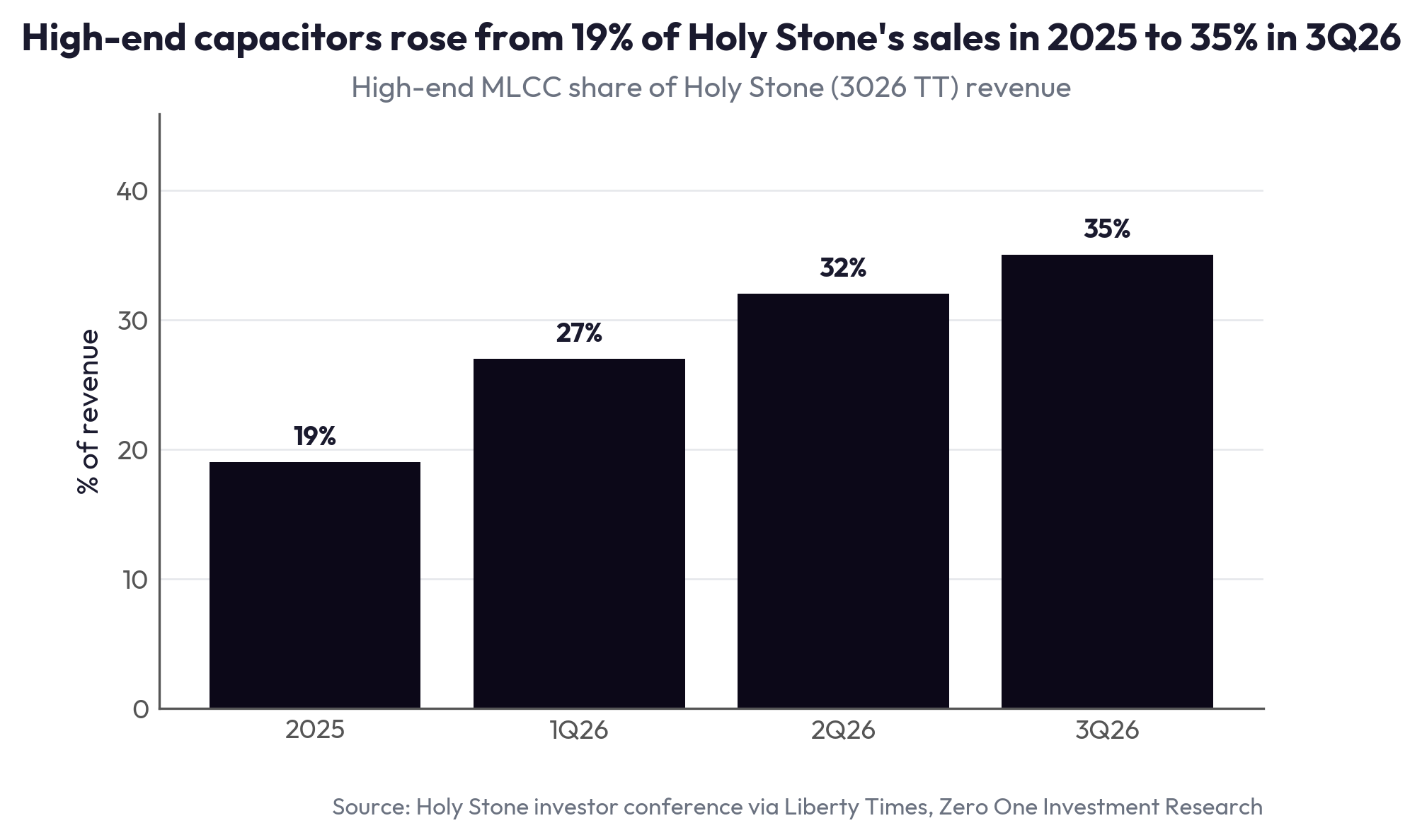
Holy Stone (3026 TT), a Taiwanese passive component maker, said customer demand for high-end MLCCs (multilayer ceramic capacitors, small parts that steady the power supply on a circuit board) is far above its supply, even with capacity up 30% this year and another 40% in 2027, Economic Daily News reported from its 10 Nov investor conference. AI applications reached 35% of passive component revenue in 3Q, with a 4Q target of 38%, up from 19% for all of 2025.
The demand comes from power. AI server power supplies have grown from 600W and 800W in early designs to 18kW, 30kW and even 110kW, which raises the number of resonant capacitors per system. TPU and ASIC platforms also need more output capacitors that tolerate high voltage and heat, and Holy Stone expects the two types to be roughly half each of its AI capacitor demand in 2027.
Holy Stone plans more than NT$3.5bn of capex over five years, mostly in Taiwan, with new tools arriving in 1H27 and adding output in 2Q-3Q27. Nichidenbo (3090 TT), a Taiwanese component distributor, said each AI server generation needs more high-end capacitors, leaving consumer electronics facing steeper price increases, DigiTimes reported. Our 10 Nov Blade reported October revenue at Yageo (2327 TT), the largest passive component maker, up 55% YoY.
Linked stocks: 3026 TT, 2327 TT, 3090 TT
Powerchip plans another 10-20% foundry price rise
Powerchip (6770 TT), a Taiwanese foundry for memory and mature logic chips, plans to raise some foundry prices by another 10-20% next year, Economic Daily News reported. October revenue reached a record NT$8.03bn, up 4.74% MoM and 94.19% YoY.
Earlier increases have not yet fully reached revenue. Powerchip prices memory foundry work when wafers start, and the wafers it shipped in 3Q carried prices about 30% below current wafer-start prices. As the higher-priced wafers come out of the fab, revenue rises even at flat volume, and Powerchip expects 4Q revenue to grow at a double-digit rate QoQ. Logic foundry prices are also rising.
Powerchip is positive on 2027 revenue and profit, citing AI chip demand. The gap between wafer-start and shipped prices should narrow through 4Q revenue; if it does not, the price increases are not holding.
Linked stocks: 6770 TT, 2303 TT, 5347 TT
Microsoft lobbies against a Chinese transceiver ban
Microsoft (MSFT US) is lobbying the Trump administration to shelve a planned ban on imports of Chinese-made optical transceivers, the parts that send data over fiber between servers and switches inside data centers, Reuters reported via CNA. Chinese companies, including Eoptolink and Zhongji Innolight, hold about two-thirds of the global market, according to Counterpoint Research.
The FCC (Federal Communications Commission) is drafting the ban. Microsoft was among a few companies that met White House technology and national security officials in September to warn about supply problems. The Information Technology Industry Council said cloud companies have already bought AI chips that would sit idle without transceivers, and some data centers need millions of them. Microsoft has 35 data centers under construction in the US and 134 in planning, according to Cleanview.
Officials are studying a threshold that would cover only 3.2Tbps transceivers, which Morgan Stanley expects to reach volume in 2028 and wide installation in 2029. That would give US makers Coherent and Lumentum time to add capacity; a Foundation for American Innovation report says they lack the scale to replace Chinese supply today. Marvell agreed to buy Lumentum at a US$115bn enterprise value, as our 7 Nov Blade reported.
Linked stocks: MSFT US, LITE US, COHR US, 300308 CH
先聲 First Word: Exclusives from Chinese-Language Sources
Packaging capacity moves into converted buildings to skip new fabs
巨漢 (6903 TT), a Taiwanese fab engineering contractor, said 3 to 4 of its current chip projects convert existing buildings, with demolition and fit-out done within six months and the fastest ready for tools in three, against 2 to 3 years from groundbreaking to tool-in for a new fab. Advanced packaging customers are buying time with old buildings; its backlog is NT$10.8bn, 68.2% from semiconductors. (11 Nov 2026) Source: cnYES 鉅亨網
AP Memory sees silicon capacitor orders through 2H27
AP Memory (6531 TT) posted record 3Q revenue and profit and said orders for its silicon capacitors, which sit beside AI chips to smooth their power, are visible into 2H27, with UMC (2303 TT) as a second production track. That matches the board-level capacitor shortage Holy Stone describes, one level closer to the chip. (11 Nov 2026) Source: 愛普IPD矽電容訂單能見度看至2H27 攜手聯電採雙軌並進
ASMedia signs a custom chip project for AMD's next platform
ASMedia (5269 TT), a designer of high-speed interface chips, said its custom chip project for AMD's next platform has completed samples, pricing and contract, with production capability in 1Q27 and shipments from 2Q-3Q27; a second custom chip customer already pays design fees. A PC chipset supplier is adding custom chip revenue as low-priced AM4 chipsets weigh on revenue. (10 Nov 2026) Source: 祥碩前三季賺近八股本

© 2026 Zero One Investment Research Pte Ltd. For informational purposes only. Not investment advice.