
Qualcomm gives AWS a stock option that vests as the chip orders land
Zero One Investment Research Daily Intelligence Brief, September 10, 2026
Qualcomm gives AWS a stock option that vests as the chip orders land
Top Market Signals
Qualcomm ties AWS chip orders to its shares
Qualcomm (QCOM US) agreed a multi-generation collaboration with Amazon Web Services covering custom AI inference chips and high-bandwidth optical interconnect, and disclosed in an 8-K filing the same day that it has issued AWS a warrant to buy Qualcomm stock at US$161.26 a share, worth about US$4bn if fully exercised.
The warrant vests in stages against binding purchase orders and actual purchases, sits against a chip purchase ceiling of US$60bn, and runs to September 2036. DigiTimes reports the structure repeats what Marvell (MRVL US) agreed with Google earlier in 2026, where the warrant is worth about US$12.2bn on full exercise against a US$120bn purchase cap running to August 2033. In both cases the customer commits no cash up front and converts the option only by buying.
Taiwan's ASIC designers sit on the wrong side of that mechanism. MediaTek (2454 TT) broke Broadcom's exclusivity at Google and holds production orders for two generations of TPU with a third in contention, but has no commitment past 2030, and its financial link to Google is a small portion of a convertible bond whose main funder was NVIDIA. AWS has twice subscribed for Alchip (3661 TT) equity without attaching any supply guarantee or purchase ceiling.
IC design executives told DigiTimes that writing share vesting against customer purchase volumes into a legal document is difficult in Taiwan, because company law provides no instrument for it. That leaves process, capacity and per-generation execution as the levers Taiwanese vendors have for holding a customer. Qualcomm finance chief Akash Palkhiwala said Amazon revenue can be recognized from the fiscal quarter beginning in October, described the agreement as the first of many, and said another hyperscale customer is in discussion.
Linked stocks: QCOM US, 2454 TT, 3661 TT, MRVL US
Kioxia calls the memory price rise far enough
Kioxia's chief executive, who took the job in April, told Bloomberg that memory prices have already risen enough, and said he has asked his sales team not to raise prices sharply on data center customers because it would damage their willingness to invest in AI. Kioxia is the first large memory maker in this upcycle to argue for a brake.
The company is arguing against its own pricing power. Kioxia's NAND flash average selling price rose about 70% QoQ in the quarter to June, after a rise of more than 100% in the quarter before that. TrendForce puts Kioxia fourth in NAND with about 13.6% share in 2Q26, close behind Micron (MU US), and it supplies Apple and NVIDIA.
His stated reasoning is that even hyperscale buyers work to a budget, and that prices running away would eventually hurt AI investment and through it the memory market itself. He also played down the prospect of deeper cooperation with SK Hynix, a shareholder and a competitor.
Our 8 Sep 2026 Blade reported that all seven Taiwan memory suppliers filing August revenue grew more than 177% YoY, which put the price cycle past the three large DRAM makers and into the module and niche-memory layer. Today the fourth-largest NAND supplier is arguing that the rise has gone far enough. Economic Daily News notes that the low-cost inventory gains Taiwan names such as Phison (8299 TT), ADATA (3260 TT) and Macronix (2337 TT) have been earning would cool if pricing flattens.
Linked stocks: 8299 TT, 3260 TT, 2337 TT, 000660 KS
Apple's first 2nm phones cost US$100 more
Apple's iPhone 18 Pro and Pro Max are the first smartphones built on TSMC's (2330 TT) 2nm process, and both start US$100 above the previous generation, at US$1,199 and US$1,299. Economic Daily News reports the increase alongside a global component shortage and tight memory supply.
The A20 Pro chip carries a redesigned six-core processor with two performance cores up to 20% faster and four efficiency cores, a seven-core graphics unit up 40%, and a neural engine that doubles from one block to two and from 16 cores to 32. Memory bandwidth rises 50%, and the new package sets the die and the memory side by side so the chip sits directly against the vapor chamber.
The foldable iPhone Duo runs the same A20 Pro and starts at US$1,999 with a 7.6 inch inner screen, which CNBC reports is close to competing products and below what Wall Street generally expected. Preorders for the 18 Pro open on 12 September with shipping from 18 September, while the Duo opens for preorder on 16 October and goes on sale on 23 October.
TSMC is the named beneficiary in the reporting. The A20 Pro is its 2nm node's first appearance in a phone, and TrendForce reported separately that 2nm contributed foundry revenue for the first time in 2Q26.
Linked stocks: AAPL US, 2330 TT, 2317 TT
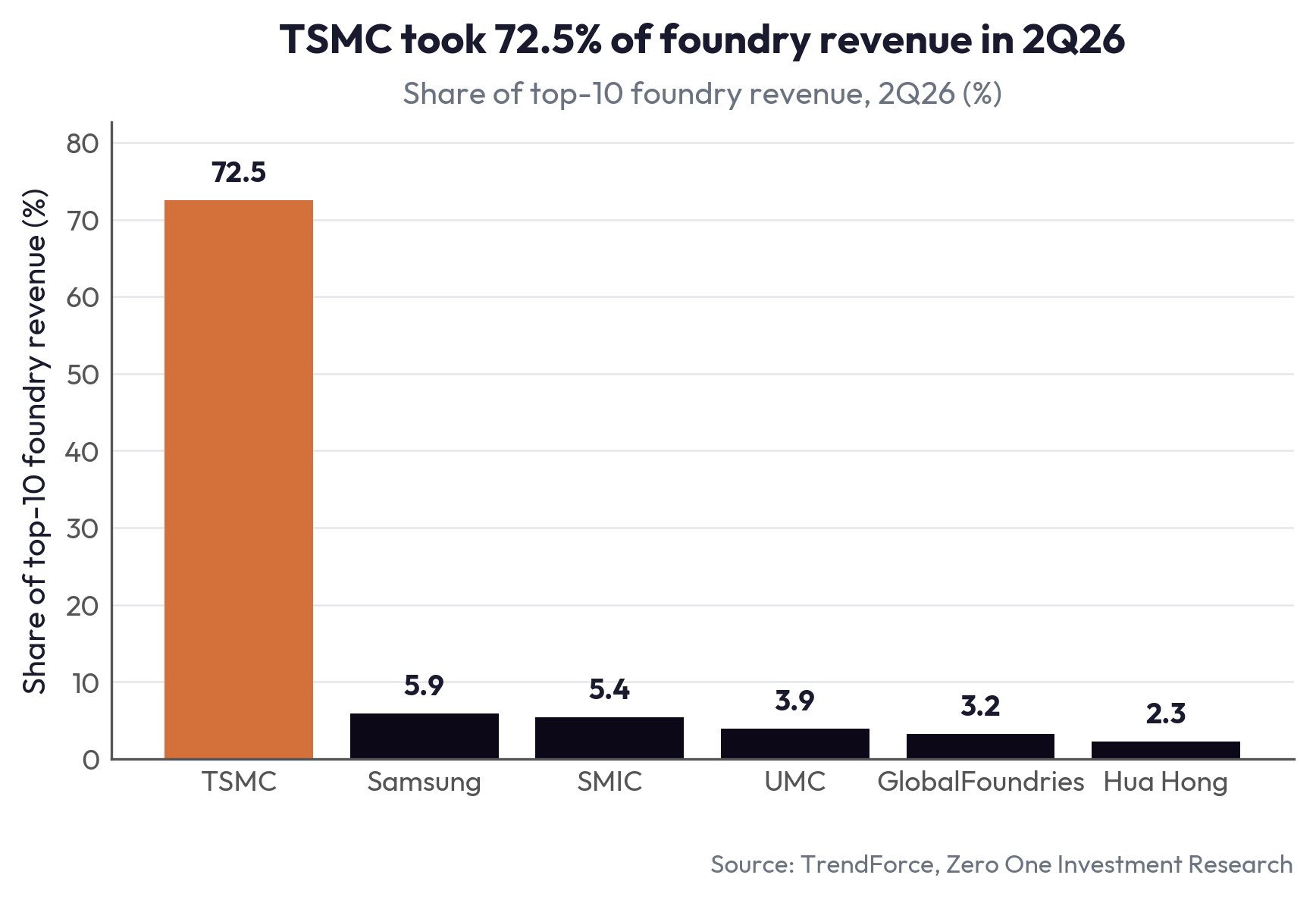
TSMC's foundry share reaches 72.5% as Samsung slips
TSMC took 72.5% of top-10 foundry revenue in 2Q26 on revenue of about US$40.2bn, up 12.1% QoQ and a record share, according to TrendForce. Samsung's foundry revenue rose 1.8% to US$3.26bn and its share fell from 6.5% to 5.9%.
The top-10 group turned over US$53.49bn in the quarter, up 11.5% from US$47.95bn in 1Q26 and also a record. TrendForce attributes the growth to full 5nm, 4nm and 3nm capacity for AI processors, rising demand for the power management and discrete power chips that surround AI systems, and early restocking in consumer supply chains. TSMC's 2nm node contributed revenue for the first time.
The distance between first and second place is now 12.3 times, the widest on record, and TSMC has held above 70% for five consecutive quarters. SMIC ranked third at 5.4% with revenue up 20% QoQ past US$3bn, helped by consumer restocking, AI peripheral chips and foundry work created by the memory shortage. UMC (2303 TT) was fourth at 3.9% and GlobalFoundries (GFS US) fifth at 3.2%.
Samsung's answer is capacity in the United States. Its Taylor, Texas fab sold out its 2nm capacity before opening, with orders including Tesla's AI5, Broadcom's next-generation communications chip and an Arm edge AI chip, and is due to start trial operation in October before mass production in 2027 at an initial 50,000 wafers per month. Construction of a second Taylor fab is set to begin by the end of 2026.
Linked stocks: 2330 TT, 005930 KS, 2303 TT, GFS US
Wistron passes Quanta as notebook shipments fall
Wistron (3231 TT) reported August consolidated revenue of NT$460.07bn, up 166.5% YoY and its first month above NT$400bn, passing Quanta Computer's (2382 TT) NT$423.97bn to become Taiwan's second-largest contract manufacturer by revenue behind Hon Hai (2317 TT).
Revenue for the first eight months reached NT$2.51tn, up 98.9% YoY and already above the whole of 2025. Underneath the record, the older businesses shrank: August notebook shipments of 1.4m units fell 36.4% YoY, desktop shipments of 500,000 units fell 37.5%, and monitor shipments of 750,000 units fell 6.3%.
Our 9 Sep 2026 Blade carried Quanta's own August record of NT$423.97bn alongside its guidance for a double-digit full-year decline in notebooks. Wistron's month sets out the same split more sharply and reverses the order between the two companies.
The board approved about US$220m of new spending in the United States and Vietnam. That covers up to US$146m of building work and equipment at the Westport (D2) site in Texas, funded through a US$150m capital injection into the US subsidiary, a Dallas plant lease worth up to US$15.05m running from 2026 to 2033, and up to US$59.05m in Vietnam. Wistron said NVIDIA's Vera Rubin platform has started shipping with no gap between generations because GB-series orders continue, and expects 4Q26 to be the peak quarter.
Linked stocks: 3231 TT, 2382 TT, 6669 TT, NVDA US
Custom chip servers pass general purpose at Wiwynn
Wiwynn (6669 TT) told an analyst meeting that servers built around customers' own ASIC designs will reach half of shipments in 3Q26, level with general-purpose servers, and overtake them in 4Q26, with GPU servers beginning to ship at the end of the fourth quarter.
August revenue was NT$144.31bn, up 22.6% MoM and 50.4% YoY and a record month, taking the eight-month total to NT$816.66bn, up 42.8% YoY. Gross margin in 2Q26 was 9.26%, helped by engineering service revenue, and management expects the shift toward ASIC servers to leave margin broadly unchanged depending on how much of that engineering revenue repeats.
The US plant is now in production, building L10 and L11 assemblies with liquid-cooled models the priority for expansion. Before it opened, Mexico held 70% of capacity, Malaysia 20% and Europe 10%, and the target is for the US site to reach about 20% next year.
Capital spending was NT$12bn in 1H26 and is planned at US$942m in 2H26, with a further increase next year, going mainly to sites in Taiwan and Malaysia and to liquid cooling and power infrastructure. On components, management said supply is tight, with processors the tightest, but stopped short of describing it as a shortage.
Linked stocks: 6669 TT, 3231 TT, 2382 TT
NVIDIA's Groq deal draws a Justice Department probe
The Justice Department is investigating whether NVIDIA (NVDA US) structured last year's licensing agreement with AI chip startup Groq to avoid the antitrust review that a straight acquisition would have triggered, according to a New York Times report citing two people familiar with the matter.
Groq described the December deal as a non-exclusive license giving NVIDIA access to its inference chip technology, and its chief executive Jonathan Ross and operations chief Sunny Madra joined NVIDIA afterwards. The department opened the inquiry soon after the announcement and has issued a formal demand for documents. No finding has been made, and the report suggests a fine is a more likely outcome than an order to unwind the deal.
The Federal Trade Commission is examining the same category of transaction. Licensing technology and hiring the team behind it has become a common route for large AI companies to absorb a startup without the automatic review a merger brings, and Democratic senators including Elizabeth Warren argue the arrangements amount to acquisitions.
Groq continues to sell cloud services and announced a US$350m funding round in August that NVIDIA plans to join. NVIDIA spokesman John Rizzo said the case is an example of the American system working as designed to promote innovation and reward entrepreneurs.
Linked stocks: NVDA US, AMD US, AVGO US
先聲 First Word: Exclusives from Chinese-Language Sources
TSMC's 1.4nm cluster runs a year ahead of plan
TSMC is building four 1.4nm fabs in the second phase of the Central Taiwan Science Park, and the park administration confirmed the first has finished its steel structure, will begin trial runs in April 2027 and could reach mass production in 2H27, ahead of an original 2028 schedule. More than 5,400 operating and contract staff move in from April, and the park estimates annual revenue from the four fabs at NT$500bn, a figure it describes as possibly low. (10 Sep 2026) Source: 台積電1.4奈米廠拚提前量產 中科二期四座新廠明年起接棒投產
AP Memory moves silicon capacitors into volume
AP Memory (6531 TT) said its substrate-embedded silicon capacitors enter volume shipment this quarter with high demand visibility and a larger ramp next year, while its 1+8Hi stacked memory product has completed a functional demonstration and is in validation for production between late 2027 and early 2028. August revenue was NT$1.03bn, up 150.8% YoY, with the first eight months up 109%. (10 Sep 2026) Source: 鎧俠為報價漲勢踩煞車、記憶體多下跌 這檔逆勢大漲站回千元
Foxsemicon's Thailand plant lifts second-half output
Foxsemicon (3413 TT) told its analyst meeting that the Chonburi plant in Thailand has been ramping since July and that 3Q26 revenue will grow QoQ to another record, with 2H26 running ahead of 1H26 and profit improving as the product mix shifts. 2Q26 revenue was NT$6.3bn, up 13.3% QoQ and 21.1% YoY, and 1H26 revenue reached NT$11.86bn, up 17.8% YoY. (9 Sep 2026) Source: 京鼎泰國廠逐步放量 下半年營運優於上半年

© 2026 Zero One Investment Research Pte Ltd. For informational purposes only. Not investment advice.