
Four Taiwan firms build NVIDIA's first volume optical switch as Groq turns GPU buyer
Zero One Investment Research Daily Intelligence Brief, August 18, 2026
Four Taiwan firms build NVIDIA's first volume optical switch as Groq turns GPU buyer
Top Market Signals
Taiwan builds four links of NVIDIA's optical switch
NVIDIA (NVDA US) said its Spectrum-X Ethernet Photonics switch, which packages the optical engine together with the switch silicon, has entered full volume production. Of the eleven supply partners NVIDIA named, four are Taiwanese: TSMC (2330 TT), Foxconn (2317 TT), ASE Technology's SPIL unit (3711 TT) and Browave.
The other seven are Corning, Coherent, Fabrinet and Lumentum in the United States, Senko Advance and Sumitomo Electric in Japan, and one Chinese optical communications supplier. Economic Daily News describes the Taiwanese four as consecutive stages of one line rather than four separate niches: TSMC produces the photonic engine on its COUPE platform, ASE's SPIL packages it, Browave supplies the fiber connection parts, and Foxconn assembles the finished switch.
The volume claim is dated and sized rather than promised. Foxconn chairman Young Liu said the company will ship about 10,000 co-packaged optics switches this year and expects several times that next year. Foxconn's rotating chief executive said revenue from switches above 800G should double for the full year, with the all-optical switch reaching volume in 3Q26. CoreWeave, Lambda and Oracle are the first customers named.
TSMC put numbers on why the architecture moves at all. Against copper, COUPE on the substrate gives four times the power efficiency and cuts latency by 90%; on the interposer the same technology reaches ten times the power efficiency and a 95% latency cut. TSMC also said the first 200Gbps micro ring modulator built on COUPE enters volume production in 2026, running a bit error rate below 1e-8. NVIDIA puts the switch itself at five times the network power efficiency and ten times the mean time between failures of pluggable optics, and 1.6 times the AI network performance of conventional Ethernet.
Linked stocks: 2330 TT, 2317 TT, 3711 TT, NVDA US
Groq halves its value, turns NVIDIA customer
Groq has raised US$350m at a US$3.5bn valuation, down from the US$6.9bn it carried last September, and now runs NVIDIA systems rather than competing with them. TechCrunch reports the round is led by Disruptive with planned participation from NVIDIA itself.
Groq was built to challenge NVIDIA on inference with its own language processing units. That ended when NVIDIA hired founder and chief executive Jonathan Ross along with other senior staff as part of a US$20bn licensing deal paid out to Groq investors. The company then moved from designing chips to operating data centers full of NVIDIA accelerators, raising US$650m in June to start that shift.
A company spokesperson told TechCrunch the lower valuation is not a down round but a new mark for the version of Groq that exists after the licensing deal. The operating base is sizeable: 13 data centers across North America, Europe, the Middle East and Asia Pacific, more than 6m developers and enterprise users, and a plan to scale from 54 megawatts to more than 200 megawatts in 2027.
What the round removes is the last well funded independent inference silicon story of this cycle. NVIDIA now supplies the GPUs behind CoreWeave, Lambda, Nebius and Groq, and holds or is taking equity in several of them. Whether that model returns capital is still open. CoreWeave grew second quarter revenue strongly and signed Meta and Anthropic, and investors continue to weigh its capital spending, debt load and hardware depreciation against free cash flow.
Linked stocks: NVDA US, CRWV US, AVGO US
Samsung is paid before it makes the memory
Samsung Electronics (005930 KS) held about KRW23.6tn, roughly US$16.5bn, in contract liabilities at the end of June 2026. DigiTimes reports the balance rose about KRW8.5tn in three months, an increase of 56.4%.
Contract liabilities are cash a customer has already handed over for goods not yet delivered. A balance of this size at a memory maker means buyers are funding output ahead of production rather than ordering against a price list, and it turns what was a spot market into something closer to a book of prepaid capacity.
The working capital effect runs in Samsung's favor at exactly the point in the cycle when capacity additions are most expensive. Cash arrives before the wafer starts, which lowers the amount of balance sheet the company has to commit to a given expansion. The same money is a claim on future volume at agreed terms, so the revenue it eventually converts into carries less pricing upside than an equivalent spot sale would.
The quarterly step is what makes this worth watching rather than the level. A balance that grows 56.4% in three months is not a settled financing arrangement, it is a buyer base moving position quickly.
Linked stocks: 005930 KS, 000660 KS, MU US
Graphics card shortage shows up in price, not units
PC Partner, which builds cards under the AMD, Inno3D, Manli, Sapphire and Zotac brands, told investors in its first half results that graphics memory costs will rise further and push card costs up substantially in the second half. It also said card shipments fell substantially in 1H26 versus 2H25 and that availability will fall again.
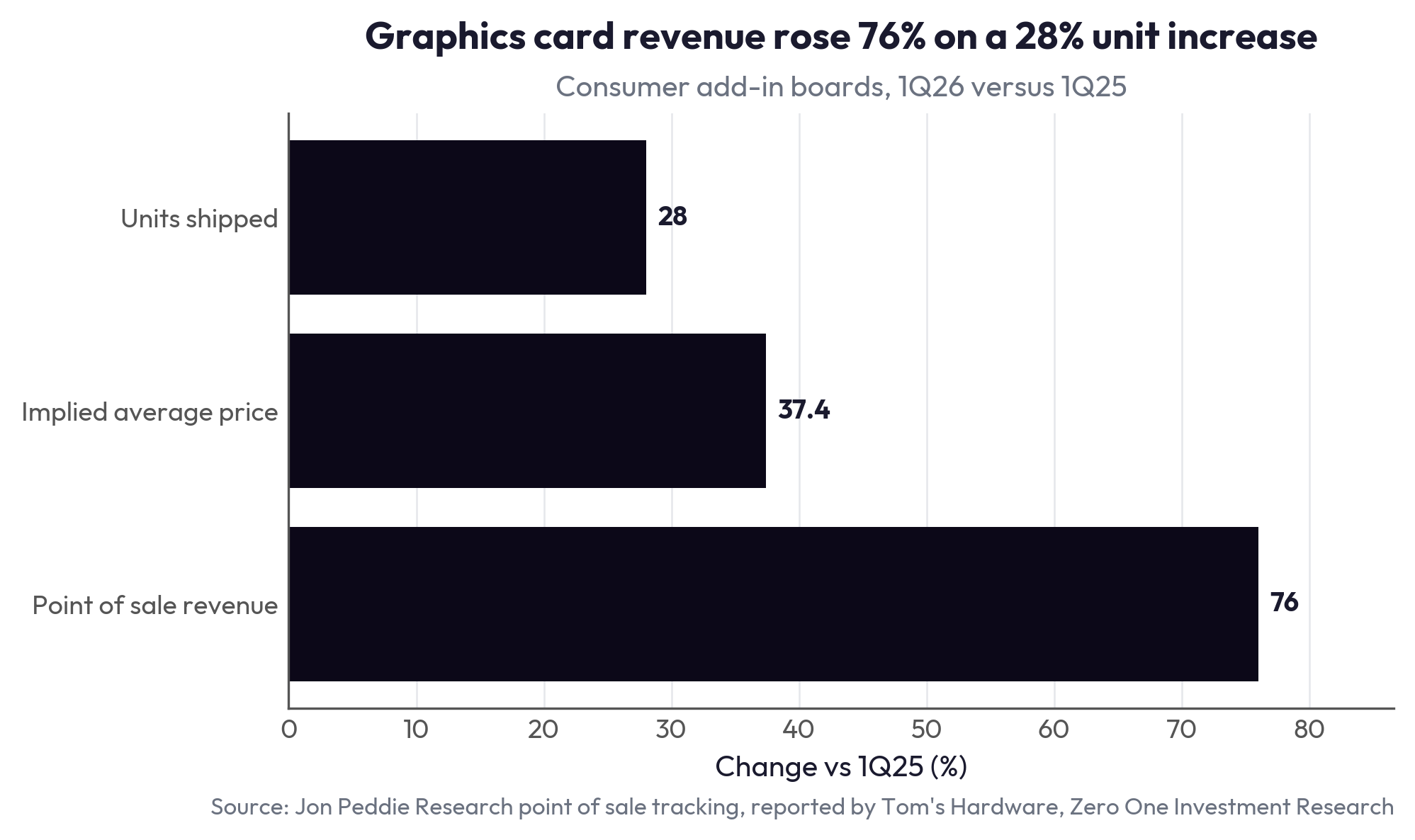
Jon Peddie Research data points the other way on volume. Jon Peddie told Tom's Hardware that 9.25m add-in boards sold in 1Q25 against 11.82m in 1Q26, a 28% unit increase, while tracked point of sale revenue went from US$6.18bn to US$10.85bn, a 76% increase. Units grew; the money grew almost three times faster.
The split matters because it separates two readings of the memory shortage. A shortage that destroys demand shows up as falling units. This one is showing up as price, with buyers absorbing the increase rather than walking away, which is the same behavior the memory makers' prepayment balances describe from the other side.
PC Partner expects entry level cards to face the worst shortages and the sharpest price moves. That is where graphics memory is the largest share of the bill of materials, so the cost pass through has the least room to hide. Taiwan's board and system makers took the read badly on Monday, with Gigabyte (2376 TT) down 9.9%, MSI (2377 TT) down 6.0% and ASUSTeK (2357 TT) down 5.8%.
Linked stocks: 2376 TT, 2377 TT, 2357 TT, MU US
Warpage forces a simpler heat spreader on Rubin
NVIDIA had planned a two piece heat spreader for the chip package on its Vera Rubin platform to improve heat removal, and has moved to a one piece design as an interim step because of substrate warping. TrendForce, cited by Liberty Times, says Jentech Precision (3653 TT) is currently the sole supplier of that part for the platform.
A thermal design that steps back for mechanical reasons is a useful read on how tight the package already is. Warping rises with substrate area and with the number of stacked components, so a heat spreader simplified at this stage says the limit sits in what the substrate tolerates rather than in what the cooling can remove.
The rest of the platform moves the other way. TrendForce says Vera Rubin adopts a fanless full liquid cooling architecture, which raises the cooling value in each rack. Liquid cooling reaches 53% of AI chips in 2026 and should approach 60% in 2027, driven by rising thermal design power at NVIDIA, AMD and Google. Cold plate supply runs through Cooler Master and BOYD abroad and Asia Vital Components (3017 TT) and Auras Technology (3324 TT) in Taiwan, with Asia Vital Components shipping Vera Rubin cold plates in 3Q26 and qualified into AWS and other custom accelerator platforms.
Rack volumes are not the constraint on that content growth. TrendForce expects NVIDIA GB and Vera Rubin rack shipments to double, and even with the Kyber NVL144 rack architecture possibly slipping in 2027, total GPU rack demand should still grow more than 30% that year.
Linked stocks: 3653 TT, 3017 TT, 3324 TT, NVDA US
Power chips head for a third price rise
Taiwan's discrete power semiconductor makers are preparing a third price increase this year, at 10% to 15% on non contract products from October at the earliest, following Infineon's own increase. Economic Daily News names Taiwan Semiconductor Co (5425 TT), Pan Jit International (2481 TT) and Devitek as the makers positioned for higher prices and volumes in the second half.
Two rounds have already gone through. Average power semiconductor prices in 1H26 ran 15% to 20% above the same period last year. The October round would put the count at three increases inside twelve months for a component class that spent the prior cycle competing on price.
Demand is the first driver and it has changed shape. AI data center power draw has made the rack itself a major consumer of MOSFETs, transient voltage suppression diodes and power diodes. The move toward 800V direct current distribution raises conversion efficiency and voltage rating requirements across silicon, silicon carbide and gallium nitride parts. Our 17 August Blade flagged NVIDIA publishing a staged 800VDC roadmap with deployment starting in 2H26; this pricing round is that schedule reaching the component makers.
Cost pass through is the second driver and it explains the timing. Foundries, leadframe suppliers and others raised prices through the year while end demand was still soft, and the power chip makers absorbed most of it to hold orders. With supply and demand tighter, they are passing it on. Taiwan Semiconductor Co has 650V transient voltage suppression diodes ramping and is moving toward 1,000V parts for AI racks. Pan Jit said its increases center on small signal products, with power MOSFETs still prioritized for market share, so the round is not uniform across the group.
Linked stocks: 5425 TT, 2481 TT, IFX GR, NVDA US
Apple looked at Chinese memory and was blocked
Apple (AAPL US) has been evaluating Chinese made memory to ease its own supply crunch, and the Trump administration and Micron (MU US) have moved together to stop it. DigiTimes carries Wall Street Journal reporting that Apple recently assessed parts produced by CXMT and YMTC.
The evaluation is the datapoint, whatever the outcome. Apple qualifies memory years ahead and has the strongest claim on supply of any consumer hardware buyer. A company in that position examining Chinese suppliers it has avoided on policy and quality grounds shows how far the AI data center buildout has pushed the consumer memory market.
Blocking it leaves the same shortage in place with fewer routes out. Apple's alternative is to pay the contract prices the incumbent suppliers are setting, which is the mechanism already visible in graphics card pricing and in Samsung's prepaid balances.
Linked stocks: AAPL US, MU US, 005930 KS
先聲 First Word: Exclusives from Chinese-Language Sources
Samsung's chip chief says the HBM recovery is mostly the cycle
Jun Young-hyun, vice chairman and head of Samsung Electronics' Device Solutions division, has been cautioning internally that the high bandwidth memory turnaround is about 30% execution and 70% market conditions, according to Seoul Economic Daily reporting carried by DigiTimes, even after Samsung commercialized HBM4 first. A supply-side executive discounting his own division's recovery is a rare check on how much of current memory earnings the sellers themselves attribute to the cycle. (18 Aug 2026) Source: 3成靠實力、7成靠景氣! 三星全永鉉再端HBM危機論
Korean substrate lines run near 90% as camera modules fall behind
Samsung Electro-Mechanics (009150 KS) and LG Innotek averaged about 90% utilization on their semiconductor substrate lines in 1H26 on demand for the high value substrates used by AI accelerators and server CPUs, and both are building the packaging substrate business into their main growth engine ahead of camera modules. Two Korean handset component suppliers reallocating toward AI substrates adds capacity to a segment where Taiwan's ABF suppliers currently price as a seller's market. (18 Aug 2026) Source: 三星電機、樂金Innotek基板稼動率飆破9成 相機模組退居二線
MediaTek group resources turn a small switch chipmaker profitable
Ethernet chip maker Jiuyang told its 17 August earnings call that operations improved markedly after Airoha took a stake and joined management, with help from MediaTek group resources, and that it swung to a profit in 1H26. Management gave no financial forecast but described itself as cautiously optimistic, with 3Q order visibility clearer than 4Q. It puts the MediaTek group against Realtek in switch silicon at a point when Ethernet content per rack is rising. (18 Aug 2026) Source: 達發與聯發科集團資源注入九暘 整合Switch直球對決瑞昱

© 2026 Zero One Investment Research Pte Ltd. For informational purposes only. Not investment advice.