
TSMC's packaging overflow reportedly reaches Intel's Malaysia plant; NAND revenue jumps 77% in a quarter
Zero One Investment Research Daily Intelligence Brief, August 19, 2026
TSMC's packaging overflow reportedly reaches Intel's Malaysia plant; NAND revenue jumps 77% in a quarter
Top Market Signals
Intel's Malaysia plant reportedly absorbs TSMC's packaging overflow
TSMC (2330 TT) is short of back-end advanced packaging capacity, and Economic Daily News reports industry talk that some of those back-end orders have spilled over to Intel's (INTC US) plant in Malaysia, serving a customer both companies supply. A foundry leader routing packaging work to its closest process rival breaks the convention that each ecosystem keeps its own back end.
The bottleneck is specific. Industry sources told the paper that back-end packaging is ramping more slowly than the front-end process, so front-end wafers queue behind it. TSMC chairman C.C. Wei said at a previous earnings call that TSMC is concentrating on front-end advanced packaging and welcomes more suppliers taking the back-end shortfall, because outside capacity lets TSMC's own wafer business ship faster.
Export data supports the routing. SemiAnalysis Chipbook figures cited in the report show about US$1.3bn of high-bandwidth memory shipped to Malaysia, while the value of HBM shipped to Taiwan has fallen below US$3bn. Industry analysis holds that the only operation in Malaysia able to integrate HBM into chip products at scale is Intel's plant there. Neither TSMC nor Intel has confirmed the arrangement, and the HBM export figure is an inferential proxy for it, not a disclosed overflow number. Intel chief executive Lip-Bu Tan said separately that EMIB-T, Intel's next-generation bridge-based packaging, is being brought to reliable yield, that Intel is in an unusual position to provide relief given the known CoWoS shortage, and that several customers have already prepaid for substrates.
The shared suppliers are the read-through. ASE Technology (3711 TT) chief operating officer Tien Wu has said CoWoS, chip-on-wafer-on-substrate, and EMIB are not substitutes for one another: if a customer picks Intel's EMIB-T, ASE can still buy the substrate and take the back-end assembly and final test. Unimicron (3037 TT) management has said it holds customer commitment and is working with two Japanese makers toward 2027 mass production of EMIB-T substrates. Gudeng (3680 TT) sits in the same overlap.
Linked stocks: 2330 TT, INTC US, 3711 TT, 3037 TT
Nan Ya PCB sees no substrate ceiling to 2028
Taiwan's three ABF substrate makers, Unimicron (3037 TT), Nan Ya PCB (8046 TT) and Kinsus (3189 TT), are running at full capacity, and Nan Ya PCB says it cannot see a clear price ceiling before 2028. ABF, Ajinomoto Build-up Film, is the insulating layer in the high-end IC substrates that carry AI accelerators and switch silicon.
Specification upgrades are the cause. Liberty Times reports that AI server and networking switch designs have made substrates physically larger and added layers, and supply has fallen short of demand. Substrate makers have been renegotiating with customers since late last year and raised prices again through 1H26. Foreign brokers estimate long-term contract prices rise 10-15% per quarter from 3Q26, with spot prices rising more than 20% per quarter.
The pricing is already in reported profit. Nan Ya PCB sells on spot terms, where increases have run ahead of contract prices, and its 2Q26 profit rose 72% QoQ. It has committed NT$46.8bn to a next-generation advanced packaging substrate plant and expects the supply and demand imbalance to persist to 2028, with BT substrate prices holding quarterly gains of 20-30%. Kinsus reported 2Q26 profit up 138% QoQ as a US customer's CPU penetration rose.
Unimicron carries the packaging link into next year. Intel's EMIB-T substrates enter mass production in 2027, optical module revenue grew about three times last year, and AI OAM and UBB board work is lifting yields across its HDI and PCB lines. The condition that would change this pricing path is new substrate capacity arriving before 2028, which is what Nan Ya PCB's new plant is being built for.
Linked stocks: 3037 TT, 8046 TT, 3189 TT, INTC US
NAND's top five grew 77% on price
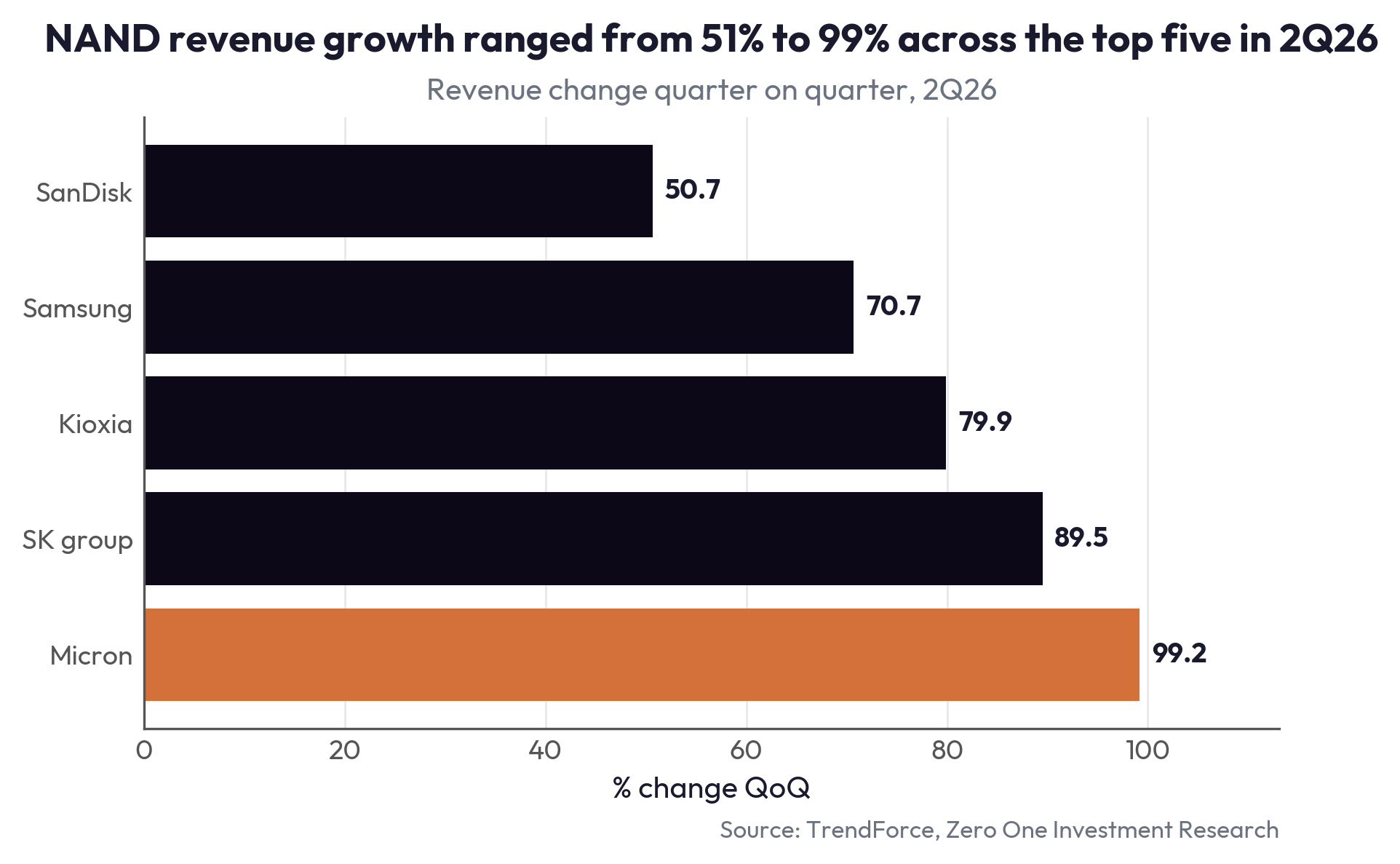
The five listed NAND flash brands grew revenue 77% QoQ in 2Q26 to US$68.87bn, according to TrendForce, and the increase came from average selling prices rather than from bits shipped. Enterprise SSD demand from AI servers kept the market short, which let makers reprice through the quarter.
The dispersion reshuffled the ranking. Micron's NAND revenue rose 99.2% QoQ to US$11.85bn, the fastest of the five, taking it to third place. SK group, which combines SK Hynix and Solidigm, rose 89.5% to US$14.27bn on the 321-layer ramp and high-capacity QLC enterprise SSD orders, with its operating margin reaching a record.
Samsung stayed first at close to US$23.06bn, up 70.7%, but its share slipped to 29.3% because peers grew faster. Kioxia rose 79.9% to about US$10.72bn as BiCS8 output ramped, its share easing to 13.6%. SanDisk grew 50.7% to about US$8.97bn, the slowest of the group, held back by a more conservative bit shipment plan.
Our 13 August Blade carried Counterpoint data showing YMTC taking 14% of 2Q26 NAND bits and entering the global top three on volume. The two datasets do not conflict: bit share and revenue share have separated this cycle, because the brands winning revenue are the ones selling into enterprise SSD at repriced ASPs rather than the ones shipping the most bits.
TrendForce expects ASPs to keep carrying industry revenue into 3Q26 for three reasons: smartphone and PC demand is weaker because higher bill-of-materials costs are being passed into finished-goods prices, enterprise SSD demand for AI servers stays firm, and makers are prioritizing capital spending on DRAM and HBM, which limits new NAND capacity.
Linked stocks: 005930 KS, 000660 KS, MU US, SNDK US
Anthropic grows revenue sixfold, adjusted operating profit positive
Anthropic's annualized revenue passed US$65bn at the end of July and its adjusted operating profit turned positive in the most recent quarter, according to preliminary documents seen by Bloomberg. Annualized revenue extrapolates a full year from a shorter recent period, so it moves faster than reported revenue, but the profit line does not.
The rate of change is the striking part. Annualized revenue was US$9bn at the end of last year, so the figure has risen more than sixfold in roughly seven months. Revenue in the most recent quarter exceeded US$11.5bn against US$787m in the same period a year earlier, more than fourteen times higher. The two figures are consistent with a run rate still climbing through the period: US$65bn annualized implies about US$16bn a quarter, above the US$11.5bn just reported.
This matters to the hardware chain because the packaging, substrate and memory shortages in today's other signals are being funded on expectations about model-layer revenue. A model developer converting usage into revenue at this scale, with adjusted operating profit positive, is a check on whether that spending has revenue underneath it.
Both Anthropic and OpenAI have filed confidentially for a listing, and Anthropic could list as early as this autumn, ahead of OpenAI. The Wall Street Journal separately reported that OpenAI's 2Q sales growth was modest measured against Anthropic's. Anthropic was until recently treated as the weaker position in the model race, and coding tools have carried much of the gain.
Linked stocks: NVDA US, GOOGL US, AMZN US
Foxconn adds US$358m to its Vietnam subsidiary
Foxconn (2317 TT) disclosed on 18 August a US$358.4m (NT$11.475bn) capital increase in its Vietnam subsidiary, which the market reads as co-packaged optics capacity, together with a MXN460m (NT$859m) increase in Mexico and a MXN382m (NT$715m) land purchase there for AI server production.
The filings name the entities. Foxconn Singapore took equity in FuKang Technology, Foxconn's principal Vietnam subsidiary, as a long-term investment. Cloud Network Technology Singapore took equity in FII AMC Mexico, and that entity bought land at El Salto in Jalisco. Mexico is already a production center for AI servers, and both disclosures were made on the same day.
Our 18 August Blade described the four Taiwanese links inside NVIDIA's Spectrum-X photonics switch, with Foxconn on the final assembly step. Yesterday's filings attach a capital figure to that step and put the capacity in Vietnam rather than Taiwan or China. Co-packaged optics places the optical engine in the same package as the switch chip, which raises the assembly content per unit.
Geographic spread is why Foxconn absorbs this kind of customer requirement without losing share. Economic Daily News notes the group runs more than 240 production sites across 24 countries and regions, so demands for non-China capacity in AI servers and smartphones have raised its share. FII, the mainland industrial unit, has reported AI server revenue growth of more than three times YoY and thirteenfold growth in switches above 800G.
Linked stocks: 2317 TT, NVDA US, 3450 TT
Gigabyte raises capex as neocloud share climbs
Gigabyte (2376 TT) reported record 2Q26 earnings per share of NT$9.86, up 117% YoY, and raised its 2026 capital expenditure plan from NT$2.3-2.5bn to NT$2.8-3.0bn. The company builds servers for the newer cloud providers rather than for the largest hyperscalers, which makes its order book a read on second-tier AI capacity.
Product mix pushed gross margin down and operating efficiency offset it. A higher share of high-end server racks diluted gross margin, while production efficiency cut the operating expense ratio to 4%. An NT$880m foreign exchange gain took the quarter above analyst expectations.
About 80% of Gigabyte's AI revenue comes from neoclouds and tier-two and tier-three cloud providers. Analysts covering the company expect combined annual deployment from that customer group to approach 3GW from 2027, and Gigabyte's AI revenue to more than double this year, taking AI servers to roughly 70% of total revenue. Operating margin is expected to hold at 5-6% despite the continuing mix dilution.
Capacity is the near-term variable. The US assembly plant begins formal shipments in 3Q26 after power supply issues were resolved, and the company is expanding in Taiwan, Malaysia and the United States while pre-stocking key components to protect shipment schedules. Rental prices for high-end chips are still rising, which is what pulls the second-tier operators into further capacity commitments.
Linked stocks: 2376 TT, NVDA US, 6669 TT
先聲 First Word: Exclusives from Chinese-Language Sources
SK Hynix draws 64% of first-half revenue from the United States
The US market accounted for 64% of SK Hynix's total revenue in 1H26, with NVIDIA and one other US technology company each contributing about KRW17tn (US$12.1bn), more than KRW34tn combined. Two customers now sit behind a large share of the HBM revenue carrying Korean memory earnings, a concentration that the current shortage makes easy to overlook. (18 Aug 2026) Source: NVIDIA之外還有大客戶 助SK海力士美國營收佔比衝上64%
Samsung reportedly a quarter ahead on the next DRAM node
Korean outlet The Bell reports that Samsung Electronics is on track to complete development of 10nm-class seventh-generation DRAM, known as 1d, ahead of the industry and about one quarter before SK Hynix. Node leadership in DRAM decides which supplier sets the specification for the next generation of high-bandwidth memory. (18 Aug 2026) Source: 三星1d DRAM開發傳領先SK海力士1季 有望奪回DRAM技術王座
Taiwan's largest chip distributor sees memory tight into 1H27
WPG Holdings (3702 TT) told its earnings call that memory supply stays tight with prices still rising, and guided 3Q26 revenue to grow 0.8% to 9.6% QoQ with 2H26 ahead of 1H26. A distributor sees order flow across the whole component market rather than one product line, so its call that the shortage runs at least into 1H27 is a broader check than any single maker's. (18 Aug 2026) Source: 大聯大看旺下半年 估記憶體至少缺到明年上半年

© 2026 Zero One Investment Research Pte Ltd. For informational purposes only. Not investment advice.