
TSMC's Arizona fab outearns both China plants; NVIDIA dates its 800-volt power shift
Zero One Investment Research Daily Intelligence Brief, August 17, 2026
TSMC's Arizona fab outearns both China plants; NVIDIA dates its 800-volt power shift
Top Market Signals
Arizona is now TSMC's biggest overseas earner
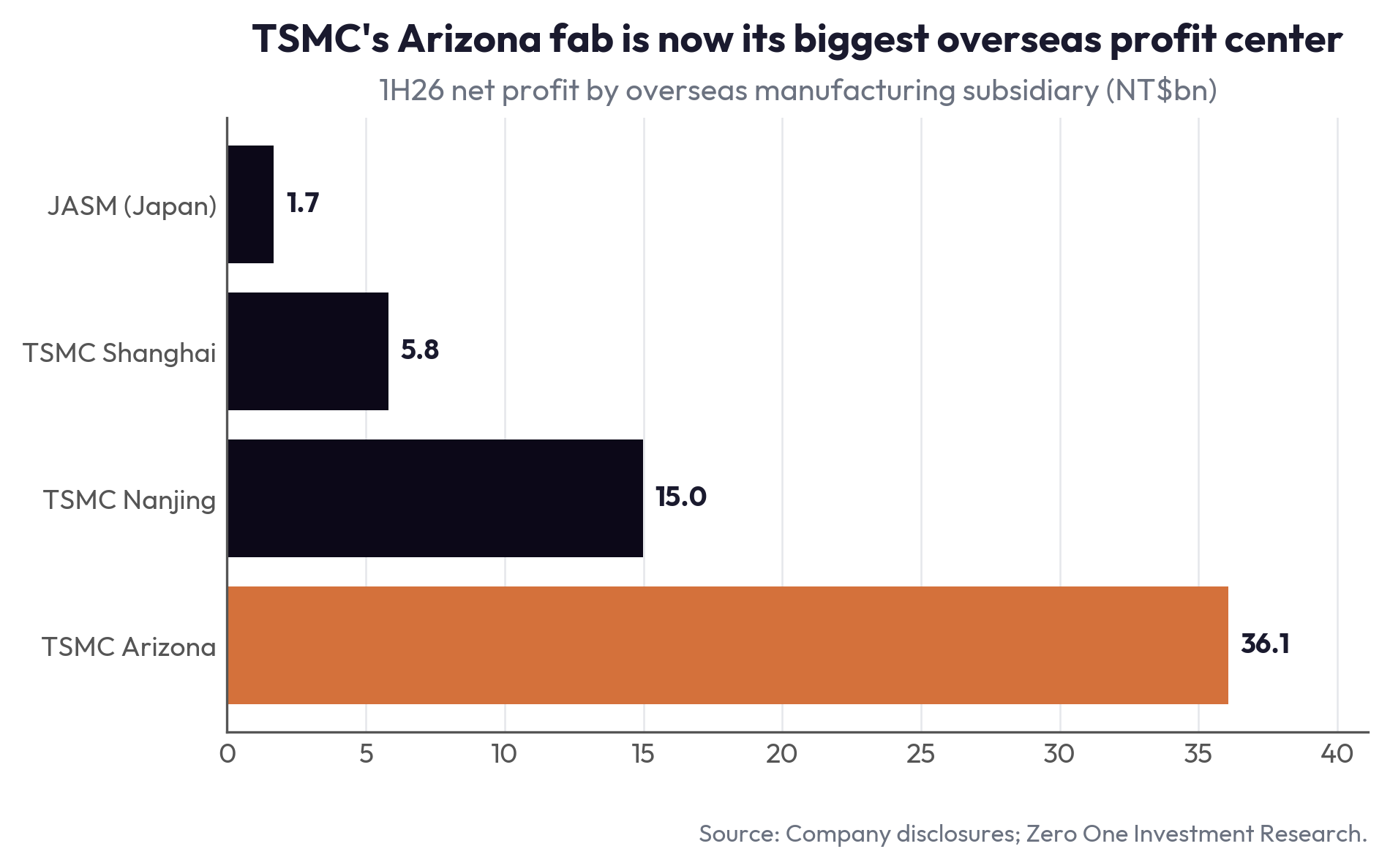
TSMC (2330 TT) disclosed that its four overseas manufacturing subsidiaries earned a combined NT$58.53bn in 1H26, up 215.4% from NT$18.56bn a year earlier and a record for the period. Arizona alone produced NT$36.07bn of that, more than the Nanjing and Shanghai fabs earned together, which moves the center of TSMC's offshore profit from China to the United States inside a single year.
According to Economic Daily News reporting on the half-year filings, TSMC Arizona earned NT$36.07bn against NT$4.73bn in 1H25, a rise of 662.8% and the highest first half on record for the unit. The split was NT$18.81bn in 1Q26 and NT$17.26bn in 2Q26, down 8.2% QoQ but up 307.8% YoY. TSMC recognized NT$31.15bn of investment income from the Arizona unit over the half, consistent with its holding in the entity.
Japan turned the corner in the same period. JASM earned NT$1.68bn in 1H26 against a NT$6.22bn loss a year earlier, its first profitable first half, with NT$0.95bn in 1Q26 and NT$0.73bn in 2Q26. JASM has said its first Kumamoto fab is back to pre-earthquake output. Germany's ESMC in Dresden is still loss-making and sits outside the four, which the paper attributes to the early construction phase.
The drivers reported are customers pulling orders forward, demand for leading-edge capacity held outside Taiwan, and supply chain scheduling. Arizona's recognized profit in the first half already exceeds 94% of what the unit contributed across all of 2025, and the P3 fab topped out in May, ahead of schedule. The 2Q26 sequential dip at both Arizona and JASM is what to watch from here, because it is the first quarter in this run where overseas profit did not grow, and a second one would say the step up has found its level rather than still climbing.
Linked stocks: 2330 TT, TSM US, NVDA US
Silicon capacitors move inside the AI package
Rising GPU power is pulling a passive component off the motherboard and into the chip package. Silicon capacitors, built with semiconductor processes directly on a silicon substrate, are being placed next to GPU, CPU and ASIC die to hold voltage steady, and three Taiwanese firms hold three different process routes into the market.
The mechanism is transient current. As AI chip power moves from hundreds of watts toward the kilowatt level, and as HBM (high-bandwidth memory) capacity and compute density rise, the current an accelerator draws swings faster. If the power delivery path cannot respond quickly enough the result is voltage droop and noise. Shorter paths deliver transient current faster, so the closer a capacitor sits to the die, the better it works. Against traditional MLCC (multi-layer ceramic capacitors), silicon capacitors offer lower equivalent series inductance and resistance, better high-frequency response and a much thinner profile, which is what lets them sit on the package substrate or directly under the die. MLCC keeps the motherboard and peripheral positions on cost and volume.
The three Taiwanese routes are distinct. AP Memory works from its DRAM stacking capacitor technology into a product called S-SiCap, supporting top-side, land-side and embedded positions. Powerchip (6770 TT) uses deep trench, etching large numbers of deep channels into the wafer to raise effective surface area and capacitance per unit area. Winbond (2344 TT) stacks layers using technology from its CUBE platform, and sells standard capacitor cells plus a process design kit so customers can combine them in series and parallel to their own specification.
Powerchip is the one already earning from it. Its deep-trench product entered volume production in 2Q26 and is qualified into Intel's EMIB advanced packaging supply chain, with utilization running high. For a mature-node foundry that matters beyond the line item, because it moves legacy capacity from consumer electronics toward AI work. Winbond has reserved silicon capacitor capacity at Module B of its Kaohsiung fab. The read to test from here is whether demand extends past AI accelerators into servers, network switches and edge devices, which is where the industry expects the second wave.
Linked stocks: 6770 TT, 2344 TT, 2330 TT
NVIDIA puts dates on its 800-volt shift
NVIDIA (NVDA US) published a staged roadmap for 800VDC (800-volt direct current) data center power on its own site, with deployment starting in 2H26. Putting dates and hardware stages on the record turns an architecture debate into a procurement schedule for the power and compound-semiconductor suppliers underneath it.
The case NVIDIA makes is conversion loss. Distributing power at higher-voltage DC removes conversion stages between the grid and the accelerator, leaving more of the delivered power available for compute. Its DSX reference design walks operators from today's AC infrastructure through a hybrid stage to a fully 800VDC facility. The staging is specific: MGX-compatible 800VDC power racks arrive in 2H26 and drop into existing AC infrastructure without reworking a building's electrical system; rack-row power centers acting as a central power station for a whole row, fed by an overhead 800VDC busbar and rated up to 2MW per row, are due in service in 2027; facility-level DC power blocks that convert grid power to 800VDC in a single step are framed as the architecture for the next decade.
The standards work is already broad. NVIDIA developed the architecture with Google and Microsoft through the Open Compute Project, published a joint white paper in March 2026, and followed with the LVDC Solid-State Transformer Specification v0.3 in July. More than 80 equipment makers and infrastructure companies are building products to that specification.
Taiwan's power suppliers are on the first rung. Lite-On (2301 TT) is sending 800VDC power rack samples to customers in August for validation, with mass production as early as November and a larger ramp in 1Q27, using Wolfspeed silicon carbide in its 800VDC sidecar power platform. Delta (2308 TT) plans mass production of 800VDC and plus-minus 400V DC in 3Q26, small shipments in 4Q26, and heavier 800VDC volume next year. Higher voltage cuts current for the same power, which reduces line losses and copper content but raises the demands on power semiconductors. That routes content to silicon carbide: Episil (3707 TT) runs 4-inch and 6-inch SiC process platforms covering Schottky barrier diodes and MOSFETs, and Episil-Precision (3016 TT) sits upstream in the epitaxial wafers those devices are grown on, where SiC yield is largely set.
Linked stocks: 2308 TT, 2301 TT, 3707 TT, NVDA US
Indium phosphide runs its largest price increase
Indium phosphide, the compound semiconductor substrate that optical transceivers are built on, is short enough that 4Q26 prices are being set more than 10% higher, the largest increase the market has recorded. Suppliers quoted by Economic Daily News say money alone no longer secures material, which places the binding constraint of the optical buildout upstream of the module makers.
The increases have been running for a year. Substrate prices began rising in 4Q25 and have been raised three times since, with a fourth now in preparation. Epitaxial wafers made from those substrates have been raised twice and are heading for a third increase in 4Q26. The step change is in size rather than direction: earlier rounds ran 3% to 5%, and the coming one is above 10%.
The bottleneck is structural to the supply chain's order. Epitaxial wafers can only be made from indium phosphide substrate, and substrate capacity is limited by policy and by plant, so upstream supply has not caught up with demand. Demand is being pulled by NVIDIA's newest platform and by the industry's shift from running copper and optical in parallel toward optical displacing copper, where indium phosphide's high-frequency and high-speed transmission properties are what put it in the path.
The three listed Taiwanese beneficiaries are all adding capacity. VPEC (2455 TT) is buying equipment, reports high order visibility and expects 3Q26 revenue to rise month by month while it works to secure substrate supply. Landmark Optoelectronics (3081 TT) is expanding epitaxial capacity, has committed NT$1.315bn to equipment, and has signed a long-term indium phosphide substrate supply contract with Sumitomo Electric of Japan. IET-KY (4971 TT) began phase two of its US plant in July last year and expects to complete it this year. The Sumitomo contract is the item to watch, because a long-term substrate agreement is the one thing on that list that addresses the actual constraint rather than the capacity downstream of it.
Linked stocks: 2455 TT, 3081 TT, 4971 TT
NVIDIA cuts the size of its OpenAI guarantee
NVIDIA (NVDA US) has reduced the data center guarantee it is offering OpenAI from roughly US$250bn to under US$120bn, according to Wall Street Journal reporting carried by Taipei Times and other outlets. At the same time it is negotiating to put its own equity into the power developer building the site, which trades a large contingent obligation for a smaller, more concentrated position.
The direct investment is up to US$3bn into SB Energy, SoftBank's (9984 JT) energy and infrastructure arm, which is developing a large data center campus in Ohio for OpenAI. Beyond the equity, The Information reports the three parties are discussing NVIDIA providing up to US$100bn in credit support for the campus. Terms, financing structure and final amounts may all change before anything is signed, and none of the three companies has commented.
Our 11 August Blade flagged the prior step in this pattern, when NVIDIA began offering residual-value support to turn GPUs into financeable, income-producing assets. Today's reporting runs in the other direction on size and the same direction on intent: less balance sheet extended to a customer, more cash put directly into the power and land that customer needs before it can install anything.
The counterweight came from the White House. AI and crypto adviser David Sacks, speaking on the All In Podcast, said the largest risk in the US$500bn AI financing platform is not demand but overbuild, producing idle capacity in the way unused dark fiber followed the dotcom buildout. He noted the exposure sits with those who built compute expecting spot prices of US$30 to US$50 per watt, a level Elon Musk has estimated. Sacks also argued the political difficulty of getting data centers approved makes genuine oversupply less likely, which is the unusual part of the warning: the constraint he expects to prevent a glut is permitting, not discipline.
Linked stocks: NVDA US, 9984 JT, TSM US
Samsung and SK Hynix line up record payouts
Samsung Electronics (005930 KS) and SK Hynix (000660 KS) are expected to publish new shareholder return programs as early as this month, which analysts cited by Korea Times size at up to KRW300tn combined. Both policies are percentage-of-cash-flow formulas, so the number each company announces is itself a disclosure about how much free cash flow management expects to generate.
Samsung has committed to returning half of its free cash flow under its 2024 to 2026 policy, which market estimates suggest leaves up to KRW200tn to distribute. Kim Dong-won, head of research at KB Securities, expects the new program to be large enough to lift Samsung's dividend yield above 7% at the current share price. SK Hynix runs a similar 50% of free cash flow commitment covering 2025 to 2027, against up to KRW100tn.
SK Hynix has already passed the KRW100tn net cash target it set at its annual general meeting earlier this year, according to Daishin Securities analyst Ryu Hyung-keun, helped by proceeds from selling its stake in Kioxia and by a capital increase through American depositary receipts issued on Nasdaq. Those factors, Ryu said, "create an environment in which up to 100 trillion won could potentially be allocated to share buybacks and cancellations, special dividends and other shareholder returns." Record 2Q operating profits of KRW89.5tn at Samsung and KRW60.5tn at SK Hynix are what funds the range.
The pattern extends past Korea. SanDisk has pledged to return all of its excess cash to shareholders, and Micron (MU US) has said it will move toward returning 100% of excess free cash flow. What makes this cycle different from prior memory peaks is that the same cash is covering both the largest capacity programs these companies have run and payouts of this size, rather than forcing a choice between them. The test is what the formulas do on the way down, since a policy fixed to a percentage of free cash flow shrinks with the cycle rather than defending a level.
Linked stocks: 005930 KS, 000660 KS, MU US
先聲 First Word: Exclusives from Chinese-Language Sources
TSMC's Taiwanese suppliers follow it to the United States
Topco Scientific (5434 TT), the Gudeng (3680 TT) group and the G2C+ alliance are opening US operations alongside TSMC's fab buildout, supplying specialty materials, key components and equipment services. Topco raised its full-year outlook for the first time at its May earnings call, set up a Thai subsidiary early this year, is posting staff to Dresden, and plans service sites in Boise, Idaho and in Mumbai, with Boise placed to serve Micron nearby. (17 Aug 2026) Source: 台積電協力廠爭取在地商機
Taiwan's five fab-engineering contractors post a strong first half
Hantang, Marketech, Acter, YEC and Acme all ran stronger in 1H26 on continued advanced-process and packaging investment by TSMC, Micron, ASE and SPIL, with order books holding at high levels and work extending into the United States and Singapore. These five are the listed proxy for how much fab construction is actually being built rather than announced, and their order books lead the equipment and materials cycle. (17 Aug 2026) Source: 台積、美光、封測、資料中心狂建廠 台系廠務五雄1H暴賺
Getac's drone unit targets a tenfold year
Getac (3005 TT) reported 2Q26 revenue of NT$11.51bn, up 23.7% QoQ and 17.4% YoY, with gross margin of 31.1% and net profit of NT$1.57bn, up 44.7% QoQ. The company is pushing ground control systems in drones off a small base, guiding to tenfold growth this year and to 8% to 12% of rugged-computer revenue next year, which would take drones from a rounding error to a second reportable business. (17 Aug 2026) Source: 神基今年業績拚新高

© 2026 Zero One Investment Research Pte Ltd. For informational purposes only. Not investment advice.