
DRAM shortage strands US$1bn of Apple chips inside TSMC; Winbond's customers now want 2030
Zero One Investment Research Daily Intelligence Brief, August 7, 2026
DRAM shortage strands US$1bn of Apple chips inside TSMC; Winbond's customers now want 2030
Top Market Signals
DRAM shortage halts US$1bn of Apple processors
TSMC (2330 TT) is holding roughly US$1bn of finished Apple processors it cannot package, because the DRAM that has to go into the package has not arrived. The chips are the A20 Pro, Apple's first part built on TSMC's 2nm (N2) process, due in the iPhone 18 family next month. TSMC had not commented as of 6 August.
The bottleneck is the packaging step rather than the wafer. TSMC combines the A20 Pro die with DRAM using wafer-level multi-chip packaging (WMCM), an integrated fan-out variant it has run for a decade and which the industry describes as a mobile version of CoWoS (chip-on-wafer-on-substrate). Without the memory, finished logic sits in the warehouse.
Columnist Tim Culpan, writing on Culpium and cited by Economic Daily News, reported that Apple and assemblers including Foxconn (2317 TT) and BYD are working with Apple to secure DRAM. Apple relies mainly on Micron (MU US) and also buys from SK Hynix (000660 KS) and Samsung. Culpan reported they are confident of meeting the first wave of demand but expect online order lead times to stretch as retail inventory drains.
For TSMC itself the damage is narrower than the headline suggests. Liu Pei-chen of the Taiwan Institute of Economic Research said TSMC cannot direct DRAM allocation but can move lines toward AI and high-performance computing parts, where the memory pinch is smaller. 2nm tape-outs already run well ahead of 3nm at the same stage and high-performance computing has passed consumer handsets in the mix, so the cost lands mainly on Apple's procurement and on TSMC's working capital while the chips wait.
Our 03 Aug 2026 Blade flagged the shortage reaching a finished Apple product, with the MacBook Air out of stock. Today it has moved one step upstream, from a product Apple cannot keep on shelves to silicon Apple cannot get out of the fab.
Linked stocks: 2330 TT, AAPL US, MU US, 2317 TT
Winbond's customers are trying to book 2030 capacity
Winbond Electronics (2344 TT) reported record 2Q26 revenue, profit, gross margin and operating margin, and president Chen Pei-ming told the results call that 2027 will be shorter of memory than 2026. Customers already holding 2028 contracts are pressing Winbond to sign long-term agreements running through 2029 and into 2030, and some are willing to pay more to secure the capacity.
The quarter's growth came from price rather than shipments. In low-power DRAM, revenue rose 78% QoQ while bits shipped fell about 10%, because average selling price more than doubled; Winbond cut some volume to protect supply to strategic customers. Flash revenue rose 65% on a 156% jump in bits, led by NOR flash. Chen expects 3Q prices to keep rising, though not at the pace of a doubling.
The 2027 call rests on a gap in Winbond's own capacity. Kaohsiung runs 15,000 wafers a month now and reaches 24,000 by the end of 2026, with 16nm replacing the older 20nm and 25nm flows. After that the company has close to two years in which it can add output only by moving to finer processes, not by adding tools.
The board has approved a new Kaohsiung fab, MB, breaking ground in January 2027, installing equipment from January 2029 and reaching volume production at the end of 2029, with output arriving in 2030. Its cleanroom is about 30,000 square metres against 15,500 today, and full capacity is 50,000 to 60,000 wafers a month at 14nm and later 12nm. EUV (extreme ultraviolet) tools carry a three to three-and-a-half year lead time against 12 to 14 months for ordinary equipment, so the fab is being built in a pre-EUV phase and an EUV phase.
A second line is opening alongside the memory business. Chen is targeting silicon capacitors and related products at 5% to 10% of revenue by 2027, driven by NVIDIA's next-generation rack power design, which steps 800V DC down to 1.2V or 0.9V at the die. At those voltages conventional MLCCs (multilayer ceramic capacitors) no longer meet the size, thickness and temperature requirements, and capacitors are also being embedded into CoWoS packages and substrates to hold signal quality.
Our 05 Aug 2026 Blade reported substrate buyers asking Taiwanese makers to pull 2029 and 2030 plant plans forward. The same request has now reached the memory layer, from customers rather than from the makers.
Linked stocks: 2344 TT, 2408 TT, 000660 KS, MU US
Semiconductor revenue is set to double this year
World Semiconductor Trade Statistics (WSTS) put 2Q26 global semiconductor revenue at US$403bn, up 124% YoY, and raised its full-year 2026 forecast to US$1.655tn, growth of 108% against a prior estimate of 90%. Every product category except sensors was revised up.
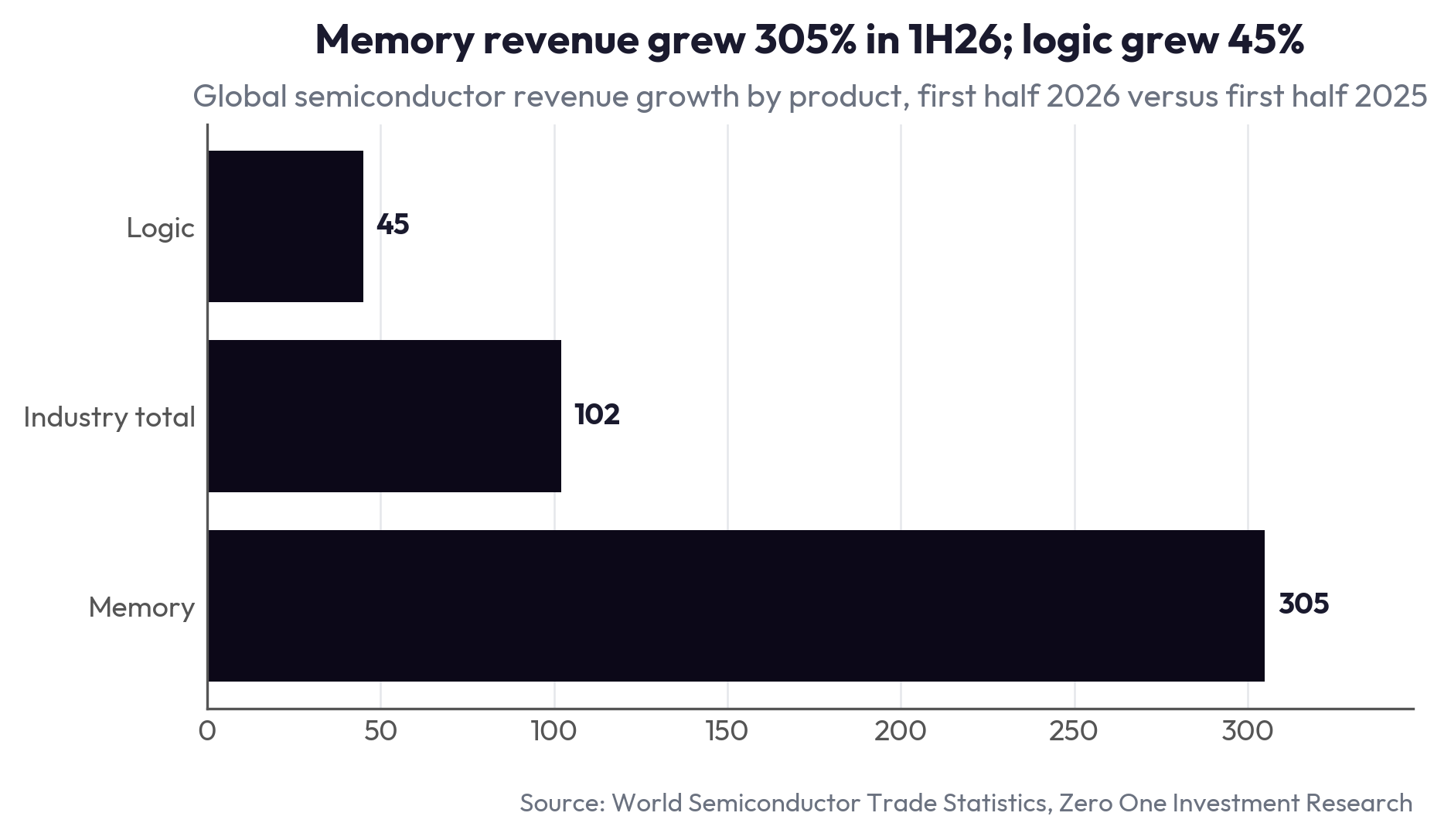
Memory is the reason. First-half memory revenue rose 305% YoY while logic rose 45% and the industry total rose 102% to US$702bn. WSTS lifted its full-year memory growth forecast to 302% from 249%, and expects the Americas and Asia Pacific to keep leading.
WSTS also raised 2027, to US$2.14tn, another 29% on a base that has already doubled. Growth of that size on a base that large has to come from memory contract prices holding near current levels rather than from a second doubling in volume, which is what the multi-year agreements now being signed will settle.
Linked stocks: 000660 KS, MU US, 2408 TT, 2330 TT
King Slide's gross margin tops its AI customer
King Slide Works (2059 TT), which makes the sliding rails that hold servers in a rack, reported a 2Q26 gross margin of 87.42%, a record and above that of NVIDIA (NVDA US), the chip designer at the other end of the same rack. Net profit was NT$7.088bn, up 103% QoQ and more than ten times higher YoY.
Economic Daily News attributes the margin to King Slide's patents and product design in a niche where it holds about 90% of the global server rail market. First-half net profit of NT$10.573bn already exceeds all of last year, and July revenue of NT$6.407bn was a record month, up 44.2% MoM and 3.5 times higher YoY.
The demand behind it is rack count. GB300 shipments are put at 68,000 racks in 2026, up 172% YoY, with SpaceX alone raising its GB300 order to 13,000 racks. NVIDIA's Vera Rubin platform enters volume production in 2H26 and is modelled at 80,000 racks in 2027. Amazon Web Services raised full-year capital spending about 10% to US$220bn, and its in-house accelerator volumes are put at 2m units in 2026 and 3.7m in 2027.
Capacity is following the orders. President Lin Shu-chen said the Houston plant starts volume production in 3Q26, a second Taiwan plant comes on line in mid-2027, and expansion phases three and four at subsidiary Chuan-Yi go out to tender by year end, with a European site under evaluation.
A margin that far above the rest of the rack holds only while the rail stays a designed-in part rather than a commodity. The first test is Nan Jun International (6584 TT), where two customers are validating Vera Rubin rails and a third is close to finishing tests.
Linked stocks: 2059 TT, NVDA US, 6584 TT, AMZN US
Memory costs cut smartphone processor shipments 15%
Global smartphone application processor shipments fell 15% YoY in the first half of 2026, with Qualcomm (QCOM US) and MediaTek (2454 TT) each shipping more than 25% fewer units, according to research data reported by DigiTimes. Unisoc grew against the trend on the strength of its low-price positioning.
The cause is the same shortage lifting memory revenue. Handset brands are holding conservative inventory, replacement cycles have lengthened, and rising component costs are reaching end demand. A phone maker facing a doubled DRAM bill either raises the retail price or builds fewer units, and both outcomes cut processor volume.
The share movement matters more than the level. Both premium vendors fell close to twice as fast as the market while the supplier that gained was the cheapest one, so a shortage in one component is moving share in another. Where 2027 memory contract prices settle decides whether this reverses, because the entry-tier phone is where a doubled memory bill does the most damage to the bill of materials.
Linked stocks: 2454 TT, QCOM US, 2330 TT
AMD buys Taalas to etch models into silicon
AMD (AMD US) agreed on 6 August to buy Taalas, a Toronto startup that writes the weights of a specific AI model directly into silicon instead of loading them from memory. Terms were not disclosed. The move parallels NVIDIA's (NVDA US) US$20bn licensing arrangement with Groq last December, and aims at the same target: running agent-style inference faster and cheaper.
The performance claim is large. Taalas showed a first test chip, HC1, on TSMC's 6nm process in February; running Meta's Llama 3.1 8B it produced up to 16,960 tokens per second, which the company put at 48 times an NVIDIA GPU and 8.5 times a Cerebras wafer-scale accelerator at the time of publication. A second chip, HC2, arrives this summer targeting 20bn parameters on a single die, which would put a one-trillion-parameter model on roughly 50 accelerators.
The architecture differs from the dataflow designs used by Groq and Cerebras. The processor splits between a mask-ROM fabric holding the model weights and an SRAM fabric holding the KV cache, the running memory of a conversation, plus fine-tuning adapters. AMD is expected to pair it with its Instinct-based Helios racks in a split arrangement, GPUs handling prompt processing and Taalas parts handling token generation.
The cost is flexibility. Once a chip is made it is bound to the model burned into it, and a significant model change means a new design and a new tape-out. Taalas chief executive Ljubisa Bajic said the platform can turn a new model into hardware in about two months. The whole case rests on that two-month cycle: it works if model architectures settle enough for hardware to keep up, and it does not if they keep moving.
Linked stocks: AMD US, NVDA US, 2330 TT
Optical supply stays short until mid-2027
Applied Optoelectronics (AAOI US) reported 2Q26 revenue up 86% YoY to US$191.9m, a fifth consecutive record quarter, and told investors demand will run ahead of its capacity until the middle of 2027. Non-GAAP EPS was US$0.06 against a US$0.03 estimate and a loss of US$0.16 a year earlier, on an analyst revenue estimate of US$189.3m. Non-GAAP gross margin was 29.8%, against 30.4% a year ago. Shipments of 800G transceivers more than doubled QoQ.
The constraint shows up in the 3Q guide. Revenue is guided to US$255m to US$290m, a midpoint of US$272.5m against a US$273m estimate, but non-GAAP earnings are guided to a loss of US$0.11 to US$0.26 a share where analysts had modelled a US$0.28 profit, on gross margin of 29% to 30.5%.
Management named the reason directly. Chief executive Thompson Lin said capacity and the supply of key components, not orders, are what limit near-term revenue, and CFO Stefan Murry said the company could ship more today if it could build more, particularly in 800G. Roughly in-line revenue paired with a loss where a profit was expected points at the cost of adding lines and securing components ahead of the revenue those lines will carry.
The 1.6T generation would extend the squeeze. Lin said customers are showing strong interest in both 800G and 1.6T products, so the capacity now being added has demand attached before it exists.
Linked stocks: AAOI US, COHR US, NVDA US
先聲 First Word: Exclusives from Chinese-Language Sources
Nanya raises 2026 capex 34% and commits to EUV
Nanya Technology's board approved lifting 2026 capital spending to no more than NT$69.7bn from NT$52bn, with the additional NT$17.7bn going to equipment prepayments for the new 5A fab, and set a 2026 to 2029 capex ceiling of NT$346.6bn that includes EUV lithography tools. Phase one of 5A is planned at 35,900 wafers a month. The EUV line item is the part that matters: it puts Nanya on a path to compete on process node rather than on niche capacity alone. (07 Aug 2026) Source: 南亞科今年資本支出升至 697 億元,加強 5A 新廠產能建置
Samsung opens its flagship driver IC socket to Novatek
Samsung Display has asked Novatek (3034 TT) and other suppliers to quote for the display driver IC in the Galaxy S28, due in 2028, according to Korean industry reports. Samsung's flagship handsets have taken driver ICs from its own System LSI division; opening the socket would put Taiwan's largest driver IC supplier into the highest-volume premium phone line outside Apple. (07 Aug 2026) Source: 打破自家系統LSI獨家供應? 三星S28傳徵詢聯詠DDI報價
AP Memory locks Powerchip and ASE capacity years ahead
AP Memory Technology (6531 TT) reported higher 2Q26 revenue and profit and said it has signed long-term capacity agreements with Powerchip and ASE Technology (3711 TT), covering growing IoT RAM demand and a silicon capacitor line for AI advanced packaging, with ultra-high-frequency memory due at the end of 2027. A design house of this size locking foundry and packaging capacity years ahead is the same behavior seen at Winbond's customers, one tier further down the chain. (07 Aug 2026) Source: IPD先行、VHM接棒 愛普簽下力積電、日月光LTA產能

© 2026 Zero One Investment Research Pte Ltd. For informational purposes only. Not investment advice.