
Nanya's July revenue jumps 720% as NVIDIA weighs cutting Rubin Ultra's memory
Zero One Investment Research Daily Intelligence Brief, August 4, 2026
Nanya's July revenue jumps 720% as NVIDIA weighs cutting Rubin Ultra's memory
Top Market Signals
Nanya's July revenue rises 49% in a single month
Nanya Technology (2408 TT) reported July revenue of NT$43.87bn, up 49.27% MoM and 719.61% YoY, another monthly record. Seven-month revenue reached NT$175.50bn, up 660.87% YoY.
A DRAM maker already running near full utilization cannot add 49% of volume in one month. The move is price. July is a contract renewal point, and the reset landed there. Team Group (4967 TT) put numbers on the same reset alongside its 2Q26 result, guiding DRAM contract prices up 20% to 25% in 3Q26 and a further 15% to 20% in 4Q26.
President Lee Pei-ying told the company's earnings call that cloud data center demand for HBM (high-bandwidth memory) and RDIMM server modules is crowding out supply for phones, PCs, automotive and consumer memory, and that the shortage covers the whole product range rather than one segment. He expects undersupply to persist for several more quarters.
New supply arrives late. Lee said capacity additions are being planned against customers' long-term agreement commitments and expand gradually from 2028. Long-term agreements already cover roughly 50% of Nanya's total capacity, and shorter contracts are being converted to longer ones as they expire. A maker that has pre-sold half its output on multi-year terms has given up part of the next price upswing in exchange for visibility.
Linked stocks: 2408 TT, 4967 TT, 000660 KS
Sources: 南亞科 7月營收續創單月新高!衝上 438.68 億元、年增 719.61%, 十銓獲利大爆發 上半年賺逾五股本 超越歷年年度表現
NVIDIA opens Rubin Ultra to a smaller memory stack
NVIDIA (NVDA US) has stopped treating HBM4e 12hi as the fixed memory design for Rubin Ultra and is evaluating HBM4e 8hi, HBM4 12hi and HBM4 8hi in parallel, according to TrendForce. The company held the 12hi baseline from 2025 through 1H26 and opened the alternatives from early 3Q26. No configuration has been settled.
TrendForce attributes the review to two supply constraints rather than any change in demand. DRAM stays short through 2027, which limits the wafer capacity memory makers can allocate to HBM, and HBM4e qualification and yield ramp remain uncertain.
Stack height decides two things at once. Within a generation, it sets how much HBM sits on each GPU and therefore how many GPUs can be built from a fixed wafer allocation. TrendForce reads NVIDIA's primary goal for Rubin Ultra as raising I/O speed and its secondary goal as growing GPU shipments, so a decision to cut would most likely come out of stack layers. Whether HBM4e qualifies on time decides whether Rubin Ultra reaches 14 to 16Gbps or stops at 11 to 12Gbps, against Rubin's 8 to 11.7Gbps.
Our 27 Jul 2026 Blade flagged NVIDIA halving the SOCAMM memory capacity on the Vera Rubin Superchip module as LPDDR5X supply tightened. The same pressure has now moved from the module memory to the HBM stack on the flagship 2027 part, and TrendForce says some cloud providers are considering the same cut on their next in-house ASIC designs. HBM shipment bits are forecast to grow 50% to 60% in 2027, which TrendForce expects to fall short of demand.
Linked stocks: NVDA US, 000660 KS, MU US, 005930 KS
Sources: TechNews
PC makers qualify Chinese memory to keep building notebooks
HP (HPQ US), Asus (2357 TT) and Acer (2353 TT) have started using small quantities of DRAM from China's CXMT in notebooks, according to Nikkei Asia reporting relayed by Tom's Hardware. The chips go into a limited number of models, and those models are not sold into the United States.
Many major PC makers completed CXMT qualification recently, per the same reporting. Qualification is the step that matters. It is a multi-month engineering process, and once a part is designed in, the second order is far easier than the first. Volumes today are described as very limited, and the caution has two sources. CXMT is listed by the Pentagon as having ties to China's military, with lawmakers in Washington lobbying to blacklist it outright, and the PC makers are also wary of antagonizing Micron, Samsung and SK Hynix while allocation is scarce.
Acer was the only vendor to respond to Tom's Hardware. It declined to name suppliers and said it works with multiple manufacturers to manage component price changes and supply chain resilience. It did not deny the report.
Export policy has spent years trying to keep Chinese memory out of Western hardware. A shortage severe enough to threaten notebook production has opened those designs in a few months. CXMT has said most of its investment goes to DRAM wafer lines and process upgrades rather than HBM, so the capacity it is adding points at exactly the PC and handset market the AI build is starving. Apple has separately been reported lobbying Washington for permission to buy CXMT parts.
Linked stocks: 2353 TT, 2357 TT, MU US, HPQ US
Sources: Tom's Hardware, Bloomberg
SK Hynix and SanDisk publish a NAND standard for AI memory
SK Hynix (000660 KS) and SanDisk (SNDK US) released the first specification for high-bandwidth flash, or HBF, and demonstrated it at FMS 2026 in California. The Open Compute Project has published the standard, and Google (GOOGL US) and Tenstorrent have joined the ecosystem.
HBF sits between HBM and the solid-state drive. The first specification covers 8-layer and 16-layer NAND stacks, a maximum 512GB of capacity, and bandwidth from 0.4TB/s to 3.0TB/s depending on grade. It connects to GPUs and CPUs over UCIe, the same die-to-die interconnect standard used in chiplet designs.
The engineering answers the constraint NVIDIA is now working around. HBM capacity per accelerator is limited by DRAM wafer allocation, and NAND is the one memory type with capacity available at scale and a cost per bit far below DRAM. Giving it a bandwidth-oriented interface creates a tier that can hold large model weights without competing for DRAM wafers.
Google signing on at launch matters more than the specification itself. One vendor's fast NAND is a product; a tier that a hyperscaler has committed to is something other NAND makers have to answer, which is why publishing through the Open Compute Project rather than as a proprietary part is the commercially significant part of the announcement. SK Hynix also showed its tenth-generation 375-layer 4D NAND, which it says improves performance per watt 2.5 times over the prior generation, with enterprise SSD production planned for early 2027.
Linked stocks: 000660 KS, SNDK US, MU US, GOOGL US
Sources: 強強聯手!SK海力士攜SanDisk發布HBF首項標準 搶攻AI儲存商機, Google News
Vanguard puts 2027 foundry price increases on the record
Vanguard International Semiconductor (5347 TT) reported 2Q26 revenue of NT$14.25bn, up 13.7% QoQ and 21.8% YoY, with net profit of NT$2.98bn, up 32.4% QoQ, and EPS of NT$1.56. Gross margin rose 3.0 points to 32.3%.
Price did as much work as volume. Wafer shipments rose about 11% QoQ while average selling price rose about 3%, and the 3Q26 guide keeps both moving: shipments up 1% to 3% QoQ, average selling price up 2% to 4% QoQ, and gross margin of 32.5% to 34.5%. Utilization is guided to reach 90%, with order visibility of about four months and 2H26 utilization of 85% to 90%.
Chairman Fang Leuh said price adjustments in 2027 are unavoidable, given AI and power management demand running through next year alongside rising equipment, materials and staffing costs, and that the increase will not be smaller than this year's. Discussions with customers are underway.
Vanguard runs 8-inch and mature 12-inch capacity in power management, well away from the leading edge where this cycle's pricing power has been concentrated. A mature-node foundry guiding higher prices four months out, and committing publicly to more in 2027, puts the tightness well outside the advanced nodes where it started. Capex stays at roughly NT$60bn to NT$70bn, in line with 2025, with 85% going to the Singapore joint venture, whose first fab reached better than 99% yield in June trial production and starts volume output in 1Q27.
Linked stocks: 5347 TT, 2303 TT, 6770 TT
Sources: TechNews, 〈世界法說〉方略:2027年漲價無可避免 幅度不會低於今年
Graphics cards in Korea rise up to 30% from August
Korean graphics card brands plan to raise GeForce RTX 50 prices by as much as 30% from August, according to ZDnet Korea reporting relayed by Tom's Hardware and MoneyDJ. Importers and distributors have confirmed the increases, and one card maker said the major brands halted shipments ahead of the change.
Two costs are moving at once. TSMC (2330 TT) has asked customers to prepare for advanced-process price increases covering not only 3nm but mature nodes including 7nm, and the GDDR7 2GB module used on RTX 50 cards has reached US$20 each on TrendForce data. NVIDIA has raised the package price it charges its board partners, and those partners are passing it on.
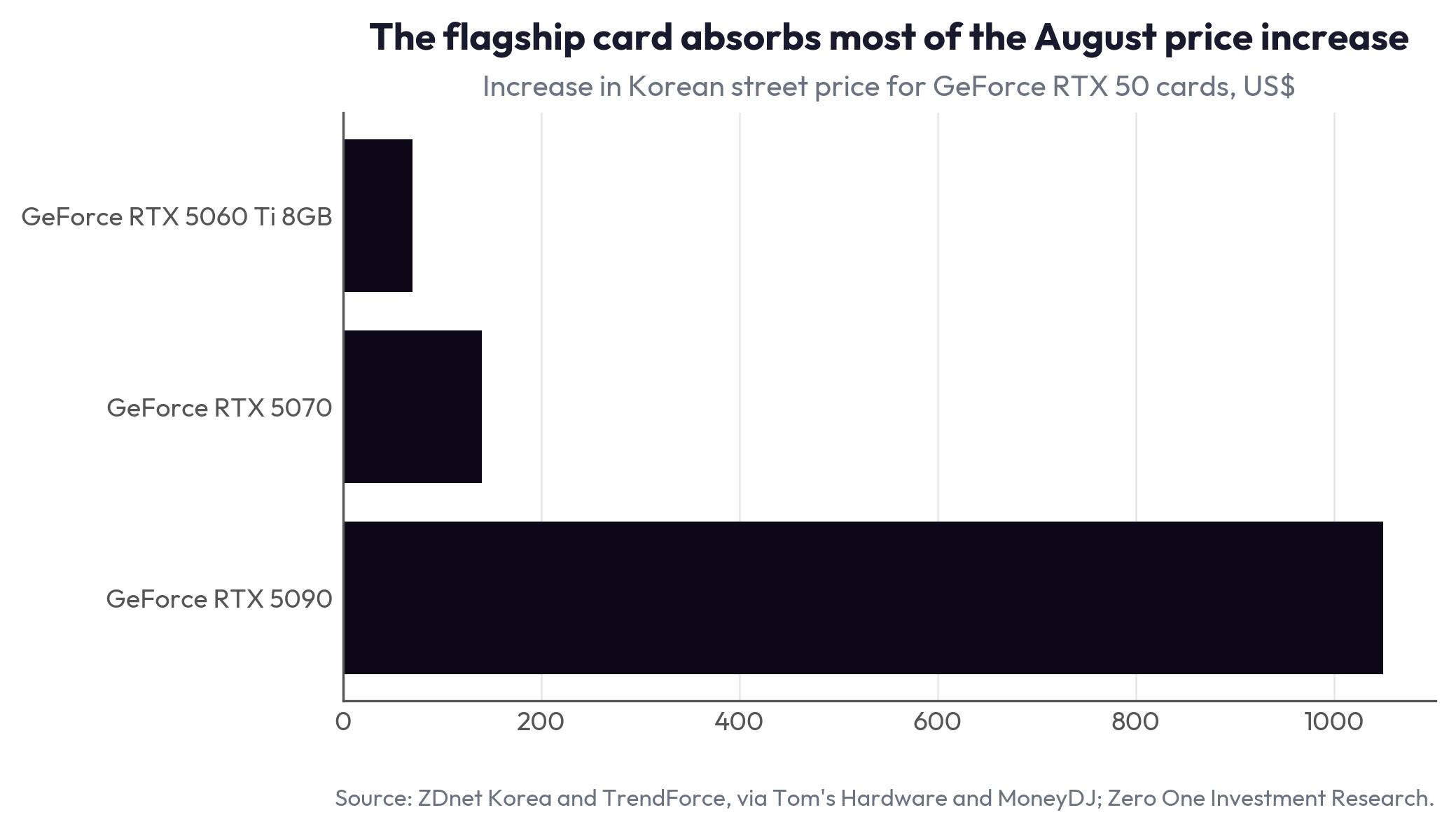
The retail numbers give the pass-through a size. The cheapest RTX 5060 Ti 8GB now sells for about KRW700,000, or roughly US$490, up about US$70. The RTX 5070 starts near KRW1.1m, about US$770, up roughly US$140. The flagship RTX 5090 reaches KRW7.3m, about US$5,112, up around US$1,050 from last month's high.
The cards carrying the most GDDR7 take the largest increase, in dollars and in percentage terms, which is what a memory bill arriving on the shelf looks like rather than a general price rise. It is also the clearest read so far on how much of the AI build's component inflation the consumer is being asked to fund. One distributor said a smaller brand is considering about 20% while others go to 30%.
Linked stocks: NVDA US, 2330 TT, 000660 KS, MU US
Sources: 台積電漲價+GDDR7 變貴 南韓 RTX 50 顯卡 8 月喊漲
Raydium's margin falls on its best quarter in four years
Raydium Semiconductor (3592 TT) reported 2Q26 revenue of NT$6.82bn, up 25.4% QoQ and 16.6% YoY, its highest quarterly revenue in the four years since the pandemic. Gross margin fell 2.9 points QoQ to 25.7%, and operating profit of NT$350m was down 19.1% YoY despite the revenue record.
Chairman Huang Yu-kuo attributed the revenue to customers pulling orders forward rather than to end demand. Driver IC buyers pre-built inventory in response to mature-node capacity tightening and supply chain price increases, lifting all three product lines. AMOLED driver ICs gained on early pulls ahead of new handset launches and rising penetration in premium wearables, and large-panel driver ICs gained on television and IT restocking.
Huang expects 3Q26 momentum to slow from 2Q as memory price increases feed through to end retail prices and consumer demand turns cautious, with the pre-building now finished. Smartphone driver IC pull-through is slowing most noticeably. Automotive and industrial driver ICs are the exception and should keep growing.
Set against Nanya's July print, the two describe one transfer. The same contract price reset that took Nanya's revenue up 719.61% shows up here as 2.9 points of gross margin and a guided volume slowdown at a company that buys mature-node capacity and sells into consumer hardware. The half-year figures make it plainer: 1H26 revenue rose 5.0% YoY while operating profit fell 28.9%.
Linked stocks: 3592 TT, 2454 TT, 2353 TT, 2408 TT
Sources: 瑞鼎:記憶體漲價影響消費需求 Q3營運動能較上季趨緩
先聲 First Word: Exclusives from Chinese-Language Sources
Samsung's GaN foundry ramp slips again, with customers said to be evaluating Powerchip
Samsung Electronics (005930 KS) has run into trouble in trial production of its 8-inch gallium nitride power semiconductor foundry line, with some pilot chips found not to operate correctly at high temperature, and mass production originally set for the end of 2026 may be delayed again, according to Korean outlet Theelec relayed by DigiTimes. Customers are reported to be evaluating GlobalFoundries and Powerchip (6770 TT) as alternatives. GaN is the switching technology behind the high-voltage power architectures now being designed into AI data centers, so a delay at one qualified supplier reroutes design wins rather than deferring them. (04 Aug 2026) Source: 三星GaN代工量產恐再延 客戶傳評估GF、力積電合作
Elite Semiconductor's July revenue rises 491% on niche memory
Elite Semiconductor (3006 TT) reported July revenue of NT$6.79bn, up 40.0% MoM and 491.1% YoY, taking seven-month revenue to NT$28.00bn, up 281.5% YoY. A move of that size at a specialty memory designer shows the price reset reaching well beyond the DRAM majors, as AI-driven capacity crowding pushes buyers of lower-density parts into a market with no spare supply. (04 Aug 2026) Source: 晶豪科7月營收月增40.0%
Samsung Electro-Mechanics pulls its Philippines MLCC plant forward to early 2027
Samsung Electro-Mechanics (009150 KS) will start production at its new multilayer ceramic capacitor plant in Calamba, the Philippines, ahead of schedule at the end of 1Q27, according to Seoul Economic Daily reporting relayed by DigiTimes. The company is expanding on the basis of long-term supply agreements signed with global technology customers. Passive component capacity is now being committed on the same multi-year contract terms that have become standard in memory, which leaves less available to spot buyers. (04 Aug 2026) Source: 三星電機菲律賓MLCC新廠傳提前投產 長約推動超高速擴產

© 2026 Zero One Investment Research Pte Ltd. For informational purposes only. Not investment advice.