
The Blade: a free daily AI & semiconductor supply chain newsletter
AI chip financings pass US$150bn as OpenAI's revenue comes in US$20bn below reports
Zero One Investment Research Weekly Intelligence Brief, Week ending October 10, 2026
Top Market Signals
Anthropic, SpaceX and OpenAI chip financings total more than US$150bn
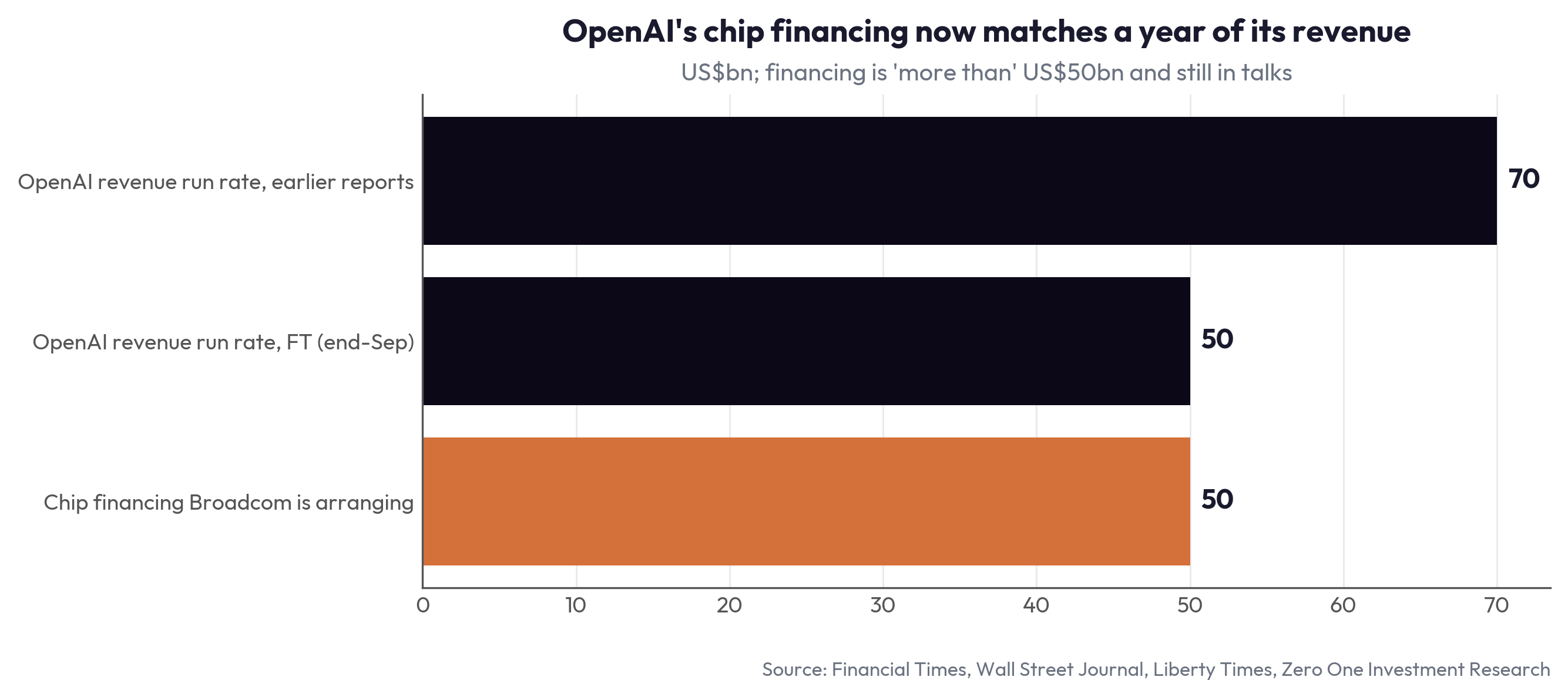
Three financings for AI chip orders surfaced last week. Banks began selling down a US$60bn loan that funds Anthropic's 2027 rental of Google chips, the Financial Times reported on 5 Oct. SpaceX is seeking about US$40bn of loans and investment-grade bonds for an NVIDIA (NVDA US) order, and Broadcom (AVGO US) is arranging more than US$50bn for the custom chips it is building with OpenAI, with Apollo (APO US) and Blackstone in talks.
The deals differ in who carries the risk. About US$42bn of the Anthropic loan is guaranteed by Broadcom, which is rated A minus, and banks offered that part first. The other US$18bn rests on Anthropic's own credit and may wait for its IPO. SpaceX borrows directly on a BBB rating, the second-lowest investment grade.
The borrowers' revenue is the weak side. The FT reported on 8 Oct that OpenAI's annualized revenue was about US$50bn at the end of September, against about US$70bn in media reports late last month. Broadcom's OpenAI financing alone would equal a year of that revenue. At Anthropic, Microsoft (MSFT US) cut its internal Claude budget by more than a third and Meta's internal Claude Code users halved to about 30,000; the market believes the two are the unnamed customers behind about 25% of Anthropic's revenue.
Linked stocks: AVGO US, NVDA US, APO US, MSFT US
Foxconn books Taiwan's first NT$1tn month as TSMC beats guidance by 2%
Foxconn (2317 TT) reported September revenue of NT$1.16tn, up 38.4% YoY, the first Taiwan-listed company to pass NT$1tn in a single month. TSMC (2330 TT) reported 3Q26 revenue of NT$1.494tn, up 51% YoY and about 2% above the top of its guidance.
The server builders carried September. Wiwynn (6669 TT) doubled its revenue YoY to a record, and Quanta's (2382 TT) 3Q26 revenue rose 125% to NT$1.12tn. Notebooks went the other way: Quanta's 3Q notebook shipments fell 24.4% YoY, and Wistron, Inventec and Compal each shipped fewer notebooks than in 2Q.
The next platform is a first-quarter story. Quanta said NVIDIA's Vera Rubin ships in small volume in 4Q26 and ramps in 1Q27, with GB300 carrying the fourth quarter. King Slide's (2059 TT) September revenue fell 30.9% MoM as customers changed over between platforms, which fits Quanta's timeline. Foxconn's margin is the open question: its 2Q26 gross margin slipped to 6.12%, and its 12 Nov results will show whether profit keeps pace with rack volumes.
Linked stocks: 2317 TT, 2330 TT, 6669 TT, 2382 TT
ITEQ raised laminate prices 30% as analysts see 2027 wafer prices up 40%
ITEQ (6213 TT), a maker of copper-clad laminate (the base material circuit boards are built from), raised prices by about 30% in 3Q26, and a Japanese broker expects another 20% to 30% in 4Q26. Elite Material (2383 TT) and Taiwan Union Technology (6274 TT) also set September revenue records, and Elite's high-end laminates are sold out.
The shortage starts in the glass cloth woven into laminates. Nitto Boseki (3110 JT), the Japanese supplier of T-Glass, says demand exceeds supply and its lines run full. ITEQ's chairman called securing raw materials the group's biggest problem as it plans more than 60% more capacity by 2029.
Price increases also reached the start of the chip. Analysts estimate GlobalWafers' (6488 TT) 2027 contracts rise 40% or more for 12 inch polished wafers, the discs every chip is built on. Texas Instruments (TXN US), Renesas and onsemi are raising power chip prices by up to 15% as AI racks use more of them, and Taiwan chip designers say they will keep passing these costs to customers through 2027. Analysts told Economic Daily News the laminate increases could fade in 2027 as new glass cloth capacity opens.
Linked stocks: 6213 TT, 2383 TT, 6488 TT, 3110 JT
Nanya lifts DRAM prices up to 20% as Micron's Taiwan union votes to strike
Nanya Technology (2408 TT) is telling customers DRAM contract prices will rise again, by up to 20% on some products, industry sources told Economic Daily News; Nanya said it cannot comment on customer pricing. The top of that range is above TrendForce's 10% to 15% forecast for 4Q26.
Price is doing the work. Nanya's 3Q26 revenue rose 612% YoY while its shipments stayed roughly flat, and its new fab starts wafers only in 2H27. Samsung Electronics (005930 KS) reported preliminary 3Q26 profit up 783% YoY, and orders for HBM4 (high-bandwidth memory, stacked beside AI processors) are filling its 4nm foundry lines.
Supply now carries a labor risk. Micron's (MU US) Taoyuan union won the legal right to strike with 88.3% of members in favor, at a company whose Taiwan sites hold more than 60% of its capacity. Industry sources say a stoppage would touch at least 15% of global memory supply, and Micron's customers have already committed to more than 75% of its fiscal 2027 output. Nanya's 12 Oct results call is the first confirmation of the increase; a figure below TrendForce's 10% floor would be the first sign that new Chinese capacity is loosening supply.
Linked stocks: 2408 TT, MU US, 005930 KS, 2344 TT
Samsung may cut 4Q phone output 30% as phone memory costs rise 211%
Samsung's phone division has asked suppliers to cut deliveries by 20% to 30%, and its 4Q phone output could fall by as much as 30%, Korean media reported. Its phone memory purchase cost rose 211% in 1H26 while its average phone price rose about 7%, leaving the phones earning almost no profit.
The rest of the device chain showed the same cost. MediaTek (2454 TT) beat its 3Q guidance but supply chain sources say its phone orders weaken into November. Largan Precision (3008 TT) said a phone customer cut orders in September and posted its lowest gross margin in 13 years. Quanta still expects full-year notebook shipments to fall by a double-digit percentage.
The same memory prices that lifted Samsung's chip division to record profit are cutting how many phones its handset arm builds.
Linked stocks: 005930 KS, 2454 TT, 3008 TT, 2382 TT
Marvell sets a US$80bn fiscal 2031 target built on design wins
Marvell Technology (MRVL US) guided fiscal 2031 revenue to US$70bn to US$90bn at its 6 Oct investor day, with the US$80bn midpoint 70% above the analyst average. Stifel said Marvell built the figure from design wins it has already secured, which ties the target to customer chip programs Marvell has won.
Custom chips, the processors cloud providers design for their own data centers, are spreading across suppliers. Marvell raised its fiscal 2029 custom accelerator target to US$12bn from US$10bn. MediaTek's first AI accelerator for a large US cloud provider enters mass production in 4Q, and it expects data center revenue above US$2bn this year.
Linked stocks: MRVL US, 2454 TT, AVGO US
TSMC adds a US$2bn US interposer source as Musk keeps Terafab in-house
GlobalFoundries (GFS US) signed a five-year, US$2bn deal to make silicon interposers, the slab of silicon under an AI processor and its memory, for TSMC's (2330 TT) CoWoS packaging in New York from 1H28. Terafab went the other way: Elon Musk confirmed talks with TSMC on 3 Oct, then said on 7 Oct that Tesla (TSLA US) and SpaceX will build and run the plant, with TSMC at most subleasing space and Intel's (INTC US) 14A process still planned.
Linked stocks: 2330 TT, GFS US, INTC US, TSLA US

© 2026 Zero One Investment Research Pte Ltd. For informational purposes only. Not investment advice.