
The Blade: a free daily AI & semiconductor supply chain newsletter
Meta runs Google's AI chips in production as TSMC seeks rare-earth-free motors
Zero One Investment Research Daily Intelligence Brief, October 23, 2026
Meta runs Google's AI chips in production as TSMC seeks rare-earth-free motors
Top Market Signals
Meta runs Google's AI chips in production
Meta Platforms (META US) is running AI inference in production on tensor processing units (TPUs), the custom AI chips of Google (GOOGL US), through a new version of the SGLang inference engine that runs PyTorch code natively on TPUs, Google announced on its developer blog, as reported by Tom's Hardware. PyTorch is the open source AI toolkit Meta created; until now, these engines ran on TPUs only through Google's own JAX framework.
"SGLang-TorchTPU is running in production at Meta today," said Zongwei Zhou, Meta's PyTorch-TPU lead. Jana van Greunen, Meta's director of PyTorch engineering, said Meta "cannot be constrained by a single hardware architecture." Google co-developed the TorchTPU software with Meta's PyTorch team. Where Meta's TPUs sit is not disclosed, and the footprint is likely small next to the NVIDIA and AMD servers Meta keeps buying. Meta reportedly signed a multi-year TPU rental agreement.
Meta research teams used TPUs through an older bridge from 2020 to 2023 before Meta canceled those contracts, SemiAnalysis reported last year. On 21 Oct, Google Cloud also said it will deploy NVIDIA (NVDA US) Vera Rubin rack systems with up to 960,000 Rubin GPUs, entering full buildout in November, Economic Daily News reported. Google is buying NVIDIA's chips at that scale while its own chip goes into another hyperscaler's data centers.
Our 20 Oct Blade covered Amazon's TorchNeuron, which lets PyTorch apps move to its Trainium chip by changing one line of configuration. Both companies are using software that runs PyTorch code unchanged to open their chips to customers whose code was written for NVIDIA. MediaTek (2454 TT) is a design partner on Google's TPU v9, whose tape-out may slip to January 2027, as our 19 Oct Blade reported.
Linked stocks: GOOGL US, META US, NVDA US, 2454 TT
TSMC asks suppliers for rare-earth-free motors
TSMC (2330 TT) has asked its equipment suppliers whether the factory automation tools in its fabs can use motors that need no rare-earth magnets, Reuters reported citing three industry executives briefed on the plan. Two of them said the talks are at an early stage and have not led to large-scale use of such equipment.
Rare-earth magnets drive the moving parts of industrial machinery, including the highly automated tools in TSMC's fabs. China accounts for about 70% of rare-earth mining, about 90% of refining and about 95% of finished permanent magnets, according to US Geological Survey and International Energy Agency figures cited by Tom's Hardware. China put seven rare earths and the magnets made from them under export licensing in April 2025; a wider set of controls announced in October 2025 was suspended until 10 Nov 2026, and that suspension has now been extended by another 90 days.
Motors without rare-earth magnets are already sold for factory pumps, fans and compressors. ABB, Siemens, WEG and Nidec (6594 JT) sell synchronous reluctance motors, and Taiwan's TECO Electric & Machinery (1504 TT) mass-produces a rare-earth-free version used in electronics plant water pumps, Uanalyze reported via cnYES. Chipmaking tools need tighter motion control and reliability than a pump, so any replacement would have to meet each tool maker's requirements.
A shortage of specialized motor parts would first complicate maintenance and repair of the tools TSMC already runs, as well as expansion. The next test is whether China lets the suspended controls take effect when the extension runs out.
Linked stocks: 2330 TT, 1504 TT, 6594 JT
Meta lifts its capex low end as cash flow turns negative
Meta Platforms (META US) raised the low end of its 2026 capital expenditure guide to US$135bn from US$130bn, keeping the top at US$145bn, after 3Q26 revenue rose 26% YoY to US$64.6bn, Economic Daily News reported. Free cash flow was negative US$2.12bn, the first negative quarter since its listing, though smaller than the negative US$9.4bn analysts had expected.
Meta will create a new class of nonvoting Class C shares, distributed one for one to existing holders in January 2027. It can then use them to raise capital, pay employees and fund acquisitions without affecting Mark Zuckerberg's voting control. Meta guided 4Q26 revenue to US$73-76bn.
Foxconn (2317 TT), Quanta (2382 TT), Wistron (3231 TT) and Wiwynn (6669 TT) build Meta's servers. Analysts cited by Economic Daily News expect Meta to keep buying AI servers built on NVIDIA and AMD platforms while it develops servers on its own custom chips (ASICs) for inference. Zuckerberg said Meta is expanding compute so it can serve more than 1 billion people in the coming years, DigiTimes reported.
The new share class gives Meta a way to raise equity for AI spending. How much stock it issues after January will show how far cash flow falls short of capex.
Linked stocks: META US, 2317 TT, 2382 TT, 6669 TT
Cleanrooms and parts limit Lam's growth
Lam Research (LRCX US) expects wafer fab equipment (WFE) spending to pass US$200bn in 2027 and said cleanroom space and component supply are becoming bottlenecks, DigiTimes reported. Revenue for the quarter ended 27 Sep rose 54.4% YoY and 22% QoQ to a record US$8.22bn.
Systems revenue rose about 62% YoY to US$5.73bn and customer support about 40% to US$2.49bn. Adjusted gross margin was 52.4% and operating margin 40.2%. Lam guided December-quarter revenue to US$8.2-9.0bn, a US$8.6bn midpoint, with an adjusted EPS midpoint of US$2.33 against the US$2.32 analysts expected, MoneyDJ reported citing Seeking Alpha.
The limits Lam named are cleanroom space and components, so faster revenue growth depends on how fast its customers and parts suppliers add capacity. Lam's main customers include TSMC (2330 TT), Samsung, Intel and Micron.
Our 17 Oct Blade reported ASML's CEO saying the capacity ASML planned for 2027 and 2028 may not fully meet demand. Two of the largest chip tool makers now describe their supply as the limit on growth.
Linked stocks: LRCX US, ASML NA, AMAT US, 2330 TT
Server CPU shipments to grow over 40% in 2027
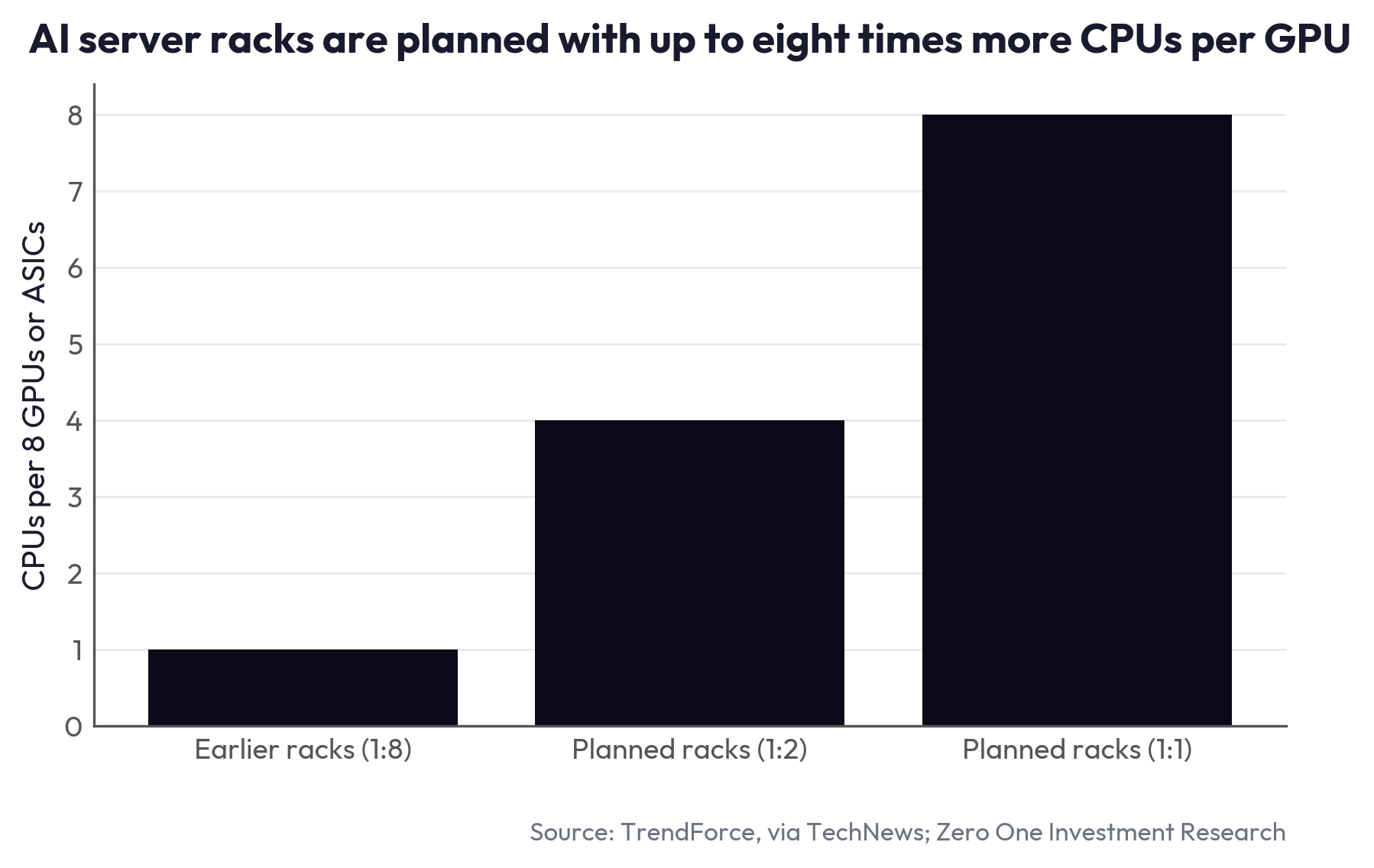
Server CPU shipments should rise 31% YoY in 2026 and more than 40% in 2027 as AI agents add inference work in cloud data centers, research firm TrendForce said, as reported by TechNews. The server racks AI providers are planning move the ratio of CPUs to GPUs or custom AI chips (ASICs) from 1:8 toward 1:2, or even 1:1.
Arm-based designs are taking share. x86 chips from Intel (INTC US) and AMD (AMD US) held nearly 90% of the market in 2025, with Arm-based CPUs just past 10%. TrendForce expects Arm to pass 20% in 2026 and reach about 30% in 2027, led by NVIDIA's (NVDA US) Vera, AWS Graviton, Google Axion, Microsoft Cobalt 100, Arm's own CPU, and new chips from OpenAI, Huawei and Alibaba.
Within x86, AMD's share should rise to about 27% in 2026, though tight TSMC capacity limits how many extra orders it can fill. Intel's new products face process and packaging delays and its own capacity is tight, so its share is falling.
The same demand shows up in Taiwan: DigiTimes reported that Wiwynn (6669 TT) and Quanta (2382 TT) are tracking CPU server demand from Meta.
Linked stocks: AMD US, INTC US, ARM US, NVDA US
TI's data center sales nearly double
Texas Instruments (TXN US) said 3Q26 data center revenue nearly doubled, DigiTimes reported, as total revenue rose 28% YoY to US$6.06bn, above the US$5.92bn LSEG consensus. TI guided 4Q26 revenue to US$5.8-6.3bn, a midpoint roughly flat with 3Q, in a quarter that usually declines seasonally.
Analog revenue rose 32% YoY to US$4.91bn and embedded processing 21% to US$848m. Analog chips manage power and convert physical signals such as sound, light and temperature into digital ones, so data centers and other electronics need them. CEO Haviv Ilan named industrial, automotive and AI data centers as the support for the 4Q guide.
Analog chip supply remains tight, and TI sees its content per humanoid robot reaching up to US$1,000, DigiTimes reported. TI is adding capacity in line with demand and named its 12-inch wafer capacity as a competitive advantage, alongside trailing 12-month operating cash flow of US$9.9bn.
Linked stocks: TXN US, IFX GR, NXPI US
Micron rules out the DRAM design CXMT chose
Micron Technology (MU US) will not pursue 4F² DRAM, a memory cell design about 33% smaller than today's 6F² cells at the same feature size, president and chief technology officer Scott DeBoer said at a company event on 21 Oct, after two decades of evaluating it. CXMT, China's largest DRAM maker, says it has completed a 4F² design and plans DDR5 products on it by year-end, news Economic Daily News said set off a sharp correction in memory stocks.
DeBoer said capacitor pitch, the spacing between the capacitors that store each bit, decides how many cells fit on a wafer, and both designs must fit their transistors beneath those capacitors. Micron will stay on 6F² and move to 3D DRAM, which stacks cells vertically. He said EUV lithography is needed for either design; CXMT would have to scale 4F² without ASML's EUV tools.
Samsung Electronics (005930 KS) and SK hynix (000660 KS) still have 4F² on their roadmaps, according to TechInsights. Industry sources told Economic Daily News that Micron's position should ease concerns for Nanya Technology (2408 TT) and Winbond (2344 TT), and a foreign broker expects neither 4F² nor 3D DRAM to have a material effect before 2028.
Our 20 Oct Blade reported Apple and Tesla citing CXMT as a possible source to push Samsung and SK hynix to cut prices. Whether CXMT ships 4F² DDR5 in volume by year-end will show how much product stands behind that pressure.
Linked stocks: MU US, 2408 TT, 000660 KS, 005930 KS
先聲 First Word: Exclusives from Chinese-Language Sources
Foxconn targets 10-week AI server product launches
Foxconn (2317 TT) unit Foxconn Industrial Internet has put humanoid robots on its AI server lines, reaching 94% automation coverage and a 97% first-pass yield, with new product introduction down to 3.5 months and targeted at about 10 weeks, its CIO said. Different GPU platforms, storage servers and network racks can mean hundreds of product configurations, which is why the group is moving to equipment it can reuse across products. (23 Oct 2026) Source: 鴻海AI伺服器產線再進化 新產品導入拚縮至10週
UMC and AP Memory tape out an AI chip power capacitor
UMC (2303 TT) and AP Memory (6531 TT) have taped out and passed initial functional checks on a discrete silicon capacitor built on UMC's deep trench capacitor process, with tests of capacitors inside package substrates next, Economic Daily News reported. Capacitors are moving from the circuit board into the package, closer to the chip, as AI chips draw more power. (22 Oct 2026) Source: 聯電攜愛普 攻 AI 伺服器供電 進擊先進封裝電源整合市場
TSMC has 16 Taiwan fabs planned or under construction
Taiwan's Minister of Economic Affairs Kung Ming-hsin said TSMC (2330 TT) has 16 fabs and advanced packaging plants planned or under construction in Taiwan, and that Taiwan will still hold 70-80% of TSMC's global capacity in 2035, Commercial Times reported. He was responding to President Trump's claim that the US will soon hold 50% of global chip capacity. (21 Oct 2026) Source: 經長:2035台積在台產能上看8成

© 2026 Zero One Investment Research Pte Ltd. For informational purposes only. Not investment advice.