
TSMC sets A14 trial production for early 2027 as Samsung pulls Tesla's AI5 forward
Zero One Investment Research Daily Intelligence Brief, September 22, 2026
TSMC sets A14 trial production for early 2027 as Samsung pulls Tesla's AI5 forward
Top Market Signals
TSMC dates A14 trial production to early 2027
TSMC (2330 TT) will begin trial production of its A14 process at the Baoshan Fab20 site in Hsinchu in 1Q27, with chip designers telling Commercial Times that development is running ahead of the company's original internal plan. Fab20's P3 building, which steps from 2nm to A14, received its use permit in 2Q26 and began taking tool deliveries in September, and the volume site is Fab25 in Taichung.
The physical evidence is already in place. Fab25's P1 building is in floor construction and may finish before April 2027, with trial production as early as the start of 3Q27. TSMC told its July earnings call that A14 test vehicles were showing device performance near 90% of target and 256Mb SRAM yield near 90%, with tape-outs running ahead of plan.
In 2027 three advanced generations expand at once rather than in sequence. Institutional estimates carried by the paper put 2nm monthly capacity at 90,000 to 100,000 wafers by the end of this year and 130,000 to 140,000 in 2027, while 3nm in Tainan runs at 170,000 to 180,000 wafers a month in 4Q26 and may pass 200,000 next year. A14 trial production lands on top of both.
Equipment, materials, mask, facility and validation purchasing for a node normally starts well before trial production, so a 1Q27 date pulls those orders into the coming two quarters. The extensions matter too: A13 is designed to be backward compatible with A14 design rules and A12 adds backside power delivery to the same platform, both targeted at 2029, which gives the A14 tooling base a longer life than a single node would.
Linked stocks: 2330 TT, 2454 TT, 3443 TT
Topoint stops raising prices as mix lifts margin
Topoint Technology (8021 TT), which makes the drill bits that cut holes in printed circuit boards, reported a 2Q26 gross margin of 41.78%, up 12.34 percentage points YoY, and then told the market it has no plan for an across-the-board price increase in 2H26.
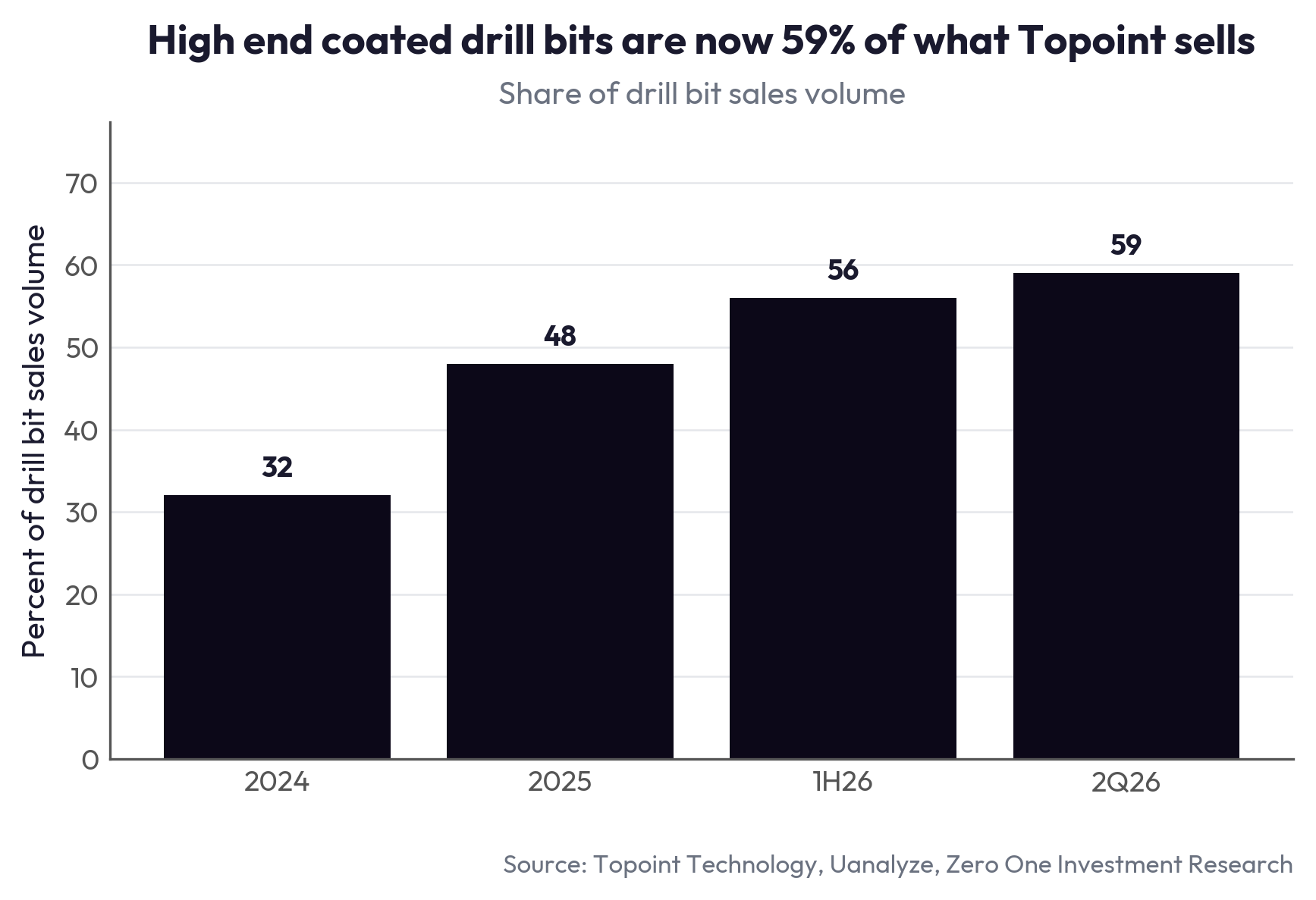
The margin came from what Topoint sells rather than what it charges. High end coated drill bits, used where AI server boards need more layers and harder drilling, rose from 32% of sales volume in 2024 to 48% in 2025, 56% in 1H26 and 59% in 2Q26. August revenue reached NT$771m, a sixth consecutive monthly record and up 97.75% YoY, taking the first eight months to NT$4.667bn, already above the NT$4.41bn of all of 2025.
The expansion behind that mix is large. Monthly drill bit capacity goes from 35m units in April 2026 to 45m by the end of this year, 70m by the end of 2027 and 90m by the end of 2028, more than a 1.5 times increase against a capital spending program in the billions of New Taiwan dollars. The new Zhongli plant reaches volume production in 4Q26. Once that equipment starts depreciating, utilization rather than price decides whether the margin holds.
Three of Topoint's own customers have taken the other side of that risk. Unimicron (3037 TT), Zhen Ding Technology (4958 TT) and Gold Circuit Electronics (2368 TT) all joined a private placement as strategic investors. Our 19 September Blade noted Aspeed booking two years of ASE packaging capacity through the end of 2028; buying equity in a supplier is the same behavior one rung further, with the customer carrying the expansion risk rather than only placing the order.
Linked stocks: 8021 TT, 3037 TT, 4958 TT, 2368 TT
Apple's foldable assembly yield sits just above 60%
Apple (AAPL US) goes on sale with the iPhone Duo, its first foldable, on 23 October, and people close to the Foxconn supply chain tell Jiemian News that whole-unit assembly yield is currently only just above 60%, with the first production batch small. Reaching a mature yield at Apple's current quality bar could take another six months to a year.
The calendar already said as much before anyone quoted a yield number. Over the past five years an autumn flagship iPhone has taken about three days from launch event to preorder and about ten days to retail. The iPhone Duo took 36 days and 43 days, roughly a month of extra line tuning. Build plans match: the global target this year is 6m to 8m units with channel guidance above 5m, against the 20m to 30m a single Pro or Pro Max ships over a product cycle.
Industry people say the low yield is not one unsolved technical problem. This is the first foldable Foxconn (2317 TT) has built at volume, so equipment, process steps and parameters are being adjusted in live production. Samsung Display's OLED panel and the hinge components both had yield shortfalls, delivery delays and design changes earlier, and any upstream slip compresses the time the assembler has to tune. Mizuho flagged hinge specification and the screen crease as the core variables in a 3 September report. The supply chain is now waiting on Apple to decide whether it relaxes its quality standard to move faster.
Foldables remain a small category. Omdia counted 18.2m foldables shipped globally in 2025, up 6%, against roughly 1.26bn smartphones, about 1.4% of the market, and the first half of 2026 fell 21.6% to 5.1m units with flip-style designs down 47%. Taiwanese lines exposed to iPhone volume, including TSMC (2330 TT), Largan Precision (3008 TT) and Shin Zu Shing (3376 TT), see the effect through total iPhone units rather than through this model.
Linked stocks: AAPL US, 2317 TT, 3008 TT, 3376 TT
Micron's Taiwan union moves toward a strike vote
Micron (MU US) and the Taoyuan wafer union failed to reach agreement in a second mediation on 21 September, and the union has announced it will move to a strike vote under Taiwan's labor dispute settlement law, with details to follow. The dispute is over a permanent profit-sharing formula at a company whose Taiwan fabs supply a DRAM market where buyers are already contracting for 2027.
Micron has answered with a timetable. The company says the scheme touches global corporate governance and has to go to the US parent board, that it has prepared several options internally, and that it expects to put them to the board on 8 October US time. It has asked the union for the time to run that process, and it will hold a second mediation with the Taichung union on 22 October as planned.
Our 16 September Blade reported the same union rejecting Micron's largest ever employee award on 15 September and asking instead for a permanent formula set at 15% of operating profit. What has changed in six days is that the union now has a route to stopping work, and the company has put its answer on a date it does not control in Taiwan. The union added that a failed mediation does not end talks and that the company still has the chance to negotiate as an equal.
Linked stocks: MU US, 005930 KS, 000660 KS
TSMC builds a shared validation site for tools
Construction started on 21 September at the Baipu industrial park in Kaohsiung. TSMC (2330 TT) is building a joint site there to validate equipment and materials before they reach production, a qualification hub distinct from its advanced packaging plants. Phase one covers 88.73 hectares with about 53.63 hectares zoned for industry, and leasing is already full, with TSMC on the south side and international firms targeted for the north.
The design is small and specific. Ho Chun, TSMC's vice president of advanced packaging technology and service, has described an initial footprint of about 3 hectares and two buildings holding small cleanrooms, laboratories and validation engines, built as modular lines the company calls Mini-Loop, with a target of raising validation efficiency by 25% to 50%. The scope can extend from today's wafer level packaging to panel level, chiplet and more complex 3D integrated circuit structures.
TSMC is running this itself because the two sides of the problem are growing at different rates. Ho puts the compound annual growth rate of TSMC's CoWoS capacity, the chip-on-wafer-on-substrate packaging that carries AI accelerators, above 80% through 2027 with growth continuing to 2029, while back end equipment makers are far smaller in revenue and research budget than the front end tool giants. Validating each tool separately no longer keeps pace with how fast AI chips change, so a common site standardizes it.
ASE Technology (3711 TT) plans two plants at Baipu, which would put a packaging and test volume operation next to the validation platform. The Ministry of Economic Affairs is adding inspection and validation capability through ITRI and the Metal Industries Research and Development Centre, aimed at letting Kaohsiung's existing metalworking, fastener and precision machinery firms qualify into semiconductor equipment supply.
Linked stocks: 2330 TT, 3711 TT, 2317 TT
Samsung starts Tesla's AI5 early in Texas
Samsung Electronics (005930 KS) has begun trial production and yield validation of Tesla's (TSLA US) AI5 chip at its Taylor, Texas foundry, ahead of the November date it had set for full operation. The line has started running 2nm wafers, validation is expected to finish before the end of 2026 and volume supply begins in 2027.
Samsung's Hwaseong and Pyeongtaek lines running 2nm to 4nm are saturated on AI chip demand from large technology customers, and that is what moved the Tesla work to Texas sooner. Samsung brought tools into Taylor in April and completed AI5 tape-out in July, so the compression is at the validation stage rather than in design.
Tesla signed a US$16.5bn semiconductor supply contract with Samsung in 2025, covering a chip Tesla plans to use in the Model 3 and Model Y, the Cybercab robotaxi, the Optimus humanoid and its own data centers. TrendForce put Samsung at 5.9% of the global foundry market in 2Q26 against SMIC at 5.4%, a gap of half a percentage point, which is the immediate reason filling Taylor quickly matters to Samsung. A second Taylor fab is being prepared for a construction start at the end of 2026 and operation around 2030 on a 1.4nm process.
Linked stocks: 005930 KS, TSLA US, 2330 TT
Panel makers raise prices by cutting output
BOE (000725 CH), TCL CSOT and HKC have told television brands including Samsung Electronics (005930 KS), LG Electronics (066570 KS) and Sony (6758 JT) that LCD panel prices are going up, with BOE's new prices from 4Q26 and the other two already raising some products from September. Industry estimates put utilization on parts of the Chinese LCD base at only about 70%, so the price increase comes from holding supply back while plenty of capacity sits idle.
The output cuts are scheduled around China's October holiday. TrendForce expects utilization on Gen 5 and larger lines to fall 4.2 percentage points MoM in October to 79.6%, with HKC taking seven days of downtime at its H1 plant, five at H2 and H4 and three at H5, TCL CSOT taking seven days each at T1, T6 and T10, and BOE taking four to five days on its 10.5G line. Front end production is being cut to match the assembly shutdowns.
AI is raising the cost side at the same time. TrendForce estimates total television panel cost rises 4% to 7% QoQ in 4Q26 because AI demand is taking upstream materials capacity, while fourth quarter television panel demand falls 4% QoQ as peak season stocking finished in the third quarter. Notebook and monitor panel orders weakened in the second half after customers built inventory early, and most makers are loss-making on those products, which is why they moved into television panels to defend profit even where it costs them share.
The pricing position is the result of years of consolidation. Omdia puts the three Chinese makers at 70% to 85% of the large LCD television panel market at 65, 75 and 85 inches and at almost all of the 90 inch and above segment, with the three together now about 70% of total supply. Samsung Display closed its LCD lines in 2022 and LG Display sold its Guangzhou LCD plant to TCL CSOT in 2024, so the Korean brands buying for the holiday season have limited alternatives at the moment their orders peak.
Linked stocks: 005930 KS, 066570 KS, 2409 TT, 3481 TT
先聲 First Word: Exclusives from Chinese-Language Sources
Samsung's Exynos took processor share from MediaTek and Qualcomm
Samsung Electronics' Exynos application processors reached their highest shipment share in nearly two years in 2Q26, while the two largest vendors, MediaTek and Qualcomm, both lost share, with the memory supply shortage cited as the cause. Memory scarcity is now reshuffling positions in a market usually decided on processor design and price, which favors the one vendor that makes its own DRAM. (22 Sep 2026) Source: 手機AP版圖2Q26悄生變 三星Exynos蠶食高通、聯發科市佔跌
OpenAI and Anthropic are expected to buy memory directly from 2027
Korean industry reporting indicates that Anthropic, OpenAI and similar AI service companies will expand direct purchasing of high bandwidth memory and other DRAM in 2027, securing the resources their compute build needs ahead of time. That would put model developers into the customer mix at Samsung Electronics, SK Hynix and Micron alongside the chipmakers and cloud operators who buy there today. (22 Sep 2026) Source: OpenAI、Anthropic傳擴大記憶體直購 牽動三大原廠客戶組合
Microsoft puts its own AI chip into volume production next year
Microsoft Taiwan general manager Bian Zhixiang said the company's in-house AI chip program is progressing well across design, capacity and deployment, with large scale production expected next year, and that Microsoft cannot meet its own compute needs so the capacity will not be opened to third parties in the near term. Foreign reports have put the Maia 300 in discussions with TSMC for more than 300,000 chips of capacity for 2027 delivery. (22 Sep 2026) Source: 微軟自研 AI 晶片 估明年量產

© 2026 Zero One Investment Research Pte Ltd. For informational purposes only. Not investment advice.