
TSMC needs 90% more tools than it planned; construction labor is the limit
Zero One Investment Research Daily Intelligence Brief, September 3, 2026
TSMC needs 90% more tools than it planned; construction labor is the limit
Top Market Signals
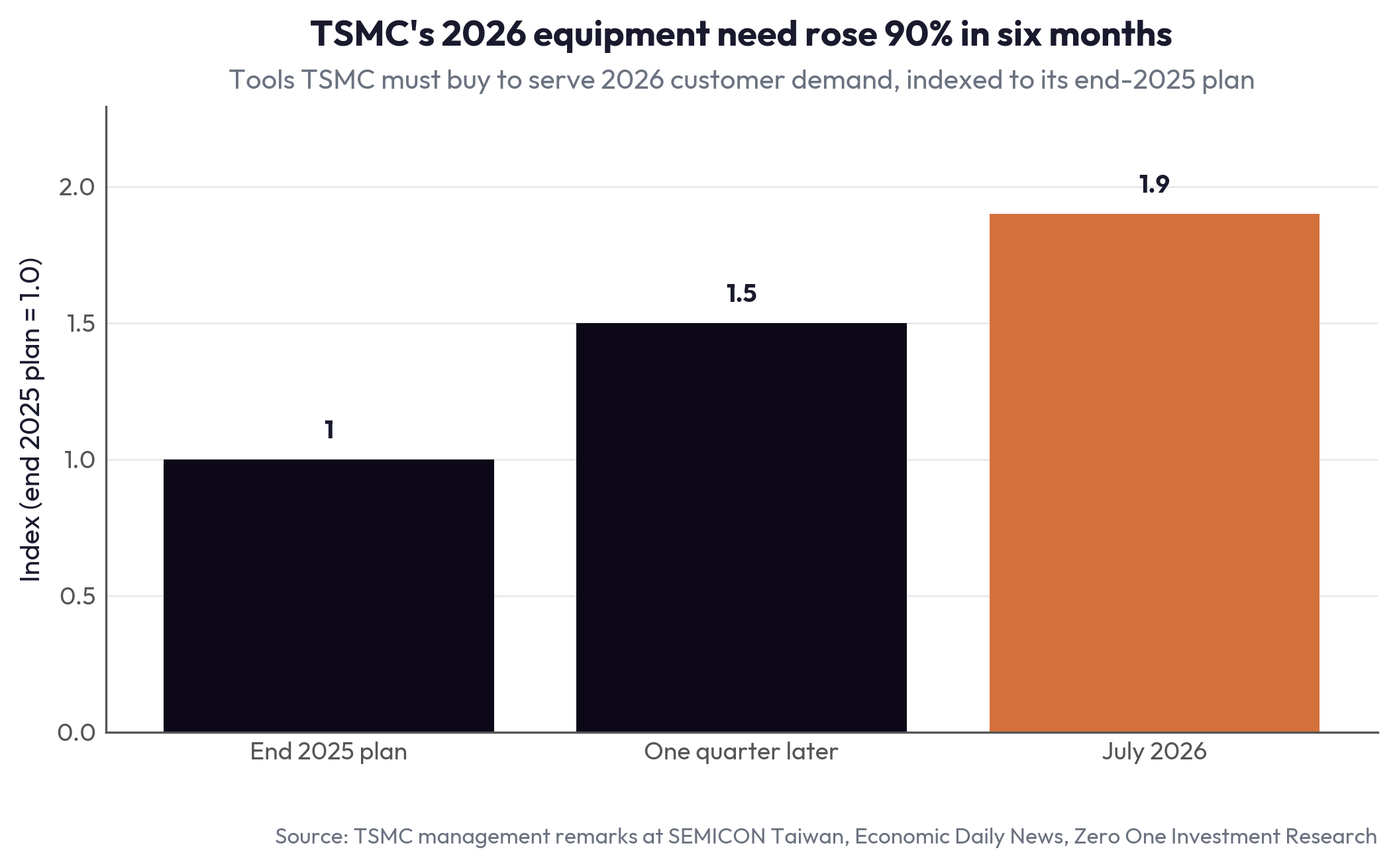
TSMC's equipment requirement rose 90% in six months
TSMC (2330 TT) senior vice president and deputy co-chief operating officer Hou Yung-Ching told the SEMICON Taiwan master forum on 2 September that the equipment TSMC must buy to meet 2026 customer demand has been revised up twice since the end of last year. Against a baseline of 1.0 set at the end of 2025, the requirement moved to 1.5 within a single quarter and reached 1.9 by July.
Hou, who also chairs the Taiwan Semiconductor Industry Association, said the industry has not seen demand grow this fast or change this often in 30 years. TSMC has close to 20 fabs under construction worldwide at the same time and still cannot fully keep up. Customers, he said, now ask whether the company can build 30.
His answer points at something other than capital. The biggest bottleneck on any new site, in Taiwan or in Arizona, is construction labor, which has to be hired locally and is already short in Taiwan. Each site can absorb only so many workers. Once the shell is up the tools still have to go in, and with equipment demand nearly doubling inside six months nobody in the chain can match that pace.
Hou's second point was about how the chain works together. Chip-level performance on its own no longer decides the outcome, so each supplier has to guarantee that the next one can realize what it hands over while holding yield, which replaces the linear handoff the industry has run on. Our 2 September Blade carried the same argument applied to tools, in TSMC's plan for a shared Mini-Loop validation line at the Baipu park in Kaohsiung where equipment and materials vendors qualify in the same building.
Linked stocks: 2330 TT, ASML NA, 8035 JT, 3711 TT
MediaTek hires TSMC packaging leaders for 3D IC
MediaTek (2454 TT) has recruited two of TSMC's (2330 TT) packaging leaders as it builds the 3D integrated circuit capability behind its AI ASIC business, where an ASIC is an application-specific integrated circuit built for one customer's workload. Former TSMC research and development vice president Yu Chen-Hua joins as a part-time adviser and TSMC advanced packaging senior director Hou Shang-Yung joins the company, Commercial Times reported.
The number MediaTek is working from explains the urgency. Global supply chain management head Liu Tien-Yi, citing the cost structure of NVIDIA's (NVDA US) B200 accelerator, said that excluding memory about 75% of the cost sits in advanced packaging, assembly and test. Back-end process has gone from a minor line in a chip's cost to the majority of it.
Liu said AI compute demand is doubling roughly every four to five months, faster than process shrinks deliver, so the competitive question has moved from whether a chip can be designed to whether it can be built at acceptable yield, cost and scale. As interposers and substrates keep growing, spreading chips sideways in 2.5D runs out of room, which is the argument for stacking logic vertically.
The Google (GOOGL US) tensor processing unit account is where this gets paid for. From TPU v8t, codenamed Zebrafish, MediaTek took over input and output design service plus the back-end design, and supply chain sources say it keeps both on TPU v9t, due in 4Q27.
Linked stocks: 2454 TT, 2330 TT, GOOGL US, NVDA US
Broadcom sees AI chip revenue quadrupling by FY28
Broadcom (AVGO US) told investors on 2 September that it has line of sight to US$115bn of AI semiconductor revenue in FY27 and US$230bn in FY28, against US$58bn expected for FY26. Third-quarter AI semiconductor revenue was US$16.7bn, up 221% YoY and 54% QoQ, on total revenue of US$29.6bn.
Quadrupling AI chip revenue over two fiscal years, from a base that is itself up 186% this year, rests on customer accelerator programs that are already committed.
The near-term guide came in lighter. Broadcom put 4QFY26 revenue at about US$34.8bn, up 93% YoY but below what analysts had modeled, with AI semiconductor revenue of US$21.7bn. Shares fell about 5% after the release.
For the Taiwan chain the FY27 and FY28 figures carry further than the quarter. Broadcom is the largest designer of customer-owned accelerators, and that volume runs through TSMC (2330 TT) wafers and advanced packaging, so a stated path to US$230bn sets the reference the other ASIC houses, MediaTek and Global Unichip among them, get measured against.
Linked stocks: AVGO US, 2330 TT, 2454 TT, 3443 TT
Nanya's August revenue rose 561% to a record
Nanya Technology (2408 TT) reported August revenue of NT$44.69bn, up 1.88% MoM and 560.85% YoY and a fresh record. Elite Semiconductor Memory Technology (3006 TT) reported NT$7.91bn, up 16.5% MoM and 605.2% YoY. DigiTimes attributes the step up at both to third-quarter contract prices being reset higher.
Nanya's first eight months came to NT$220.19bn, up 638.19% on the same period last year. Elite Semiconductor's eight-month total was NT$35.90bn, up 324.4%. July was the larger monthly jump for Nanya, at 49.27% MoM, so August held near that level without a second step up.
President Lee Pei-Ying has told investors that AI demand is changing memory supply and demand in a way that damps the usual cycle swings, and that HBM (high-bandwidth memory) and RDIMM (registered dual in-line memory module, the standard server memory format) demand from cloud data centers is crowding phone, PC, automotive and consumer memory out of available supply. He expects the shortfall to run several more quarters.
The capacity answer is dated and it is not soon. Lee said new capacity is being planned against customers' long-term agreements and comes on gradually from 2028, so the buildout is tied to demand the customers have already signed for.
Linked stocks: 2408 TT, 3006 TT, MU US, 000660 KS
CPO suppliers push volume shipments out to 2028
The suppliers who have to build co-packaged optics used SEMICON Taiwan to move the volume date out. Winway Technology (6515 TT) executive vice president Chen Shao-Kun, whose company makes the test sockets, said CPO (co-packaged optics, which puts the optical engine inside the switch or accelerator package instead of in a pluggable module) reaches initial small volume in 2H27 at the earliest and real volume in 2028, possibly later.
Chen said whether the process can be fully automated decides whether it can be built at volume, and that 2025 was CPO's first year with this year spent putting the infrastructure underneath it. Winway has ten CPO socket projects running and plans to add another 50% of socket capacity between 2Q27 and 3Q27. He also said the problem in AI is supply rather than demand, with foundry, packaging, test and equipment capital spending all extending through the next two to three years.
Two other suppliers made the same point from different angles on the same day. Lam Research (LRCX US) put the bottleneck in materials. Broadcom (AVGO US) core switching general manager Asad Khamisy said that for switches the right architecture stays an external laser rather than one integrated into the package, because a switch chip can draw thousands of watts against 10 to 20 watts for an optical module and lasers are highly temperature sensitive. Broadcom's own Tomahawk 5 and Tomahawk 6 CPO parts use external laser sources.
Our 31 August Blade carried TSMC (2330 TT) telling a Taipei silicon photonics forum that co-packaged optics enters mass production in 2H26 and that silicon photonics passes 50% of the optical communications market by 2027. Both statements can hold. A foundry can start producing packages well before the test, materials and assembly layers can support volume shipments, and the distance between those two dates is where the ramp risk sits.
Linked stocks: 6515 TT, AVGO US, 2330 TT, LRCX US
TSMC asks suppliers for 5 micron HBM microbumps
TSMC (2330 TT) has asked materials and equipment suppliers to develop 5 micrometer class microbump bonding and underfill for advanced HBM (high-bandwidth memory) packaging, DigiTimes reported citing Korea's ETNews. That points to the foundry scaling conventional microbumps further rather than moving high-bandwidth memory onto hybrid bonding.
Hybrid bonding joins two dies by polishing them flat and bonding copper pad directly to copper pad with no solder in between, which allows far tighter spacing. TSMC has taken its SoIC bond pitch from 9 microns to 6 and mapped a path to 4.5 by 2029. Intel (INTC US) shipped Foveros Direct hybrid bonding in its Clearwater Forest server processor in 1H26, and AMD (AMD US) has used the technique in volume since the first 3D V-Cache parts.
Memory is the exception. A JEDEC decision this year to raise the permitted HBM stack height lets HBM4 stay on microbumps, which defers hybrid bonding in high-bandwidth memory to HBM4E and HBM5 at the end of the decade. Microbumps have historically run at about 40 micron pitch and have been tightening toward 10 for the latest memory, so a 5 micron target puts them inside the range where hybrid bonding was supposed to take over.
The density gap is why this was expected to go the other way. AMD has cited roughly 15 times the interconnect density for hybrid bonding against conventional 2.5D microbump stacking, and figures TSMC presented at its 2026 technology symposium put face-to-face hybrid bonding at about 14,000 signals per square millimeter against roughly 1,500 for face-to-back through-silicon-via stacking. Suppliers that geared for a hybrid bonding transition in memory now have several more years of microbump tooling to sell instead.
Linked stocks: 2330 TT, INTC US, AMD US, 000660 KS
Delta's Vera Rubin power supplies go into replacement
Some Delta Electronics (2308 TT) VR200 high-wattage power supply units have developed capacitor faults that can cause overheating and failure, and the affected units have gone into replacement handling, Commercial Times reported on 3 September citing supply chain sources. NVIDIA (NVDA US) has notified several large customers including US cloud service providers and will review Delta's output plan.
Delta said it cannot comment on market talk or on customer details, but that where a supplier's component has a problem the company will help the customer arrange replacement so that demand is not affected.
What the fix costs depends on which of two explanations holds, and the report says the industry is split on it. If the problem sits in the capacitor material or the choice of part, changing the component and requalifying restores supply relatively quickly. If it sits in the product design, the redesign has to go back through qualification, which takes longer and can move the output schedule.
The stage of the program limits the damage. These high-wattage units are not yet in volume production, so there is room to correct before the ramp. If the report is accurate, buyers have already adjusted some capacitor sourcing and may raise other suppliers' share, and a second source could cover any shortfall. Rack-level power is the part of an AI system with the least tolerance for an unstable component, which is why customers are pressing for backup supply.
Linked stocks: 2308 TT, NVDA US, 2301 TT, 2317 TT
先聲 First Word: Exclusives from Chinese-Language Sources
Wah Lee sees semiconductor material orders into 2028 and PCB tools into 2030
Wah Lee Industrial (3010 TT) chairman Chang Tsun-Hsien said visibility on some semiconductor materials now runs to the end of 2028, and that lead times on PCB (printed circuit board) equipment already reach 2030. He expects double-digit growth in both businesses next year on new fabs, advanced packaging capacity coming on line and more overseas customers, with specialty gas shipments going mainly to South Korea, the United States and Japan. A materials distributor's order book runs ahead of the fabs it serves, so visibility to 2028 says the capacity behind those dates is already committed. (02 Sep 2026) Source: 華立唱旺半導體、PCB
Elite Advanced Laser's July profit rose 279% as optical supply stays short
Elite Advanced Laser (3450 TT) disclosed unaudited July net profit of NT$148m, up 279% YoY, with EPS of NT$1.02, after the regulator required it to publish financials. Second-quarter EPS was NT$2.09, first-half EPS NT$2.78 and the seven-month total NT$3.80. The company told investors that AI optical supply remains far behind demand even with the chain expanding, that the shortage should persist for several years, and that its board will approve financing to fund more capacity. Its COSA optical sub-assembly line covers 65G, 100G and 200G EML chips, with order volumes doubling annually. (02 Sep 2026) Source: 聯鈞7月自結獲利1.48億元、年增279% 下半年擴產滿足客戶出貨
I-Chiun takes ITRI cold plate technology into a new subsidiary
I-Chiun Precision Industry (2486 TT) chairman Chou Wan-Shun said the company has completed a technology transfer from ITRI (Industrial Technology Research Institute) and set up Hui Zhi Advanced, 70% owned, to move into microchannel cold plates and two-phase liquid cooling modules for AI servers. The team comes from ITRI's electronics and optoelectronics lab with more than four years of work behind it, and I-Chiun intends to list it. Heat sinks are already about 45% of revenue, ahead of the traditional lead frame business, with new equipment going into the Wugu plant and a Sanchong plant starting construction in 4Q26 for production in 1Q27. (02 Sep 2026) Source: 一詮擴張高階散熱版圖

© 2026 Zero One Investment Research Pte Ltd. For informational purposes only. Not investment advice.