
Big Tech booked more than US$160bn in paper gains as SK Hynix courts Intel's foundry
Zero One Investment Research Daily Intelligence Brief, August 31, 2026
Big Tech booked more than US$160bn in paper gains as SK Hynix courts Intel's foundry
Top Market Signals
SK Hynix weighs Intel for HBM base chips
SK Hynix (000660 KS) is considering Intel (INTC US) as a second manufacturer of the base chips that sit under its high-bandwidth memory stacks, work TSMC (2330 TT) has done alone since the HBM4 generation. The Korea Herald reported that the evaluation starts with HBM4E, the seventh generation of the product.
The base chip, also called the logic die, is the controller at the bottom of an HBM (high-bandwidth memory) stack that moves data between the memory above it and the GPU or CPU it serves. SK Hynix made its own base chips through HBM3E and switched to TSMC for HBM4, which is in production now on a 12nm-class process. Industry estimates put the cost of a TSMC-built HBM4 base chip at three to four times the cost of one of the 1b-generation core dies stacked above it.
Cost is why the question is live. HBM sells largely on long-term agreements, so a foundry price increase cannot be passed into product prices quickly, and TSMC plans to raise prices on processes below 7nm and on parts of its 12nm, 16nm and 28nm capacity by 5% to 10% from 2027. TSMC is also short of capacity for AI accelerators, which slows anything queued behind them.
For Intel the prize is larger than one product line. External customers accounted for 5% of Intel Foundry's US$5.8bn of 2Q26 revenue, or US$293m, and the division needs an anchor client to turn profitable on its 18A process. Intel hired former SK Hynix chief executive Lee Seok-hee in June as a foundry senior vice president covering advanced packaging and back-end process. Chief financial officer David Zinsner told Deutsche Bank's 2026 technology conference that defect density on the next node, 14A, is falling faster than on any node since 22nm, and that customers have moved from asking for technical data to asking about available capacity and scheduling.
Linked stocks: 000660 KS, INTC US, 2330 TT
Big Tech's AI paper gains more than doubled
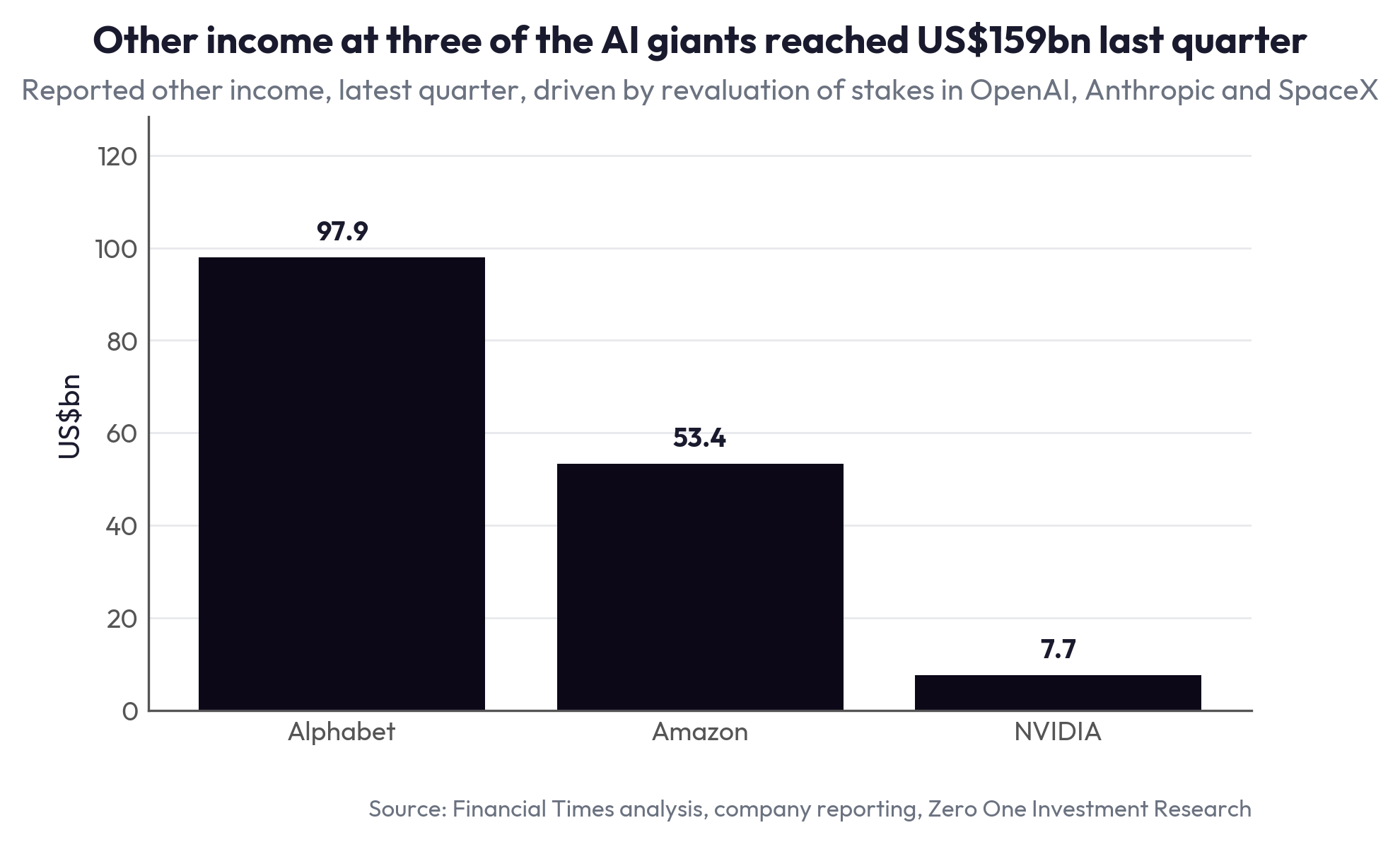
Alphabet (GOOGL US), Amazon (AMZN US), NVIDIA (NVDA US) and Microsoft (MSFT US) booked more than US$160bn of gains last quarter on their holdings in other AI companies, against about US$69bn for the same four a quarter earlier, on a Financial Times analysis of the filings.
The gains sit in the other income line and come from revaluing stakes in OpenAI, Anthropic and SpaceX. Accounting rules require listed holdings to be marked to market every quarter and unlisted holdings to be revalued after each funding round, with the change running through the income statement. Alphabet's other income more than doubled from the prior quarter to US$97.9bn and Amazon's more than tripled to US$53.4bn. NVIDIA held close to 123m SpaceX shares at the end of June and reported US$7.7bn of other income for the quarter to the end of July.
SpaceX listing this year is what turned the dial. It absorbed xAI before the listing and named space-based AI data centers as a priority, and the share price move lifted the carrying value of both Alphabet's and NVIDIA's holdings. Anthropic and OpenAI are both expected to list, so the same effect can repeat next year.
Pre-tax profit records at the hyperscalers last quarter were therefore not all operating. Manish Kabra of Societe Generale ties the fall in the group's multiple from about 25x to 20x to doubts about earnings quality, and Citi's Scott Chronert warns the gains set up a comparison that could produce negative earnings growth next year. Kasper Elmgreen of Nordea says first-half earnings clearly overstated repeatable earning power.
Linked stocks: GOOGL US, AMZN US, NVDA US
TSMC puts co-packaged optics into production this half
TSMC (2330 TT) told a silicon photonics forum in Taipei on 31 Aug 2026 that co-packaged optics, which puts the optical engine inside the chip package instead of in a pluggable module, enters mass production in the second half of this year, and that silicon photonics will hold more than 50% of the optical communications market by 2027.
The demand behind that is steep. Optical transceiver sales grew 25% in 2025 over 2024, and TSMC expects a further 50% in 2026. The segment above 100G doubled in 2024 and grew another 60% in 2025, almost entirely on AI scale-out.
TSMC's own contribution is COUPE, which stacks an electronic chip on top of a photonic chip using its SoIC three-dimensional bonding at a 2 to 4 micron pitch. At 112Gbps the company puts transmission loss through that joint at 0.06dB against 1.38dB for conventional microbumps, with latency of 10 to 20 nanoseconds. A 200Gbps micro-ring modulator reaches production in 2026 at 0.5 Tbps per mm of bandwidth density, rising to 4 Tbps per mm by 2030.
TSMC was direct that the remaining bottleneck is not in the fab. Wafer foundry can already scale optical engine output; lasers, fiber, fiber connectors, optical coupling and full-stack testing are where the constraint sits, which is why Taiwan formed a silicon photonics industry alliance. That puts the next round of value in the components and assembly chain rather than in the photonic chip.
Linked stocks: 2330 TT, 3406 TT, 2455 TT
Google breaks its TPU work into cheaper pieces
Google is moving parts of its tensor processing unit program to customer-owned tooling, where it keeps the front-end architecture in house and buys only physical design and production services, and is adding suppliers beyond Broadcom (AVGO US) and MediaTek (2454 TT).
The cost ladder explains the move. Chip design firms put the saving from replacing NVIDIA GPUs with an in-house accelerator at about 30%, and the further saving from moving off a turnkey design house arrangement to customer-owned tooling at more than 20% on top of that. With TPU spending moving from billions of dollars to tens of billions, a few percentage points is real capital expenditure.
Alchip (3661 TT) is one of the firms bidding, on the strength of physical design for TSMC leading-edge nodes and its 2.5D and chiplet packaging integration work. Its AWS T3 program entered mass production at the end of May 2026 with monthly revenue contribution climbing since, and the next-generation T4 is due to tape out at the end of 4Q26 for 4Q27 production. Accelerators are moving to several dies per package, with a 2nm compute die alongside a 3nm input-output die, which raises the value of die-to-die interconnect work.
The back end is picking up the same volume. ASE Technology (3711 TT) has taken added advanced packaging and test orders as Google expands TPU capacity, with the design roster now spanning Broadcom, MediaTek, Marvell and AMD, and market estimates put TPU shipments at 12m to 15m units when volume arrives in 2028. Packaging and test houses have already raised prices by 5% to 10%.
Linked stocks: 3661 TT, 3711 TT, AVGO US, 2454 TT
SB Energy paid OpenAI to become its tenant
SB Energy, the SoftBank-controlled power developer, issued OpenAI warrants worth about US$5.5bn to secure it as a data center customer, according to a Wall Street Journal report on the company's draft listing document. SB Energy is preparing to file publicly as soon as this week for a listing that could come in September.
The draft is the first detailed account of the financial ties between SB Energy, its parent and its customers. SoftBank (9984 JT) and OpenAI are expected to be the main tenants of three SB Energy data centers, while a 900MW site in Scurry County, Texas has no tenant yet. SB Energy has no data center in operation and 800MW under construction, against customer contracts for close to 9GW and a data center order book above US$400bn, most of it resting on a southern Ohio campus that has not broken ground.
The document also says SB Energy's ability to fund the Ohio campus depends on NVIDIA (NVDA US) agreeing to provide a residual value guarantee, and warns investors that a deterioration in OpenAI's finances would hit SB Energy directly.
Our 20 Aug 2026 Blade covered Marvell issuing Google a warrant over US$12.2bn of its own stock, released in tranches against every US$500m of qualifying revenue, a supplier paying its customer in equity to secure the business. The same structure has now reached the power layer, and SB Energy's version is both larger relative to the issuer and looser: US$5.5bn of warrants from a developer with no operating data center and no data center revenue, against Marvell's revenue-linked release schedule.
Linked stocks: 9984 JT, NVDA US, MSFT US
AI test capacity is booked before it opens
Sigurd Microelectronics (6257 TT) has sold the new capacity at its Hukou plant before the equipment arrived, and King Yuan Electronics (2449 TT) expects AI work to pass 30% of revenue this year from about 25% last year, as chip testing becomes the slowest step in getting an AI part to a customer.
Sigurd's July consolidated revenue crossed NT$2bn for the first time at NT$2.01bn, up about 27% YoY and a monthly record, with part of the new Hukou site producing from July. A second plant at Zhudong is due to finish in 4Q26 and start production in 1Q27. Its order flow comes from US processor, GPU, cloud accelerator and silicon photonics customers.
King Yuan carries the other side of the same demand. NVIDIA has named it a wafer and chip test partner for the Vera Rubin generation, and Google TPU and Amazon Trainium volumes are adding to utilization. Its in-house burn-in oven technology is the specific advantage, because final test for AI parts now includes high-power burn-in and system-level test rather than a functional check.
Test time is stretching because the chips changed. Moving from 3nm to 2nm and adding CoWoS (chip-on-wafer-on-substrate) packaging raises die density, compute and power together, and a package built from several dies has far more to verify than a single chip. Test used to be the cheap step at the end of the line, and is now a capacity decision taken two years ahead.
Linked stocks: 6257 TT, 2449 TT, 3711 TT
SK Hynix scouts Japan for a memory venture
SK Group chairman Chey Tae-won said in Sendai that SK Hynix (000660 KS) is looking at sites across Japan for a joint-venture memory plant, four days after the company broke ground on its packaging plant in Indiana.
Chey told Bloomberg the company is looking anywhere in Japan with good power and water, and declined to name a partner or a location. SK Hynix is already committing KRW54tn, about US$39bn, to expanding its Korean fabs, and is building an advanced memory packaging plant at West Lafayette, Indiana, where production is planned from 2H29.
Japan is where much of SK Hynix's supplier and customer base already sits. The company holds an indirect stake in Kioxia, buys from Namics and Tokyo Electron, and counts Sony and Nintendo as customers. Micron (MU US) already runs a plant in Hiroshima, and the Japanese government has been willing to subsidize foreign chipmakers building there, TSMC included.
Chief executive Kwak Noh-jung said last week the company is studying how to develop the NAND flash market alongside customers and suppliers, and NAND is where the incremental pull now sits. Meta and Amazon are expanding storage for AI workloads and want something faster than hard drives, which is a different capacity question from the HBM build.
Linked stocks: 000660 KS, 005930 KS, MU US
先聲 First Word: Exclusives from Chinese-Language Sources
Visual Photonics secures indium phosphide supply as substrate prices keep rising
Visual Photonics Epitaxy (2455 TT) has obtained material from the leading US indium phosphide substrate supplier and is also taking consignment orders from a large US optical chip customer that ships its own substrate, leaving its lines fully loaded and gross margin rising from 3Q26. Indium phosphide substrate prices have risen several times since 4Q25 and epitaxial wafer prices twice, with a third increase likely in 4Q26. AXT and Sumitomo Electric hold 70% to 80% of global substrate capacity, so the material rather than the epitaxy is what gates the 1.6T optical and co-packaged optics build. (31 Aug 2026) Source: 全新取得磷化銦料源 光通訊晶片大客戶自行帶料下單 營運火毛利率喊衝
Intel packaging expansion pulls in Taiwanese equipment makers
Intel is building out EMIB advanced packaging lines in the United States and Vietnam, lifting demand for degassing, baking, laser processing, underfill and automation tools from Taiwanese suppliers including E&R Engineering (8027 TT), which has been shipping Intel packaging equipment since June with deliveries running through 4Q26. Taiwanese back-end equipment growth has come almost entirely from TSMC CoWoS expansion, so a second large buyer restarting packaging investment widens that customer base for the first time in years. (31 Aug 2026) Source: 英特爾擴建 EMIB 先進封裝產線 印能、鈦昇搶搭設備商機
Pegatron sells NT$14.4bn of Kinsus at a record share price
Pegatron (4938 TT) disclosed on 28 Aug 2026 that its Huawei Investment unit sold 16,000 lots of substrate maker Kinsus (3189 TT), worth about NT$14.38bn at Friday's NT$899 close, to fund working capital. Pegatron still holds 33.77% of Kinsus across three investment vehicles. The parent is trimming a substrate stake at a record share price in the same week Taiwan's largest substrate maker came under criminal investigation, which is a useful marker of where an insider thinks the cycle sits. (31 Aug 2026) Source: 〈焦點股〉和碩處分景碩1.6萬張處分利益近144億元 股價抗跌有撐

© 2026 Zero One Investment Research Pte Ltd. For informational purposes only. Not investment advice.