
AWS ordered two million more GPUs as memory cut NVIDIA's margin guide to 71-72%
Zero One Investment Research Daily Intelligence Brief, August 28, 2026
AWS ordered two million more GPUs as memory cut NVIDIA's margin guide to 71-72%
Top Market Signals
NVIDIA doubles supply commitments to US$279bn on memory
NVIDIA (NVDA US) more than doubled its supply purchase commitments in a single quarter, from US$119bn to US$279bn, and Commercial Times reported that the increase is mainly memory. The company also told investors that the memory shortage now raising its costs is largely a product of the AI buildout it supplies.
The 2QFY27 numbers themselves were comfortably ahead. Revenue reached US$96.2bn, up 106% YoY and 18% QoQ, against the US$92.5bn analysts expected, with earnings per share of US$2.22 versus US$2.09. Data center revenue was US$89.0bn, up 117% YoY and 92% of the total, split between US$48.7bn from hyperscalers and US$40.3bn from AI cloud, industrial and enterprise customers, a line that grew 138%.
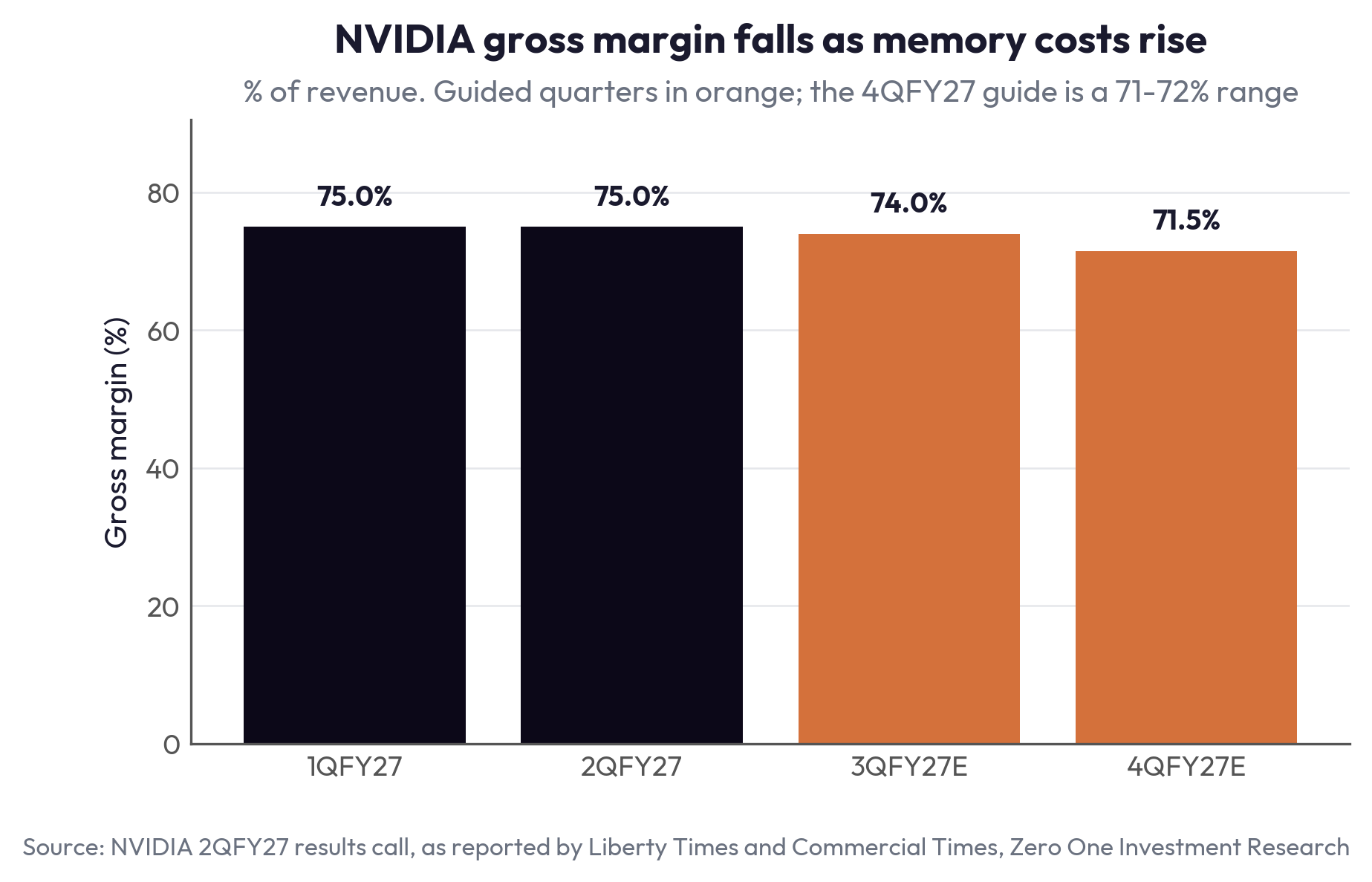
What changed is the cost side. Gross margin held at 75% for two straight quarters and is guided to about 74% in 3QFY27, then to a trough of 71% to 72% in the January quarter. Chief financial officer Colette Kress said margin only settles back at 72% to 73% in FY28, and only after NVIDIA raises its own prices. Liberty Times reported the company describing memory costs as extremely high, rising faster than it had expected, and set to climb again next year.
The revenue guide is being framed as a supply number rather than a demand number. NVIDIA guided 3QFY27 revenue to US$108bn plus or minus 2%, excluding China data center sales, and Kress put FY28 revenue growth at roughly 70% against analyst expectations of 44% to 45%. She added that the growth rate would be higher if more supply were available. The buyer with the most pricing power in the chain is now absorbing memory increases it cannot fully pass on until next year, which tells the memory makers how much room they still have.
Linked stocks: NVDA US, 000660 KS, 2408 TT
AWS books a quarter of NVIDIA's annual chip supply
Amazon (AMZN US) will deploy more than two million additional NVIDIA GPUs across its global infrastructure in 2027 and 2028, covering Blackwell Ultra, Rubin and Rubin Ultra, alongside NVIDIA's Vera CPU. Some Vera units will be paired with Rubin and some will run standalone.
Two million GPUs has to be weighed against what can physically be built. Economic Daily News cited estimates that TSMC's leading edge and CoWoS packaging capacity supports roughly 7 million NVIDIA GPUs a year in 2026, rising to perhaps 9 million next year. On that arithmetic AWS has just claimed 25% to 30% of a single year's available supply.
This is also an increase on an increase. At NVIDIA's GTC 2026 event, AWS said it would add more than one million GPUs from 2026. Demand ran past that plan inside two quarters. Kress framed the wider spending backdrop by putting the top five cloud providers' combined capital expenditure at US$800bn in 2026 and US$1.3tn next year.
Taiwanese assemblers are the first read across. Local institutional commentary named TSMC, ASE and King Yuan Electronics on the semiconductor side, and Foxconn, Quanta and Wistron among the system builders, with Wiwynn, Accton, King Slide and Asia Vital Components flagged as the AWS-specific chain.
Linked stocks: AMZN US, NVDA US, 2330 TT, 6669 TT
Vera Rubin reaches 20% of data center revenue
Vera Rubin will account for about 20% of NVIDIA's data center revenue in 3QFY27, its first full quarter of shipments. Kress told analysts, "We see Vera Rubin accounting for about 20% of data center revenue in Q3," adding that NVIDIA has "already received purchase orders from every major hyperscaler, AI cloud, and system OEM" and expects the platform "to mark the fastest product ramp in Nvidia's history."
Against the US$108bn quarterly guide, and with data center at roughly 92% of sales, that implies close to US$20bn of Vera Rubin hardware in three months, from effectively no platform revenue in the prior quarter. Tom's Hardware noted that a ramp of that shape, at NVIDIA's scale, has no precedent in the sector.
The unit count is more modest than the revenue suggests. Working from a VR200 NVL72 rack price of US$5m to US$7.8m, Tom's Hardware estimated the quarter at roughly 2,550 to 3,975 racks, holding 91,700 to 143,100 Vera CPUs and 183,500 to 286,100 Rubin GPUs. Rack-scale pricing is doing much of the work, so anyone modeling component volumes from the revenue line will overshoot.
The first production NVL72 rack was assembled by Foxconn (2317 TT) subsidiary Ingrasys on a fully automated line and shipped to Microsoft, which Economic Daily News reported as the first commercial deployment.
Linked stocks: NVDA US, 2317 TT, MSFT US
NVIDIA sells custom memory into its customers' chips
NVIDIA introduced NVHBM, a custom high-bandwidth memory product that moves NVIDIA's own memory controller off the accelerator die and into the base die at the bottom of the 3D HBM stack, paired with a custom physical interface. Against standard HBM4E, NVIDIA claims up to 30% more memory bandwidth, 15% lower HBM power, and up to 25% of the accelerator's compute die freed for logic.
The customer for that die area is not NVIDIA. A memory controller sitting on the accelerator is a cost every designer of a custom AI chip has to carry, along with the work of qualifying each HBM vendor separately. NVIDIA plans a standardized NVHBM implementation validated across multiple memory suppliers, which cuts both. Amazon's Annapurna Labs is the first partner, and its Trainium4 generation will support NVLink Fusion so that Amazon's own accelerators and NVIDIA GPUs can sit in a common rack architecture.
Taiwan sits on the design side of this. MediaTek (2454 TT) and Alchip (3661 TT) are already NVLink Fusion custom-chip partners, and Commercial Times reported TSMC's N12 process supporting HBM4 logic base dies with N3P aimed at custom HBM4E designs. Moving control and logic functions into the base die raises the leading-edge logic content of every HBM stack.
One question is unresolved. Economic Daily News reported that NVIDIA wants to design the HBM4 and HBM4E base die itself, and that the base die remains patented process technology held by the DRAM makers. Whether Samsung, SK Hynix and Micron hand that over decides how much of the memory stack NVIDIA ends up owning.
Linked stocks: NVDA US, 2454 TT, 3661 TT, 2330 TT
SK Hynix packages HBM in Indiana and keeps the wafers in Korea
SK Hynix (000660 KS) broke ground on 27 August local time in West Lafayette, Indiana, on its first HBM advanced packaging site outside Korea. Total investment is put above US$4bn, with the cleanroom due for completion in October 2028 and mass production of next-generation HBM from 2H29.
Advanced wafers will continue to be made in Korea and shipped to Indiana, where the packaging and test steps happen, and the finished HBM is then supplied to nearby customers as a US-made product. What is being reshored is the back end, not the fab.
The site is being built to draw a cluster around it. SK Hynix said more than 100 partners across semiconductor materials, components and equipment are in discussions about locating in West Lafayette, and put the employment effect at about 7,000 direct and indirect jobs with US companies. The plant itself is targeted at more than 1,000 staff once it is running fully.
Advanced packaging research and test equipment goes in alongside the production line, and SK Hynix signed a memorandum of understanding with Purdue University on next-generation integration and packaging research. Indiana governor Mike Braun, senator Todd Young and Purdue president Mitch Daniels attended the ceremony, alongside SK Hynix chief executive Kwak Noh-jung.
Linked stocks: 000660 KS, MU US, NVDA US
SEMCO takes MLCC price rises straight to set-makers
Samsung Electro-Mechanics (009150 KS) has raised its 4Q26 multilayer ceramic capacitor quotes directly to OEM and ODM customers rather than to distributors, which TrendForce reads as the point at which the MLCC market turns.
The increases are graded by application. Consumer-grade X5R parts go up 25% to 30% on average to set-makers, a level TrendForce says is meant to damp order appetite and release capacity for higher-end lines. AI-server-grade X6S parts are negotiated customer by customer at an average of 10% to 20%. A supplier raising price to slow orders, rather than to collect more on the orders it already has, is behaving as though it expects the shortage to last.
Taiwanese and Chinese makers are quoting 4Q up 10% to 20% on mid to high capacitance consumer parts as the overflow lands on them, with some suppliers now running near 90% utilization. AI data center demand and a widening supply gap in optical modules are pulling MLCC demand tighter, which is what is pushing customers toward the second tier.
Inventory data points the same way. Liberty Times reported a UBS study showing global MLCC distributor inventory volume down another 8% from four weeks earlier to a record low, while the value of that inventory rose 10%. The counterweight is that Murata, Taiyo Yuden and Kyocera are all holding quotes flat for now, and TrendForce treats whether the Japanese makers follow as the test of how far this goes.
Linked stocks: 009150 KS, 3026 TT, 6981 JT
先聲 First Word: Exclusives from Chinese-Language Sources
Wire-bond packaging faces a 20% shortfall in 2027
Some Taiwanese outsourced assembly and test firms have told chip designers that traditional wire-bond packaging capacity could fall more than 20% short of demand in 2027, and that new capacity cannot be added quickly. AI server shipments are lifting CPU, networking, power management and peripheral chip volumes, which consume the oldest packaging type rather than the advanced kind everyone tracks. (28 Aug 2026) Source: (獨家)IC設計2027年恐有新瓶頸 傳統打線封裝產能缺口逾2成
Fire at Vanguard's third fab forces an overnight evacuation
Taoyuan fire services received a call at 23:28 on 27 August reporting a fire at Vanguard International Semiconductor's (5347 TT) Fab 3 in Luzhu, which was upgraded to a second-alarm response while more than 200 staff were evacuated. The site is one of Vanguard's main 8-inch foundry and specialty integrated circuit bases in Taiwan, and reported July revenue of NT$4.71bn. (28 Aug 2026) Source: 世界先進三廠驚傳火警 目前疏散員工中
Powertech enters AMD's chain with panel-level packaging
Powertech Technology has moved fan-out panel-level packaging into customer product qualification and says it is already supplying AMD, with small-volume trial production in 1H27 and mass production targeted for the middle of that year. Its Singapore joint venture with Broadcom has started equipment procurement, with small-volume output possible by the end of 2027. (27 Aug 2026) Source: 力成加速衝FOPLP 拚明年中量產

© 2026 Zero One Investment Research Pte Ltd. For informational purposes only. Not investment advice.