
TSMC grew 37% and still lost share as SK Hynix retires US$28bn of stock
Zero One Investment Research Daily Intelligence Brief, August 21, 2026
TSMC grew 37% and still lost share as SK Hynix retires US$28bn of stock
Top Market Signals
TSMC and Foxconn grew fast and lost share
TSMC (2330 TT) grew revenue 37% year to date and still lost four percentage points of Taiwan's chip manufacturing revenue share, which fell to 81.8%, because the other 26 manufacturers in the sub-sector grew more than twice as fast. DIGITIMES attributes the shift to memory makers scaling up.
The same shape shows up one layer down the chain. Foxconn (2317 TT) grew 37.9% year to date and ranks only seventh of the 20 companies DIGITIMES tracks in Taiwan electronics manufacturing services, while the other 19 grew 56.9% between them. Quanta (2382 TT) and Wistron (3231 TT) are close to doubling.
Both numbers are strong in isolation, and both leaders are being outgrown inside their own sub-sectors. For a reader tracking Taiwan through its two largest names, that is a gap worth knowing about: the incremental revenue from this cycle is landing disproportionately outside TSMC and Foxconn, in memory and in the AI server assemblers.
Linked stocks: 2330 TT, 2317 TT, 2382 TT, 3231 TT
SK Hynix retires shares, pays bonuses in shares
SK Hynix (000660 KS) said on 19 August it will buy back about KRW40tn (US$28.4bn) of its own stock and cancel all of it on completion, the largest share cancellation by a listed Korean company on record.
In the same week the company settled a wage dispute by changing what it pays employees with. Under a preliminary 2026 wage and collective bargaining agreement reported by Yonhap, pay rises 6.3% and profit-sharing bonuses move from all cash to 40% cash and 60% company stock. The dispute had threatened to escalate into collective action, and no strikes are now planned.
Samsung Electronics (005930 KS) is working on the larger number. Korea Economic Daily reports a shareholder return package of about KRW150tn (US$107.6bn) going to the board this month, above the KRW100tn reported earlier by MoneyToday, sized on a principle of returning half of free cash flow. Brokers cited in that reporting put Samsung's 2026 free cash flow at KRW263tn.
Our 17 August Blade flagged that both companies were expected to publish new shareholder return programs as early as this month, sized by analysts at up to KRW300tn combined. SK Hynix has now put a figure on its half, and it retires the stock rather than holding it in treasury, so those shares do not return to the market later.
Linked stocks: 000660 KS, 005930 KS, MU US
SMIC raises prices into a shortage sanctions built
SMIC (981 HK) posted its first US$3bn quarter and, the next day, told analysts it will charge more for wafers processed in 3Q26. Co-chief executive Zhao Haijun said price negotiations concluded in the first quarter and more are coming: "Since there's still a big gap between industry-leading wafer prices and SMIC's current prices, we need to negotiate with customers for fairer pricing."
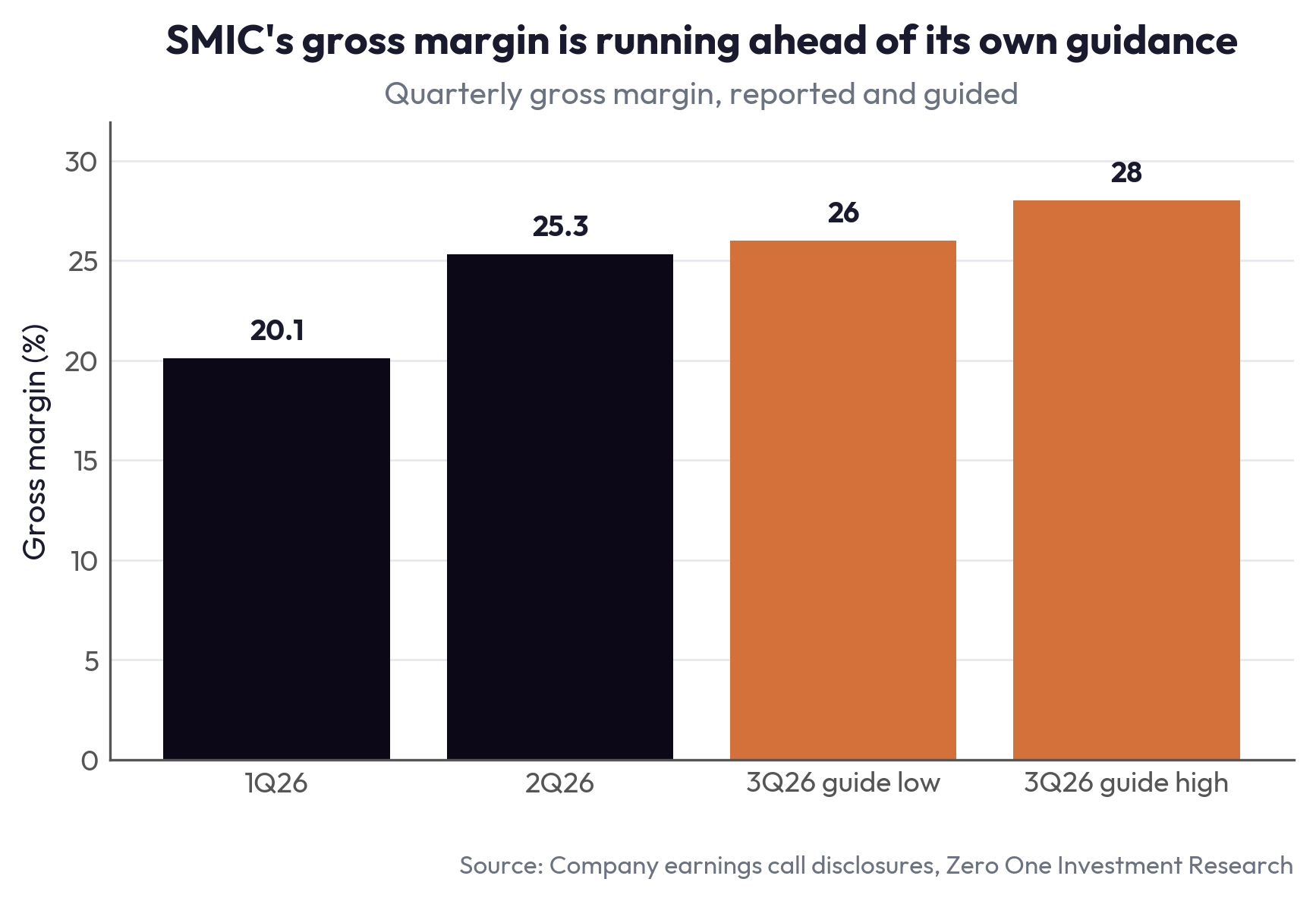
The quarter beat the company's own guidance on both lines. SMIC had guided to 14-16% sequential revenue growth and a 20-22% gross margin, and delivered 20% growth to US$3.01bn and a 25.3% margin, up from 20.1% in 1Q26. Revenue rose 36.1% YoY, net profit nearly tripled to US$479.2m, and utilization reached 93.7%. Wafer shipments rose 14% QoQ to 2.9m 8-inch equivalents while blended selling prices climbed 5.7%.
The demand is not coming from the parts of AI that get the attention. Zhao said the surge came mostly from AI chips other than CPUs and GPUs: logic ICs, BCD power management parts and optical transceiver components, all in short supply. Industrial and automotive chips rose to 16.5% of wafer revenue from 10.6% a year earlier, and China accounted for 90% of revenue.
This is the same company that ran at 68.1% utilization in 1Q23 and spent 2023 and 2024 cutting mature-node prices to defend share against new Chinese capacity. US export controls kept Chinese AI accelerator demand away from TSMC and Samsung at the leading edge, Beijing wants 70% of silicon wafers sourced domestically this year, and SMIC is the only Chinese foundry mass-producing 7nm-class logic.
Linked stocks: 981 HK, 1347 HK, 2330 TT
Micron puts US$10bn into research, not capacity
Micron (MU US) said it will invest US$10bn over ten years in a new research center in Boise, Idaho, called Micron Research Labs. Construction is due to start in 2027.
The facility is designed to hold several hundred researchers and to bring customers, universities, government and the wider semiconductor supply base into one place, hosting international symposia and workshops. It will connect Micron's existing research and technology network across the United States, Europe, Japan, India, Singapore and Taiwan.
The size is easier to read against what Micron has already promised. The company has committed more than US$250bn to US manufacturing and research, so this is an incremental sum directed at a decade of long-horizon work rather than at wafer output, announced while high-bandwidth memory demand is what is pulling the industry's capacity plans.
Linked stocks: MU US, 000660 KS, 005930 KS
SK Hynix maps optical links into memory
SK Hynix (000660 KS) published a co-packaged optics roadmap on 20 August, setting out an architecture that would connect memory to processors with light rather than copper. Co-packaged optics, or CPO, puts the optical transceiver inside the processor package so the high-speed electrical path stays short and the longer runs travel as light.
The research, published with outside academics in Nature Electronics, sets targets of more than 100Tb/s of bandwidth per node, energy efficiency below 1 picojoule per bit, and die-to-die latency under 10 nanoseconds, spanning 2D packaging, 2.5D interposers and 3D heterogeneous integration. Copper runs into physical limits on speed and distance as clusters scale to thousands of GPUs, which raises power draw, latency and signal design complexity.
The part that changes what a memory vendor sells is the photonic interposer. SK Hynix proposes connecting memory and processor directly through it, which would let several AI accelerators share one large memory pool and move data more freely between compute units. Seunghoon Hong, who heads the company's AI infrastructure team, said this means memory makers are no longer only supplying components such as HBM, or high-bandwidth memory, but are taking part in the customer's overall system performance.
Kyusang Lee of the University of Virginia, who co-led the research, said optical interconnect is moving out of the laboratory into early commercialization.
Linked stocks: 000660 KS, 2330 TT, NVDA US
Samsung delays its next lithography step to 2030
Samsung Electronics (005930 KS) does not expect to move High-NA extreme ultraviolet lithography into volume production until its 1nm-class generation, a timeline DIGITIMES places at around 2030. The company had earlier hoped to introduce the tools at its 2nm and 1.4nm nodes.
High-NA machines are ASML's (ASML NA) next-generation lithography tools, using a wider lens aperture to print finer features in a single exposure rather than splitting the pattern across multiple passes.
The consequence is arithmetic rather than opinion: 2nm and 1.4nm are now Samsung foundry nodes that will run on existing EUV tools. Those are the nodes where Samsung competes with TSMC for external foundry customers.
Linked stocks: 005930 KS, ASML NA, 2330 TT
China's biggest memory maker planned on stolen IP
ChangXin Memory Technologies, China's largest maker of DRAM, the main working memory in computers and servers, planned to obtain Samsung's process technology intellectual property to develop its own production nodes, according to testimony given in a South Korean criminal case over leaked Samsung technology.
Maeil Business, reported by Tom's Hardware, says the company's managers allegedly had no intention of developing an in-house process from scratch, so acquiring Samsung IP was a strategic decision rather than an opportunistic one. A former Samsung engineer who moved to the Chinese memory maker is now in custody.
CXMT is the domestic supplier China is relying on for DRAM while export controls limit what it can buy at the leading edge. How much of its process came from somewhere else bears directly on how quickly it can reach the next node without help.
Linked stocks: 005930 KS, 000660 KS, MU US
先聲 First Word: Exclusives from Chinese-Language Sources
MediaTek says a million H100s will look mid-tier
Liang Bo-song, senior deputy director at MediaTek (2454 TT), told the DIGITIMES AI on Chips forum that AI has moved from a single large language model to teams of AI agents with different functions, and that in future a million H100 GPUs would rank only mid-tier as a compute base. It reframes compute demand as scaling with the number of agents running rather than with the size of any one model. (21 Aug 2026) Source: 算力瓶頸衝向太空 聯發科梁伯嵩:未來100萬顆H100只是中段班
SK Group weighs underwater data centers with a Chinese partner
SK Group is reportedly in talks with Highlander, a Chinese marine IT and defense company, on underwater data center cooperation, extending its AI data center investment into seawater cooling to cut power, cooling and land acquisition costs. A Korean group sourcing marine infrastructure from a Chinese defense-linked supplier runs against the direction most cross-border AI infrastructure ties are moving. (21 Aug 2026) Source: SK傳與中國海蘭信洽談 評估水下資料中心合作
Xiaomi's next in-house phone chip runs on TSMC N3P
Xiaomi founder and chief executive Lei Jun confirmed on Weibo that the next XRING chip, provisionally named O3, is on the way, while supply chain sources say it has completed bring-up testing and entered product integration on TSMC's (2330 TT) N3P process. It puts another Chinese handset maker's flagship silicon on a leading-edge Taiwanese node at a time when Beijing is pushing domestic sourcing elsewhere in the stack. (21 Aug 2026) Source: 台積電N3P助攻玄戒O3 雷軍證實小米新晶片蓄勢待發

© 2026 Zero One Investment Research Pte Ltd. For informational purposes only. Not investment advice.