
Google ties US$12.2bn of Marvell stock to chip revenue as Samsung raises foundry prices
Zero One Investment Research Daily Intelligence Brief, August 20, 2026
Google ties US$12.2bn of Marvell stock to chip revenue as Samsung raises foundry prices
Top Market Signals
Google's Marvell warrant unlocks in US$500m steps
Marvell Technology (MRVL US) has issued Alphabet's Google a warrant to buy up to 58.97m of its shares at US$206.58 each, about US$12.2bn and roughly 7% of shares outstanding. Exercised in full, it would make Google the fifth largest holder of a company it also buys chips from.
The terms decide how much of that stock ever transfers. In the first year only 1.36m shares release, in equal quarterly amounts. The rest is split into 240 equal tranches running from 3Q of Marvell's fiscal 2027 through fiscal 2033, and one tranche releases for every US$500m of qualifying revenue the partnership generates. Earning the award in full therefore tracks roughly US$120bn of custom-chip business, which is why the headline number and the likely number are not the same thing.
The work covered is broad. It spans chips compatible with Google's tensor processing unit (TPU) ecosystem: AI inference accelerators, storage controllers, network interface controllers, memory interface controllers and near-memory compute. Inference is the part of AI spending that repeats every day a model is used, and it is where buyers are working hardest to reduce their dependence on NVIDIA graphics processors.
Broadcom (AVGO US) still holds more than 70% of the custom AI chip market, signed its own long-term Google agreement in April 2026 running to 2031, and has pointed to US$100bn of AI chip revenue by 2027. Economic Daily News, citing a SemiAnalysis report, adds that AMD (AMD US) is working on one of Google's tenth-generation TPUs, drawn in by its CPU cores and packaging technology, with MediaTek (2454 TT) widely assumed to hold the current generation. Neither the AMD nor the MediaTek work has been confirmed by the companies involved.
Marvell shares rose 7% on 19 Aug 2026 and Broadcom fell more than 5%. The vesting schedule is the check on both moves, because the equity only transfers if the orders arrive.
Linked stocks: MRVL US, AVGO US, GOOGL US, 2454 TT
Samsung's largest price rises go to Chinese customers
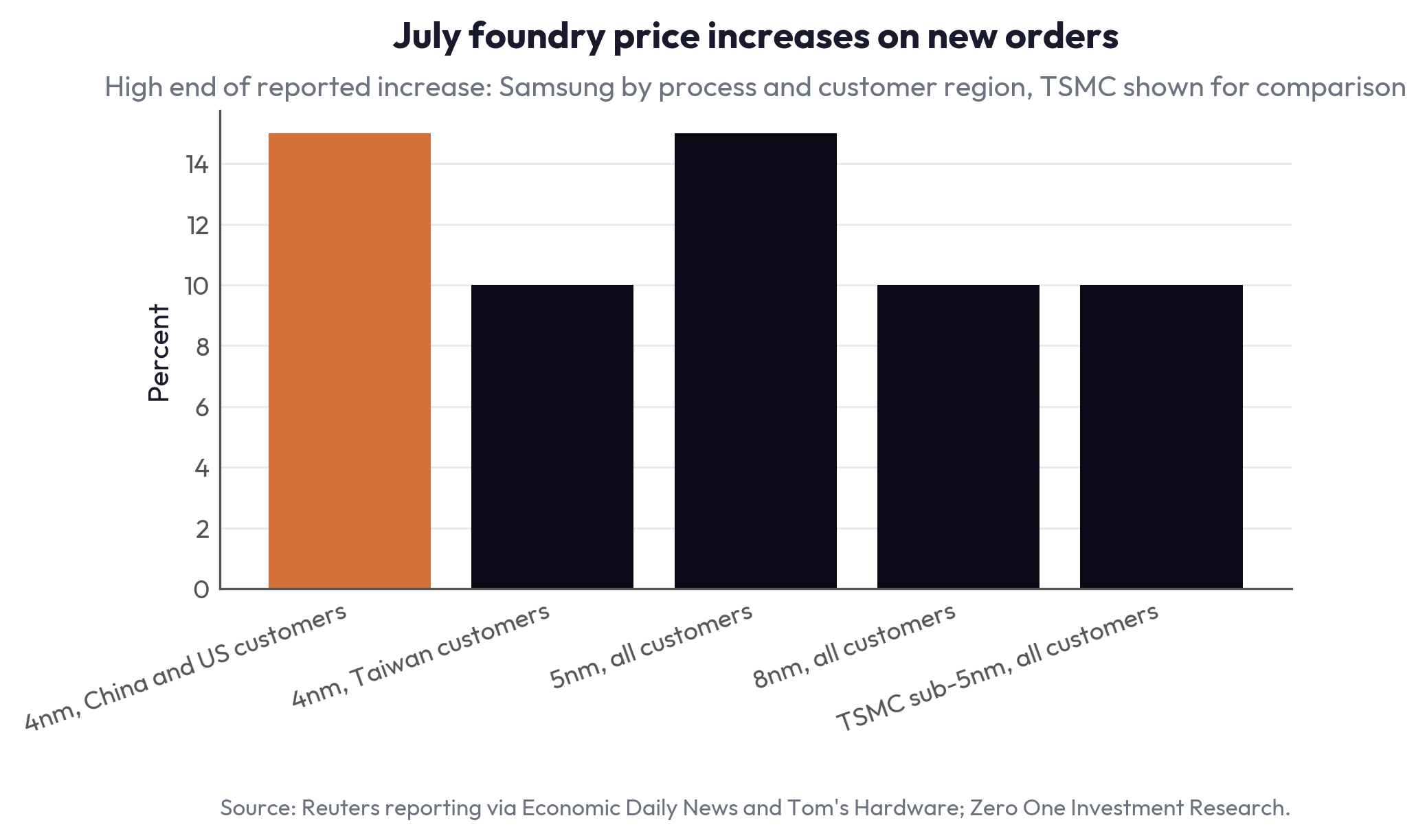
Samsung Electronics (005930 KS) raised quotes on new foundry orders in July, and the steepest increases went to the customers with the fewest alternatives. Reuters reporting, carried by Economic Daily News and Tom's Hardware, puts the increase on the 4nm process at 10% to 15% for Chinese and US customers against 5% to 10% for Taiwanese customers, with 5nm up 10% to 15% and 8nm up close to 10%.
Chinese chip designers, cut off from advanced chipmaking tools by US export controls, are accepting the largest hikes. Their orders now exceed what Samsung can take, because US customers are served first and part of the line stays reserved for Samsung's own silicon. The Pyeongtaek 4nm line has been running full since late last year.
Samsung can charge more because TSMC has no room left. TSMC's (2330 TT) leading-edge capacity is booked out by AI orders and TSMC has notified customers of 5% to 10% increases across all sub-5nm nodes, so Samsung is raising underneath that umbrella and still quoting below where TSMC is headed. Samsung had been quoting its 2nm wafers at US$20,000 to undercut TSMC by about a third.
The size of the business puts the move in proportion. Counterpoint puts Samsung at 7% of global foundry revenue in 1Q26 against more than 70% for TSMC, and the division has been loss-making since 2022. Lee Min-hee of BNK Investment and Securities told Reuters that continued increases could return the foundry business to profit as early as next year. Samsung wants advanced nodes to supply more than half of 2026 foundry revenue, with AI and high-performance computing above 30%, from 15% to 20% at the end of 2025.
The Pyeongtaek 4nm line also builds the base dies underneath Samsung's own memory stacks, so external foundry customers are bidding against the division that produced the group's record profits.
Linked stocks: 005930 KS, 2330 TT, INTC US
TSMC gets backside power without a redesign
TSMC has developed and validated A16, which industry sources describe as the first angstrom-class process to run its power delivery on the back of the wafer while keeping the gate density and design flexibility of N2P, the enhanced version of its 2nm platform. Production starts in 4Q26.
Moving the power network to the back of the die clears the front side for signal routing, which matters because power and signal wiring have been competing for the same space at every new node, raising congestion and voltage drop. Against N2P, DigiTimes reporting carried by Liberty Times puts A16 at 8% to 10% faster at the same power, or 15% to 20% lower power at the same speed, with 8% to 10% higher density.
Customers have to change very little to use it. Intel (INTC US) shipped backside power first with PowerVia, but had to modify its cell architecture along the way, adjusting pin counts and relaxing metal pitch. TSMC ran dedicated vertical contacts from the back directly to the source and drain of each transistor and left front-side gate structures, cell sizes and layout largely alone, so existing designs carry across. Samsung is developing its own backside approach for SF2, reportedly closer to Intel's method.
The gap behind it has widened. Samsung told its SAFE Forum 2026 that 1.4nm production moves to 2029, against the 2027 date it gave in 2022, and is prioritizing yield and performance on second and third generation 2nm instead, with SF2P+ due next year for a roughly 20% performance gain. TSMC has A14 in 2028, and both A13 and a second-generation backside rail in A12 in 2029. Yield through the 4Q26 A16 ramp is what turns that calendar into revenue.
Linked stocks: 2330 TT, 005930 KS, INTC US, NVDA US
Global Unichip raises NT$65bn, its largest ever
Global Unichip (3443 TT), the design service company TSMC part-owns, said its board approved a NT$40bn syndicated loan with a bank group that includes Mega Bank, and an overseas unsecured convertible bond of up to US$800m. Together that is about NT$65bn, the largest fundraising in the company's history.
The raise is about working capital. A design service house pays for wafers, packaging, testing and materials on the customer's behalf, on short payable terms, then waits months for the receivable. As project sizes scale with AI demand, the gap between those two dates scales with them, and the cash has to be in place before the work starts.
The near-term projects explain the timing. A cloud service provider CPU program is due to reach volume between the end of this year and early next, and a North American automotive chip taped out in April for production in 2H27. Bond proceeds are earmarked for foreign-currency material purchases and the loan can flex 25% either way, which points at input costs rather than at capital equipment.
Raising most of it as bank debt rather than equity keeps the share count from inflating as the order book grows, which is the useful part for existing holders. The test is whether receivables convert as those programs reach volume. Shares fell NT$240 to NT$5,295 on 19 Aug 2026.
Linked stocks: 3443 TT, 2330 TT, 3661 TT
Cerebras builds an AI computer without high-bandwidth memory
Cerebras Systems (CBRS US) introduced CS-4, a compute platform that uses no high-bandwidth memory (HBM), the stacked memory that sits beside every mainstream AI accelerator. It runs three of the company's WSE-3 Turbo wafer-scale chips, built on TSMC's 5nm process with system-on-wafer packaging, and replaces HBM with SRAM on the chip itself, with additional capacity supplied from outside the platform.
The design gives up memory capacity and gains supply certainty. Memory that a customer can scale is harder to add here, but the platform does not compete for HBM allocation or absorb HBM pricing, which is the constraint the rest of the AI hardware market has been managing all year. System-on-wafer packaging connects the circuits before the wafer is diced, which lifts performance above the mainstream chip-on-wafer-on-substrate (CoWoS) route and raises production risk, because one failed circuit can cost the whole wafer.
The platform has commercial commitments behind it. Cerebras holds an OpenAI order worth more than US$20bn and an agreement with Amazon Web Services, CS-4 is with a small number of customers now and supply widens in 3Q26, and the company says it runs several times faster than the prior generation. Flex integrates the racks, with Foxconn, Quanta, Wistron, Compal and Inventec all pursuing that work.
Memory names fell hard in the same session, SK Hynix by 9.7%, Samsung by 7.7%, Nanya Technology by 6.6% and Winbond by about 4.8%. One platform's design choice does not remove HBM from anyone's GPU roadmap. What it does establish is that a shipping architecture can reach customers without joining the queue for HBM, and the number that settles how much that matters is how many CS-4 systems actually ship in 2H26.
Linked stocks: CBRS US, 2330 TT, 000660 KS, 2408 TT
Intel's next desktop chip reportedly widens TSMC use
Intel's Nova Lake desktop processors, due early next year, will reportedly pair Intel's own 18A process with TSMC's N2P, and the following Razor Lake generation is reported to use N2X, the high-performance version of TSMC's 2nm platform aimed at high-frequency CPUs, AI and high-performance computing. Commercial Times carries the supply chain reporting, and Intel has not confirmed it.
Nova Lake leads with a large last-level cache, a bigger pool of on-chip memory that cuts trips out to system memory, aimed squarely at AMD's 3D V-Cache parts. Laptop versions may wait for the later Razor Lake-HX generation. If N2X reaches production, Intel's use of TSMC would extend across a wider part of the 2nm family rather than sitting at a single node.
The move spreads process risk. Intel keeps advancing 18A, but placing part of the compute die at TSMC means launch timing, performance and capacity do not all depend on one process. The same week, Japan's Socionext said it will use Intel's 18A-P for custom system-on-chip development, having previously built at TSMC.
For Taiwan the read-through is in consumables. N2X moves transistors from FinFET to nanosheet structures, which tightens requirements in deposition, etch, clean and chemical mechanical planarization, the polishing step that keeps each layer flat. Kinik (1560 TT), which makes the diamond discs that dress polishing pads, reported 2Q26 revenue of NT$2.49bn, up 17.9% YoY, with gross margin of 40.1% and rising shipments of discs for 2nm and 1.6nm work. Sunsun, one of the few Taiwanese makers of CMP pads, lifted semiconductor revenue 25% in 1H26 to 66% of its total and says its current capacity is not enough.
Linked stocks: INTC US, 2330 TT, 1560 TT, AMD US
Taiwan's robot makers pick components over whole humanoids
Delta Electronics (2308 TT) said on 19 Aug 2026 that it will not build complete humanoid robots and will supply key components instead, meaning joint modules that combine sensors, motors, reducers and drivers, plus the control systems that run them. It launched a joint module with a built-in force sensor the same day, a year after setting up its robotics research institute.
Techman Robot, the arm maker affiliated with Quanta, has its own humanoid in proof-of-concept testing and is putting volume behind two-armed collaborative robots instead. Its TM45S carries up to 100kg across both arms for server assembly, and Quanta Computer (2382 TT) adopts it in 1Q27. Techman already holds the leading share in moving wafer cassettes with a robot arm and a mobile base.
The obstacles named are specific. Techman's chief operating officer Huang Shih-chung points to dexterous hands with more than 20 degrees of freedom that do not yet survive the three years of use customers require, safety and security rules that do not exist yet in any market, and a shortage of training data for physical AI. A single accident with a 90kg machine in a home would end the product.
The money is following the components. Nexcom's robotics unit NexCOBOT took robot orders up 80% in 1H26 with shipments up 30%, helped by the US Federal Communications Commission moving to restrict Chinese supply chain robots, and expects revenue above NT$400m this year, a record. Techman's line-design business, where it plans whole automation lines rather than selling arms, grew one to two times this year and is 10% to 20% of 1H26 revenue. NVIDIA named 16 Taiwanese firms including Advantech (2395 TT), Delta and Nexcom for the physical AI showcase at the Taipei automation show that opened 19 Aug 2026.
Linked stocks: 2308 TT, 2382 TT, 2395 TT
先聲 First Word: Exclusives from Chinese-Language Sources
Samsung's own phone division paid 211% more for memory
Samsung Electronics' Device eXperience division, which builds Galaxy handsets, paid 211% more for mobile memory in 1H26 than the 2025 average, with no internal discount from the group's own memory business. When the largest captive buyer in the industry pays the market price to its own colleagues, the shortage is being rationed by price rather than by relationship. (20 Aug 2026) Source: 三星同一屋簷也無「友情價」 Galaxy吞高價記憶體換穩定供貨
TXC's AI revenue share doubles as optical modules move to 1.6T
TXC (3042 TT), a quartz component maker, told its earnings call that AI applications rose from 11% of revenue last year to 16% in 1H26 and should reach about 20% by year end, that it supplies all ten of the largest optical module makers, and that it holds more than 20% share of quartz components in optical modules. Two price increases this year, of 5% to 10% in 2Q26 and a larger one from 3Q26, start reaching margins in 2H26, and capacity grows about 10% next year on capital spending of NT$1.078bn. (20 Aug 2026) Source: 晶技 AI 業務大爆發 打入十大光通訊模組鏈
Samsung's second Taylor fab nears foundations with no CHIPS money received
Samsung's second fab at Taylor, Texas has nearly completed foundation work, ahead of the first fab entering formal production, but the city's mayor says none of the CHIPS Act award approved in 2024 has yet arrived. A second shell going up before a single subsidy dollar lands shows how far US capacity plans have separated from the program meant to fund them. (20 Aug 2026) Source: 三星泰勒二廠地基接近完工 市長:晶片法補助一毛未到

© 2026 Zero One Investment Research Pte Ltd. For informational purposes only. Not investment advice.