
Foxconn's custom-chip scale exceeds its reported revenue as YMTC cracks flash memory's top three
Zero One Investment Research Daily Intelligence Brief, August 13, 2026
Foxconn's custom-chip scale exceeds its reported revenue as YMTC cracks flash memory's top three
Top Market Signals
Foxconn's custom-chip server business is bigger than reported
Foxconn (2317 TT) told investors on 12 August that its custom AI chip server business is running well ahead of what shows up in its revenue line, because most of those projects are built from materials the customer supplies rather than parts Foxconn buys itself.
Chief financial officer Huang Te-tsai said custom chip servers, built around application-specific integrated circuits designed for one buyer rather than general-purpose GPUs, were about 10% of AI server revenue last year, and that the first half of 2026 was already slightly above that full-year level. He then added the qualifier that matters: because these projects mainly run on a customer-consigned materials model, revenue recognized in the accounts does not fully reflect the actual scale of the business. A contract manufacturer that assembles a customer's own silicon books the assembly fee, not the value of the chips passing through its plants.
That reframes the target management gave alongside it. Rotating chief executive Chiang Chih-heng said Foxconn is aiming for more than 40% share of the custom chip server market and is heading toward 50% share in AI racks overall, and that new customers and new projects were added this year. He declined to comment on any single customer.
The quarter itself was the strongest second quarter Foxconn has reported. Net profit was NT$59.97bn, up 35% YoY and 20% QoQ, for earnings of NT$4.27 per share, taking first-half profit to NT$109.89bn, up 27% YoY. July consolidated revenue reached a record NT$946.5bn. Chiang said order visibility is better than at the May call and now extends into 2027, and that full-year operating margin should exceed last year's 3.2%.
On the ramp itself, third-quarter AI rack shipments are expected to grow by a high double-digit percentage QoQ, with NVIDIA's Vera Rubin platform completing validation in the third quarter and shipping in volume from the fourth, becoming the main product next year. Existing GB series demand runs at least through next year. Capital spending will rise more than 30% this year, going early into rack, liquid cooling and test capacity across Taiwan, the United States, Mexico and Vietnam.
Linked stocks: 2317 TT, 2330 TT, NVDA US
Asus and Pegatron raise server targets again
Asus (2357 TT) raised its full-year server growth target for the second consecutive quarter on 12 August, from 100% to more than 150%, while Pegatron (4938 TT) said it is now very confident of the tenfold server revenue growth it had guided to and is trying to beat it.
Asus co-chief executive Samson Hu said the company is in the first wave of the supply chain for NVIDIA's Vera Rubin generation, and expects server growth to stay strong for the next year or two. Second-quarter server revenue grew more than 200% YoY, and group net profit of NT$19.05bn was close to double both the prior quarter and the year-earlier level, with revenue, gross margin and operating margin all at records. For the third quarter Asus guided PC revenue up 15% to 20% QoQ, components up 5% to 10% QoQ, and servers up 10% to 15% QoQ.
Pegatron co-chief executive Cheng Kuang-chih said the server unit is on track to pass NT$100bn of revenue and could become one of the company's three largest divisions. Second-quarter net profit was NT$4.49bn, up 187.5% QoQ, for earnings of NT$1.68 per share, with first-half profit of NT$6.05bn. To fund the expansion the company plans to issue up to NT$20bn of domestic convertible bonds and US$100m of overseas convertibles.
The caution sits in the other half of both businesses. Cheng said that while GB series, B200 and B300 servers keep growing through the third quarter, the notebook business is being hit by rising CPU and memory prices and by component shortages, which will partly offset the server momentum. Component cost inflation is now taking back on the consumer side some of what the AI side is adding, and both companies are guiding through that split rather than around it.
Linked stocks: 2357 TT, 4938 TT, 2324 TT
CoreWeave books 2020 GPUs on contracts to 2029
CoreWeave (CRWV US) has signed a contract for NVIDIA A100 accelerators that runs into 2029, nine years after the Ampere generation launched, chief executive Mike Intrator disclosed on the company's second-quarter earnings call. Intrator said pricing for prior-generation parts is at or above where it was years ago.
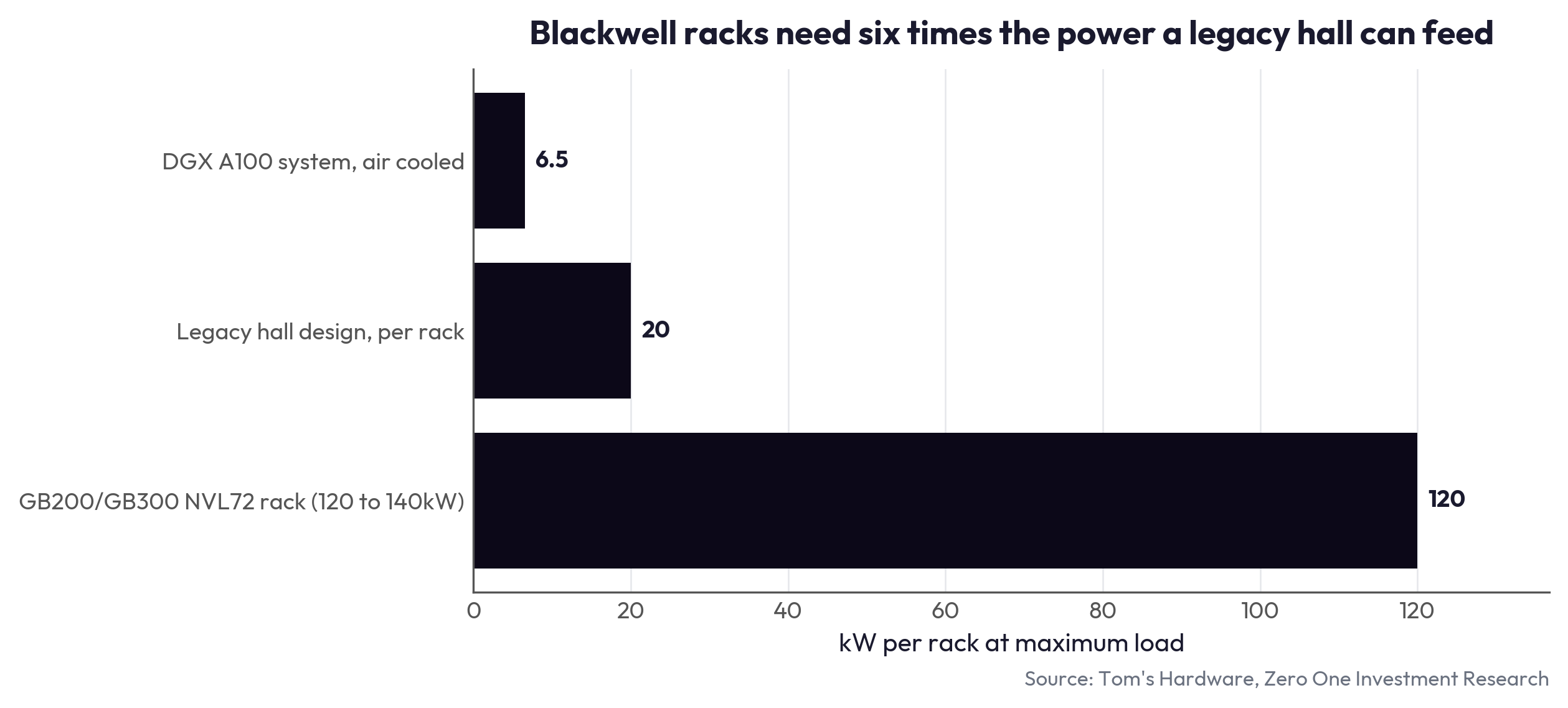
The reason is the building, not the silicon. An air-cooled NVIDIA DGX A100 system draws 6.5kW at full load and sits comfortably in older data center halls designed for roughly 20kW per rack. NVIDIA's current GB200 and GB300 NVL72 racks draw 120kW to 140kW and require direct-to-chip liquid cooling, about six times what those halls can feed and cool. Blackwell therefore cannot move into the space where Ampere is installed without rebuilding power delivery and cooling first. That energized, air-cooled capacity has no higher-value use, so renting six-year-old accelerators beats leaving it dark.
This lands directly on the depreciation argument that has run under the AI trade since last November, when Michael Burry accused hyperscalers of understating depreciation by US$176bn between 2026 and 2028 by stretching GPU useful-life assumptions to five or six years against an annual architecture cadence. NVIDIA finance chief Colette Kress answered at the time that A100s sold six years ago still run at full utilization. A contract running to 2029 extends contracted revenue on 2020 silicon past even the six-year schedules the hyperscalers have been defending.
The rest of the print carried the same demand picture. Quarterly revenue was US$2.58bn, up 112% YoY, against a US$104bn backlog that excludes more than US$25bn of commitments booked since July. Contracted power reached 3.7GW in the second quarter and stood at 4.2GW at the time of the call, against 1.5GW actually online, so customer commitments already cover close to three times the capacity the company can currently deliver.
The read for suppliers is that older installed capacity is not being retired to make room for new racks. It is being kept in service on separate contracts while the new racks go into purpose-built halls, which means power and cooling capacity, not chip supply, sets how fast the installed base turns over.
Linked stocks: CRWV US, NVDA US, SMCI US
NVIDIA reportedly buys into China's optical module leader
NVIDIA (NVDA US) is reported to be planning a US$2bn strategic stake in Zhongji Innolight, China's largest optical transceiver maker, to fund next-generation module development, global capacity and a new plant in Thailand. NVIDIA is also reported to be weighing a cornerstone investment in a Hong Kong listing by Eoptolink, China's second-largest module maker. Neither Chinese company confirmed the reports on 12 August, saying only that their own announcements are authoritative.
The two companies sit at the center of the part of the AI rack that copper can no longer carry. Innolight makes 400G, 800G and 1.6T transceivers and holds close to half the global market in the 800G and 1.6T products the large AI buyers are installing, above 50% on some specifications, with NVIDIA, Google and Amazon as customers. First-quarter revenue was RMB19.50bn, up 192% YoY, with net profit of RMB5.74bn, up 262%. Eoptolink leads in linear pluggable optics and silicon photonics and has guided first-half net profit of RMB7bn to RMB8bn, up 78% to 103% YoY.
What makes the reported investment awkward is what Washington is doing at the same time. The Federal Communications Commission is drafting a measure that would block imports of new Chinese transceiver models, with officials hoping to publish it before the end of 2026. When that proposal surfaced, Innolight, Eoptolink and TFC Optical all fell in Shenzhen while Coherent closed 12.4% higher and Lumentum 8.9% higher, before the Chinese names recovered most of the ground. A US-China summit is expected in September.
The tension is that the largest buyer of Chinese photonics hardware is the United States, and the company most exposed to a supply gap is the one now reported to be buying equity in the supplier. Optical module supply is the constraint NVIDIA has been spending against all year, and a rule written before that supply can be replaced would land on its own rack shipments first.
Linked stocks: NVDA US, COHR US, LITE US
YMTC enters flash memory's top three on volume alone
Yangtze Memory Technologies shipped 14% of the world's NAND flash bits in the second quarter of 2026, entering the global top three for the first time and narrowly displacing Kioxia, according to Counterpoint Research data published on 12 August. Samsung led with 25% and SK Hynix followed at 22%.
The ranking moved because the incumbents walked away from the low end, not because the Chinese maker won anything at the high end. Samsung's shipment share has fallen from 32% in 2Q24 to 25% as it caps flash output in favor of higher-margin DRAM. Kioxia has sold out its entire 2026 production, sends more than 30% of its bits into servers, and lost the third spot when its customers pulled back as prices climbed. Contract prices for NAND rose roughly 75% in the second quarter alone.
On revenue YMTC still ranks fifth, behind both Kioxia and Micron, because almost all of its output goes into consumer products that sell for a fraction of what hyperscaler buyers pay for enterprise drives holding inference data. The company has been on the US Entity List since December 2022, which bars it from qualifying for Western server sockets where the margin sits.
The volume it is taking share of is also shrinking as a proportion of the market. Enterprise solid-state drives absorbed 48% of every NAND bit shipped worldwide in the quarter, up from 26% a year earlier, and Counterpoint expects them to pass half of all bits by year end. YMTC grew shipments 22% YoY while mass-producing 267-layer flash on its Xtacking architecture, with more than 300 layers in development, and plans to shift its own mix toward enterprise drives in the second half. Its third Wuhan fab has cleared Beijing's 50% domestic-tooling threshold and is due to start production late this year, with two more planned.
Linked stocks: 005930 KS, 000660 KS, MU US
A new chip test plant takes two years to build
King Yuan Electronics (2449 TT) president Chang Kao-hsun put a number on the test capacity problem on 12 August: a plant of the same size takes 24 months or more to go from land preparation to completion, and since last year demand has been running at a pace that could require two or three plants inside a single year.
Chang said the company is building in the United States because customers asked for it, and because a local supply chain that has everything except test is an incomplete supply chain. Whether the US site will be built from scratch or leased is still being planned. In Taiwan the company is adding capacity at Yangmei, where he said the binding problems are not only build time but the cost and availability of water, power, gas, materials and construction labor, with labor the scarcest of the four.
Testing is where chips become finished parts, and it is the step that has absorbed the least attention through the AI buildout even as it has become harder. Winway Technology (6515 TT) executive vice president Chen Shao-kun, speaking at a SEMI event the same day, said this year's orders are essentially settled and that nearly every company in the industry is booked out to year end. More customer projects open from next year, and as chip performance rises and packaging grows more complex, test difficulty rises with it and the value of the test interface rises too. He said he sees a strong two to three years ahead and no bad signals in the order book.
The arithmetic is the point. Capital spending can be approved in a quarter, but a 24-month build against demand that wants two or three plants a year cannot be closed by spending faster. Chen said the capacity pressure that arrived quickly last year is easing as the supply chain adapts, which is a statement about coping rather than about the shortage ending.
Linked stocks: 2449 TT, 6515 TT, 3711 TT
先聲 First Word: Exclusives from Chinese-Language Sources
CXMT's DDR5 yield reportedly passes 90%
CXMT, China's largest DRAM maker, has reportedly lifted DDR5 yield above 90%, narrowing the technology gap with Samsung Electronics. Major PC makers have completed qualification of its memory and it is now shipping in some notebooks. Chinese DRAM moving from qualification into volume notebook builds changes the supply picture in the one segment where the three incumbents have been happy to give up share. (12 Aug 2026) Source: 長鑫存儲DDR5良率傳破90% 與三星差距快速縮小
TSMC runs advanced packaging at 5.5 times reticle size
TSMC advanced packaging vice president Ho Chun said the company is in high-volume production of chip-on-wafer-on-substrate packages at 5.5 times reticle size with yields above 98% on several AI customer products, and expects to reach 14 times by 2029. He also said hybrid-bonded three-dimensional stacking has entered high-volume production at 6 micron pitch, moving to about 4.5 micron in 2029, and flagged that ABF substrate, the build-up film that carries the package, will stay short for years alongside memory. (12 Aug 2026) Source: 台積先進封裝 全面晉級
Asia Vital Components lifts gross margin to a record on liquid cooling
Asia Vital Components reported a second-quarter gross margin of 32.57%, up 2.8 percentage points QoQ and 8.16 points YoY, with first-half revenue of NT$98.1bn, up 85.5% YoY. Server revenue grew 153.4% and rose from 48.4% to 66.1% of the total. Management expects liquid cooling penetration in data centers to pass 50% this year and guided capital spending of about NT$15bn, mostly in Vietnam. (12 Aug 2026) Source: 【奇鋐法說會AI摘要】 2026/8/12

© 2026 Zero One Investment Research Pte Ltd. For informational purposes only. Not investment advice.