
Microsoft seeks 300,000 AI chips from TSMC; NVIDIA lines up US$500bn for buyers
Zero One Investment Research Daily Intelligence Brief, August 11, 2026
Microsoft seeks 300,000 AI chips from TSMC; NVIDIA lines up US$500bn for buyers
Top Market Signals
Microsoft offers its in-house AI chip to Anthropic
Microsoft (MSFT US) is in talks with TSMC (2330 TT) for capacity to deliver more than 300,000 Maia 300 accelerators in 2027, against the tens of thousands of Maia 200 chips it has built to date. It is also pitching the new chip to outside cloud customers including Anthropic.
According to The Information, reported in Taiwan by the Economic Daily News and the Commercial Times, the launch could come as early as September. Microsoft's longer ambition is capacity for more than 1m units, which the reporting says depends on component supply and on how the TSMC negotiation lands.
The cost case is why outside labs are being approached. Microsoft told investors in July that Maia 200 runs OpenAI and Microsoft models at operating costs 30% to 40% below NVIDIA's high-end chips, and Maia 300 is tuned further for Microsoft's own models. Even without a large external customer, Microsoft can move internal AI work onto Maia and keep renting the more expensive NVIDIA capacity to Azure customers, which raises utilization of its own silicon.
Scale is the qualifier. Maia 200 sat in only two US data centers as of the end of July, and Morgan Stanley estimates Google will build more than 3m tensor processing units this year and possibly 5m next year. Even at 300,000 units, Microsoft would still be an order of magnitude behind. The test is whether Anthropic or another large lab actually commits.
Linked stocks: 2330 TT, MSFT US, NVDA US, GOOGL US
TSMC to take 40% of a Sony sensor venture
TSMC (2330 TT) and Sony (6758 JT) plan to invest about JPY1tn (US$6.3bn) in a joint venture to make next-generation image sensor chips in Kumamoto, Japan, with Sony holding about 60% and TSMC about 40%. Commercial production is targeted for around 2029.
The two signed a non-binding memorandum in May 2026. Nikkei and Bloomberg report the venture should be established before the end of March 2027, with new production and research lines built inside Sony Semiconductor Solutions' existing sensor plant in Koshi, Kumamoto. TSMC said on 10 Aug 2026 that it had nothing to add to its May statement.
TSMC's usual position with a customer is wafer supplier, not shareholder in the product company. A 40% stake puts it inside the economics of the finished sensor, and Sony keeps control at 60%.
Both companies name physical AI as the target market, meaning the cameras and sensors that let vehicles and robots read their surroundings, alongside continued supply into Apple's iPhone. The reporting says the investment schedule is still undecided and will be staged against demand and Japanese government support, so the open item is when the money goes in.
Linked stocks: 2330 TT, 6758 JT, AAPL US
Intel raises US$15bn before filling its foundry
Intel (INTC US) will sell US$15bn of common stock to fund chip manufacturing and foundry expansion, with proceeds directed at physical AI, custom chips, advanced packaging and foundry services. JPMorgan, Goldman Sachs, Morgan Stanley and Citigroup are joint bookrunners, with a 30-day option on a further US$2.25bn.
The raise is priced off a share price that has nearly tripled in 2026, which is what makes equity cheap for Intel now. Reuters reports the company is spending heavily on new plants and advanced packaging to close the gap on TSMC, and it has lifted 2026 capital spending to US$20bn. The EUR5bn upgrade of its Irish plant alone accounts for more than a quarter of that budget.
What the money buys is capacity ahead of committed demand. Intel's 14A process is the destination for a large share of the spend, and TechNews reports Tesla as a secured 14A customer, while an Apple processor partnership remains a market rumor rather than a disclosure. The demand Intel points to is central processors for running AI agents, which it says is pressing against its current manufacturing limit.
Shares fell about 4% on the day to US$97.52, with reporting attributing the move to dilution of existing holders. What would settle the question is a named 14A customer shipping at volume.
Linked stocks: INTC US, 2330 TT, NVDA US
NVIDIA turns its GPUs into loan collateral
NVIDIA (NVDA US) has signed memoranda with Apollo, BlackRock, Blackstone, Brookfield, Goldman Sachs and KKR to build a financing platform targeting more than US$500bn of third-party money for AI data centers. The point of the structure is that buyers can acquire NVIDIA hardware without funding it from their own balance sheets.
Per CNBC and Reuters reporting, the platform brings institutional credit, insurance money and private capital in to underwrite graphics processor purchases and data center construction. Jensen Huang described compute hardware as productive, long-lived, fungible and income-generating, which is the argument a lender needs before treating it as collateral. BlackRock's Larry Fink compared the arrangement to the creation of mortgage-backed securities in the 1970s.
The context is a cash flow constraint rather than a demand one. Large technology companies are expected to spend more than US$730bn on AI this year, and Moody's has warned that capital spending at that level is compressing free cash flow and pushing the platforms into heavier debt. Moving the funding to third parties takes the strain off the customer's balance sheet and, in doing so, protects NVIDIA's order book.
The unresolved part is price. GPUs have been treated as fast-depreciating hardware, and NVIDIA disclosed neither the financing terms, nor individual commitments, nor a timetable for the US$500bn. Whether the first deals clear at rates that work against that depreciation is what will show if the model holds.
Linked stocks: NVDA US, 2330 TT, MSFT US
Alchip's July revenue nearly matched a full quarter
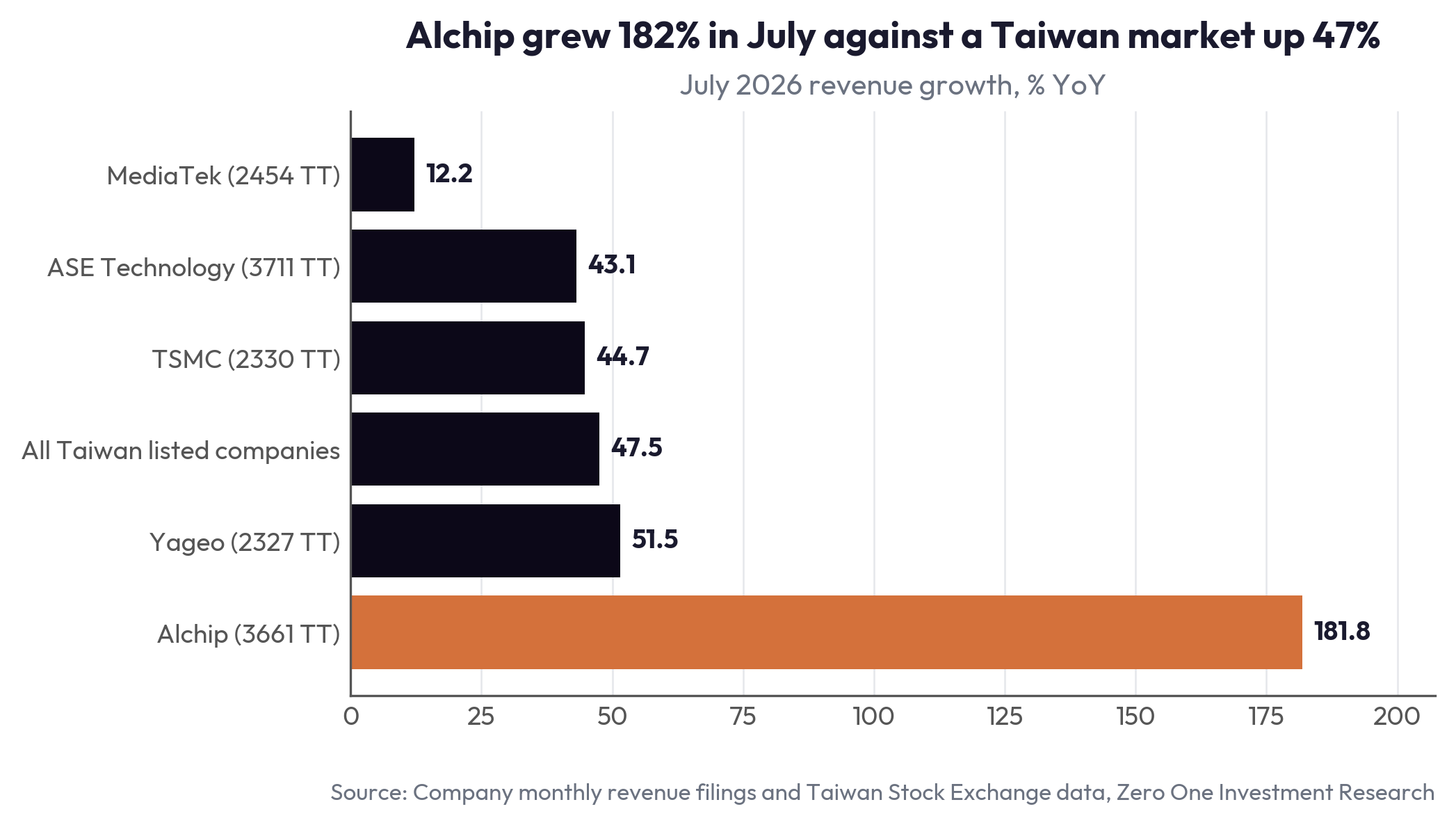
Alchip (3661 TT) reported July revenue of NT$7.43bn, up 108.1% MoM and 181.8% YoY and a monthly record. Total 2Q26 revenue was NT$7.64bn, so a single month came within 3% of an entire quarter.
The driver is a North American cloud provider's 3nm AI accelerator, which entered volume production at the end of 2Q26. The Commercial Times reports shipments should scale month by month through 3Q26 as wafer, advanced packaging and high-end substrate capacity arrives. Automotive driver-assistance chips add a second revenue line in 2H26.
The year-to-date figure shows how abrupt the change is. Alchip's first seven months came to NT$19.17bn, still down 13.8% YoY. The custom-chip business moved from design work to production revenue inside one month, and the annual number has not caught up with it.
MediaTek (2454 TT) is roughly a quarter behind on the same path. July revenue was NT$48.48bn, down 16.4% MoM and up 12.2% YoY, with its first AI accelerator for a large US cloud provider entering volume production in 4Q26. MediaTek expects data center revenue above US$2bn this year, and has raised its 2027 serviceable market estimate for AI accelerators to US$80bn with a 15% to 20% share target. Its first large cloud project is reported to be Google's eighth-generation tensor processing unit, with a 2nm follow-on in progress.
Gross margin is the thing to watch at Alchip. Volume production for one large customer dilutes it, and the company's own stated focus is whether the 3nm shipment peak carries into 4Q26.
Linked stocks: 3661 TT, 2454 TT, 2330 TT, GOOGL US
Memory is 62% of NVIDIA's next platform cost
Memory chips account for roughly 62% of the cost of NVIDIA's Vera Rubin platform, and the main-memory module attached to the Vera central processor costs nearly US$20,000 per unit. That module carries a larger share of the bill than the sixth-generation high bandwidth memory (HBM4) stacked beside the graphics processor.
The figures come from Korea's Chosun Biz, reported in Taiwan by DigiTimes. SOCAMM2 is the compressed main-memory module NVIDIA designed for its own processor, built on low-power DRAM rather than on the stacked high bandwidth memory that supplies raw GPU bandwidth.
The read-across is about who captures the AI memory dollar. The industry has treated high bandwidth memory as the scarce, high-value part and main memory as the commodity beside it. If a US$20,000 main-memory module outweighs HBM4 inside one platform's bill of materials, conventional DRAM makers hold more AI content than the high bandwidth memory share tables imply. Nanya Technology (2408 TT) posted July revenue of NT$43.86bn, seventh-largest of any Taiwan listed company that month.
What would test the figure is configuration. Tom's Hardware reports NVIDIA is evaluating at least three Rubin Ultra builds carrying as little as 192GB of memory, against the 1TB of HBM4E originally planned. A cheaper memory configuration would move the 62% down before any supplier negotiates a price.
Linked stocks: NVDA US, 2408 TT, 000660 KS, MU US
先聲 First Word: Exclusives from Chinese-Language Sources
Samsung's next-generation memory yield approaches 80%
Samsung Electronics' yield on sixth-generation high bandwidth memory is reported near 80%, up from under 60% when volume shipments began about six months ago. Faster yield gains let Samsung supply more into a market where memory is short, which matters most to buyers currently rationed by SK Hynix. (11 Aug 2026) Source: 三星HBM4良率衝近80% 「黃金良率」助攻擴大供應
Apple presses Samsung Display and LG Display on iPhone 18 panel prices
Korean media report Apple has demanded sharp cuts in organic LED panel quotes for the iPhone 18, with prices on some models approaching half their prior level, to offset rising build costs. Panel makers are being asked to meet a harder technical specification without price to match, so Apple is pushing its own component cost increases down into the display chain. (11 Aug 2026) Source: 蘋果力壓i18 OLED面板價格 傳部分機型SDC、LGD報價逼近腰斬
Walsin Technology's order-to-shipment ratio reaches 1.8
Walsin Technology (2492 TT) president Tseng Ming-tsan said the passive component maker's book-to-bill rose from 1.4 last quarter to 1.8, with order visibility running to the end of 2026 and into 2027, and capital spending lifted to NT$3bn to NT$4bn, a multi-year high. Chairman Jiao Yu-heng said the group will serve US customers from Japan and Singapore rather than shift capacity to the United States. (11 Aug 2026) Source: 華新科旺到年底 訂單出貨比達1.8

© 2026 Zero One Investment Research Pte Ltd. For informational purposes only. Not investment advice.