
TSMC wants AUO's cleanrooms and power quota as SK Hynix's US$38bn arrives in 2029
Zero One Investment Research Daily Intelligence Brief, August 10, 2026
TSMC wants AUO's cleanrooms and power quota as SK Hynix's US$38bn arrives in 2029
Top Market Signals
TSMC reportedly audits two AUO panel fabs
TSMC (2330 TT) is in talks to buy two of AUO's (2409 TT) older panel plants at the Central Taiwan Science Park to expand advanced packaging capacity, and has already sent staff for on-site due diligence, according to Economic Daily News. No contract has been signed. Industry estimates put the price above NT$30bn, the most a Taiwanese panel maker has been paid for old-generation plants in recent years.
The two sites are L7, a 7.5-generation line, and L5C, a 5-generation line. They sit across the road from TSMC's Fab 15 campus. TSMC said it does not comment on market rumors and AUO said it does not comment on speculation. The reported arrangement would follow the template TSMC used with Innolux, and would target fan-out panel-level packaging and CoPoS (chip-on-panel-on-substrate, the panel version of the CoWoS process that packages AI chips today).
What is being bought is the shell, not the display equipment inside it. Large industrial sites are hard to acquire in Taiwan and an approved power supply is harder still, and an old panel fab comes with a very large cleanroom and an existing power allocation attached. TSMC and ASE (3711 TT) are both expanding packaging capacity, which has turned obsolete display plants into contested assets.
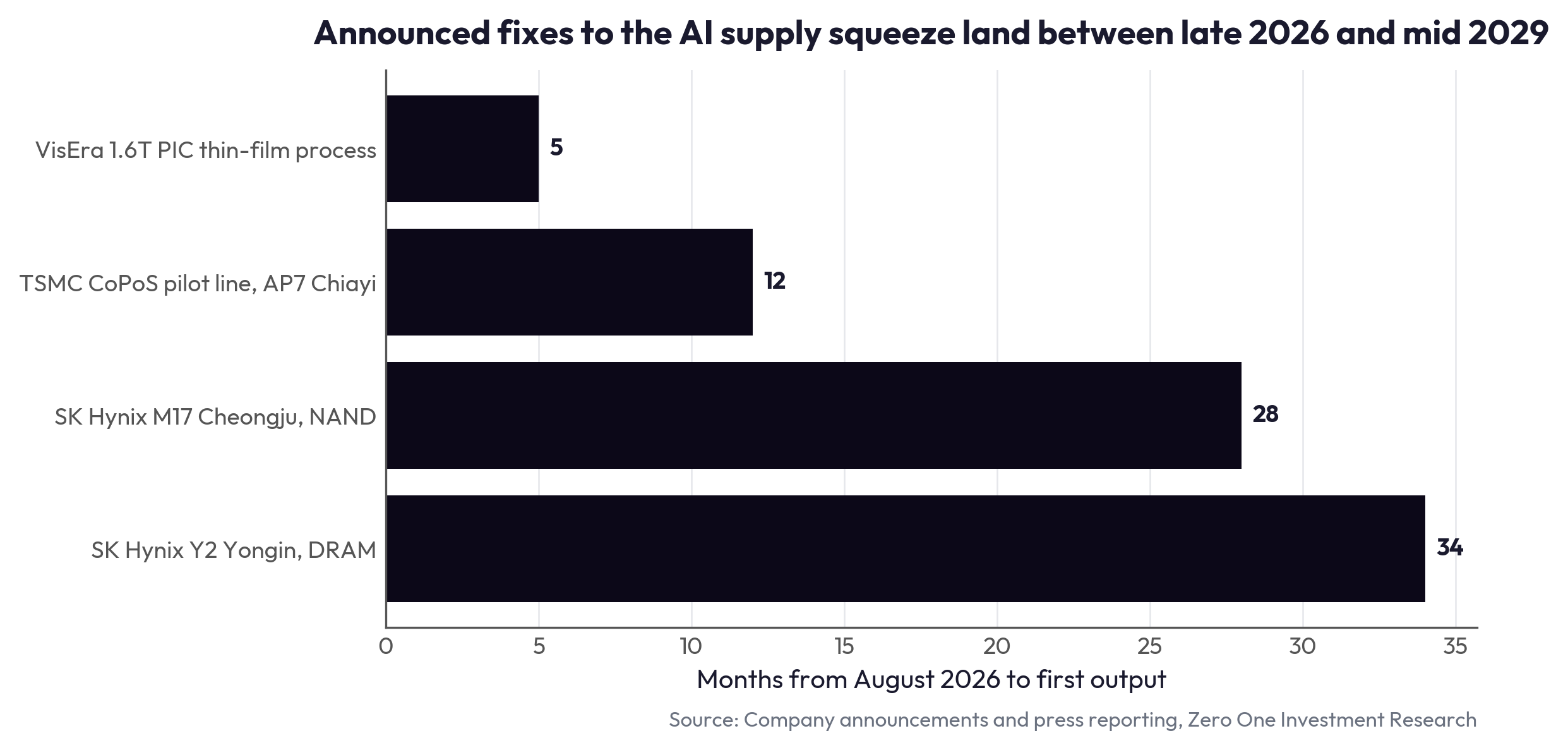
TSMC's first CoPoS line, at the AP7 plant in Chiayi, is built and running at a 310mm by 310mm panel size, and Economic Daily News reports roughly a year is needed for the process and yield to mature. AUO's board approved NT$8.641bn of capital spending on 30 July for pilot lines covering through-glass vias, redistribution layers and glass core substrates. Chairman Paul Peng told that same investor call AUO would develop the technology with partners. He had said repeatedly before then that AUO would stay asset-light and stay out of advanced packaging.
Linked stocks: 2330 TT, 2409 TT, 3711 TT
SK Hynix's largest capex approval produces nothing until 2029
SK Hynix's (000660 KS) board approved KRW54.3tn, about US$38.1bn, for two new fabs. It is the largest single allocation in the company's history, with only the first cleanroom ready by end 2028 and most capacity coming online from 2029.
KRW35.2tn goes to the Yongin Y2 site, a DRAM plant covering 1.13m square meters. Construction starts in July 2027 and the first cleanroom comes online in June 2029, producing HBM (high-bandwidth memory) and next-generation DRAM. The remaining KRW19.1tn goes to the Cheongju M17 plant for NAND flash aimed at enterprise solid-state drives, with construction from February 2027 and a first cleanroom in December 2028.
The split is the part to look at. Just over a third of the biggest capital approval SK Hynix has ever made goes to NAND rather than DRAM, and enterprise storage gets a dedicated site rather than shared capacity, at a point when DRAM contract pricing is the tighter of the two markets.
Our 7 Aug 2026 Blade flagged Winbond's customers trying to book capacity out to 2030, and AP Memory locking Powerchip and ASE capacity years ahead. Today's approval is the supply side of that same arrangement, and it puts a date on it: buyers contracting for 2028 and 2029 volumes are contracting against wafers that have no building yet.
Linked stocks: 000660 KS, 005930 KS, MU US
Power replaces GPUs as the data center bottleneck
Wistron (3231 TT) chief technology officer Shen Ching-yao said GPU delivery times have shortened enough that ordering about six months ahead is now sufficient, and that the largest constraint on AI data centers has moved to electrical infrastructure, specifically the delivery schedule for power distribution units. He was speaking at Delta Electronics' AI sustainability summit on 7 August, per DigiTimes.
A six-month accelerator lead time is the number that has changed. Through 2025 the GPU set the build schedule for an AI site. On Shen's account the schedule is now set by whether the power distribution unit, the equipment that splits incoming power across the racks, arrives when the racks do.
The capital is moving the same way. NVIDIA (NVDA US) is investing US$2bn in Lancium for a stake of about 20%, with up to US$1bn more conditional on the company hitting grid connection and power capacity milestones, according to The Information. Lancium owns the 1,000-acre Abilene campus in Texas that was the first operational site under Stargate. Separately, Zayo confirmed NVIDIA as a major new fiber customer, saying NVIDIA wanted enough fiber in the ground both for its own use and for the wider AI ecosystem.
This is checkable in the suppliers' own numbers. If accelerators are no longer the gating item, order visibility should shift toward power equipment, and the monthly revenue at Delta Electronics (2308 TT) and the other data center power suppliers is where it shows up first.
Linked stocks: 3231 TT, 2308 TT, NVDA US
Capacitor buyers pay triple to jump the queue
Customers are paying two to three times the going price to secure multilayer ceramic capacitors from Yageo (2327 TT) and Murata (6981 JT), according to Economic Daily News, with lead times at the main suppliers stretched to 12 to 16 months.
Yageo confirmed demand is running very strong across capacity utilization, new customer projects and long-term contract requests, and that a growing number of AI customers want to lock capacity in advance. It expects utilization on standard products to rise from about 80% in 2Q26 to above 90% this quarter, with specialty products holding above 90%.
What changed is the allocation mechanism. Large customers and long-standing partners keep first call on capacity, so smaller buyers who run short of inventory can only bid up, and urgent orders are clearing at two to three times the original price. Yageo is adding capacity in Kaohsiung, Suzhou, Vietnam and Mexico, which arrives quarter by quarter as equipment is installed rather than in one step.
The Japanese makers describe the same conditions. Murata raised its annual profit forecast with the data center build as one of the drivers, and Taiyo Yuden (6976 JT) said AI server demand has run ahead of its own expectations and is pushing the market toward higher-capacitance parts.
Linked stocks: 2327 TT, 6981 JT, 6976 JT
Co-packaged optics reaches racks only after 2028
The supply chain has put a date on co-packaged optics, the approach that places the optical engine in the same package as the compute chip. Scale-out switches adopt it this year into next, and rack-level and in-rack deployment only after 2028, according to Commercial Times.
TSMC defined the architecture last year in two parts: the CoWoS compute module, and the COUPE silicon photonics engine, which stacks the electronic integrated circuit on the photonic integrated circuit using SoIC before combining the result with CoWoS. The compute die, the memory and the optical input and output progressively move into one package.
Component-level silicon photonics and 800G and 1.6T optical modules are already ramping, and switch-level co-packaged optics is in early delivery. What gates full data center deployment is compound yield across the whole stack, test throughput, thermal management, repairability and supply. Silicon photonics dies also have to clear wafer-level optical test and known-good-die screening before integration, so defects are not found after packaging.
The Taiwanese optics suppliers carry their own dates. VisEra, TSMC's optical component unit, has its receive-side microlens for 800G in mass production, plans to introduce the 1.6T thin-film process at the end of 2026, and targets 2H27 for a high-density optical coupling platform. Largan (3008 TT) has pushed fiber array precision below 0.3 micron. Himax (HIMX US) and Browave are jointly supporting a second-generation design above 6.4T, with 12.8T as the next target.
Linked stocks: 2330 TT, 3008 TT, HIMX US
Microsoft lifts Windows OEM fees 7% to 10%
Microsoft (MSFT US) raised Windows OEM licensing fees by an average of 7% to 10% from July, against the single-digit annual increases of prior years, PC brand executives told Economic Daily News. Retail PC prices in Taiwan are set to rise about another 5% this quarter.
The fee is priced by processor tier, so a machine built on a Core i7 carries a higher operating system charge than an i3 or i5, and the increase lands unevenly across a brand's range. Executives said current pricing already reflects it, and that buyers have not reacted to this line separately because so many component costs have risen this year that no single one stands out.
Memory is still the bulk of the added cost. Memory, SSD and CPU shortages have run since 2H25, with memory prices up by multiples, and that remains the main reason PC prices have risen this year. ASUS (2357 TT) and Acer (2353 TT) have both said this quarter's products go up by about 5% or a single-digit percentage; ASUS said in May that some of its Taiwan-market products were already close to 30% above their 4Q25 prices.
Volumes have started to answer. Counterpoint Research puts 2Q26 global PC shipments at about 65m units, down 4% YoY and the first decline since 1Q25, and says the Windows migration cycle and AI PC adoption are still supporting commercial replacement while memory and component costs squeeze OEMs from both ends.
Linked stocks: MSFT US, 2357 TT, 2353 TT
先聲 First Word: Exclusives from Chinese-Language Sources
I-Chiun samples micro-channel lids for NVIDIA's Feynman platform
I-Chiun Precision (2486 TT), already a thermal supplier to Google, Amazon and Broadcom, has sampled package-level micro-channel lid parts for NVIDIA's next-generation Feynman platform, and supply chain sources say NVIDIA wants a second source alongside market leader Jentech (3653 TT). With GPU power heading toward 2,000W, heavier material and custom design are lifting unit prices for stiffeners and lids. I-Chiun plans to double thermal capacity this year and again next year. (10 Aug 2026) Source: 一詮有喜 傳輝達有意扶植為「小健策」 擴大釋單
AUO assembles its affiliates into a co-packaged optics group
AUO (2409 TT) has lined up its optoelectronics affiliates behind TSMC's co-packaged optics push: Ennostar (3714 TT) on low-power Micro LED sources for short reach inside the rack, GCS Holdings (4991 TT) on VCSEL and long-distance lasers, TynTek (2426 TT) on receive-side photodiodes for 800G and 1.6T, and AUO on packaging. Testing light source and sensor together on panel-level glass shortens a qualification none of them could complete alone at a foundry. (10 Aug 2026) Source: 經濟日報
AblePrint ships equipment into both foundry camps
AblePrint Technology (7734 TT) has reportedly won orders for Intel's EMIB advanced packaging platform and begun shipping, adding a second foundry camp to existing TSMC CoWoS demand, with SoIC equipment deliveries following in 2H26. Analysts expect revenue to double this year and capacity to rise a further 30%, which makes it one of the few Taiwanese equipment names with revenue tied to both leading-edge packaging roadmaps. (10 Aug 2026) Source: 印能科技卡位雙陣營 今年營收估倍增、產能再增3成

© 2026 Zero One Investment Research Pte Ltd. For informational purposes only. Not investment advice.