
The Blade Weekly: Memory Cost Starts Cutting PC Units
Week of August 9 to August 15, 2026 · Zero One Investment Research
Key signal 1
Memory cost is now cutting units
Why it matters
Quanta guided third-quarter notebook shipments down more than 20% and the full year to a double-digit decline, the first time the shortage has shown up as fewer machines rather than dearer ones.
Quanta Computer (2382 TT) reported its best quarter on record and guided notebooks down in the same session. Second-quarter revenue was NT$1.04tn, up 105.6% year over year, and net profit set a single-quarter record. Notebook shipments reached 11.5m units, ahead of the company's own plan, because brands pulled orders forward from the second half once component prices started moving.
That pull-forward is part of why the third quarter falls so hard. Management sees no near-term improvement in CPU or memory availability, and said consumer brands are taking the heavier hit.
The same cost is arriving from other directions. Microsoft (MSFT US) raised Windows OEM licensing fees by an average of 7% to 10% from July, against the single-digit annual increases of prior years. Counterpoint Research puts second-quarter global PC shipments at about 65m units, down 4% year over year and the first decline in five quarters.
Quanta shipped 11.5m notebooks in the second quarter, so the guide puts the third below roughly 9.2m. A print above that would be the first sign brands are absorbing the memory bill rather than cutting builds.
Key signal 2
Relief from the shortage is a 2029 event
Why it matters
A new NAND plant takes up to four years from investment to output, so the largest approvals reported in the past week, SK Hynix's KRW54.3tn and Nanya's close to NT$400bn, produce nothing until 2028 at the earliest.
Phison Electronics (8299 TT), which makes the controller chips that manage flash memory, is closer to the buyer than the fabs are. Chief executive Pan Chien-Cheng said supply is tight "not just until next year, but many years," and that 2027 and 2028 still will not balance. His argument is a build-time argument rather than a demand one.
The approvals fit that timetable. SK Hynix (000660 KS) approved KRW54.3tn, about US$38.1bn, for two fabs, the largest single allocation in its history. The Cheongju NAND plant opens its first cleanroom in December 2028 and the Yongin DRAM plant in June 2029. Nanya Technology (2408 TT) is planning two 12-inch fabs at Yunlin and Pingtung, which Formosa Plastics Group describes as the largest investment in its history.
What the shortage has already done to price sets the scale. Sercomm (5388 TT) chairman Wang Wei said a 1Gb unit of memory that cost under US$0.30 five quarters ago now costs more than US$3.00.
Where Nanya builds was decided by power rather than by preference: TSMC's (2330 TT) domestic expansion has left northern Taiwan's supply committed, so both sites are in the south.
Key signal 3
Margin is going to whoever holds the inventory
Why it matters
Phison's gross margin rose 36.25 points year over year to 65.31% while Lotes', selling into the same AI servers, fell 5.53 points to 45.47%, and both companies name the same cause.
Phison posted the biggest quarter in the history of Taiwan's memory industry, with second-quarter revenue up 279.5% year over year and first-half profit exceeding the previous 23 quarters combined.
Management was direct about where the margin came from. Cheap NAND bought before the run-up flatters the current cost line, and Pan said that benefit fades as inventory turns, so margin cannot keep climbing in a straight line. Phison is holding roughly eight months of supply, funded partly by an US$800m convertible bond issued during the quarter.
Lotes (3533 TT), which makes the sockets that hold processors onto a server board, sits on the other side of the same trade. Spokesperson Tsai Ming-jui said the low-priced raw material bought last year was consumed during the first quarter, so the second quarter reflects current market prices for the first time. Servers were 55.36% of revenue and the company still lost margin.
Its recovery is dated outside this year. Tsai put it on oil prices settling and on the 2027 Intel and AMD server platforms reaching volume.
Chart of the Day
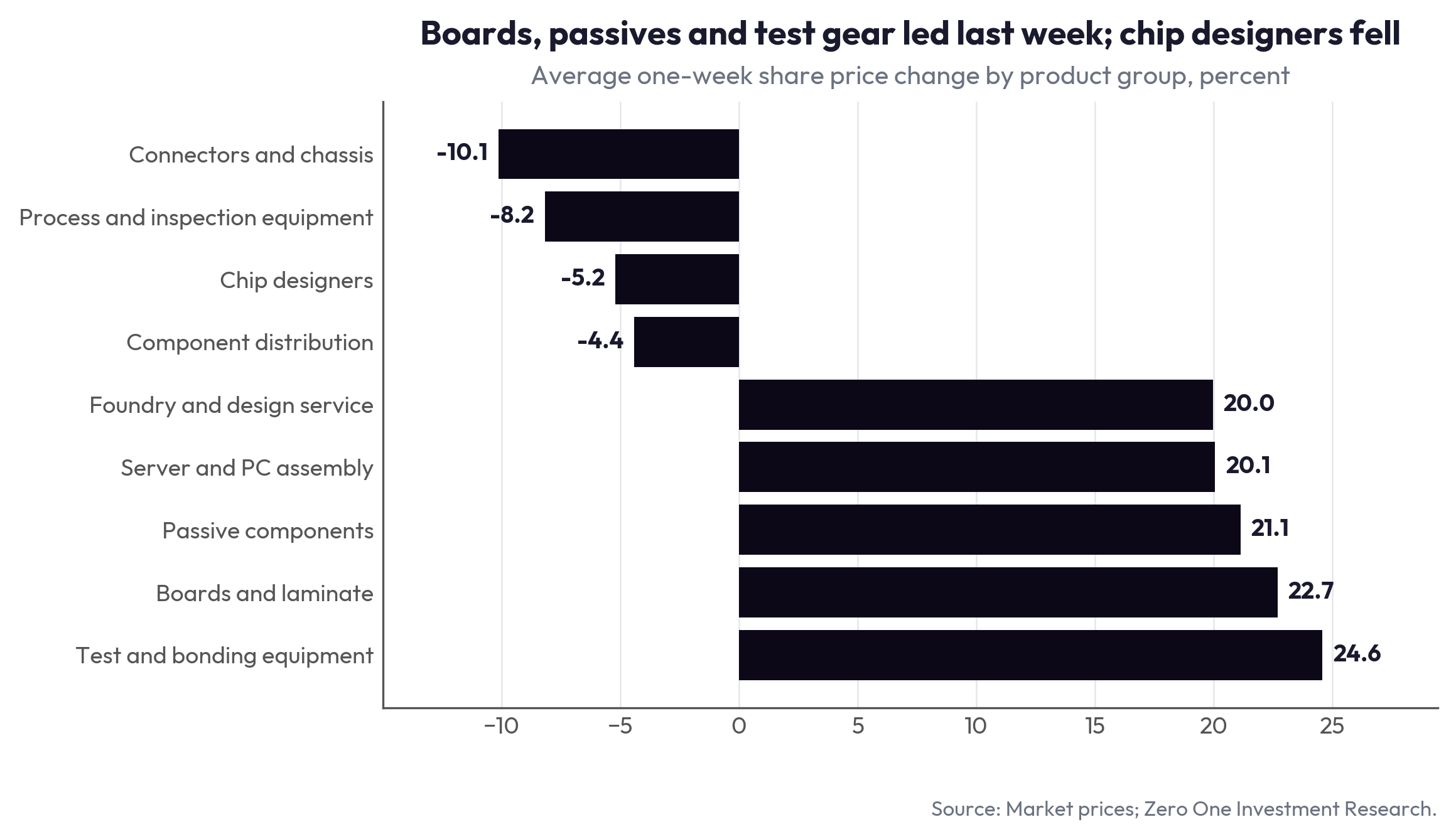
The same split showed up in prices. Last week's moves separated into two groups with almost nothing in between: boards, laminate, passives and the test and bonding equipment that memory makers buy all averaged gains above 20%, while chip designers, distributors and process equipment fell. Connectors and chassis was the weakest group at -10.1%, which is where Lotes sits.
Key signal 4
Buildings and power, not chips, set the schedule
Why it matters
Wistron's technology chief said six months is now enough notice to order GPUs and that power distribution delivery sets the build schedule, while Cerebras said customers lack the space to install hardware they already own.
Shen Ching-yao of Wistron (3231 TT) said the largest constraint on AI data centers has moved to electrical infrastructure, specifically the delivery schedule for the power distribution units that split incoming power across the racks. Through 2025 the accelerator set the build schedule.
CoreWeave (CRWV US) showed what that does to old equipment. Chief executive Mike Intrator disclosed a contract for NVIDIA A100 accelerators running into 2029, nine years after that generation launched, at pricing at or above where it was years ago. An air-cooled A100 system draws 6.5kW into halls designed for roughly 20kW per rack, against 120kW to 140kW for a GB300 NVL72 rack that also needs direct-to-chip liquid cooling. Blackwell cannot move into the space Ampere occupies without rebuilding power and cooling first, so the cheapest use of an energized legacy hall is to keep renting the silicon already in it.
Cerebras Systems (CBRS US) described the same limit from the seller's side: hardware revenue fell 23% year over year, which chief executive Andrew Feldman attributed partly to customers not yet having the space to install what they ordered.
TSMC is buying against that constraint directly. It is in talks, neither side confirmed, for two of AUO's (2409 TT) older panel plants, wanted for the cleanroom area and the approved power allocation rather than the display equipment inside.
Key signal 5
Custom silicon is turning into a key growth driver
Why it matters
Alchip's July revenue of NT$7.43bn came within 3% of its entire second quarter, and Foxconn said its custom-chip server business is larger than its accounts show because customers consign the chips.
Alchip (3661 TT) reported July revenue up 181.8% year over year, a monthly record, on a North American cloud provider's 3nm accelerator that entered volume production at the end of the second quarter. The year-to-date figure shows how abrupt the change was: the first seven months came to NT$19.17bn, still down 13.8% year over year.
Foxconn (2317 TT) added the accounting qualifier. Chief financial officer Huang Te-tsai said custom chip servers were about 10% of AI server revenue last year and that the first half of 2026 already exceeded that, but that because those projects run on a customer-consigned materials model, recognized revenue does not fully reflect the actual scale. A contract manufacturer assembling a customer's own silicon books the assembly fee, not the value of the chips passing through its plants. Rotating chief executive Chiang Chih-heng is targeting more than 40% share of that market.
At Foxconn Industrial Internet, its mainland manufacturing unit, racks built around custom chips shipped at threefold growth in the first half, against 3.2 times for GPU racks.
Microsoft is in talks with TSMC for capacity to deliver more than 300,000 Maia 300 accelerators in 2027, against the tens of thousands of the prior generation built to date, and is pitching the chip to outside labs including Anthropic.
Key signal 6
Capital is easier to raise than capacity
Why it matters
Intel's US$19.7bn share sale drew roughly US$100bn of orders and NVIDIA lined up six asset managers behind a US$500bn financing platform, in a week when the binding constraints were land, power and build time.
Intel (INTC US) raised US$19.7bn at US$95.00 a share, its first public share sale since listing in 1971. The raise is priced off a share price that has nearly tripled in 2026, which is what makes equity cheap for the company now.
NVIDIA (NVDA US) signed memoranda with Apollo, BlackRock, Blackstone, Brookfield, Goldman Sachs and KKR to build a platform targeting more than US$500bn of third-party money for AI data centers, so that buyers can acquire NVIDIA hardware without funding it from their own balance sheets. Jensen Huang described compute hardware as productive, long-lived, fungible and income-generating, which is the argument a lender needs before treating it as collateral. NVIDIA disclosed neither the financing terms, nor individual commitments, nor a timetable.
Taiwan's own approvals ran alongside. TSMC's board cleared a further US$29.44bn of capital budget on 11 August, and Siliconware, the packaging arm of ASE Technology (3711 TT), broke ground on a Douliu plant at close to NT$100bn whose first phase opens in 2028.
Also last week: a test plant takes two years to build
King Yuan Electronics (2449 TT) president Chang Kao-hsun said a test plant of the same size takes 24 months or more to go from land preparation to completion, against demand that since last year has been running at a pace that could require two or three plants a year. Winway Technology (6515 TT), which makes the test interfaces, said this year's orders are essentially settled and that nearly every company in the industry is booked out to year end.
The past week's rotation: into boards, passives and test
The past week's move was a rotation into the physically short layer rather than a broad rally. The largest gainers were boards, laminate, passive components and test equipment, the parts rationed by lead time and repricing now, while process and inspection equipment, chip designers and component distributors fell. Aehr Test Systems, up 30.07%, and Tripod Technology, up 23.86%, mark the two ends of that layer. Equipment did not move as one group: Hanmi Semiconductor, which builds the bonders that stack high bandwidth memory, rose while Lasertec and Applied Materials fell.
| Company | Ticker | Group | 1-week |
|---|---|---|---|
| Aehr Test Systems | AEHR US | Test equipment | +30.07% |
| Tripod Technology | 3044 TT | PCB | +23.86% |
| ITEQ | 6213 TT | Copper clad laminate | +23.39% |
| Samsung Electro-Mechanics | 009150 KS | Passives and substrate | +21.91% |
| ASUSTeK Computer | 2357 TT | PC and server assembly | +21.91% |
| Holy Stone Enterprise | 3026 TT | Passives | +20.93% |
| Nan Ya PCB | 8046 TT | PCB and substrate | +20.83% |
| Walsin Technology | 2492 TT | Passives | +20.52% |
| Global Unichip | 3443 TT | ASIC design service | +20.24% |
| Powerchip | 6770 TT | Foundry | +19.69% |
| Hanmi Semiconductor | 042700 KS | Memory bonding equipment | +19.08% |
| Compal Electronics | 2324 TT | Server and PC assembly | +18.19% |
| Lasertec | 6920 JT | Semicap inspection | -10.41% |
| Chenbro Micom | 8210 TT | Server chassis | -10.31% |
| Lotes | 3533 TT | Connectors and sockets | -9.95% |
| Broadcom | AVGO US | Fabless | -8.13% |
| WPG Holdings | 3702 TT | Component distribution | -6.12% |
| Applied Materials | AMAT US | Semicap equipment | -5.93% |
| Novatek | 3034 TT | Fabless | -5.54% |
| Realtek | 2379 TT | Fabless | -3.87% |
| STMicroelectronics | STM US | Integrated device maker | -3.23% |
| Synnex Technology | 2347 TT | Component distribution | -2.68% |
Ranked by one-week change; prices as of the Friday, 14 August 2026 close in each listing market. The Taiwan, Korea and Japan closes precede the US Friday session, so the Asian figures do not include that day's US move.
Week Ahead / What to Watch
- NVIDIA 2Q FY27 results (26 August) The first scheduled read on how rising memory prices are landing in NVIDIA's own cost base, after reports it has been weighing lower memory configurations for Rubin Ultra.
- SK Hynix Indiana advanced packaging groundbreaking (27 August) Whether additional US investment is announced indicates how far the packaging commitment runs beyond the announced plant.
- Taiwan August revenue filings (due 10 September) Whether board and passive component price increases are still passing through, and whether notebook builds are falling at the pace Quanta guided.
- Intel underwriters' option (through mid-September) Underwriters hold 30 days to take up to 31.6m further shares at US$95.00, lifting proceeds toward US$23bn.